

A sixth aircraft joins the fleet in spring, a third base opens in summer, and by autumn the compliance monitoring programme shows a large share of its audits still not carried out. None of these three facts triggered a request to the authority: taken one by one, none seemed to touch the conditions of the certificate. The question raised by such a sequence is not an administrative one. It concerns the moment when an operator ceases to hold the means it demonstrated on the day of its certification, and the signals that say so before an auditor says it in its place.
A Certificate Describes a Sizing, Not a Permission
An AOC records demonstrated capacity, not abstract authority. It documents that, on a given date, a specifically named organisation demonstrated it held the means — people, procedures, documentation, oversight — needed to conduct the scope described in the operations specifications annexed to it: aircraft types, areas, bases, specific approvals. The certificate itself is brief; everything that carries weight sits in the annex and in the manuals it references.
The EU Air Operations Regulation requires the management system to be proportionate to size and complexity. That wording is often read as leniency toward small structures. For those that grow, it says the opposite: proportionality is a continuing obligation, not a status acquired at certification. A set-up judged sufficient for four aircraft at one base does not become insufficient on the day of an audit; it became insufficient well before, on the day the workload crossed what its post-holders could absorb.
This is where the geometry of the problem comes from. Activity grows continuously: one more sector, one more rotation, one more aircraft delivered. An organisation’s capacity grows in steps — a person is recruited, a function is split — and each step requires selection, training, and taking up post, that is, a delay during which capacity stays flat. Between two steps, the gap widens without anyone having made a single faulty decision.
An operator’s certificate describes what they can do at a specific moment, not forever. As they grow, their systems must keep up – but adding people and procedures takes time, while demand grows steadily. This creates a gap where the company is effectively operating beyond its certified capacity.
A regional airline with 4 aircraft at one base gets certified. By year 2, they have 6 aircraft and a second base. Their compliance manager, who could handle 4 aircraft alone, now needs an assistant. But the company waits 6 months to hire, during which time the manager is overwhelmed but no audit finds a problem yet.
Two Change Regimes, and a Boundary the Operator Qualifies Itself
EU law distinguishes two paths. Some changes require prior approval: they alter the conditions of the certificate, the operations specifications, or an element of the management system that the authority has explicitly approved. They are not implemented before the decision, whatever the commercial pressure. The others are managed internally, on the express condition of having had approved a management-of-change procedure describing who qualifies the change, how it is assessed, and in what form it is recorded and then brought to the authority’s attention.
The sensitive point, then, is not the list of cases, which everyone has read. It is the act of qualification: deciding which path the project at hand belongs to. That act is entrusted to the operator, and it occurs when the case is most fragile — before the charter contract is signed, before the order is placed, before the commercial announcement, that is, when nobody wants to hear about a regulatory review.
| Criterion | Prior approval | Management by approved procedure |
|---|---|---|
| What is affected | Conditions of the certificate, operations specifications, approved elements of the management system | Internal organisation, with no effect on the approved scope |
| Typical cases | New type, new base, new area, specific approval, change of accountable manager or of a nominated post-holder | Internal reassignment, evolution of a documented process, staffing adjusted within an unchanged scope |
| Who decides | The authority, before implementation | The operator, in line with the approved procedure |
| Evidence expected | Complete case file: named resources, amended manuals, risk assessment, timeline | Traceable record: qualification, analysis, decision, effectiveness follow-up |
| Qualification error | Not applicable: the review has taken place | Operation outside the terms of the certificate, for the whole period |
The trap: the list of notifiable changes copied from a template. Written for the original organisation, single-base and single-type, it was never revisited. The project at hand does not appear on it: it is treated as an ordinary management decision, with no record, no risk assessment and no referral. The gap only surfaces the day the authority compares the operations specifications with the flying programme actually conducted, and it covers the whole elapsed period.
Nominated Post-Holders: Where Growth Shows First
An operator appoints post-holders for flight operations, ground operations, crew training and continuing airworthiness, under the authority of an accountable manager who commands the necessary financial resources. These appointments are accepted on the basis of a file: qualifications, experience, and — the part that people forget to reassess — availability. Holding two of these functions at once is common and acceptable in a small structure; it becomes a point of fragility as soon as the demands stop being sequential.
Because what growth adds is not, first and foremost, work volume, it is the number of interfaces. An extra base adds a ground-handling provider, a contract, a local team, a contact to get to know. An extra type adds a training organisation, a simulator resource, a maintenance programme, a pool of instructors to build. Each branch consumes only a few hours a month, but it consumes discontinuous attention — precisely the resource that an oversight function needs in an uninterrupted block.
The symptom is recognisable from the outside: the signature remains, direct knowledge disappears. The nominated person for flight operations keeps approving documents whose substance he no longer has time to check, and the organisation knows it without saying so. An audit will not necessarily find a formal non-conformity — the documents are signed, the deadlines met — but the management system no longer produces feedback information, only apparent compliance.
The Indicators That Signal the Overrun Before the Audit Does
A growing operator spontaneously measures volumes: flight hours, sectors, flight-crew numbers, aircraft in service. None of these figures says anything about capacity, since by construction they keep rising. The useful indicators measure a delay or an age, never a quantity.
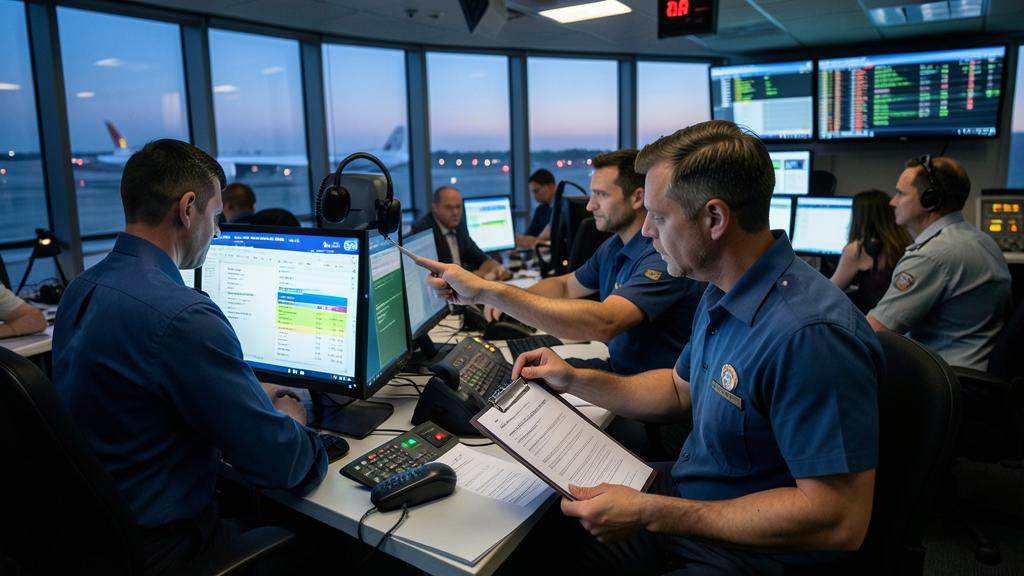
- the completion rate of the audit programme to date, not at the end of the cycle, when it is too late to catch up;
- the average age of open findings, and the share of those whose corrective-action deadline has already been extended;
- recurrence: the proportion of findings that repeat a theme already dealt with, a sign that the root cause was not reached;
- the time between a safety report and the first feedback given to whoever filed it;
- the age of items deferred under the minimum equipment list;
- the stability of rosters: changes made after publication, and use of the commander’s discretion, which measures not fatigue but the planner’s optimism.
The underlying mechanism holds for any queue, which is what makes it predictable. The incoming flow — findings, reports, requests for analysis — grows with activity. Processing capacity is a plateau: a number of people multiplied by time genuinely available. As long as the flow stays below the plateau, the backlog is zero and nothing shows. The day it crosses the plateau, the backlog grows like the area between the two curves, that is, faster and faster. Hence that so frequent shift, from a state of “everything is fine” to a state of “we can’t keep up” in a single quarter.
The right reflex: qualify the change at the intention stage, not at implementation. Any decision that adds a site, a type, a provider or a category of operation goes through a record signed off by compliance monitoring before contractual commitment. This review costs a few internal exchanges; a requalification after signature costs a commercial timeline to redo, and sometimes a contract.
Base, Type, Charter: Three Kinds of Growth That Do Not Cost the Same
‘Growing’ is not a single operation. Three ways of adding capacity draw on very different parts of the organisation, and the most costly is not the one people expect.
Opening a base poses a supervision problem: the procedures are already written, but they assumed a physical presence and information flowing back through conversation. Adding a type poses a training and documentation problem: everything that was single becomes double, from the operations manual to the minimum equipment list, and a pool of instructors cannot be recruited in a quarter. Resorting to chartered capacity poses a control problem: the fact that the aircraft and crew come from elsewhere does not mean operational responsibility changes hands.
| Path | Functions drawn on first | Documentation to be revised | Usual breaking point |
|---|---|---|---|
| Additional base | Ground operations, crew supervision, compliance monitoring | Operations manual (organisation, subcontracting), audit programme | Remote supervision with no local presence or designated relay |
| Additional type | Crew training, continuing airworthiness, flight operations | Aircraft-specific part of the operations manual, minimum equipment list, maintenance programme, training manual | Pool of instructors and examiners, simulator access |
| Chartered capacity | Operational control, safety, compliance monitoring | Charter procedures, contractual interfaces | Who exercises operational control, and with what means of verification |
A field observation, often learned too late: growth through chartering looks reversible, and therefore light. It is not, for the management system, which has to oversee a partner whose procedures it does not control, with access to information that depends on a contract.
What the Authority Reviews, and in What Order
An extension case file is not judged by its thickness, but by the match between request and capability. The order of review varies little — scope, named resources with their availability, amended documentation, risk assessment, timeline — and the most frequent reason for rejection fits in one sentence: the file describes the target organisation without saying by what path it gets there.
The risk assessment for the change is regularly framed incorrectly. It does not concern the future operation, which the amended procedures will cover, but the transition: coexistence of two configurations, a partly qualified workforce, documentation being amended, a provider with no track record, supervisory staff tied up by the project and therefore less present on the line. This is the period when failures occur, and the only one the case file can still protect.
The trap: announcing an opening date before the change has been reviewed. A published date weighs on the review: the file gets completed to meet the schedule instead of the schedule being set by the file. Extensions obtained this way are paid for at the first surveillance audit, when documentation amended in a hurry meets actual operations.
The Grey Zone, and What to Go and Check at Home
The real difficulty is not the clear-cut change, which is visible and handled. It is scaled-up growth: more hours, more crews, more rotations, without a single line of the operations specifications moving. Nothing requires declaring the hundredth additional flight hour. But the proportionality obligation keeps running, and it is up to the operator to demonstrate that it has reassessed it, not up to the authority to prove the opposite.
- Does the list of changes subject to prior approval in the manual still correspond to the operations specifications currently in force, or was it copied from a template at certification?
- Who, by name, holds the power to qualify a change, and is that person informed of projects at the intention stage or only at signature?
- Is there an internal threshold — flight hours, flight-crew numbers, number of sites — whose crossing triggers a traceable resource review? Failing that, proportionality rests solely on the judgement of a person who is already overloaded.
For anyone preparing to take up a supervisory post, the subject changes the nature of the interview: the question is no longer ‘do you know the regulations’ but ‘at what signal would you have referred the matter to the authority, and what would you have done during the review’. It is prepared by looking at one’s own delay indicators, and is usefully discussed among practitioners on the FL330 forum.
This article describes mechanisms, not an applicable legal text. The regulation in force, the decisions of the competent authority and the operator’s approved documentation prevail over everything written here; in the event of a discrepancy, it is the approved version of the manual that governs.
Questions fréquentes
Does opening a new operating base require prior approval?
Opening a base changes the conditions described in the operations specifications and the way oversight is exercised: it therefore falls under review with the authority, not mere notification. What is examined is not the site’s address but supervision: who ensures on-site management presence, how the audit programme covers the new site, which ground services are subcontracted and how they are monitored. The case file must therefore be started before the lease and before flights are published.
Can two nominated functions be combined as the fleet grows?
Combining functions is possible and is practised in small organisations, provided the operator demonstrates that the post-holder has the time, competence and authority to take on both roles, and the authority accepts it in view of the size and complexity of the activity. What makes the combination untenable is not fleet size in itself, but the simultaneity of demands: two functions that flare up on the same day can no longer be held by the same person. A serious growth plan puts the date for splitting the posts on the calendar, instead of noting it after the fact.
Which indicators should be monitored to detect a capacity overrun?
The most telling ones measure a delay rather than a volume: the completion rate of the audit programme to date, the average age of open findings, the share of corrective actions already extended, the time between a safety report and its first feedback, and the age of deferred technical tolerances. A rising volume is normal during growth; a lengthening delay means processing capacity is saturated. These indicators must be read as a trend over several months, never as a snapshot.
Must gradual growth with no notifiable event be declared?
There is no obligation to declare, as such, an additional flight hour. However, the operator remains required to maintain a management system proportionate to its activity, which obliges it to reassess its resources whenever the volume changes order of magnitude, and to document that reassessment. The robust practice is to set internal thresholds oneself — flight hours, flight-crew numbers, number of sites — whose crossing triggers a traceable resource review that can be presented at audit.
What does the authority look at first in an extension file?
The match between what is requested, what the manuals describe and what the staffing allows: named individuals with their qualifications and actual availability, manuals that have actually been amended rather than merely announced, a compliance monitoring programme resized to the new scope. Added to this is the risk assessment of the change itself, with its mitigation measures and its timeline. A file that describes the target organisation without saying by what path it gets there is the most common reason for rejection.
Does a short-term charter arrangement engage the certificate?
The answer comes down to a single question: who retains operational control of the aircraft and the crew. When an aircraft is operated with its crew on behalf of another carrier, responsibility for the operation remains attached to the certificate of whoever actually conducts it, and the arrangement falls under prior review. A charter presented as commercial and temporary remains, nonetheless, a change that must be qualified before implementation, and then monitored with resources sized for that purpose.


Leave a Reply
You must be logged in to post a comment.