
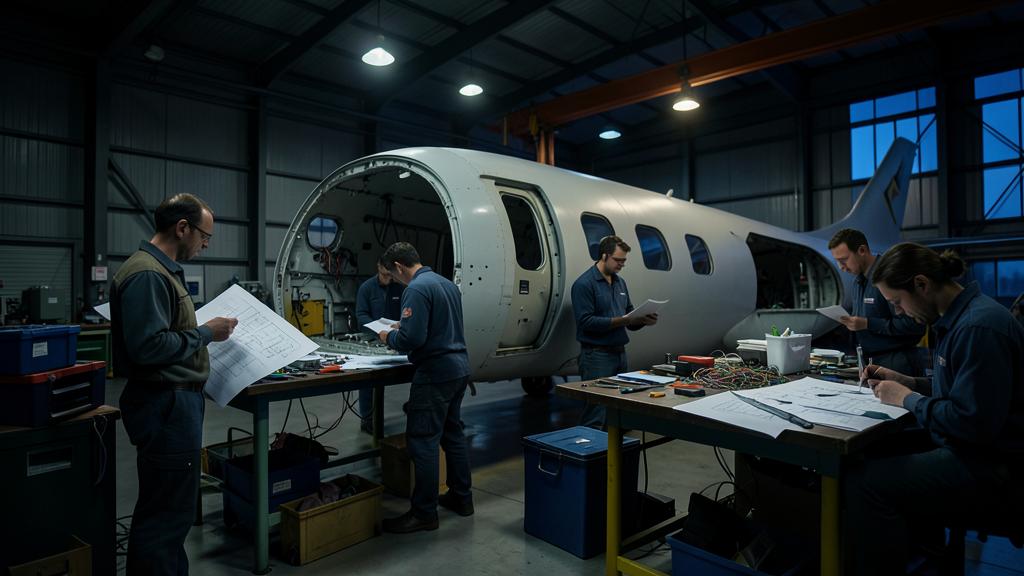
An operator asks for a small change: a different stowage, a relocated switch, an extra provision behind a panel. Two years later it is in every aeroplane leaving the line, including those ordered by carriers who never asked for it. Between those two moments sits a decision chain that is mostly commercial and configuration management, only partly engineering, and almost entirely invisible from outside the manufacturer. It is also the chain that decides whether your fleet ends up with one standard or three.
A change starts as a commercial question
The technical feasibility of a modification is rarely the hard part. Aircraft manufacturers employ people who can design almost any reasonable change to their own product. What takes the time, and what decides the outcome, is a set of questions that have nothing to do with whether it can be drawn.
Who pays the non-recurring engineering? Who carries the recurring cost per aircraft thereafter? What does it weigh, and who absorbs the performance penalty across the fleet? What is the supplier lead time for the parts, and does the supplier have the tooling? Does it affect an interface owned by somebody else? And, above all: is this a change one customer wants, or a change the manufacturer wants?
That last question is the fork in the road. A request that stays customer-specific is expensive per aircraft and stays expensive forever, because it defeats the entire economics of a production line built on repetition. A request the manufacturer adopts becomes cheap, because the cost is spread across the remaining production run — but the manufacturer only adopts it if it believes the change has a market, reduces its own cost, closes a competitive gap, or pre-empts a regulatory requirement it can see coming.
The real decision isn’t about whether a change is possible, but whether it makes financial sense for the manufacturer. If enough customers want it, the change becomes standard and cheaper for everyone. If only one airline asks, it stays expensive.
An airline orders 50 A320neo jets and requests a custom galley layout. The manufacturer calculates the cost per aircraft and decides to offer the layout as an option. Later, when 30 other airlines choose it, the manufacturer makes it standard, saving costs for all future buyers.
Three destinations, and they are not equivalent
| Destination | Who can have it | Cost profile | Long-term consequence |
|---|---|---|---|
| Customer-specific change | The requesting operator only | Requester pays engineering and a per-aircraft premium | Bespoke configuration to maintain, document and support for the life of the aircraft |
| Catalogue option | Any customer who orders and pays for it | Engineering amortised across takers; priced per aircraft | Fleet split by choice; supported as a normal option |
| Basic standard | Every aircraft from the cut-in point | Absorbed into the aircraft price | Fleet split by delivery date, not by choice, and permanent |
The migration from the first row to the third is the story the industry rarely tells. A change frequently enters as a bespoke request from a large or influential customer, proves itself in service, gets offered as an option once a second and third operator ask for it, and is finally rolled into the basic standard when enough of the order book has taken it that carrying two configurations costs more than making everybody take one. Manufacturers actively manage this: an option with high take-up is a candidate for standardisation precisely because standardising it removes a variant from the line.
Classification decides the cost, and the certification basis can move
Once the commercial answer is yes, the design change has to be classified under the applicable initial airworthiness framework — Part 21 in the European system, 14 CFR Part 21 in the American one. The essential division is between minor and major changes: a minor change is one with no appreciable effect on mass, balance, structural strength, reliability, operational characteristics or other characteristics affecting airworthiness; anything else is major. Minor changes can be approved under the privileges of an approved design organisation. Major changes require approval by the authority or under specific design organisation privileges, with a defined compliance demonstration.
Two consequences of classification are routinely underestimated outside engineering.
- The first is the changed product rule. When a product is changed, the certification basis for the changed area is re-examined, and the latest amendment of the airworthiness code may apply to that area rather than the amendment the aircraft was originally certificated against. A change that looks trivial can therefore drag a modern requirement into an old design and turn a small modification into a substantial compliance exercise. This is one of the main reasons a manufacturer declines a request that the customer considers obvious.
- The second is the boundary at the top. If a change is so extensive that a substantially complete investigation of compliance would be required, it is not a change at all — it is a new type certificate, with everything that follows. Between the two extremes sits the supplemental type certificate, the route used when the change is developed and approved by an organisation other than the type certificate holder.
| Route | When it applies | Approved by |
|---|---|---|
| Minor change | No appreciable effect on airworthiness characteristics | Design organisation under its privileges, or the authority |
| Major change by the TC holder | Appreciable effect, within the existing type design | The authority, or the design organisation where privileges allow |
| Supplemental type certificate | Major change developed by someone other than the TC holder | The authority, on the basis of the applicant’s demonstration |
| New type certificate | Change so extensive that compliance must be investigated afresh | The authority, as a new certification programme |
The effectivity number is the real decision
Every modification carries an effectivity: the set of aircraft it applies to, expressed by serial or line number and by an embodiment status. This is the most consequential single number in the whole process, and it is decided by lead time rather than by engineering readiness.
A production cut-in cannot be earlier than the point at which parts, tooling, drawings, supplier deliveries and assembly instructions all exist together. Structure and wiring have to be installed long before an aircraft rolls out, so a change touching either is committed months ahead of the aircraft that first shows it. The result is a boundary in the order book: aircraft before the cut-in are built to the old standard, aircraft after it to the new. Customers who ordered identical aircraft on the same day receive different aeroplanes because they are positioned differently in the build sequence.
Aircraft on the wrong side of the boundary, whether delivered or still in build, are handled by a service bulletin describing a retrofit. This is a different kind of document from a production modification: it addresses an aircraft that already exists, has to be performed with the tooling available in a maintenance environment, and normally quotes a man-hour estimate, a downtime, a parts kit and the maintenance check at which it can sensibly be done.
The trap. Maintenance data is valid only for the effectivity it names. Two aeroplanes of the same type in the same fleet can require different task cards, different part numbers and different torque values because one has a modification embodied and the other does not. Reading the effectivity block before the procedure is not administrative diligence — it is the procedure.
Provisions: paying now for the right to change later
The cheapest moment to modify an aeroplane is before it is built. The second cheapest is at a scheduled heavy check. Everything else is expensive, and the gap between the first and the last can be an order of magnitude or more for the same physical outcome.
This is why provisions exist. An operator that expects to install a system later can specify structural provisions, wiring provisions, cooling or plumbing provisions at build, so that the eventual installation becomes a matter of fitting equipment rather than opening the airframe. The cost at build is small; the saving at retrofit is very large, because it removes panel removal, structural work, harness routing and the associated inspection and downtime.
Provisions are also the manufacturer’s own hedge. When a change is anticipated but not yet mature, building the provisions into the standard aircraft keeps the future cut-in cheap and keeps the retrofit population manageable. An operator reading a specification should treat a long provisions list as information about what the manufacturer expects to happen next.
Provisions are like empty slots in an aircraft where future upgrades can be added easily. They save money later because they avoid costly structural changes. Manufacturers also use them to plan for future changes they expect to make.
An airline orders a Boeing 787 and requests provisions for future satellite connectivity. The manufacturer installs wiring and structural supports during production. Later, when the airline decides to add the system, the installation takes hours instead of days, saving thousands in labor and downtime.
The clock is set by suppliers, not by drawings
Ask an engineering department how long a modification takes and the answer will be a range measured in months, sometimes years, for a change that could be designed in weeks. The delay is almost never in the design office.
Long-lead items dominate. A part that requires new tooling, a casting, a forging or a qualification test programme sets the earliest possible cut-in on its own, and no amount of internal priority moves it. Where the change touches an item bought from a supplier, the supplier’s own change process, its own certification obligations and its own production commitments to other customers all sit inside the timeline. A modification that depends on three suppliers advances at the speed of the slowest.
Compliance demonstration adds its own duration, and it is not proportional to the size of the change. A modification requiring a flight test, a structural test article or a systems safety assessment can take longer than one involving ten times the parts, because the constraint is test resource and authority review rather than manufacturing.
The practical consequence for an operator is that a request made after the aircraft is on order will usually be answered with a retrofit rather than a production cut-in, simply because the build sequence has already passed the point where the change could be installed. Getting a change into the aeroplane you are buying means raising it during specification, not after signature.
What the change drags behind it
A modification is never only a modification. Approval of the design triggers a documentation and operational cascade, and the cascade is usually longer than the engineering.
| Item | Owner | What it changes for the operator |
|---|---|---|
| Instructions for continued airworthiness | Design approval holder | New or revised maintenance tasks, intervals and limitations |
| Maintenance and wiring manuals, illustrated parts catalogue | Manufacturer | New effectivity blocks, new part numbers, spares provisioning |
| Flight manual and operating documentation | Manufacturer, then operator | Revised limitations, procedures, performance data |
| Master minimum equipment list | Manufacturer, approved by the authority | Drives the operator’s own MEL and its dispatch conditions |
| Operational suitability data | Manufacturer, part of the type certificate | Differences training level for flight crew, cabin crew data, simulator data, certifying staff |
| Mass and balance | Operator | Revised aircraft basic mass and index after embodiment |
| Aircraft records and configuration status | Operator continuing airworthiness organisation | Embodiment recorded; determines which data applies from then on |
The operational suitability data line is the one that surprises people. Because flight crew data sits inside the type certificate under the European framework, a change that alters crew procedures or the flight deck can generate a formal differences requirement, and a differences level obliges the operator to deliver training before the aircraft can be flown by its crews. A modification that costs a few hours of maintenance per aircraft can therefore cost far more in crew training across a large fleet than it ever costs in the hangar, and that arithmetic — not the maintenance cost — is often what decides whether an operator accepts it.
Mandatory, recommended, optional
Service bulletins carry a category assigned by the manufacturer, and that category is a recommendation, not an obligation. What creates an obligation is an airworthiness directive issued by the authority of the state of design, which makes the corrective action compulsory within a stated compliance time for the affected effectivity.
Two details matter operationally. An airworthiness directive normally calls up a service bulletin at a specific revision level, sometimes with later approved revisions accepted explicitly; embodying a revision the directive does not name establishes nothing. A directive revised to call up a later bulletin revision can therefore reopen an action the operator considered closed. And the directive, not the bulletin, sets the compliance time — so a bulletin marked “recommended” that is later mandated becomes urgent on the authority’s timetable, regardless of when the operator planned the check.
The right reflex. When evaluating any optional modification, price the whole cascade rather than the kit: parts, labour, downtime, spares for a split fleet, manual revisions, MEL impact and any differences training. A fleet-wide modification is frequently cheaper than a partial one, because a split configuration is paid for every day for the rest of the aircraft’s life.
When the change does not come from the manufacturer
Operators and third parties modify aircraft continuously — cabin interiors, connectivity, medical or surveillance installations, freighter conversions. These are approved through the supplemental type certificate route, held by a design organisation that is not the type certificate holder.

Two frictions follow, and both are chronic. First, the STC holder owns its own continued airworthiness data, so the operator maintains a hybrid aeroplane whose documentation comes from two organisations that are not obliged to coordinate. Second, a subsequent manufacturer modification touching the same area may be incompatible with the STC installation, or may require the STC holder to reassess and reissue. An operator with a fleet carrying several third-party modifications will eventually find that a routine factory change cannot be embodied without a new approval from a supplier whose commercial interest in providing it is limited.
None of this argues against third-party work; it argues for treating configuration control as a strategic asset rather than a records function. The operators who manage this well are the ones who can say, for any aircraft in the fleet, exactly which modifications are embodied and which document revision applies — and who therefore know what a proposed change will actually cost them. Fleet configuration and continuing airworthiness practice come up frequently among engineers on the FL330 forums.


Leave a Reply
You must be logged in to post a comment.