
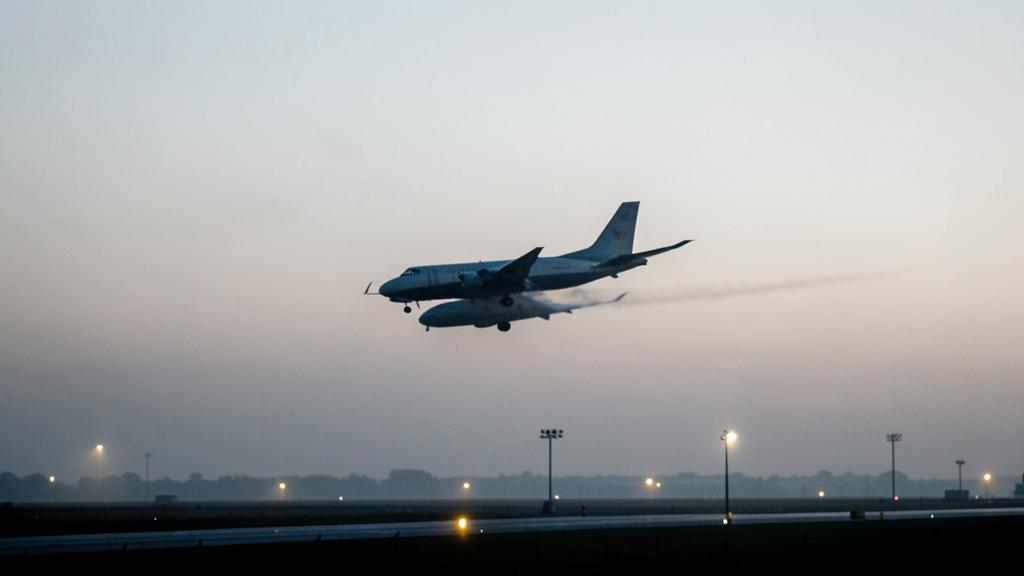
An aircraft rolls onto final at the prescribed separation behind a long-haul jet, with the wind reported at a few knots, under an early-morning inversion. At five hundred feet it takes an uncommanded roll, corrects, and reports the encounter. Nothing was breached: the separation applied was the correct one, and the wake was there all the same. That event says rather precisely what a classification scheme, however refined, can do — and why it is worth going back to the physics beneath the table of values.
What the wing leaves behind
A wing that lifts sustains a pressure difference between its lower and upper surfaces, and that difference cannot survive at the tip: the circulation bound to the aerofoil escapes round the end, and the shed vortex sheet rolls up, within a few wingspans downstream, into two counter-rotating vortices. This is not a by-product of propulsion nor a defect of workmanship; it is the unavoidable counterpart of lift. The engine jet dilutes in a few seconds; the vortices do not.
The strength of each vortex is contained in a simple expression: the circulation grows with the weight being carried and falls with the product of air density, speed and wingspan. Three consequences for the flight deck. The strongest wake is not produced at full power but slowly and heavily — full configuration, approach speed, high mass. A short wingspan concentrates the same circulation into a tighter vortex, hence a more violent core. And at altitude, the low air density increases the circulation for a given mass and indicated airspeed: an encounter in the cruise is no curiosity.
An often-forgotten corollary: the wake exists only where the wing is lifting. It begins at the rotation point and stops when the lift is transferred to the landing gear. The whole geometry of take-off and landing separations follows from those two limits.
Wake turbulence is created by the difference in pressure between the top and bottom of a wing. The stronger the lift, the stronger the vortices. A heavy, slow aircraft creates the strongest wake. The vortices don’t disappear quickly – they can last for minutes, especially in calm air. The wake is strongest right behind the aircraft and weakens as it moves away.
A Boeing 747 (maximum takeoff weight 450 tonnes, wingspan 68.5m) and an Airbus A320 (maximum takeoff weight 78 tonnes, wingspan 35.8m) both take off from the same runway. The 747’s wake will be much stronger and last longer. If the A320 follows too closely behind, it could encounter dangerous rolling moments from the 747’s vortices, especially in calm conditions.
Two clocks for decay
A vortex does not die away at a constant rate: two mechanisms compete for the work. The first is slow — viscosity and turbulent diffusion eat into the core, broaden the velocity profile and lower the tangential velocities without destroying the structure. The second is fast: the pair is intrinsically unstable. A sinusoidal deformation amplifies, the vortices come closer together in places, reconnect and close into rings that lose their coherence within moments.
What decides which one wins is the atmosphere being flown through. Marked ambient turbulence — a convective afternoon, a sustained wind, a well-stirred boundary layer — feeds the instability and cuts the life of the wake to a few tens of seconds. A stably stratified atmosphere inhibits it, because stratification opposes the vertical motions that feed the deformation. The calm before dawn, under an inversion, combines both unfavourable conditions: nothing to disperse, nothing to destabilise.
Stratification has a second effect: it slows the sinking of the pair, which settles at a level and may even rise back to it after overshooting its equilibrium. The wake then stops leaving the flight path from below, and stays in the corridor.
The wake is not where it ought to be
Away from the ground, the pair induces a downward velocity on itself and sinks a few hundred feet below the flight path before stabilising. A vertical separation is therefore effective, provided one is on the right side of it: following beneath the flight path of a preceding aircraft means going to meet its wake.

Near the ground, everything changes. As soon as the pair descends to less than about one wingspan, the ground forbids it to sink further: the image of each vortex in the ground plane imposes a lateral velocity on it, and the two vortices move away from the centreline at a few knots. Add a crosswind and the symmetry disappears. A clear-cut wind carries both vortices away to the downwind side; a light wind, of the order of their own drift, exactly cancels the movement of the one on the upwind side, which then stalls over the runway centreline.
The trap. The most dangerous window does not look like a dangerous window: clear sky, wind reported at two or three knots, the night inversion still in place. Those conditions remove the stirring that destroys the wake and hold one vortex motionless over the centreline. The prescribed separation covers a wide range of situations, not the worst atmospheric case: it is in perfect weather that one must ask for more.
Why maximum take-off mass is a poor proxy
The historic classification rests on a single quantity: maximum take-off mass. In its favour, it is published, stable and beyond dispute — against it, it appears in none of the relations that govern the subject. What matters is the weight actually being carried, the wingspan over which it is spread and the speed at which it is carried. Two aircraft of similar maximum mass but markedly different wingspans do not leave the same wake, and a heavy aircraft that is light and fast on approach does not leave the wake of that same aircraft arriving at its maximum landing mass.
Symmetrically, the same quantity was used to describe the vulnerability of the follower, as though a heavy aircraft were necessarily robust. Yet resistance to an encounter depends on two things: the wingspan of the follower compared with the spacing between the cores — the one whose span fits entirely inside a single vortex undergoes the maximum rolling moment, the one that straddles the pair sees the contributions partly cancel each other — and the roll authority available to oppose it. A single-quantity classification conflated two independent problems; the merit of the re-categorised schemes is to separate them.
| Criterion | Historic broad categories | Re-categorised scheme |
|---|---|---|
| Classification quantity | maximum take-off mass alone | maximum mass and wingspan |
| Granularity | three classes, plus a special case for the very heavy | six classes |
| Form of the rule | a scale: class of the follower behind that of the leader | a matrix: one value per pair |
| Vulnerability of the follower | implicit, conflated with mass | treated separately, through wingspan and roll authority |
| Effect on the minima | a few values applied everywhere | redistribution: some pairs tightened, others widened |
| What remains ignored | the mass of the day, approach speed, atmosphere | the same: the classification stays static |
| Scope | of general application | approved and published aerodrome by aerodrome |
What the pairwise matrix actually moved
Moving from a scale to a matrix does not reduce separations: it redistributes them. Some pairs, which the broad classes treated with a comfortable margin because they fell into the same bucket as a more unfavourable case, are tightened. Others do not move. A few are widened, because the fine mesh reveals a combination that the coarse mesh treated optimistically: a follower of small wingspan behind a powerful generator, typically. Anyone who has retained from re-categorisation only a promise of throughput therefore sometimes finds themselves more widely spaced than before.
The real benefit depends on the fleet mix. Where very similar aircraft follow one another, a fine matrix finds nothing to optimise: every pair falls into the same cell. At a heterogeneous airport, it recovers the margin that the broad classes granted by default. The logic has been pushed further still, as far as separations computed pair by pair, with no intermediate categories.
A second development deserves to be understood in its own right: expressing the minimum in time rather than in distance on final approach. At a fixed distance, a headwind reduces groundspeed and lengthens the interval actually delivered between two landings: the runway loses throughput as the wind strengthens. Converting the minimum into time restores the intended interval. The safety justification lies not in the geometry but in the decay: the stronger the wind, the more the boundary layer is stirred, the shorter the life of the wake. The reasoning therefore reverses in calm air.
The right reflex. Know, before arriving, which scheme the airport applies and whether time-based separation is in service there: that appears in the aeronautical information of the aerodrome, not in the generic classification of your aircraft. Ask explicitly for increased spacing when conditions warrant it, without waiting to be offered it. And on final, hold the path or stay slightly above it, then aim beyond the touchdown point of the preceding aircraft: that is the only protection the crew manufactures for itself.
What has not moved an inch
Re-categorisation changed a table of values. It touched neither the physics, nor the scope of application, nor the allocation of responsibilities.
The minima remain minima, applied by an air traffic control service to aircraft it is spacing along a common flight path. As soon as the crew accepts visual separation or a visual approach behind a preceding aircraft it has in sight, the geometry falls entirely to them: distance, relative height, touchdown point. The caution advisory that accompanies such clearances is not a courtesy, it is a transfer.
The go-around remains a structural grey area: an aircraft that discontinues its approach leaves a descending path for a climbing one, in a volume the preceding aircraft has just crossed and that others occupy on departure. No matrix is computed for that trajectory. Likewise, a take-off from an intermediate point on the runway places the rotation of the follower beyond the rotation point of the leader, hence where the wake already exists — whence the increased interval provided for that case, as for a take-off in the opposite direction.
In the cruise, the wake still descends, and levels are separated vertically by an amount that was not set with it in mind. An encounter behind an aircraft that is close vertically is dealt with by a lateral offset, not by a level change that may take you through the corridor across its depth.
| Phase | Organised by the rule | The responsibility of the crew |
|---|---|---|
| Final spaced by air traffic control | the longitudinal interval, according to the pair | holding the path, touchdown point, request for increased spacing |
| Visual approach or accepted visual separation | nothing quantified: the spacing is delegated | the whole geometry, distance and relative height included |
| Take-off behind a heavier aircraft | a time interval, increased from an intermediate point | rotation point, initial flight path, refusal of the slot if needed |
| Go-around | no dedicated separation | the likely position of the wake, worked out before initiating it |
| Cruise | vertical separation with no reference to the wake | lateral offset, vigilance when crossing |
The technique at the moment of the encounter has not changed either, and it remains counter-intuitive. The motion imposed is first of all a roll; the response is a firm, proportionate roll input, without excess on the recovery, without rudder to counter the roll, and without letting the angle of attack drift during the correction. What the wake most often damages is the recovery.
What to go and check in your own documentation
Three things are to be checked in your own documentation. The category actually assigned to your aircraft in the scheme applied at your usual airfields, bearing in mind that it cannot be read off the radiotelephony callsign: the heavy suffix, the letter entered on the flight plan and the class a controller applies within a six-class scheme do not carry the same information, and the gap between what is spoken and what is applied manufactures mistaken expectations. Next, the airfields where time-based separation is in service, since reading a distance there no longer means the same thing. Lastly, what the operations manual and the manufacturer documentation prescribe: conditions for requesting increased spacing, technique to be applied, report to be filed.
One grey area remains that nothing has filled: moving from a re-categorised airport to one that is not, on the same day and with the same aircraft, without the physics of the wake having changed one iota. For anyone preparing a type rating or a technical interview, that is where the interesting question lies — not reciting a table of values, but explaining why it changes shape from one airfield to another when the vortex knows nothing of local regulation. The FL330 technical courses address this point with the matrix in front of them.
On every point addressed here, the applicable text and the approved documentation of the operator prevail: what is published for the aerodrome and what the operations manual and the manufacturer documentation prescribe take precedence over any general explanation, this one included.
Questions fréquentes
Does re-categorisation always reduce separations?
No. It redistributes the minima pair by pair instead of reading them off a three-class scale. Some pairs are tightened, others remain unchanged, and a few are widened because the fine mesh reveals a combination that the broad classes treated optimistically, typically a follower of small wingspan behind a powerful generator.
Why is the strongest wake not the one produced on take-off at full power?
Because the circulation shed by the wing depends on the weight being carried, not on thrust. It grows with mass and falls with speed and wingspan: the unfavourable case is therefore the heavy aircraft flying slowly in full configuration, that is, final approach, and not the application of power. The engine jet, for its part, dilutes in a few seconds.
Which crosswind is the most unfavourable on final?
The most unfavourable case is a light crosswind, of the order of a few knots. Near the ground, each vortex drifts laterally at a few knots under the effect of the ground; a crosswind of that strength roughly cancels the drift of the upwind vortex, which then stalls over the runway centreline. A clear-cut wind, on the contrary, carries both vortices away to the downwind side, whereas a zero wind leaves them both close to the centreline. The practical conclusion is that vigilance must increase as the wind weakens, not the reverse.
Why can separation be expressed in time rather than in distance?
Because at a fixed distance, a headwind reduces groundspeed and lengthens the interval actually delivered between two landings, which costs throughput. Expressing the minimum in time restores the intended interval. The safety justification rests on the fact that a stronger wind stirs the boundary layer more and shortens the life of the wake; the reasoning therefore does not apply in calm air.
Is the radiotelephony callsign enough to know the category applied?
No, and this is a classic source of mistaken expectation. The suffix spoken on the radio, the letter entered on the flight plan and the class a controller applies within a six-category scheme do not carry the same information. The effective category is verified in the documentation of the operator and in the aeronautical information for the airfield concerned.
What does wake separation cover during a go-around?
No separation is dedicated to that trajectory. The minima are built for aircraft spaced along a common approach or departure path, not for a discontinuation path that climbs through a volume recently crossed. The likely position of the wake of the preceding aircraft must therefore be worked out mentally before initiating the go-around, not during it.


Leave a Reply
You must be logged in to post a comment.