
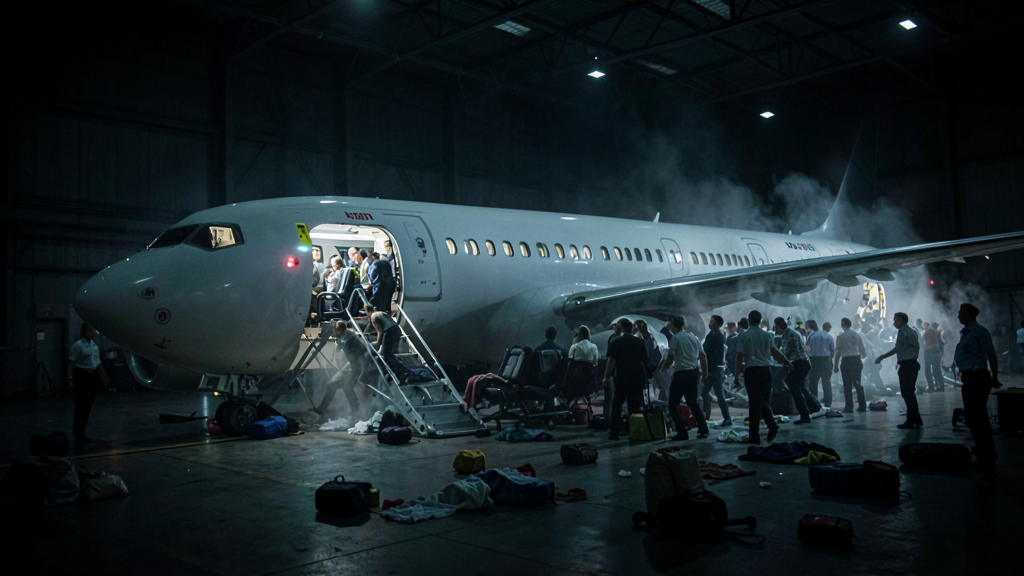
Ninety seconds is the most quoted figure in cabin safety and one of the least examined. It is not an average, not a target, and not a measurement of how fast a crowd moves. It is the output of a certification exercise run once, on a prepared aeroplane, in front of an authority, with a population selected by rule — and the distance between that morning and a real evacuation is precisely where the cabin crew’s job begins.
The ninety seconds is a fire budget, not a human one
The figure is not an observation of how fast a crowd moves. It is explained by fire behaviour: how long a fuselage next to a fuel-fed external fire holds before the skin is breached, before the cabin lining starts to contribute, and before the interior reaches conditions no occupant survives. That interval is the budget, and the requirement exists to prove the aeroplane can spend it.
The large-aeroplane codes on both sides of the Atlantic — 14 CFR Part 25 in the United States, CS-25 in Europe — carry the same demand at .803: an aeroplane with more than 44 passenger seats must be shown capable of evacuating its maximum certificated seating capacity, together with the crew required by the operating rules, to the ground within 90 seconds under the conditions of the emergency evacuation appendix.
Two consequences follow at once. First, ninety seconds is not a duration an evacuation should aim for; it is a ceiling below which the whole survivability argument holds and above which it does not. Second, because the budget is set by fire behaviour and not by human performance, no cabin layout, no crew complement and no passenger population can buy more of it. The aeroplane must fit the fire, not the other way round.
The 90-second rule is about how long an airplane can survive a fire, not how fast people can escape. It’s a safety limit, not a speed target.
What the demonstration fixes, and what it deliberately does not
The appendix to the code — Appendix J in the FAA text, with a matching annex in CS-25 — is unusually prescriptive, because a demonstration that the applicant could tune would prove nothing. The conditions worth knowing are these.
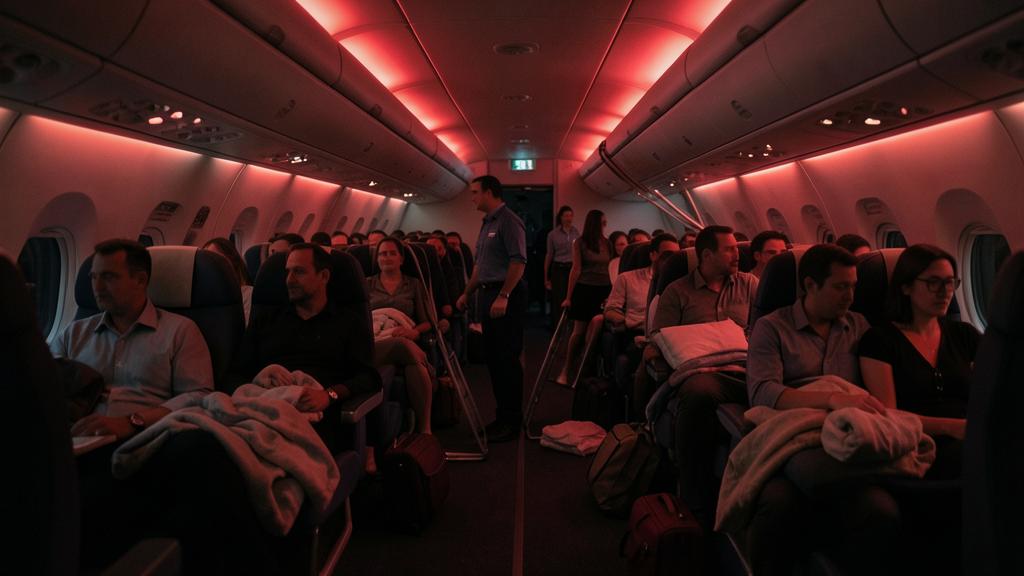
The aeroplane sits in a normal ground attitude with the landing gear extended. The demonstration is conducted in darkness, or in daylight with the effect of night simulated, on emergency lighting alone. Every seat is filled to maximum certificated capacity, belts fastened, before the signal. Carry-on baggage, blankets and pillows are distributed through the aisles and around the exits to create minor obstructions. The slides that deploy are the ones installed on the aeroplane, deploying for real, with no rehearsal of that particular run.
And not more than half the emergency exits in the sides of the fuselage may be used. The applicant designates which ones, subject to the authority’s approval; they have to be representative of the exits installed, at least one of them at floor level, and the exits left out are deactivated or marked as unusable. Nobody on board is told beforehand which half will be open. The clock runs from the evacuation signal to the moment the last occupant reaches the ground.
| Parameter | In the demonstration | On the line |
|---|---|---|
| Exits available | Half at most, designated by the applicant, approved by the authority | Whatever the fire, the terrain and the deformation leave |
| Atmosphere in the cabin | Clear air | Smoke possible within seconds, visibility to nil |
| Aeroplane attitude | Normal, gear extended | Gear collapsed, wing low, nose down, off the paved surface |
| Occupants | Uninjured, briefed, expecting the signal | Injured, disoriented, some asleep on impact |
| Cabin baggage | Distributed as obstruction, not carried out | Routinely retrieved from overhead bins on the way out |
| Crew | The number required by the operating rules, all fit | The same number, possibly one or more incapacitated |
| Repetition | Once, under observation | Once, without observation |
The people in the seats are chosen by rule
The most misunderstood part of the exercise is the passenger load. The appendix does not allow a hangar full of young engineering staff. It imposes a demographic floor — in the FAA text, at least 40 per cent of the load female, at least 35 per cent over fifty years of age, and at least 15 per cent both female and over fifty. Life-size dolls representing infants are carried by passengers and are not counted in the load. Nobody who has taken part in such a demonstration within the preceding six months may take part in this one.
Those rules exist because an unconstrained sample would produce a meaningless number. But notice what they constrain and what they leave alone. They fix age and sex. They say nothing about body mass, mobility, injury, language, sobriety, prior flying experience, or whether the person in the exit row understands what the placard asks of them. And every single participant walked into the hangar knowing what was about to happen.
The trap. Reading the ninety seconds as a performance figure the cabin crew should be able to reproduce in training. It is a certification ceiling obtained under conditions no line evacuation will ever match. A recurrent drill timed against it teaches speed where the real variable is flow control at the door.
Half the exits is the honest part of the test
Of all the assumptions in the appendix, the exit restriction is the one that earns its keep. The accident that motivates the requirement — a post-crash fuel fire — will usually deny the occupants a whole group of exits, commonly those down one side of the fuselage. Cutting the usable exits to half before the clock starts is the code conceding that the design has to survive losing a large part of its escape capacity.
What it does not concede is anything beyond that. The demonstrated time contains no allowance for a further exit failing among those in use, for a slide that does not inflate or inflates into wind, for a door blocked by a passenger stopping at the sill, or for an exit opened onto a fire the crew cannot see from the jumpseat. Those are absorbed by crew procedure, not by margin.
On an Airbus A320 with 180 seats, only 9 exits (half) are used in the test. If a real evacuation happens, some exits might be blocked by fire or debris, making reality even harder than the test.
Exit type, not cabin length, sets the capacity
The link between the demonstration and the daily reality of seat maps runs through the exit provisions at .807. The code assigns each exit type a number of passengers that a pair of such exits unlocks. Sum the pairs and you have the maximum certificated passenger seating capacity — the ceiling a densification project runs into long before it runs out of floor.
| Type | Position | Nominal minimum opening | Passengers per pair |
|---|---|---|---|
| A | Floor level | 42 in wide, 72 in high | 110 |
| B | Floor level | 32 in wide, 72 in high | 75 |
| C | Floor level | 30 in wide, 48 in high | 55 |
| I | Floor level | 24 in wide, 48 in high | 45 |
| II | Floor level or over-wing | 20 in wide, 44 in high | 40 |
| III | Over-wing, with step-up and step-down limits | 20 in wide, 36 in high | 35 |
| IV | Over-wing | 19 in wide, 26 in high | 9 |
Two things fall out of this table that are worth carrying into any cabin reconfiguration discussion. A Type IV pair buys nine passengers — which is why aeroplanes reach for Type III and above the moment density matters. And the jump from Type III to Type I is not a matter of a few inches of aperture: it is a floor-level opening, a different escape means, and a different assumption about who can use it.
What the ninety seconds does not contain
Set out plainly, the demonstrated figure excludes: fire, smoke, heat, toxic combustion products, structural deformation, ditching, injury, panic, passengers retrieving cabin baggage, passengers evacuating with mobility aids they cannot take down a slide, and the possibility that the person seated at the over-wing exit does not open it.
Investigation reports on real evacuations return to the same observation on the last of those: occupants take their bags. Not a few of them, and not only the inexperienced. The behaviour is durable enough that it should be treated as the expected case rather than as deviance — which changes what a cabin crew member should be saying at the door, and when.
The right reflex. Brief the exit-row occupant with a question that requires an answer, not a statement that can be met with a nod. “Tell me what you will do if I call for that exit” produces information; “are you willing and able to assist” produces a nod from someone who has not read the card.
What the operator inherits from the certification
The manufacturer proves the aeroplane. The operator’s task is to keep the demonstration’s assumptions true every day, and that is entirely an operational job.
Minimum cabin crew under the European operating rules is set by the seats installed, not by the seats sold: on an aeroplane with more than nineteen passenger seats, the greater of one cabin crew member per fifty seats — or fraction of fifty — installed on the same deck, and the number who actually took part in the aeroplane’s evacuation demonstration. That second limb is the whole point. The staffing floor is not an efficiency target to be worked down to; it is the crew the evacuation argument assumed. Exit-row seating restrictions, the pre-departure briefing, the stowage of cabin baggage and the serviceability of the emergency lighting are all, viewed from the certification side, maintenance of the demonstration conditions.
| Assumption in the demonstration | Kept true by | Fails when |
|---|---|---|
| Exits usable and unobstructed | Cabin crew pre-flight checks, exit-row seating policy | Baggage stowed at the sill, exit row sold to a passenger who cannot operate it |
| Aisles clear enough for flow | Boarding supervision, cabin secure check | Bags left in the aisle to speed boarding |
| Emergency lighting available | Maintenance programme, minimum equipment list | Deferred defect accepted without the associated procedure |
| Crew complement present and fit | Operating rules, rostering, fatigue management | Operating at minimum with an undeclared incapacitation |
| Occupants able to act on command | Safety briefing, card design, exit-row briefing | Briefing delivered as a formality nobody watches |
Reading a real evacuation against the number
When an evacuation happens and the time is reported, the useful comparison is not with ninety seconds. It is with the conditions. An evacuation that took two minutes with all exits available, in daylight, on a taxiway, with no fire, is not a success because it is close to the certification figure — it is a slow evacuation under favourable conditions, and the interesting question is where the flow stopped.
The variables worth capturing in the report are the ones the demonstration held constant: how many exits were actually used, why the others were not, how long the first slide took to become usable, where the queue formed, and how many occupants arrived at the door carrying something. Those answers make the next briefing better. A stopwatch reading does not.
Cabin safety departments that share this material tend to find the same patterns across fleets and operators; the discussion threads on the FL330 forums are one place where crews compare what actually happened at the door rather than what the manual says should have.
What to hold on to
Ninety seconds is a fire-survivability budget, proven once under conditions chosen to be demanding in one specific way — half the exits gone — and generous in every other. The aeroplane you fly has met it. The evacuation you may one day run will not resemble the day it did. The certification proves the design can spend the budget; the crew decides whether the cabin actually does.


Leave a Reply
You must be logged in to post a comment.