

The rule that sometimes demands two destination alternates is easy to read as an arithmetic one: the weather is bad, so take two rather than one, because two is more than one. Read that way it produces flight plans that satisfy the rule and protect nothing. Two alternates sitting under the same air mass, fed by the same front, sharing the same fog basin and served by the same area control centre are not two chances. They are one chance, counted twice, and the fuel carried to reach the second one buys nothing the first did not already offer.
What the rule actually asks
The European commercial air transport rules require the operator to select and file destination alternates, and they set out a specific condition under which one is not enough. Two destination alternates must be selected when the appropriate weather reports or forecasts for the destination indicate that, during a window opening an hour before the estimated time of arrival and closing an hour after it, the conditions will be below the applicable planning minima. Two are also required when no meteorological information is available for the destination at all.
Three features of that formulation are worth noticing before anything else, because each one carries an assumption.
It is judged on the forecast picture, not on what the aerodrome looks like at the moment of planning. The rule speaks of reports or forecasts, but when the arrival is several hours away the operative document is the terminal forecast for the window, read against a planning minimum rather than against the operating minimum for the approach.
It is bounded by a window around the arrival time, not by the whole day. An aerodrome that is forecast to be unusable for the morning and clear by mid-afternoon does not trigger the requirement for an evening arrival. The window is wide enough on either side to cover a moderate slip, and no wider: a delay large enough to push the arrival outside it changes the answer.
And it treats an absence of information exactly like bad information. This is the part most often forgotten in flight planning, and it is the reason the requirement bites at aerodromes where nothing is wrong except that nobody is forecasting.
Adequate, suitable, and the word nobody writes down
Two terms of art do a lot of work in this area, and mixing them up produces plans that look compliant and fail on the day.
| Filter | What it tests | When it is applied |
|---|---|---|
| Adequate | The aerodrome exists, is available at the expected time, and is equipped for the aeroplane: runway dimensions and strength, rescue and fire fighting cover, lighting, air traffic services, approach aids | Largely static; established by the operator’s route and aerodrome analysis, not by the crew on the day |
| Suitable | An adequate aerodrome whose weather reports and forecasts, and whose runway surface condition, indicate a safe landing can be made in the relevant period | At flight planning, and again in flight as the picture changes |
| Actually useful | Everything the rule does not test: parking, ground handling, fuel, steps or an air bridge, customs and immigration, opening hours, whether the whole region is going there too | Nowhere in the regulation; entirely on the operator’s dispatch process and the crew’s judgement |
The third row has no legal status and decides a great many diversions. An aerodrome that is adequate and suitable and has no stand available, no fuel after hours, no immigration officer at two in the morning and a curfew that has already started is a legal alternate and an operational dead end. The disciplined question at planning is not only whether the alternate is permissible, but what happens once you are on the ground there — because that is the part of the decision that has no rule to lean on.
Why planning minima are deliberately higher than operating minima
An alternate is not judged against the minima you would use to land there. It is judged against a higher, more conservative set of planning minima, and the reason is a time difference rather than a safety margin in the usual sense.
The forecast you are using at planning is a statement about conditions several hours in the future. The approach minimum you would fly is a statement about conditions you can see. Between the two sits the entire forecast error, and the planning minima table absorbs it by refusing to let you plan on the aerodrome’s best capability. The general shape of the scheme is a downgrade of one step: an aerodrome capable of a low-visibility precision approach may be planned only on the credit of the ordinary precision approach, an aerodrome offering a precision approach may be planned on non-precision credit, and a non-precision aerodrome is planned with explicit increments added to its published minima. The exact increments and the exact structure of the table differ between regulatory systems and are in the applicable rule; the logic is the same everywhere. You may not plan hours ahead on the best thing the aerodrome can do.
The trap. Choosing an alternate on the basis of its published approach capability rather than its planning credit. An aerodrome with an excellent low-visibility capability can still fail the planning test on a marginal forecast, while a plainer field with a generous forecast passes easily. The capability of the approach and the usability of the aerodrome at planning time are separate questions.
The planning minima are stricter than the actual landing minima because forecasts aren’t always perfect. If you plan to land at an airport using its best possible approach, you might be in trouble if the weather is worse than expected. So, you plan with higher minima to account for possible forecast errors.
An Airbus A320 is planning to land at London Heathrow (EGLL) with a forecast close to its ILS Cat II operating minima (decision height 100 ft, RVR 300 m). The landing itself may be possible, but the forecast is below the applicable planning minima. That triggers the requirement for two destination alternates, and each must meet the stricter planning criteria, not just the operating minima.
Two alternates are not two chances
Here is the substance of the matter, and the reason the requirement exists in the form it does.
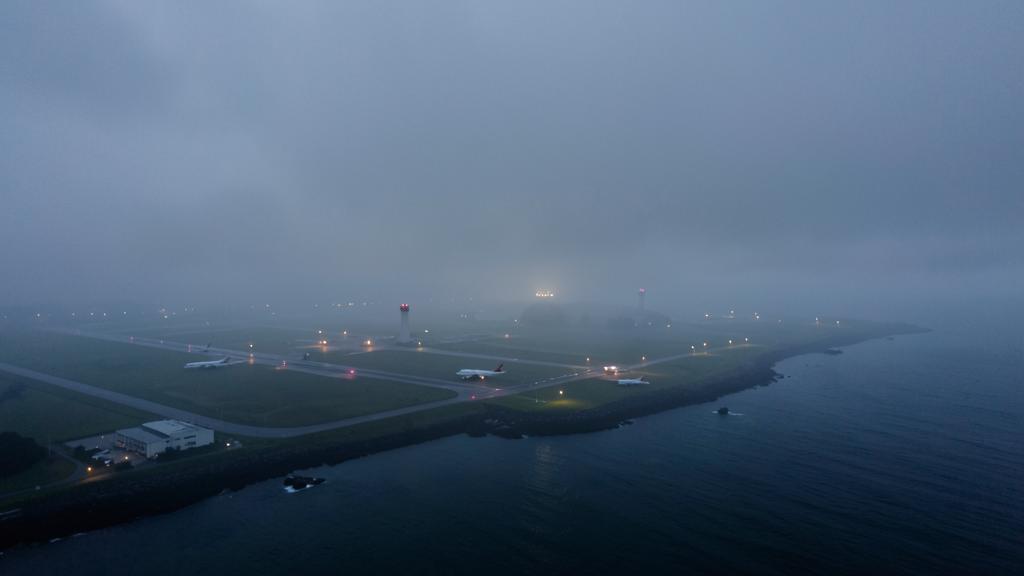
The rule is triggered by a forecast that the destination will be below planning minima. That forecast is a statement about a weather situation, and weather situations are large. A slow-moving occlusion produces low cloud and rain over hundreds of kilometres. A radiation fog event under a winter anticyclone fills every low-lying basin in a region on the same night, for the same reason, and clears at the same hour. A marine stratus incursion runs along a coastline and takes every coastal aerodrome on that stretch with it. A squall line crosses aerodromes in sequence rather than sparing some of them.
If both alternates lie inside the same phenomenon, the probability that the second is usable given that the first is not is close to the probability that the first was usable in the first place — which is to say, the second alternate adds almost nothing. The requirement to file two only produces two chances if the two are chosen so that the reason the first fails is not the reason the second fails. That is a statement about correlation, and it is not something the regulation can specify for you. It has to be reasoned on the day, from the synoptic picture.
| Shared factor | How it couples the two | The decorrelating question |
|---|---|---|
| Same air mass or frontal system | One cause, one outcome at both fields, usually at the same hour | Are they on opposite sides of the front, or upstream and downstream of its track? |
| Same topography | Two fields in the same valley or basin fog and clear together; two coastal fields share the same stratus | Is one of them inland, or at a materially different elevation? |
| Same runway orientation | A strong crosswind or a wind shift disables both at once, whatever the visibility | Do their runway axes differ enough to matter on a limiting wind day? |
| Same area control centre or approach unit | A radar, communications or systems failure closes a whole sector, not one aerodrome | Are they under different control units, ideally in different states? |
| Same regional resources | Shared de-icing capacity, shared snow clearing, one fuel supplier, one handling agent | On a winter day, could both be limited by the same shortage rather than the same weather? |
| Same popularity | Everyone diverting from the same destination picks the same obvious field, which then runs out of stands | If forty aircraft divert this evening, where does the fortieth actually park? |
The correlations that are not meteorological
The last three rows of that table are the ones that get overlooked, because the rule speaks about weather and the mind follows it there.
Air traffic infrastructure is the sharpest of them. An area control centre failure, a communications outage or a systems problem at a single approach unit removes every aerodrome under that unit simultaneously, regardless of the weather, and it does so with no warning in the forecast. Two alternates under the same centre are exposed to a single point of failure that no meteorological reasoning will surface.
Saturation is the second. The obvious alternate is obvious to everyone, and diversion traffic converges. The limiting resource is rarely the runway; it is stands, ground handling, steps, buses, immigration desks and, on a long evening, crew duty. An aeroplane that lands at a field with no available stand and no way to disembark has diverted successfully and solved nothing.
Timing is the third and the least visible. Aerodromes with curfews or with published opening hours are perfectly usable until an hour that arrives while you are airborne. An alternate that closes twenty minutes after your latest realistic arrival there is not an alternate; it is a plan with an expiry date nobody wrote down.
The right reflex. Before accepting a filed pair, ask one question: what single event would make both of these unusable? If that event has a name — this occlusion, this fog situation, this control centre, this curfew — the pair is not decorrelated and one of the two should be replaced, even if replacing it costs fuel.
What two alternates cost, and what they do not
Filing two alternates does not mean carrying fuel to both. Alternate fuel is computed for the alternate that demands the greater quantity, on the assumption that the aeroplane will go to one of them, not to each in turn. The penalty for filing a distant second alternate is therefore real but bounded: it appears only if that second field is the fuel-critical one.
That has a practical consequence worth being explicit about. The extra fuel needed to reach a genuinely decorrelated alternate — one on the other side of the front, or inland instead of coastal — is often modest compared with the extra fuel a crew would have carried anyway as discretionary fuel on a marginal day. Buying decorrelation with fuel is usually a better trade than buying holding time, because holding time only helps if the destination improves, whereas a decorrelated alternate helps whether it improves or not.
The other cost is not fuel. It is the payload the fuel displaces on a limiting sector, and that is a commercial decision the operator’s fuel policy is supposed to have framed in advance rather than left to a conversation at the aircraft.
Europe and the United States get there differently
The requirement is not written the same way on both sides of the Atlantic, and the difference is instructive rather than merely administrative.
The European scheme triggers the second alternate from the destination: if the destination forecast is below planning minima in the window around arrival, or if there is no forecast at all, two are required. The reasoning starts from how bad the destination is.
The United States framework approaches the same problem from the other end. Whether an alternate is needed at all turns on a ceiling and visibility test at the destination over a window around the arrival time. A second alternate, where it is required, follows from the alternate’s own weather being marginal rather than from the destination alone, and that provision sits in the operator’s operations specifications rather than in the rule text. The reasoning starts from how reliable the escape route is.
Neither construction is wrong, and a crew operating across both systems should know which logic they are inside. What both are groping towards is the same underlying idea, which neither states explicitly: the plan needs an escape route whose failure is not caused by the same thing that caused the destination to fail.
The alternate you filed is rarely the one you use
The alternate selected at flight planning is a prediction made hours in advance and is subject to the same obligation of in-flight reassessment as every other planning assumption. The forecast that justified it can be superseded; a field that was suitable at dispatch can be closed by a runway blockage, an equipment failure or a security event that no forecast contained.
The practical habit that pays is to know, at top of descent, which of the filed alternates is currently the live one and why — and to have looked at the current reports for both rather than at the ones printed on the flight plan. A pair selected for genuine decorrelation makes that reassessment quick, because the reason one is failing usually tells you immediately whether the other is affected. A pair selected for convenience makes it slow, because both are moving together and neither is obviously better.
The idea worth keeping
The requirement for two destination alternates is not a demand for redundancy. It is a demand for independence, expressed in a rule that can only count. The regulation can say two; only the person reading the synoptic chart can make them two. The test is a single question asked out loud before the plan is accepted: what would have to happen for both of these to be unusable, and how likely is that one thing? Flight planning and fuel policy questions of this kind are discussed regularly on the FL330 professional forums.


Leave a Reply
You must be logged in to post a comment.