
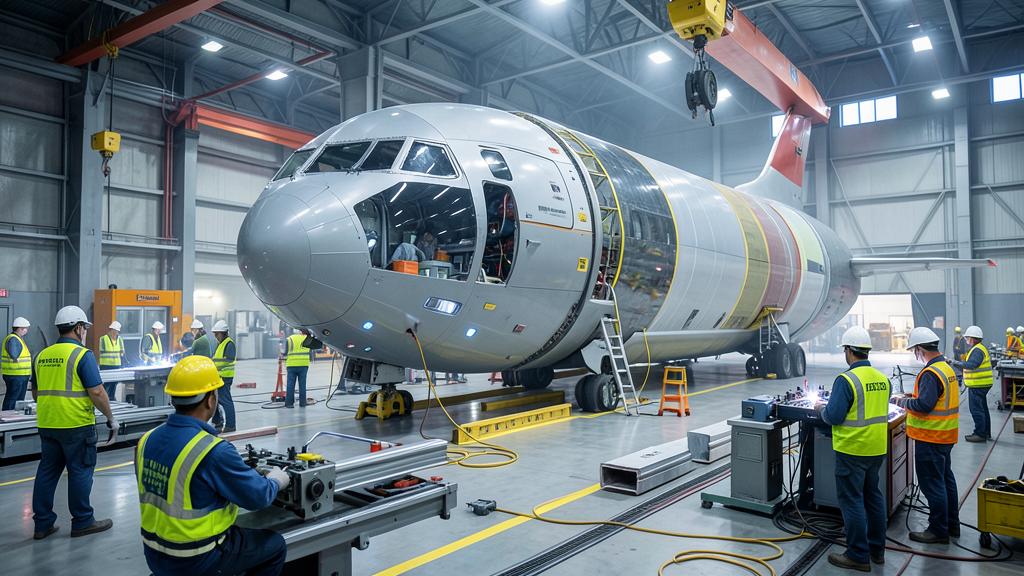
Hydrogen is usually introduced through its best figure: it carries roughly three times the energy per kilogramme of kerosene. That number is real, and it is also the least useful one in the room, because a conventional transport aeroplane has never been volume-limited by its fuel. The moment the fuel has to be stored either at twenty kelvin or at several hundred bar, the tank stops being a container inside the airframe and becomes the object the airframe is arranged around. Choosing liquid or compressed is therefore not a fuel-system decision. It is the configuration decision, taken first, and everything else follows it.
The comparison that decides the layout is per litre, not per kilogramme
Kerosene stores about 43 megajoules in every kilogramme and, at a density near 800 kilogrammes per cubic metre, roughly 34 megajoules in every litre. Hydrogen stores about 120 megajoules per kilogramme, which is the headline. Its density is where the design problem lives. Liquid at its normal boiling point sits near 71 kilogrammes per cubic metre; compressed gas at 700 bar and ambient temperature reaches only around 40, and at 350 bar around 24.
| Storage state | Approximate density | Approximate energy per litre | Volume for the same energy as Jet A-1 |
|---|---|---|---|
| Jet A-1, ambient pressure | About 800 kg per cubic metre | About 34 MJ | Reference |
| Liquid hydrogen, about 20 K, near ambient pressure | About 71 kg per cubic metre | About 8.5 MJ | Roughly four times, before insulation |
| Compressed hydrogen, 700 bar, ambient temperature | About 40 kg per cubic metre | About 4.8 MJ | Roughly seven times, before vessel walls |
| Compressed hydrogen, 350 bar, ambient temperature | About 24 kg per cubic metre | About 2.8 MJ | Roughly twelve times, before vessel walls |
Two qualifiers in the right-hand column carry the whole argument. Before insulation means that a liquid tank’s external volume is larger than its internal volume by the thickness of a cryogenic insulation system, which is not thin. Before vessel walls means that a 700-bar vessel is a thick composite structure whose wall occupies real space and real mass. The stored fluid is only part of what has to fit inside the aeroplane; on the compressed side, it is a surprisingly small part.
Hydrogen takes up way more space than kerosene, whether it’s liquid or compressed. Liquid hydrogen needs extra insulation, and compressed hydrogen needs thick, heavy walls. That means the tank takes up a lot of room in the plane, no matter which form you use.
A Boeing 737 MAX 8 typically carries about 24,000 kg of kerosene for a 3,000 nm mission. If using liquid hydrogen, the tank would need to hold roughly 8,000 kg of hydrogen (since it’s 3x more energy-dense by weight), but that would require about 113 cubic meters of space (since liquid hydrogen is only 71 kg/m³). That’s roughly 4x the volume of kerosene, meaning the tank would be much larger, likely requiring a fuselage stretch or reconfiguration.
A pressure vessel cannot be a wing
The reason kerosene has been free of configuration consequences for seventy years is that it is stored at essentially ambient pressure in a container that can be any shape at all. The wing box is a structure that exists for other reasons, and filling it with fuel costs almost nothing: no dedicated tank walls, no dedicated volume, and a fuel mass distributed along the span in exactly the place that relieves wing bending.
Neither hydrogen state permits that. A vessel holding hydrogen at 350 or 700 bar has to be a shape that carries membrane stress efficiently — a cylinder with domed ends, or a sphere. A cryogenic vessel has the same preference for a different reason: heat leak is proportional to surface area, so the efficient shape is the one that minimises surface for a given volume, again a cylinder with domed ends or a sphere. Both requirements point away from the thin, tapered, doubly curved volume that a wing offers, and towards a large body of revolution.
There is only one place on a conventional transport aeroplane where a large body of revolution already exists, and it currently contains the payload. That single geometric fact is the origin of nearly every hydrogen configuration study published in the last decade: tanks in the aft fuselage behind a rearranged pressure bulkhead, tanks forward of the cabin, tanks in a dorsal or ventral fairing, or a departure from the tube-and-wing arrangement altogether.
Cold has a mass, and it does not burn off
A kerosene tank weighs almost nothing beyond the structure that would exist anyway. A hydrogen tank weighs a great deal, and its mass is fixed for the life of the aeroplane. The useful figure of merit is the gravimetric index: the mass of hydrogen stored divided by the mass of hydrogen plus the tank system. Compressed vessels certified for road use store only a few percent of their own system mass as hydrogen, which is why automotive practice does not scale directly to a transport aeroplane. Cryogenic tanks do considerably better, and — critically — they get better as they get larger, because the insulated surface grows with the square of a linear dimension while the contained volume grows with the cube.
That scaling law is the single most important structural difference between the two options, and it is what makes the choice mission-dependent rather than universally decidable. A small tank is dominated by its own walls and insulation. A large one is dominated by its contents. Liquid storage therefore improves with aircraft size in a way compressed storage does not, while compressed storage carries none of the complications that make a small cryogenic system disproportionately expensive.
There is also an energy cost upstream that never appears in the aeroplane’s own accounts. Liquefying hydrogen requires cooling it to about twenty kelvin and, during that process, catalytically converting the ortho form to the para form. If that conversion is not forced during liquefaction it proceeds slowly in the tank afterwards, releasing heat internally and boiling off a substantial part of the contents. The total electrical energy consumed in liquefaction is typically quoted as a large fraction — commonly around a third — of the energy the fuel will eventually deliver. Compression to 700 bar costs considerably less, though it is not free either.
Boil-off is a clock that runs whether the aeroplane flies or not
No insulation is perfect, so a cryogenic tank absorbs heat continuously and its contents evaporate. The gas produced raises the tank pressure until it is either consumed, reliquefied or vented. This gives liquid hydrogen a property no aviation fuel has ever had: a dormancy limit. An aeroplane parked long enough will either vent fuel to atmosphere or exceed its tank design pressure.
The consequences reach well beyond the fuel quantity indication. Venting hydrogen on a stand requires a vent path that discharges where the gas cannot accumulate — hydrogen is extremely buoyant and disperses upward quickly in open air, which helps outdoors and is precisely the problem inside a hangar. Overnight parking, maintenance downtime, diversions to fields without hydrogen facilities and any period of low utilisation all become fuel-management events. Because boil-off rate scales with surface area while the inventory scales with volume, the daily percentage loss falls as the tank grows: another effect pushing liquid storage toward larger aircraft and longer stage lengths.
Compressed hydrogen simply does not have this problem. A room-temperature pressure vessel loses nothing but slow permeation, and an aeroplane can sit for weeks with its tanks full. For an operator whose aircraft are dispatched irregularly, or parked at outstations without cryogenic support, that is not a minor convenience. It can be the decisive argument, independent of every efficiency comparison.
The trap. Boil-off is often dismissed as a small daily percentage. It is not a percentage that matters but a schedule: the question is never how much is lost per day, it is how many hours the aeroplane can stand with usable fuel before something has to be vented, and whether the network ever leaves it standing that long.
Where the tank goes decides where the passengers go
Once the tank has to be a body of revolution inside the fuselage, the airframe consequences arrive in a fixed order, and they are the same for both storage states — only the magnitudes differ.
| Consequence | Liquid hydrogen | Compressed hydrogen |
|---|---|---|
| Tank shape | Cylinder with domed ends, sized to minimise surface area | Cylinder with domed ends or multiple smaller vessels, sized by wall stress |
| Usable location | Fuselage, typically aft of the cabin; wing storage effectively excluded | Fuselage or fairings; multiple small vessels give slightly more freedom |
| Volume penalty | Around four times kerosene, plus a thick insulation system | Seven to twelve times kerosene, plus thick structural walls |
| System mass | Heavy but improves markedly with tank size | Heavy and does not improve with size in the same way |
| Structural interfaces | Mounts must accommodate substantial thermal contraction on chill-down | Conventional mounts; no thermal cycling of the structure |
| Dormancy | Limited; venting or reliquefaction required | Effectively unlimited |
| Fuel conditioning | Pumps, vaporisers and heat exchange before the consumer | Pressure regulation, with warming rather than cooling on expansion |
- The last row rewards a moment’s attention because it inverts an intuition. Hydrogen’s Joule-Thomson inversion temperature lies below normal ambient, so throttling warm compressed hydrogen heats it slightly rather than cooling it — the opposite of what happens with most gases. Liquid hydrogen, conversely, arrives as an enormous heat sink, which is genuinely useful if the consumer is a fuel cell stack with a difficult cooling problem, and which has to be managed carefully if it is a combustor.
The cabin consequence is unavoidable. Storage that cannot live in the wing has to displace something, and in a tube-and-wing aeroplane that means either a longer fuselage carrying the same payload or the same fuselage carrying less. A stretch brings its own chain: rotation geometry and tail-strike margin, landing gear length, empennage sizing, and the structural mass of the added barrel.
Mass and balance stop behaving the way they do today
Because hydrogen carries about three times the energy per kilogramme, the same mission is flown with roughly a third of the fuel mass. That has an odd effect on the mass and balance picture. The variable mass on board — the part that burns away between departure and arrival — shrinks dramatically, while the fixed mass rises by the tank and insulation system that never burns away at all.
Three practical consequences follow. Longitudinal centre of gravity travel due to fuel burn becomes small, which is helpful, but the initial position is dictated by wherever the tank had to go rather than by the wing, which is not. The ratio of landing mass to take-off mass rises sharply, so the aeroplane lands far closer to its take-off mass than a kerosene aeroplane does, with the corresponding consequences for the landing mass the structure has to be sized for, brake energy and turnaround cooling. And the loss of fuel in the wings removes the bending relief that span-wise fuel currently provides, so the wing structure must be sized for a load case it does not see today.
The right reflex. When reading any hydrogen configuration study, look first at the operating empty mass and the fuselage length, not at the fuel mass. The fuel mass always looks excellent. The two numbers that reveal what the tank actually cost are the mass that never burns off and the length that had to be added to house it.
The crossover is a mission question, not a technology question
Put the scaling laws together and the choice stops being a contest with a winner. Each storage state has a domain where its penalty is smallest and its advantage is structural.
| Operating pattern | Tends toward | Why |
|---|---|---|
| Small aircraft, short sectors, modest energy on board | Compressed | Cryogenic overheads are worst at small tank size; volume penalty is affordable when the quantity is small |
| Irregular utilisation, outstations without cryogenic supply | Compressed | No dormancy limit and no venting infrastructure required |
| Regional and larger aircraft, meaningful stage length | Liquid | Gravimetric index improves with tank size; the volume penalty is roughly half that of 700-bar gas |
| High daily utilisation with short ground times | Liquid | Boil-off matters least when the fuel is consumed quickly and topped up often |
| Fuel cell propulsion with a demanding cooling problem | Liquid | The cold fuel is available as a heat sink before it is consumed |
The certification basis does not exist yet
The last constraint is regulatory rather than physical, and it is not a formality. The large aeroplane certification codes were written around a fuel that is liquid at ambient conditions, whose vapour is heavier than air, and whose tanks are structural volumes in the wing. Fire protection, tank inerting, lightning protection, fuel jettison, crashworthiness and fuel quantity indication all carry that assumption in their detailed requirements.
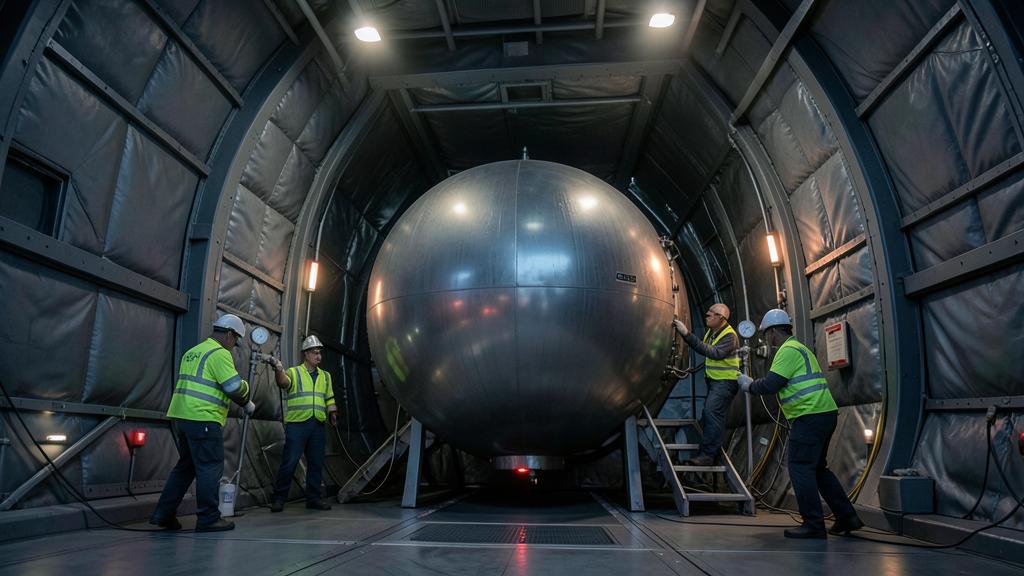
Hydrogen breaks several of them at once. Its flammable range in air runs from roughly 4 to 75 percent by volume, far wider than kerosene vapour. Its minimum ignition energy is very low. It burns with a flame that is difficult to see in daylight. It embrittles many metals over time and permeates through materials that are gas-tight to larger molecules. It is also non-toxic and violently buoyant, which makes an open-air release far less dangerous than an equivalent hydrocarbon spill — a genuine safety advantage that the existing codes have no way to credit.
The practical position is that a hydrogen transport aeroplane will be certificated against special conditions developed for it, and that the content of those special conditions is a live subject rather than a settled one. That is why serious configuration studies read as though every choice were provisional: they are, and the engineering debate around them is followed at forums.fl330.com. What is not provisional is the geometry. Whatever the certification basis eventually says, hydrogen will still be four to twelve times bulkier than kerosene for the same energy, and the tank will still have to be a body of revolution. The airframe is arranged around that fact, or it is not a hydrogen aeroplane.


Leave a Reply
You must be logged in to post a comment.