
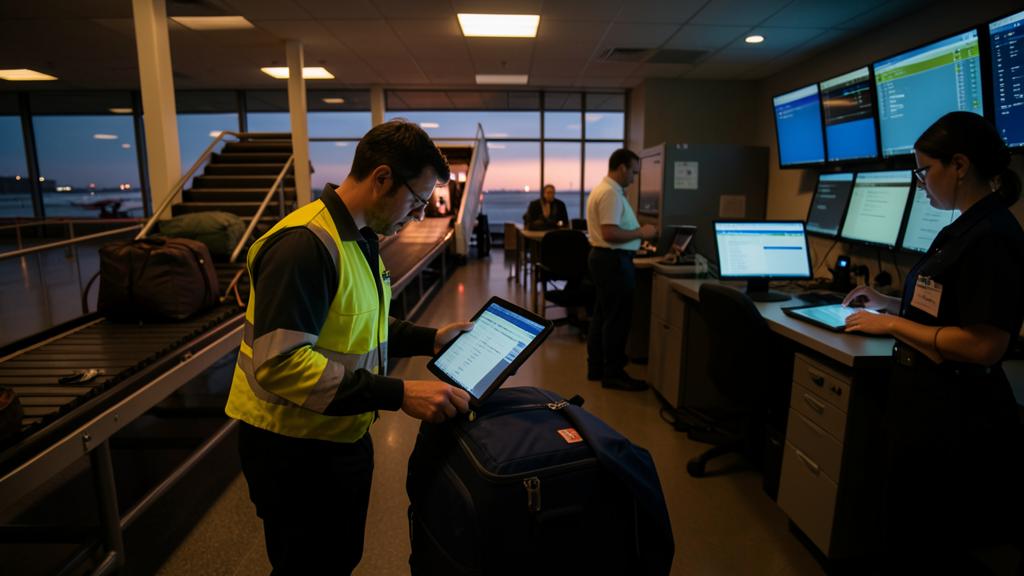
Every originating hold bag on a commercial flight is screened by machines that were unimaginable when the rule was written, and the rule has not gone away. Reconciliation — the requirement that a bag travels only if its owner is on board — looks like a leftover from an era before automated explosive detection. It is not. It defeats a different failure than screening does, it makes the offload physically possible, and the cases where it is set aside are defined narrowly for exactly that reason.
Two controls that look redundant and are not
Screening asks a question about the object: does this bag contain something on a threat list, as recognised by a detection algorithm and, at the next level, by a human reading an image. Reconciliation asks a question about the person: is the individual who checked this bag sitting in the cabin. The two questions have no overlap. A bag can pass screening and fail reconciliation; it can be perfectly reconciled and contain a device.
That is the definition of a layered system, and it is why the arrival of high-performance detection equipment did not delete the older control. Layers are only worth their cost when they fail independently. Screening fails when a device falls outside the detection envelope of the equipment, when it is configured in a way the algorithm was not trained against, or when an image is misread under time pressure. Reconciliation fails for entirely unrelated reasons — a messaging error, a bulk-loaded hold, a late gate change. Neither failure mode predicts the other, which is precisely what makes keeping both worthwhile.
| Control | Question it answers | Defeats | Blind to |
|---|---|---|---|
| Hold baggage screening | What is in the bag? | A device in a checked bag, whoever placed it and whether or not they board | Threats outside the detection envelope; anything introduced after screening |
| Reconciliation | Is the owner on board? | A bag deliberately checked by someone who does not intend to fly | Everything an accompanying passenger is willing to carry; bags with no passenger record |
| Protection of screened baggage | Has the bag been touched since? | Introduction or substitution between screening and loading | The content itself; the identity of the owner |
| Access control and staff screening | Who is near the aircraft? | Insertion by someone with no passenger record at all | An authorised person acting within their access rights |
What a screening machine certifies, and what it does not
Explosive detection systems are approved against a standard, and a standard is a specification of performance against a defined set of threats, at a defined throughput, with a defined false alarm rate. It is not a claim of omniscience. Approval regimes such as the European common evaluation process test equipment against that specification and certify a standard level; European rules have progressively withdrawn approval from equipment built to earlier standards, on deadlines that have themselves been revised more than once, so what is installed at a given airport is as much a question of date as of technology.
Two consequences follow for anyone reasoning about the residual risk. First, detection performance is probabilistic and threat-specific: raising the standard shrinks the set of configurations that pass unnoticed, but it does not empty it, and it is deliberately not published in detail. Second, the architecture is multi-level. Level one is automatic. What the machine cannot clear goes to an image operator, and what the operator cannot clear goes to an alternative technique or a manual search — in some regimes with the passenger present. Each level adds detection and subtracts throughput, which is why the alarm rate at level one is an operational figure as much as a security one.
A control whose performance depends on the threat is worth pairing with a control whose performance does not. Reconciliation does not care what is in the bag. It is threat-agnostic, and that property survives every change in explosive chemistry, every new concealment, and every generation of equipment.
Screening checks if a bag contains a bomb, but it can miss some threats. Reconciliation checks if the passenger who checked the bag is actually on the plane. Together, they cover more risks than either alone.
At Paris Charles de Gaulle, an Airbus A320 is preparing for departure. A passenger checks a bag but misses the flight due to a late gate change. The reconciliation system flags the bag, preventing it from being loaded. Without reconciliation, the bag might have been loaded, posing a security risk.
The failure reconciliation was built for
The requirement exists because of a specific attack: check a device into the hold and do not board. It is the cheapest form of attack against an aircraft, because it requires no willingness to die and no access to the airside. Two of the deadliest bombings in civil aviation, in 1985 and in 1988, both involved — on the findings of the investigations that followed — a bag that travelled without the passenger associated with it, in both cases through an interline transfer. The reconciliation requirement and, later, universal screening of originating hold baggage are the direct regulatory descendants of those investigations.
The limitation is equally specific and worth stating plainly, because it is where reconciliation’s critics have a point: it does nothing against an attacker who boards. The modern threat picture includes exactly that, which is why screening became universal rather than remaining a supplement. But the older attack did not disappear when the newer one appeared. Removing a control because the threat model has grown is only defensible if the original threat has actually gone, and a bag checked by someone who then walks away remains trivially available to anyone who wants it.
The trap. Reconciliation is often described as a check that a passenger has « checked in ». It is not. Check-in is a commercial event that can happen from a phone, days ahead. The security event is boarding — the point at which the passenger is physically established on the aircraft. Any system that reconciles against the check-in record rather than the boarding record has kept the paperwork and thrown away the control.
The second reason, which nobody writes into the security case
Reconciliation has an operational twin that is rarely acknowledged in security terms: you cannot offload a bag you cannot locate. A reconciliation system that records where each bag went — which container, which position, which hold — converts an offload from an unloading operation into a retrieval. Without that record, removing one bag from a bulk-loaded hold means removing all of them.
This is why baggage reconciliation systems, built on standardised baggage messages exchanged between departure control and the sortation system, and reinforced by the industry’s tracking requirements at acquisition, loading, transfer and arrival, are simultaneously a security tool and a punctuality tool. The security case justifies the requirement; the operational case is what keeps the data accurate. A system used only for compliance decays. A system the ramp depends on to find a bag in minutes stays correct, and a correct system is the one that can be trusted at the moment it matters.
The right reflex. When an offload is called, the useful question is not « is the bag on? » but « where is the bag? » — container identifier and position. The first question triggers a search; the second triggers a retrieval. The difference between them, on a narrowbody turnaround, is the difference between a slot kept and a slot lost.
Where the requirement comes from, and how much of it is national
The international layer is ICAO Annex 17, which sets the standards for protecting civil aviation against acts of unlawful interference, including the screening of originating hold baggage and the principle that baggage should not be carried unless its passenger is on board or the baggage has been subjected to specified additional controls. Annex 17 states the objective; it does not run an airport.
Below it, the detail is regional and national. In the European Union the framework regulation on civil aviation security and its implementing acts set out the hold baggage chapter in operational detail, and each Member State then writes a national civil aviation security programme, which each operator and each airport reflects in its own programme. Much of that detail is restricted, which has a practical consequence: an accurate statement of the applicable rule for a given flight comes from the operator’s security programme and the station’s local procedures, not from a general reference.
| Category | Reconciliation | Typical additional treatment |
|---|---|---|
| Originating, accompanied | Required — bag loaded against a boarded passenger | Screened before loading; protected from screening to loading |
| Transfer | Applied against the onward flight’s passenger record | Screened at transfer, or accepted under one-stop security arrangements with recognised States |
| Unaccompanied (rush or re-forwarded) | By definition not reconciled | Identified as unaccompanied and subjected to the additional security controls specified by the applicable programme |
| Passenger separated for reasons beyond their control | Broken involuntarily | Carried only under the derogation conditions of the national programme |
| Crew baggage | Not matched through the passenger boarding record | Screened as hold baggage, under the regime applicable to staff |
The derogations exist because separation is usually innocent
Most broken reconciliations are not attacks. A passenger misses a connection while the bag makes it. Someone is taken ill in the terminal. A passenger is denied boarding, or offloaded for a document problem, after their bag has been accepted. A mishandled bag has to be re-forwarded on a later flight with no passenger attached to it at all. If the rule were absolute, thousands of innocent bags a day would be stranded, and the pressure to work around the rule would become the real risk.
So the regulations provide for unaccompanied baggage rather than prohibiting it. The bag is identified as unaccompanied, it attracts the additional security controls that the applicable programme specifies for that status, and it is authorised for carriage on that basis. The important structural point is that the derogation replaces the control with another control; it does not waive it. Whether the substitute is a specific screening standard, a specific technique, or an authorisation trail is a national matter and, in many States, restricted information.
There is also a category that unsettles the logic: a passenger who boards, and then leaves. Once a person has disembarked after boarding, the reconciliation that authorised the load no longer holds, and the bag has to come off — which is why a passenger walking back up the airbridge produces a disproportionate operational response.
Where reconciliation fails silently
The interesting failures are not refusals. They are the cases where the system reports success and the control did not happen.
| Failure | What it looks like | What catches it |
|---|---|---|
| Reconciled against check-in, not boarding | Every bag matched; a no-show bag still loaded | Audit of the source of the match; boarding-gate data as the trigger |
| Bulk-loaded hold with no position record | The bag is known to be on board and nowhere in particular | Position recording at load; container-level discipline |
| Messaging gap between systems | A bag with no message is handled manually and drops off the list | Exception handling; a manual bag is an event, not routine |
| Late gate change or aircraft change | Bags reconciled against a flight that is no longer this aircraft | Re-issue of the load record; a physical cross-check before departure |
| Post-screening access | Reconciliation and screening both pass; the bag changed afterwards | Protection of screened baggage — a separate requirement entirely |
The common thread is that reconciliation is an information control. Its output is only as good as the link between the boarding record, the baggage message and the physical position of an object in a hold. Every manual workaround — a bag handed over at the aircraft, a tag reprinted, a container swapped between flights — breaks a link that the system then cannot see is broken.
Europe and the United States drew different conclusions
Both regimes screen all originating hold baggage, and both regard the unaccompanied bag as a special case requiring additional treatment. The emphasis differs. After the deployment of universal explosive detection screening in the United States following the 2001 legislation, positive passenger bag match lost its place as a primary domestic control, the argument being that machine detection had superseded it. The European approach kept reconciliation as a standing operational requirement alongside universal screening, and built the industry’s reconciliation and tracking infrastructure around it.
For an operator flying between the two, the practical consequence is not philosophical. It is that the applicable requirement is set by the State whose programme governs the departure, plus the requirements of the operator’s own State, and the two do not always match. This is the sort of thing that is briefed at station level and discussed between ground operations teams rather than deduced from first principles; recruitment and station-procedure threads on forums.fl330.com return to it regularly.
What it changes on the ramp
The reason to understand the two questions separately is that the daily pressure always falls on the same one. Nobody asks for screening to be skipped. People do ask, several times a day, for a bag to travel without its passenger — because the connection is tight, because the passenger will follow on the next flight, because the alternative is a delay. That request is legitimate; it just has a defined route, which is the unaccompanied baggage procedure, and an undefined one, which is loading the bag and hoping.
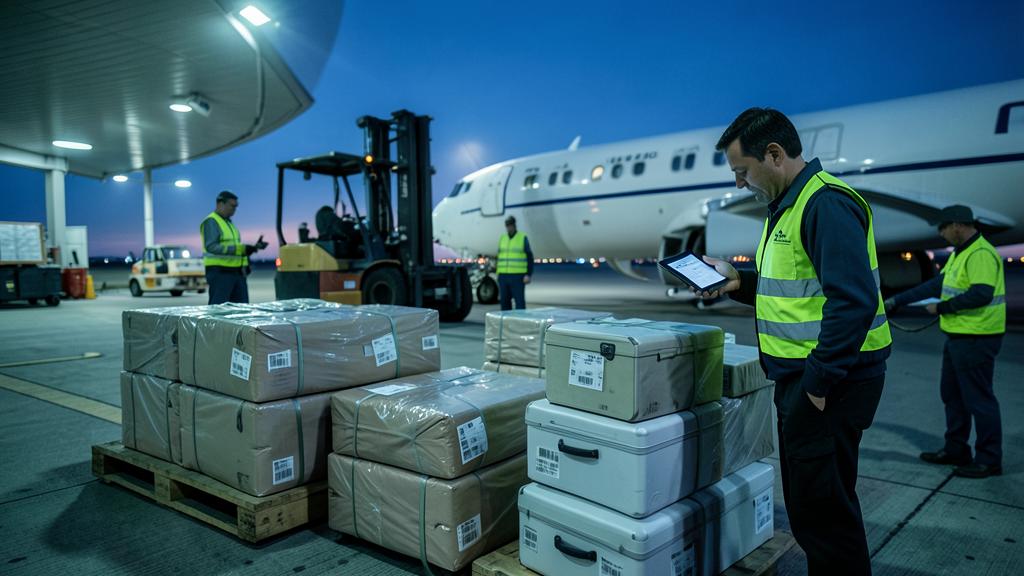
Reconciliation survived automation because it answers a question no machine in the baggage hall is asked. It is not a check on the bag. It is a check on a decision made by a human being who is standing somewhere in the terminal, or is not.


Leave a Reply
You must be logged in to post a comment.