

Moonless night, approach without vertical guidance to a confined airfield. The ground proximity warning sounds, the crew performs the evasion maneuver, and the landing occurs ten minutes later without further incident. No damage, no injuries, no failure. Should a report be written within the week, or a call to the investigation authority before leaving the parking? The answer is not on the airframe nor on the passengers: it is on the margin that remained.
Three boxes, but only two regimes
International law on investigations recognizes only three classes of occurrences: the accident, the serious incident, and the incident. These three words do not describe three levels of damage. They open two distinct legal regimes, and that is where the practical stakes lie.
Two consequences still surprise experienced crews. A serious incident is not a « big incident »: it is an incident whose circumstances indicated a high probability of accident — a probabilistic, not quantitative, definition. And the two regimes do not replace each other: notifying the investigation authority never exempts from the report.
The key difference is not about damage but about how close the event came to disaster. A “serious incident” means the situation was dangerous enough that a small mistake could have caused an accident, even if nothing bad actually happened. Always report if you’re unsure – it’s better to over-report than miss something important.
An A320 on short final at 1,500 feet AGL with a failed autopilot and strong crosswind suddenly loses radio contact. The crew executes a go-around and lands safely 5 minutes later. No damage, no injuries. This is a serious incident because the margin to disaster was extremely small, even though the outcome was good.
The accident is measured, the serious incident is assessed
The accident has a threshold-based definition, and these thresholds are objective. It occurs within a time window: from the moment a person boards with the intention of making a flight until all have disembarked. Within this window, three alternative criteria suffice: one person killed or seriously injured; damage that alters structural integrity, performance, or flight characteristics and would require major repair or replacement; the aircraft missing or totally inaccessible.
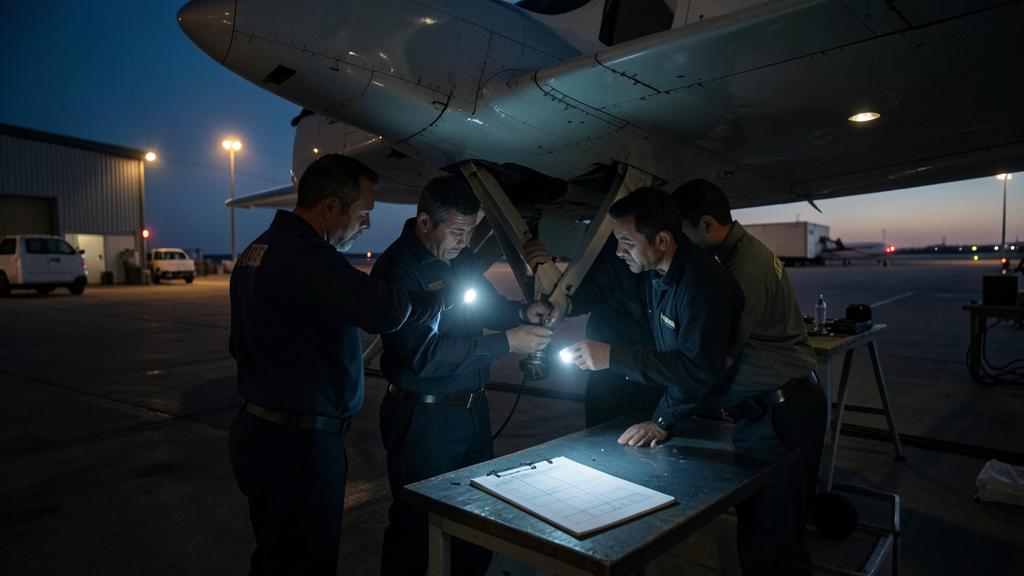
What traps the practitioner is not this triptych, but its exclusions: they remove from the « accident » box a good part of what one would spontaneously put there. The serious injury is also defined by a list, not by an impression.
| Criterion | What tips it | What the regulation excludes |
|---|---|---|
| Blessures | Death, or serious injury: hospitalisation for more than forty-eight hours beginning within seven days; fracture, except of fingers, toes or nose; severe haemorrhage or nerve, muscle or tendon damage; injury to an internal organ; second- or third-degree burns; verified exposure to infectious substances | Natural causes, injuries self-inflicted or inflicted by other persons, stowaways hiding outside the areas normally available |
| Damage to the aircraft | Damage adversely affecting structural strength, performance or flight characteristics, requiring major repair or replacement | Damage limited to the engine, its cowlings and accessories; propellers, wing tips, antennas, probes, tyres, brakes, wheels, fairings, panels, landing gear doors, windscreens; small dents in the skin; hail and bird strike damage |
| Aircraft unavailable | Aircraft missing, or wreckage completely inaccessible | Aircraft merely grounded, or deemed beyond economic repair: neither missing nor inaccessible |
Faced with this threshold mechanism, the serious incident has no threshold. It has a definition — the high probability of accident — and a non-exhaustive list of examples: near-collision with evasion, collision with the ground narrowly avoided, aborted takeoff or attempted landing on an occupied runway, takeoff performance significantly below predictions, fire or smoke, emergency use of oxygen, engine disintegration not classified as an accident, multiple system failures, in-flight incapacitation, fuel requiring an emergency declaration, runway incursion, runway excursion, unintended loss of control, flight outside the approved domain.
An event not on the list may be a serious incident, and an event on the list may not be. The test remains counterfactual.
The same occurrence, three classifications
Nothing better illustrates the mechanism than a family of events followed through its three variants: the trigger is identical, only the margin consumed and the crossing, or not, of an objective threshold change.
| Famille | Circonstances | Classement | What it triggers |
|---|---|---|---|
| Smoke | Brief odour gone after an item of equipment is switched off, flight continued | Incident | Report, analysis by the operator, trend monitoring |
| Smoke | Persistent smoke, flight crew on oxygen, diversion | Incident grave | Notification without delay, preservation, safety investigation |
| Smoke | Confirmed fire, structural damage, crew member seriously injured | Accident | Notification to the States concerned, site protection, investigation |
| Carburant | Reserve used, ATC informed without declaring an emergency | Incident | Report, analysis of the fuel policy |
| Carburant | Fuel emergency declared, landing below final reserve | Incident grave | Notification without delay, flight data frozen, investigation |
| Carburant | Fuel exhaustion flameout, forced landing with damage | Accident | Full regime, wreckage protection |
Read the column of circumstances from top to bottom: the initial event does not change. What changes is the distance to the accident, assessed at the moment of closest approach. A flight landing under the final reserve has consumed all its margin, including that which should have absorbed a go-around — the fact that the go-around did not occur does not restore it.
What the qualification triggers, hour by hour
On the investigation path, the obligation is immediate and does not target a specific position: any person involved with knowledge of the facts — captain, operator, ground organization, air traffic control — alerts the investigation authority without waiting to understand. The State where the event occurred then informs the interested States — registration, operator, design, construction — and, beyond a certain maximum mass threshold, the international organization.
Preservation comes next, and that is where the most elements are lost. The aircraft, its contents, its recordings, and if applicable the wreckage must not be moved or modified without the investigation authority’s agreement, except to render aid, avert danger, or prevent destruction of evidence. Yet the voice loop is continuously rewritten: bringing the aircraft back to base, or leaving a generator running at the parking, erases the conversation that explained everything. The first useful action is not to write, but to cut the power to the recorders.
On the reporting path, the logic is the opposite: a short deadline is granted, from a specific point. The mandatory report is transmitted as soon as possible and no later than seventy-two hours after knowledge of the event — not after the event. The nuance matters for a defect discovered during inspection, or for a deviation revealed by flight data analysis.
This report benefits from a protection regime: the information is used solely for safety, the data is anonymized, and the reporter cannot be penalized solely for the report. The protection falls in two cases: intentional fault, and a manifest, serious, and deliberate breach of an obvious duty of diligence.
The reflex that saves a file: before discussing the classification, freeze. Cut the recorders, immobilize the aircraft, prohibit any non-preservative maintenance, note the time and who was notified. A classification is corrected in cold; a rewritten voice track cannot be reconstructed.
Who classifies, and when
The most common mistake is to believe that the operator classifies. It does not: it assesses, notifies, and reports. The final classification belongs to the investigation authority, which can reclassify in either direction and decides alone whether or not to open an investigation on an ordinary incident. The operator’s assessment is provisional and is made with the information of the moment, never with that of the next day.
The consequence is underutilized: notifying an event that turns out to be only an incident costs nothing — the authority downgrades and the matter is closed. Failing to notify a serious incident causes irreversible damage to the evidence. The asymmetry should be enough to decide doubtful cases.
Two classifications with common vocabulary that do not answer the same question remain. The risk matrix of the management system crosses severity and probability to prioritize internal treatment; the regulatory qualification determines which legal regime applies. An event rated « low » internally may be a serious incident in the investigation sense. Ensure your taxonomy explicitly refers to the regulatory categories, otherwise the rating will serve as qualification.
The pitfalls of cold qualification
The first is the hindsight bias. In hindsight, one qualifies with the outcome in view: nothing happened, so nothing serious. The test requires the opposite — assessing what could have happened from the situation at the critical moment, without knowing how it would end. Frame it this way: « At that moment, what additional failure would have produced an accident? » If the answer is « one, and it was plausible, » it is a serious incident.
The second is the misread exclusion. Damage limited to the engine, its cowlings, and accessories does not constitute damage in the sense of an accident: many stop there. But engine disintegration is among the examples of serious incidents. The exclusion applies to one box, not both.
The third is the injury that is declared later. The hospitalization criterion runs over the following days: a passenger who left under their own power and was hospitalized the day after shifts the occurrence after the fact. The operator who does not follow the medical outcome of a person injured on board discovers their reclassification by a third party.
The classic pitfall: « nothing is broken, so it’s not a serious incident. » The damage criterion belongs only to the definition of the accident. The serious incident is qualified without any damage: near-collision, ground proximity warning followed by evasion, runway excursion recovered. An intact aircraft proves nothing about the margin that remained.
The fourth pitfall is organizational. The on-call chain exists on paper, but the number has never been dialed, the authorized person is on leave, and the crew on a distant layover does not know who to call at three in the morning. A defect reparable in half a day, which otherwise costs the first hours — those where something is still preserved.
What to check in your own documentation
Open the part of the operations manual that deals with the event report and ask it four questions. Is the list of events to be notified the one from the implementing regulation, or a shortened in-house version « to simplify »? Who calls the investigation authority, with what number, tested when? Does the preservation procedure exist at a non-base station, where the aircraft is entrusted to an assistant who knows nothing of these obligations? Does cutting the recorders appear in a checklist usable at the parking?
Two gray areas deserve to be addressed before they arise. The event occurring with a third party — ground assistance, workshop: the obligation follows the persons designated by the text, but the reporting depends on a contract, and a silent contract produces a gap. And the accident time window: a pushback bump, a generator fire, a fall on the boarding bridge often occur outside the period from boarding to disembarking, which removes them from the « accident » box without removing them from the report.
The type of operation does not change the definitions, it changes who reports and through which channel. The three classes of occurrences apply to public transport as well as general aviation, aerial work, or the operation of a light aircraft: a near-collision remains a serious incident on a single-engine aircraft. What varies is the reporting architecture. An operator with a management system collects, analyzes, and transmits internally; a private owner without an organization addresses their report directly to the competent authority, often through a national portal. On the maintenance and design side, the obligation also exists and targets defects that the crew will never see. The practical consequence is always the same: in a chain where several actors are subject to the obligation, each remains responsible for their part, and « the other surely reported » has never counted as a report.
For those preparing for a qualification or a safety management role, the expectation is not the recitation of definitions: it is to know what to do in the first ten minutes, in what order, and why preservation comes before qualification. Practitioner exchanges on the professional FL330 forum revolve around this point, never around the text.
This article presents a mechanism and does not replace any obligation: in case of discrepancy, the applicable texts and your operator’s approved documentation prevail over what is written here.


Leave a Reply
You must be logged in to post a comment.