
Two crews on the same runway, the same crosswind reported: the first aligns the fuselage as soon as the approach is stabilized and holds the into-wind wing down until touchdown, the second keeps the wings level and works the rudder only during the flare. Both land within the touchdown zone. Yet they have not stressed the same components, nor the same margin, and the manual figure does not arbitrate between them either way: it does not say what the structure accepts, it says what was demonstrated on a given day with the wind that was available. What remains is to trace the chain back — lateral equilibrium, ground clearance, gear loads, directional control on the rollout.
The problem is not the wind, it is the gap between heading and track
Closing this gap is the core challenge. On final, the ground track must stay on the centerline while the aircraft flies within an air mass that is itself translating. What matters here is the component perpendicular to the runway, the product of wind speed by the sine of the angle it makes with the axis. To close the gap, there are only two paths: carry it as an angle between heading and track — wings level, nose offset into the wind, no sideslip, this is drift, aerodynamically free — or as a sideslip, fuselage aligned, air arriving from the side, a state that only holds at the cost of a sustained control input.
At small angles, the drift angle equals the ratio of the crosswind component to airspeed. The same wind therefore produces a smaller angle at a higher approach speed. And this same ratio symmetrically governs the sideslip that would have to be sustained to align the fuselage: it is the same angle seen from the other side. Each of the two paths exacts its price, but at a different moment of the flight.
The key is managing the difference between where the plane is pointing (heading) and where it’s actually going (track). You can either let the wind push you sideways (drift) or fight it by banking (sideslip). Both work, but they stress different parts of the plane at different times.
On a Boeing 737 with a 20kt crosswind at 120kt approach speed, the drift angle would be about 10°. If the crew chooses sideslip instead, they’d need to bank roughly 5° into the wind to maintain alignment. The exact numbers vary by aircraft type and configuration.
Sustained sideslip: alignment is paid for in bank
Keeping aligned means fighting the wind directly. Keeping the fuselage aligned with the axis while the air arrives from the left means imposing a sideslip. The fuselage and fin respond to it with a lateral force, to the right in this example, and with a yawing moment that brings the nose back into the wind. Equilibrium therefore requires two opposing actions, hence the term crossed controls: bank into the wind, whose horizontal lift component cancels the lateral force, and opposite rudder, which cancels the weathervaning moment. Added to this is the roll response to sideslip: on a swept wing, the upwind half-span sees a lower effective sweep, produces more lift, and rolls the aircraft toward the downwind side. The into-wind aileron therefore does double duty.
The consequences are often underestimated.
- The bank angle required is not the drift angle: it results from the ratio between the lateral force generated by the sideslip and the lift, and remains modest, on the order of a few degrees in the usual cases. Hence it goes unnoticed until ground clearance becomes limiting.
- On types whose lateral control relies on spoilers, the into-wind aileron deploys the spoilers on the upwind wing: lift lost, drag gained, rate of descent increasing at the very moment one would want to control it.
- For a fixed maximum bank angle, the crosswind component sustainable in full sideslip grows with speed. This is one of the rare places where flying faster buys a real margin, and it is one of the arguments invoked when a reduced flap setting is retained in strong wind.
What limits this technique is almost never control authority: it is geometry. Underwing nacelle, wingtip, flap fairing all end up getting closer to the ground, and crosswind demonstration campaigns specifically ensure that no part of the airframe other than the gear and tires comes into contact. On long-fuselage airframes with low nacelles, full sideslip is not available at high crosswind components: the bank angle required would exceed the geometric envelope well before the rudder stop.
The workload cost is significant: three inputs to sustain — aileron, rudder, pitch attitude — through the layer of atmosphere where wind varies the most, since the component measured at anemometer height is not the one encountered at flare height, and a setting correct higher up becomes excessive lower down. Depending on the control law, the price differs further still, and the type’s flight technique manual states which of the two behaviors to expect: a mechanical linkage lets a compromise be found and eased with rudder trim, whereas a law that coordinates the turn or holds the commanded bank imposes constant cross-talk between the two axes.
The trap. Setting up full sideslip as soon as the approach stabilizes and holding it all the way to the ground. Two effects compound in the last few feet: the crosswind component decreases with height, so the sideslip becomes excessive and the aircraft drifts off the centerline into the wind; and the aileron needed to correct back deploys the spoilers on the upwind wing, which sets up a rate of descent just before touchdown. The result is an off-center contact into the wind, on a single gear leg, with an unwanted vertical speed — and, if corrected on the rudder, a return to drift at the instant of contact.
Decrab: everything happens in the final instants
This reverse technique keeps the wings level and holds drift until the last moment, then aligns the fuselage on the rudder during the flare. It fully preserves ground clearance, consumes no lateral control travel, and lets the aircraft fly without sideslip. Its entire cost is deferred to the transition.
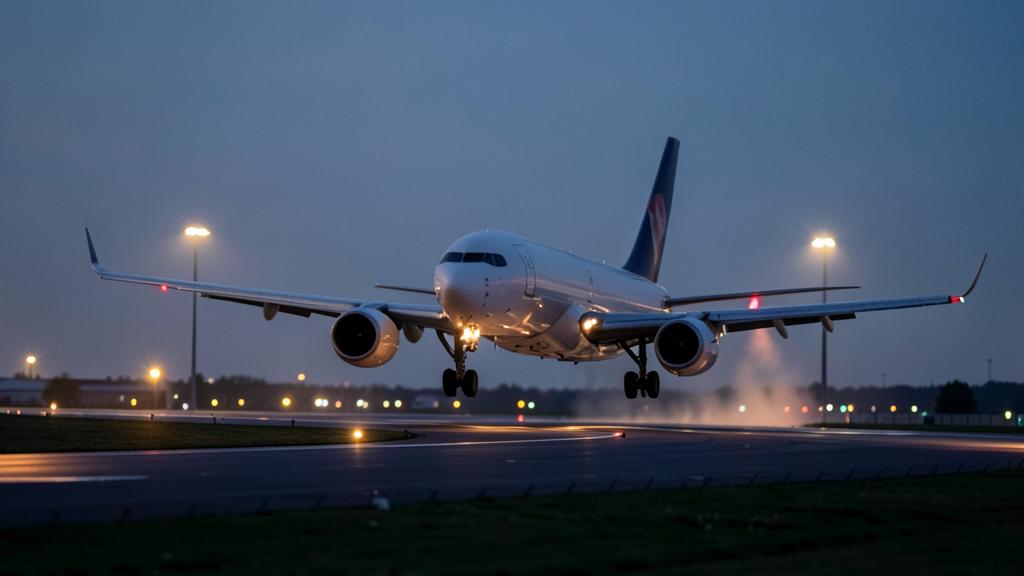
But this transition is not a simple rotation about the yaw axis. Rudder input creates a sideslip, and this sideslip immediately produces, on the swept wing, the roll described above: the aircraft rolls toward the downwind side. In the opposite sense, the lateral force generated by the rudder deflection itself acts above the center of gravity and tends to roll the aircraft toward the upwind side. The net result depends on tail height, sweep and configuration; this is exactly what the type’s manual states, because the crew must know which direction to anticipate on the ailerons rather than discover it in the last few feet.
Timing is critical. As soon as the nose is aligned, the aircraft no longer opposes the translation of the air mass: it resumes drifting downwind, at a rate that is exactly the crosswind component. Aligning too early means drifting off for the entire remaining time; aligning too late means touching down with significant residual drift. The usable window is brief, which is why most documentation prescribes a combination rather than a pure technique: hold the drift until the flare, close the gap on the rudder while simultaneously bringing in a slight into-wind low wing, and accept a residual drift at touchdown when the wind exceeds what the available bank can hold. The two techniques are not two schools but the two ends of a continuum.
| Parameter | Sustained sideslip | Drift held, then decrabbed |
|---|---|---|
| Aerodynamic state on final | Permanent sideslip, crossed controls | Symmetric flight |
| What is aligned with the axis | The fuselage, from stabilization onward | The track; the fuselage at the flare |
| First limiting factor | Ground clearance of nacelles and wingtips | Time available for the transition |
| Lateral control travel consumed | Aileron held, spoilers deployed | Reserve intact until the flare |
| Sensitivity to wind gradient | High: correct setting up high, wrong down low | Low: the drift self-adjusts |
| Critical moment | The entire final approach | The last instants before contact |
| Nature of contact | Upwind gear first, asymmetric vertical load | Symmetric contact, lateral force at the tire |
| On a contaminated runway | Track already on the axis at contact | The tire must reorient the aircraft without grip |
| Reversibility | Corrects progressively | One attempt, then go-around |
What the gear absorbs, and it is not the same thing
The comparison focuses on load nature, not intensity. A touchdown in sideslip is, by construction, made on the upwind gear: the velocity vector is aligned with the plane of the wheels, so there is no side scrubbing, but the entire initial vertical load passes through a single leg. A touchdown in drift, by contrast, presents a wheel plane inclined relative to the velocity vector: the tires immediately develop a lateral force opposing the slip, and this force has two immediate geometric consequences. Applied at the contact patch, well below the center of gravity, it produces a rolling moment; applied at the main gear, aft of the center of gravity, it produces a yawing moment. The aircraft therefore partly aligns itself, but by rolling and yawing — that is, by imposing a correction on both axes at the very instant it ceases to be an aircraft without yet being a ground vehicle.
Now a tire only develops lateral force in proportion to the vertical load it carries: a long, floated touchdown, with weight still largely borne by the wing, offers little capacity to reorient and a strong tendency to slide. On a wet or contaminated runway, the available friction coefficient collapses and the aircraft can continue on its initial track while pointing along the axis. Derotation adds its own case: residual drift still present when the nose gear touches down loads a leg sideways that is designed to steer, not to absorb.
On the airworthiness side, none of this is overlooked: the ground load conditions of the certification specifications include a drifted landing case, with lateral components applied to the tires, and a case of landing on a single main gear. But none of this translates, in crew documentation, into a drift expressed in degrees paired with an admissible load. This is the first grey area: the practitioner has a controllability criterion, not a structural one.
Demonstrated values: what the manual figure really establishes
Certification requires demonstrating a safe crosswind component for takeoff and landing on a dry runway. Published values often exceed the minimum required, not by design but because the test campaign used the wind that was available. The figure is therefore a record: a test crew, on a dry runway, using a given technique, retained control.
Three key points often get overlooked. First, unless expressly stated, the demonstrated value is not inherently limiting. Second, the reference wind definition varies – some use mean wind, others include gusts. Third, derived values (for wet runways, autoland, etc.) are systematically lower than the basic figure.
| Figure | What it establishes | What it says nothing about | Usual status |
|---|---|---|---|
| Component demonstrated in certification | Controllability observed in testing, dry runway | Gear strength, degraded runways | Demonstrated value, not inherently limiting |
| Figure in the approved flight manual | What the manufacturer declares or limits | The gust convention, if not made explicit | A limitation only if designated as such |
| Limit in the operations manual | What the operator authorizes, often modulated | Nothing: it is the binding value | Operational limitation |
| Autoland limit | Certification envelope of the system | What manual flying would allow | System limitation, lower |
The trap. Comparing this figure to a wind that does not share the same definition. The direction in the routine observation message is referenced to true north, while the value passed by air traffic control for takeoff and landing is referenced to magnetic north, like runway orientation: where magnetic variation is large, the calculated component changes depending on the source. The averaging windows also diverge — on the order of ten minutes for the routine message, noticeably less for the control tower value — while the gust lasts only a few seconds. Finally the sensor is neither at flare height, nor necessarily at the aiming threshold.
The right reflex. Settle on three figures before the approach and brief them: the retained crosswind component with its explicit source, the value applicable to the runway condition and the landing mode of the day, and the maximum residual drift one allows oneself at touchdown. Add a go-around criterion observable from outside — a ground point, a lateral deviation — rather than a feeling of energy: in the last few feet, only a decision already framed in binary terms remains workable.
After touchdown, the wind has not stopped
Drift continues even after touchdown. The weathervaning moment that brought the nose back into the wind doesn’t disappear: it must be countered on the rudder, then on nosewheel steering as speed decreases. Into-wind aileron is maintained, to prevent the upwind wing from lifting; with spoilers deployed, it even adds load onto the upwind gear, hence lateral force capacity where it’s useful. Spoilers play an underrated role here: by destroying lift, they transfer weight onto the tires, and it is this load that governs lateral grip. The first seconds after contact are therefore the poorest in guidance capability, at the moment when speed is highest.
Reverse thrust requires special attention. If the aircraft’s axis doesn’t match its track, the reversed jets create a lateral force pushing toward the downwind side. The prescribed handling is explicit and counter-intuitive: reduce reverse toward idle to regain directional control, then reapply it once the axis is recaptured.
| Phase | Limiting factor | Observable sign | Lever |
|---|---|---|---|
| Stabilized final | Ground clearance if sideslipping, workload otherwise | Repeated axis deviations | Speed, flap setting, technique retained |
| Flare and transition | Time available and induced roll | Roll onset with rudder input | Anticipated aileron, drift accepted |
| Touchdown | Vertical load on the tires | Scrubbing, immediate drift off | Firm touchdown in the zone, spoilers |
| High-speed rollout | Lateral grip and reverse thrust | Nose on axis, diverging track | Rudder, reduce reverse |
| Low-speed rollout | Rudder effectiveness collapsing | Soft response on the pedals | Nosewheel steering, differential braking |
What to go and check in your own documentation
The subject varies by aircraft type. Four key points to confirm in your documentation:
- The status of the crosswind figure: is it a demonstrated value or an operational limitation?
- The gust convention used and which wind source is primary (runway sensor, tower value, or onboard computation)
- The maximum bank angle allowed at flare and whether any residual drift is permitted
- Reduced values for different runway conditions and criteria for late go-around
Two grey areas remain. First, there’s no published relationship between residual drift and gear load capacity. Second, demonstrated values don’t account for degraded runways, though operators apply reduced limits as a precaution.
For training, the key isn’t memorizing numbers but understanding the limiting factors. Why the same crosswind component requires different handling based on weight, runway condition, and aircraft geometry. Why a demonstrated value doesn’t automatically protect the gear. Mastering these concepts resolves most crosswind landing challenges.
This article explains mechanisms and their typical effects; it’s not a procedure or approved technique. In case of conflict, official regulations and your aircraft’s documentation take precedence.
Questions fréquentes
Is the manual's crosswind component a limitation?
Not by nature: certification requires demonstrating that a component perpendicular to the runway axis remains safely controllable for takeoff and landing on a dry runway, which produces a demonstrated value rather than a structural limit. It only becomes a limitation if the flight manual designates it as such, or if the operator carries it over that way in the operations manual, the only document binding on the crew. The status of the figure must therefore be checked before reasoning about its value.
Can you touch down with residual drift, and up to what point?
Yes, and most documentation explicitly provides for it, because the available bank angle does not always allow the drift to be cancelled before contact without compromising ground clearance. The acceptable bound is the one stated in the type’s flight technique manual, and it must be set and briefed before the approach. What does not exist is a published correspondence between residual drift and admissible gear load: the criterion given to the crew is one of controllability, not of structure.
Why is the bank angle held in sideslip much smaller than the drift angle?
Because they are not the same quantities. The drift angle is a speed ratio, that of the crosswind component to the aircraft’s airspeed. Bank angle, on the other hand, results from a balance of forces: the horizontal component of lift must cancel the lateral force generated by the sideslip on the fuselage and fin, a force small compared with lift. A few degrees are therefore usually enough, and this is precisely what makes the ground-clearance limit hard to perceive in flight.
Why are crosswind limits for autoland lower?
Because they do not describe the same thing: they are the bounds of the envelope in which the system was certified, with its alignment and decrab laws, not what manual flying would allow. They are therefore genuine system limitations. In practice they require deciding early on the landing mode to be used, since exceeding the value forces a disconnection and a return to manual flying, with the associated criteria.
What should be done if the track diverges during rollout with reverse thrust deployed?
Reduce reverse toward idle before any other action, then re-establish the axis with rudder and nosewheel steering, and only reapply reverse afterward. When the aircraft’s axis does not coincide with its track, the reversed jets indeed produce a lateral component directed toward the downwind side, which adds to grip that is already degraded. Differential braking remains possible but consumes scarce grip and is paid for in stopping distance.
Do the wind reported by air traffic control and the one in the observation message give the same component?
Not necessarily. The direction in the routine observation message is referenced to true north, while the value passed by air traffic control for takeoff and landing is referenced to magnetic north, like runway orientation; where magnetic variation is large, the discrepancy shows up in the calculated component. The averaging windows also differ, and the sensor is not necessarily located at the threshold used. The operations manual designates the priority source, and that is the one to use.


Leave a Reply
You must be logged in to post a comment.