
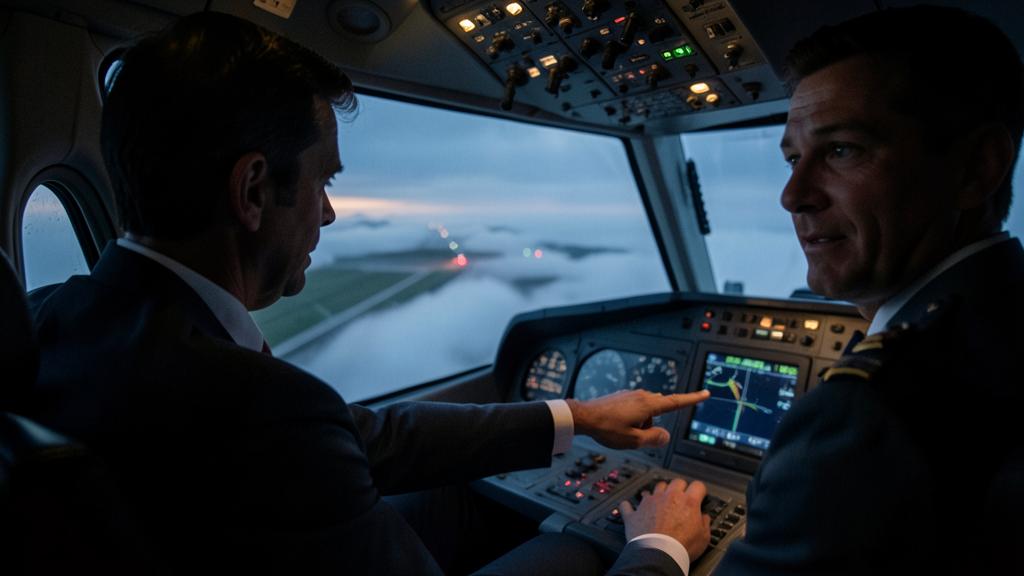
Descending towards a familiar airfield, ATC offers a short cut and the captain accepts it. The first officer, a few hundred hours on type, can see that the profile no longer works: the aircraft would have to lose altitude faster than it is able to. He says “we’re maybe a little high, aren’t we?”. The answer is a distracted “it’ll come down”, and the approach ends in a go-around nobody had anticipated. The knowledge was never lacking. What was lacking lies in the shape of the sentence, in the moment it came out, and in the price that first officer believed he had to pay in order to be more direct.
The authority gradient is a setting, not a defect
The authority gradient is the perceived difference in authority between the two seats. It feeds on experience, on rank, on seniority within the company, on reputation, sometimes on age, and it exists before the first word is spoken. Crew cooperation has never sought to abolish it: a flight deck with no arbiter decides badly, especially when time is short. What doctrine has separated is the authority to decide, which remains indivisible, and the ownership of information, which is not.
The two failure modes are symmetrical and equally documented. Gradient too steep: the less experienced pilot observes, doubts, and says nothing; or speaks so quietly, so hedged with caveats from the outset, that nothing is received. Gradient too flat: nobody settles the matter, the decision drifts towards a soft consensus, and the division of tasks comes apart at the very moment it should be tightening. The useful setting is not in the middle: it leans towards a captain who decides quickly, but who has made contradiction cheap.
And that is where the only variable the junior pilot genuinely controls is to be found. He does not set the slope: it is laid down in the first few minutes by whoever occupies the left seat, through the briefing and above all through the way the very first remark of the day is received. The unit cost of an intervention, on the other hand, is negotiated from both sides. An intervention that accuses no one, that demands no admission and that leaves the decision to the other seat is cheap to issue and cheap to receive. Everything that follows is about driving that cost down.
The authority gradient is like a slope between the captain and first officer. If it’s too steep, the junior pilot won’t speak up. If it’s too flat, no one makes decisions. The best setting is when the captain decides quickly but makes it easy for the other to disagree.
Between the doubt and the words, a trade-off lasting a few seconds
The junior pilot’s silence is rarely fear, and describing it that way makes it impossible to correct. It is a rapid trade-off under uncertainty, which asks four questions in a stable order: am I sure of what I am reading? is this already covered by something I do not yet know about? what does a mistake on my part cost me in front of him? is there still enough time for it to be worth it? Three of those four questions push towards waiting.
The mechanism is structural rather than personal. The confidence one places in one’s own mental model grows with hours on type: the less experienced pilot therefore demands more evidence before believing himself entitled to speak. His certainty threshold is higher, he waits for one more cue, and that cue arrives precisely as the margin closes. The delay is not a character trait, it is the arithmetical consequence of a higher threshold applied to evidence that accumulates slowly.
The operational consequence is clear: a threshold cannot be corrected by exhortation. “Be more assertive” shifts nothing, because the threshold is not a matter of courage but of the anticipated cost of an error. What does shift it is making available a form of speech that does not require certainty: the statement of a fact, which commits only to the reading of an instrument and leaves interpretation entirely open. One can be wrong about a conclusion; one is not wrong when reading an airspeed.
Junior pilots hesitate to speak because they’re not sure if they’re right. The more experienced they get, the faster they speak up. The key is to state facts, not opinions, to lower the risk of being wrong.
An A320 is on final approach to Paris CDG (Runway 27L, 2,600m long, 15°C). The first officer notices they’re 10 knots fast at 5 miles to touchdown. Instead of saying “We’re too fast”, he says “145 knots, 5 miles to run”. This factual statement gives the captain clear data to act on without feeling challenged.
The intervention ladder: you climb on the absence of a reply
The tool is familiar to everyone. What is less familiar is what each rung actually varies. Two quantities rise together: the strength of the assertion, and the obligation placed on the other pilot to reply. The first rung states a fact and demands nothing; the last one takes the decision away. Between the two, each step buys attention with relational capital, and that capital is not unlimited over a rotation.
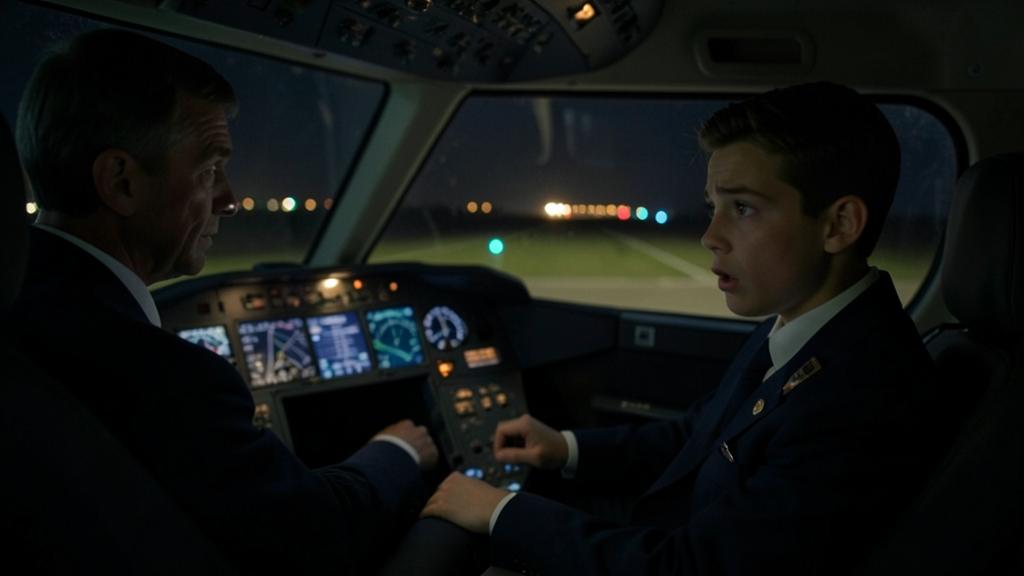
The first rung must be factual and non-attributive. “Ten knots above profile, eight miles to run” judges nobody and does not require being right. The softened version phrased as a question — “don’t you think we’re a bit high?” — sounds more polite and in fact costs more: it asks for an opinion, and therefore forces the other pilot to pronounce on his own work instead of looking at a number. It obtains an opinion, which was predictable, and the opinion closes the conversation.
The rule for climbing fits in one sentence: you climb when the reply is missing, not when it displeases. A reasoned reply — “I know, speed brakes out, we’re back below profile in two miles” — legitimately closes the rung: there is a mental model on the other side, and it is compatible. An “it’ll come down”, a nod of the head or a silence are not replies: they carry no information about what the other pilot has understood. It is that distinction, and not the counting of attempts, that makes the two-call rule work — the rule many operators have written into their manuals.
Skipping a rung costs two things. Proportion first: a named concern about a still minor speed deviation reads as nervousness and devalues subsequent alerts. Credibility next: a high rung reached with no visible history looks like a power play, and that is the moment when the discussion leaves the technical domain.
| Rung | What is stated | What is demanded of the other pilot | What prompts the next rung |
|---|---|---|---|
| 1. Factual statement | A value read off and a distance or a time | Nothing: the information is placed on the table | No visible reaction in the seconds that follow |
| 2. Targeted question | A request for intention on a specific point | A stated intention, however brief | A reply with no content, or no reply at all |
| 3. Named concern | The fact, its consequence, and the word that names the discomfort | Explicit acknowledgement of the reasoning | The flight path does not change and the margin keeps shrinking |
| 4. Firm proposal | A named action with its deadline | A decision, yes or no, right now | An operational criterion is breached or is about to be |
| 5. Taking control | The action one carries out oneself, announced | Nothing: the decision has changed seats | Not applicable: this is the last rung |
The briefing is the only place where the junior pilot sets anything
The approach briefing is often treated as a recitation whose completeness is being assessed. It is in reality a negotiation of triggers, and it is the only moment of the flight when both seats have a low workload and equal standing to talk about what has not yet happened. What is agreed there changes in nature: when the time comes to apply it, the call ceases to be an interpersonal act and becomes the execution of an agreement made by two people.
The captain who opens the door himself — say it early, even if you’re not sure, I’d rather have one remark too many — brings the entry cost down, and does so at no cost to himself. If he does not, the junior pilot has at his disposal a question that produces almost the same effect while challenging nothing: at what point do you want me to call you if we go off profile? It puts nobody on the spot, it asks for an instruction, and is therefore easy to give. And it converts a future confrontation into a prior agreement.
This is exactly the mechanism behind standard calls and stabilisation criteria: they externalise the intervention. The call is no longer “I think that” but “we said that”. The junior pilot therefore has an interest in seeing those thresholds named out loud before the descent, including the ones the manual already imposes and that everyone knows by heart, precisely because having spoken them together changes their status at the moment of invoking them.
The right habit. Three questions at the briefing, in this order, which cost nothing to ask and which pre-set the whole flight: at what point do you want me to call you if we go off profile; what fuel figure triggers a call from me; what, for you, makes this approach unstabilised. The answers are values, not opinions, and an agreed value is called out loud without having to be defended.
Monitoring presupposes having calculated something beforehand
The junior pilot spends most of his time as pilot monitoring, and it is the less well taught of the two roles. Monitoring detects nothing without a prior expectation: a deviation is only perceived relative to a value one was expecting. Whoever has not made his own top-of-descent calculation, his own reading of the wind, his own estimate of the fuel on arrival, detects only the gross deviations — the ones that, by construction, become visible late.
Hence a useful inversion: the work of monitoring is done beforehand, during the quiet phases, by building the comparator. Two or three expected values are enough, written down or simply spoken: altitude at a given waypoint, speed at a given distance, fuel at a given point. They turn passive monitoring, which reads instruments, into active monitoring, which compares. And comparison triggers speech far sooner, because a quantified deviation requires no interpretation in order to be stated.
That leaves the trough, which explains a good share of events on short final. The pilot monitoring reaches maximum workload there — radio, configuration, checklists, calls — at the very moment the pilot flying reaches his own. The two detection capabilities degrade together, precisely where a deviation becomes irrecoverable. The comparator must therefore be ready before entering that trough: once inside it, there is no longer time to build one.
The trap. “Well spotted, never said” comes up constantly in the feedback from pilots in their first line year: everything is perceived, everything is recounted at the debriefing after the doors are open. In an occurrence report, that sequence does not read as a communication problem but as a monitoring failure — the barrier was armed and it did not work. A deviation seen and left unspoken is, for the system, equivalent to a deviation not seen, except that it costs the person who writes the report.
What the other seat actually hears
The symmetrical trap deserves to be named, because it eventually concerns everyone reading these lines: many captains judge their gradient to be flat for the sole reason that nobody contradicts them. Silence is spontaneously read as agreement. It proves only one thing, that contradiction is expensive, and the cost is set by the one who receives, not by the one who speaks.
What makes a remark audible on a busy flight deck comes down to very little: it is short, it contains a number, it names the phase. A long, hypothetical remark with no data is classified as conversation by a saturated operator, and that classification is not ill will: it is workload triage, it operates below the threshold of consciousness and it is perfectly predictable. A sentence built to survive triage begins with the data and ends with the question, never the other way round.
As for the last rung, it appears in most operators’ documentation and remains, in practice, very rarely used. It is only workable if the previous ones have been climbed. Announced cold, with no audible history, it looks like a power play and ends badly, including for the flight. After two statements left without a reply, it becomes the logical continuation of a sequence both pilots have lived through. The safest wording describes the action instead of judging the previous one: you announce what you are taking and what you are doing, you explain afterwards.
What to go and check, and the area that remains grey
In one’s own documentation, three points deserve careful reading rather than reliance on memory. Does the part of the operations manual devoted to crew cooperation explicitly define a rule for climbing, or does it merely recommend self-assertion? Are the mandatory calls listed with their exact wording, or only with their purpose? Do the stabilisation criteria provide for a go-around called by the pilot monitoring, and is that call drafted as an obligation or as a suggestion? That last nuance changes everything: in the first case the call is executed, in the second it is negotiated at the worst possible instant.
The grid of observable behaviours used by the operator deserves the same scrutiny. It states what will actually be graded in the session, and in particular that in a line-oriented scenario, it is not the outcome of the flight that counts but the sequence: was the deviation detected, stated, escalated. A crew that lands correctly after letting three opportunities to speak go by is generally graded lower than a crew that goes around at the end of a clean escalation. Knowing this before the session changes the way it is prepared.
For anyone preparing a type rating or a first line release, one asymmetry has to be accepted: training bears massively on procedures and very little on wording, whereas it is the wording that is missing on the line. It is worked on dry, by preparing sentences in advance for the three or four deviations one will meet most often — descent profile, late configuration, fuel on arrival. Having the sentence ready removes most of the formulation delay, and that is the purpose of the FL330 training workshops devoted to crew cooperation.
One grey area remains, and it would be dishonest to present it as settled: the treatment given to the crew member who escalated correctly in front of a captain who took it badly. Just culture policy answers in theory; in practice, the outcome depends on what the report says, on who reads it and on how the operator separates safety analysis from personnel management. The accounts gathered on the FL330 forum differ markedly from one company to another, and that divergence is in itself information about the real state of the system.
The applicable regulation, the operator’s operations manual and the approved documentation for the type in question prevail over this article, which describes a mechanism and not an enforceable procedure.
Questions fréquentes
How should a doubt be phrased when you are not certain of what you are seeing?
By stating a fact rather than a conclusion. A value read off and a distance require no certainty and accuse nobody, whereas a conclusion obliges you to be right. The uncertainty bears on the interpretation, not on the reading of the instrument: the factual statement is therefore the only form of speech that remains available for as long as the doubt has not been resolved.
At what point should you climb a rung?
On the absence of a reply, not on disagreement. A reasoned reply, however brief, proves that there is a mental model on the other side and legitimately closes the rung. A vague acknowledgement, a nod of the head or a silence carry no information about what the other pilot has understood: they justify climbing, even if the flight path still looks acceptable.
Should the authority gradient be zero?
No, and seeking that degrades the crew as much as an excessively steep gradient. A flight deck with no arbiter lets the decision drift towards a slow consensus, and the division of tasks comes apart when the situation hardens. The useful setting combines a decision taken quickly by a single person with a very low cost of contradiction.
What should you do if the captain offers no framework at the briefing?
Ask a question that calls for an instruction instead of challenging anything: at what point does he want to be called if the aircraft goes off profile, what fuel figure triggers a call, what makes the approach unstabilised in his eyes. The answers are values, and a value agreed by two people is then called out loud without having to be defended.
Is a deviation that was seen but only reported at the debriefing a communication problem?
For the safety system, it is a monitoring failure. The barrier was armed and it did not work, which is operationally equivalent to a deviation that was not detected. The debriefing retains its learning value, but it does not recover the missed function and it puts the writer of the report in an awkward position.
How do you prepare for taking control, which almost nobody has ever practised?
By genuinely climbing the previous rungs, failing which it looks like a power play and ends badly. Announced after two statements left without a reply, it appears as the continuation of a sequence both seats have lived through. The wording describes the control taken and the action carried out; the explanation comes afterwards, never during.


Leave a Reply
You must be logged in to post a comment.