
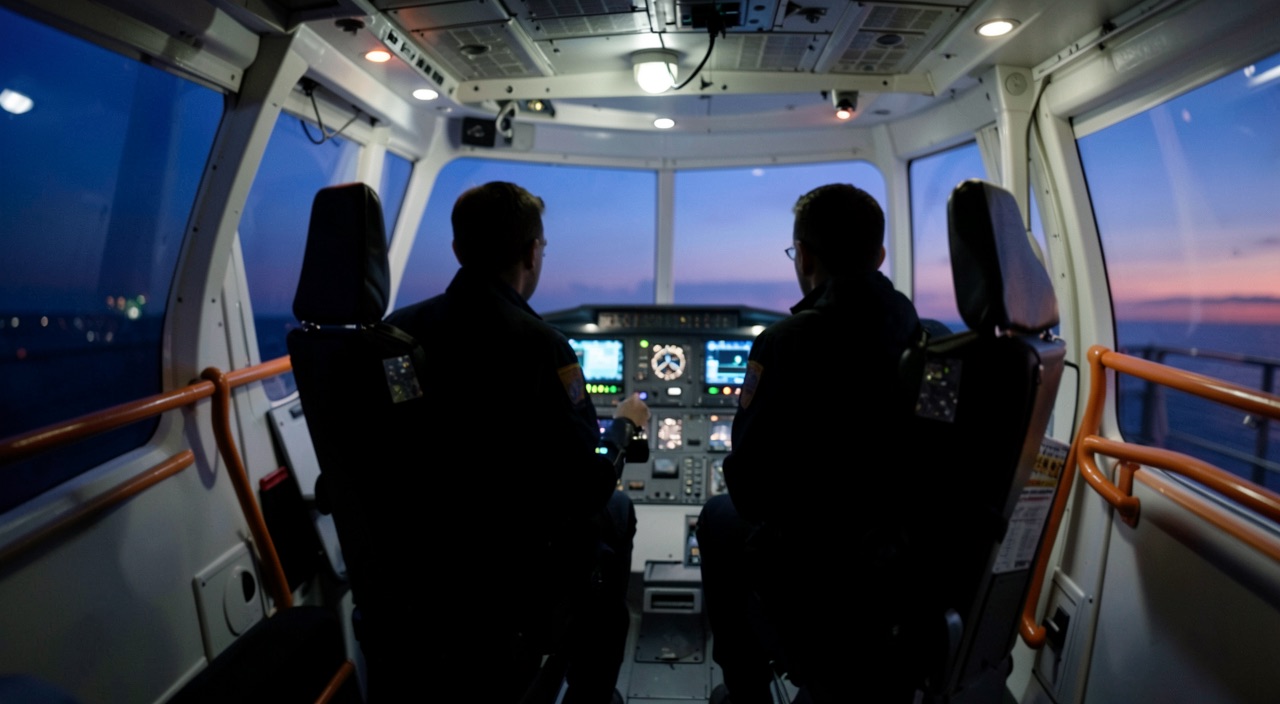
Last minute before intercept: ATC changes the runway. Both pilots lean over the pedestal, one to enter the new approach, the other to check what the first one is entering. For the few tens of seconds that follow, the automation keeps flying a plan that is no longer the right one, and nobody is watching either the altitude or the speed. No mistake has been made: each was performing a useful task. What had come apart was the division of duties, without a word and without a decision — and that is exactly where monitoring is won or lost.
A name whose content changed
Monitoring is a deliberate task. For a long time the role designated the second occupant by what he was not doing: pilot not flying. A definition by negation produces a list of residual tasks — the radio, the gear, the checklists, the paperwork — and leaves monitoring in the state of an intention. But an intention is neither planned, nor trained, nor checked: it fades as soon as the workload rises, at the very moment when it would be useful.
The shift to “pilot monitoring” is not a cosmetic change of vocabulary. It comes from the analysis of events in which the deviation was displayed on an instrument placed right under the eyes of an available pilot, and in which nobody said anything. Renaming the role moved monitoring out of the column of virtues and into the column of assigned tasks, with its callouts, its moments and its criteria — and therefore with a place in the manuals, in training and in checking.
For anyone starting out on the line, the consequence is harsh: you can be a skilful pilot and a poor monitor. The two skills are not trained together, and the second leaves no trace in a logbook.
Monitoring isn’t just paying attention—it’s a job with specific tasks. If you’re not actively checking things like speed, altitude, and automation modes, you’re not monitoring. Good monitoring keeps the flight safe, especially when things change suddenly.
On an Airbus A320, a captain and first officer are flying into Paris Charles de Gaulle. ATC changes the runway from 27L to 26R at the last minute. The first officer enters the new approach while the captain checks the new data. For 20 seconds, neither is watching the flight path, and the autopilot continues on the old approach. The captain later realizes the plane is too high and must correct, causing a slight delay. This shows how a momentary lapse in monitoring can affect the flight.
A single pair of hands on the flight path
One pilot always controls the flight path. The rule that structures everything else fits into one sentence: at any given moment, one pilot and one only holds the flight path. He also holds the means of it — pitch attitude, thrust, configuration and the level of automation in use. Engaging the autopilot does not free that seat: the pilot flying remains accountable for what the machine does in his place, he orders the modes and the targets, and he answers for the resulting flight path.
Everything else belongs to the monitoring pilot, and first of all the right to say what he sees. The transfer of the flight path is a formal act, stated and acknowledged, never a drift: both must be able to say at any moment which one is flying the aircraft. An “I’ll help you” followed by a hand placed on the controls transfers nothing; it creates a zone where each one acts believing that the other is following.
Finally, two things must be separated that the geography of the flight deck readily mixes up: the role and the authority. The captain can be the monitoring pilot without ceasing to be responsible for the decisions; and a captain who is flying and sees a heavy decision coming has every interest in handing over the controls rather than deciding while flying. Making one’s hands available is an act of command, not an admission of weakness.
What monitoring actually contains
Monitoring is a long checklist. The word is misleading because it evokes an attitude — being attentive — whereas it designates a list. The monitoring pilot holds together the flight path and the energy, the configuration, the state of the systems, the state of the automation (which mode is active, which is armed, towards which target), the outside world — clearance, terrain, weather, traffic — and, last of all, the state of the other pilot. These objects are not equal: some come with an alarm that speaks up on its own, the others have only him.
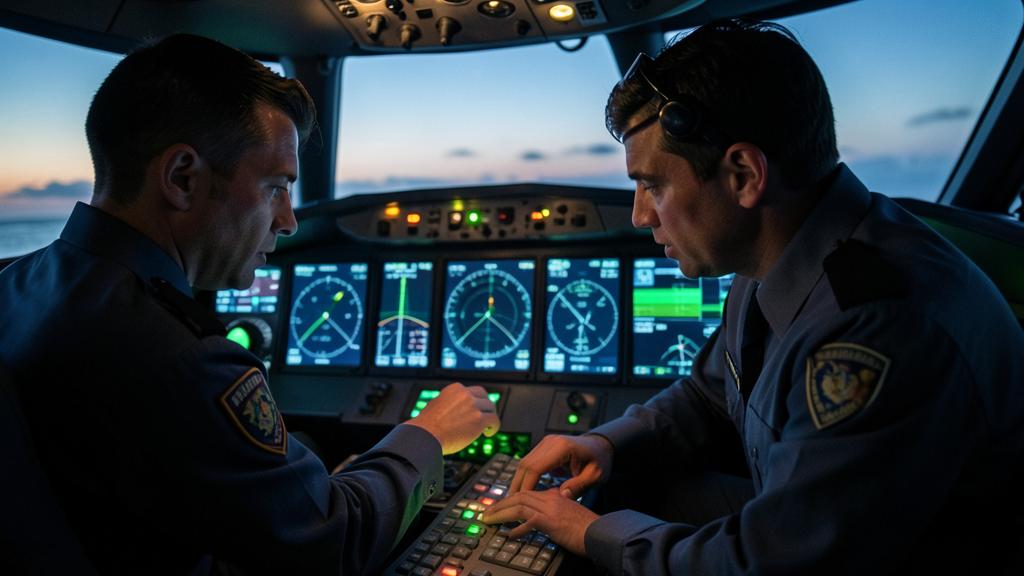
Second property: a deviation is only detected relative to an expectation. Without an announced reference — the plan, the altitudes, the speeds, what will be done if it does not work — the monitoring pilot can only observe values, never divergences. That is what the briefing is for: not reciting a procedure both already know, but setting the markers that will make a deviation visible. A briefing that is talkative about the known and silent about the way out degrades the monitoring of the whole sequence that follows.
Third property: the effort is not constant, and claiming to sustain it at the same level for hours is a costly fiction. The real need peaks at every change of state — mode, altitude capture, configuration, crossing a threshold — and falls back in between. Uniform attention is both wasted in the flat stretches and insufficient at the peaks.
The consequence is operational: heads-down tasks go in the flat stretches, never in the transitions. Recomputing a performance figure or filling in a document is perfectly compatible with flying, provided it is not done at the moment when the machine changes state.
The right reflex. Announce the heads-down period and bound it: “I’m two minutes in the box”, and the other answers that he is taking the aircraft and the radio. An absence that is announced and timed can be managed; a silent absence cannot — the other keeps believing that he is being monitored.
The moments when the division of duties comes apart
Monitoring fails silently. It almost never comes apart through a decision. It slips, and four slips recur with a regularity that makes them predictable, and therefore avoidable.
The migration of hands. The pilot flying enters the data on the pedestal himself because it is quicker. It is, once. But he has just traded holding the flight path for a data entry, and the one whose task it is watches him do it, which means monitors nothing.
The unannounced absence. The monitoring pilot becomes absorbed in a long task — a mass calculation, a message, a call from the cabin — and monitoring stops without anyone having known or decided it.
The double heads-down. Both heads go down at the same time, for the same cause: a late change, a reprogramming, a minor anomaly. This is the case at the start of this article, and the most dangerous one, because it occurs precisely when the flight path is changing.
The silent reversal. A monitoring captain who flies through the other’s hands — “take a bit less speed, no, put it back, reduce again” — has stopped monitoring without noticing it: he is driving. The first officer, reduced to the rank of an actuator, stops anticipating on his side. There are still two pilots on the flight deck and no monitoring pilot at all.
Two phases deserve a separate mention, because the division of duties there is not the one used in flight. During taxi, one has his eyes outside and the other inside, and the operator fixes who speaks and who reads. On take-off, the monitoring pilot has an active and timed role — engine parameters, cross-check of the speeds, callouts — which tolerates no parallel task.
The trap. A late runway change is never handled with two heads down. Until the new approach is entered, checked and accepted, someone is flying the aircraft: automation chosen and announced, targets verified, only one person in the box. If there is not enough time, then it is time that must be bought — a heading, a level-off, a descent declined — and not monitoring.
Intervening: three levels, and the silence that costs
Monitoring requires action. Seeing is of no use if nothing is done with what is seen. Intervention is graduated, and that gradation is the heart of the job: each level has its wording, its expected answer and its criterion for moving to the next.
| Level | What is stated | Expected answer | Move to the next level |
|---|---|---|---|
| Statement of fact | A parameter, its value, its trend, without judgement | A visible correction, or the callout that recovery is under way | Nothing moves and nothing is said within the time limit the crew has set itself |
| Intention and order | What must be done, in the imperative, with no alternative | Execution, announced by the one who carries it out | Order not carried out, or flight path still diverging |
| Taking over the controls | The standard callout, with no negotiation | The other pilot releases and announces that he has released | Not applicable: the level is terminal, the discussion comes after the flight |
The known failure is not one of detection, it is one of escalation: the monitoring pilot sees, states it once, gets no answer and does not insist. The experience gradient contributes to it, but it does not explain everything: one also hesitates because one is not certain, and because moving up a level amounts to asserting that the other is wrong. That is why mandatory callouts are written down: a prescribed callout is not a personal opinion, it does not commit the one who utters it and cannot therefore be received as an accusation.
The second point is temporal. The cost grows with the delay: a deviation stated early is corrected with a single input, the same deviation stated late calls for a manoeuvre, later still a go-around, beyond that a recovery that is undergone rather than chosen.
The right reflex. Establish at the start of the flight that a deviation callout calls for an answer: a visible correction or a spoken word. The absence of an answer then stops being a matter of politeness — it becomes, by explicit convention, the signal to move to the next level.
When a failure occurs, the division of duties is dealt again
Failures change the monitoring role. The first principle is to change nothing about what is holding the aircraft: the flight path stays with the same pilot, the order of priorities does not move. What is redistributed is the rest — and that is where operators’ procedures diverge the most.
| Task | Normal operation | Handling of a failure |
|---|---|---|
| Flight path, energy, configuration | Pilot flying, without sharing | Unchanged: flying is not interrupted for any procedure |
| Level of automation | Ordered by the pilot flying, checked on the display by the monitoring pilot | Often raised on purpose, which increases by as much the need to check what the machine is doing |
| Radiotelephony | Pilot monitoring | Frequently transferred to the pilot flying, to free the monitoring pilot |
| Reading of the procedure | Normal checklists read by the monitoring pilot | Read aloud, each irreversible action pointed at and then acknowledged by both |
| Decision, cabin, company | Captain, whatever his role of the moment | Captain, who may hand over the controls in order to make himself available |
Two points deserve attention. First the verification of the automation: handing more over to the machine reduces the pilot flying’s workload, provided that someone keeps checking what it is doing — the monitoring pilot’s work, including with his nose in a checklist. Then the cross-confirmation of irreversible actions: the hand that shuts down an engine or pulls a handle acts only after designation and acknowledgement. It is the only lock against acting on the wrong system, and it fails as soon as one of the two answers mechanically.
The go-around concentrates every mechanism described here. The pilot flying’s workload climbs all at once and then comes back down; the monitoring pilot’s rises later and higher, because he has to retract the gear, change the configuration, hold the navigation, answer ATC — and monitor a flight path that is, at that very moment, the most fragile of the flight.
Hence the fact that operators fix the order and the wording of configuration requests in this phase: a request launched before the previous one has been acknowledged is paid for more dearly here than elsewhere.
What to go and check in your own documentation
Operators have different rules. The principles look alike from one operator to another; the wordings do not — and it is the wordings that settle things in the moment. A few points are worth looking up in one’s own manual rather than being assumed:
- the exact wording of the transfer of controls, and whether an acknowledgement is required for it to be deemed done;
- what the monitoring pilot is entitled to do on the controls without a prior callout, and what the incapacitation procedure provides for;
- who selects the targets when the pilot flying asks for them, and who checks the resulting display;
- whether a deviation callout calls for a verbal answer, and within what time limit one moves up a level;
- the tasks forbidden in the phase or below the altitude the operator has designated, and the division of duties during taxi;
- in an abnormal situation: who holds the radio, who reads, who executes, who talks to the cabin and to the company.
One grey area remains that documentation does not fill: calibration. Two pilots can know the same list of callouts by heart without agreeing on the threshold from which one calls out, nor on the tone used to do so. That is settled only by saying it, in one sentence, at the first briefing — probably the most profitable sentence of a flight between strangers.
For anyone preparing a type rating, this role is assessed in its own right. The competency framework contains observable behaviours that can only be expressed from the monitoring pilot’s seat: cross-checking, callouts, escalation, management of priorities. A session flown with a faultless flight path and silent monitoring can leave a written remark — and it bears on one half of the job, since the role is exchanged from one sector to the next.
The applicable regulation, the operations manual and the operator’s approved documentation prevail over this article, which sets out only a general mechanism; in the event of divergence, the standard operating procedure of the type and of the operator is authoritative.
Questions fréquentes
Do “pilot monitoring” and “pilot not flying” designate the same person?
The same person, but not the same task. The first name describes a positive role, with callouts, cross-checks and identified moments; the second said only what that pilot was not doing and left monitoring implicit. The change of name served to bring this activity into the manuals, and therefore into training and into checking.
Can the captain be the pilot monitoring?
Yes, and it is frequent: the role describes who is holding the flight path, not who holds the authority. The captain remains responsible for the decisions whatever seat he occupies and whatever role he holds. It may even be judicious, faced with a demanding situation, that he hands over the controls in order to free himself and lead the decision.
What should be done when the pilot flying does not answer a deviation callout?
Move up to the next level rather than repeating the same statement in a more insistent tone. The statement of fact becomes an order in the imperative, then, if the flight path keeps diverging, a taking over of the controls announced without negotiation. The absence of an answer is itself the information: it indicates that the pilot flying has not taken the deviation on board.
Should one call out what the other manifestly already sees?
The callouts prescribed by the operator, yes, without personal arbitration: their value lies precisely in the fact that they do not depend on a judgement about what the other knows. For the rest, a running commentary saturates communication and costs more than it brings. The useful rule is to say what is observable and dated, not what is felt.
Who holds the radio during the handling of a failure?
It depends on the operator, and it is one of the points on which procedures diverge the most. Many manuals transfer the radio to the pilot flying so that the monitoring pilot can devote himself entirely to reading and carrying out the procedure. One must know one’s own operator’s choice before needing it, because it cannot be improvised in flight.
How can one progress in the monitoring role when starting out on the line?
By working on anticipation rather than on reaction speed: preparing the expected values before each change of state makes it possible to detect the deviation instead of merely noting it. Using the standard callouts exactly as they are written removes the need to decide whether to speak. Finally, asking at the end of the flight which deviations the other pilot saw and let pass reveals more than any self-criticism of one’s handling.


Leave a Reply
You must be logged in to post a comment.