

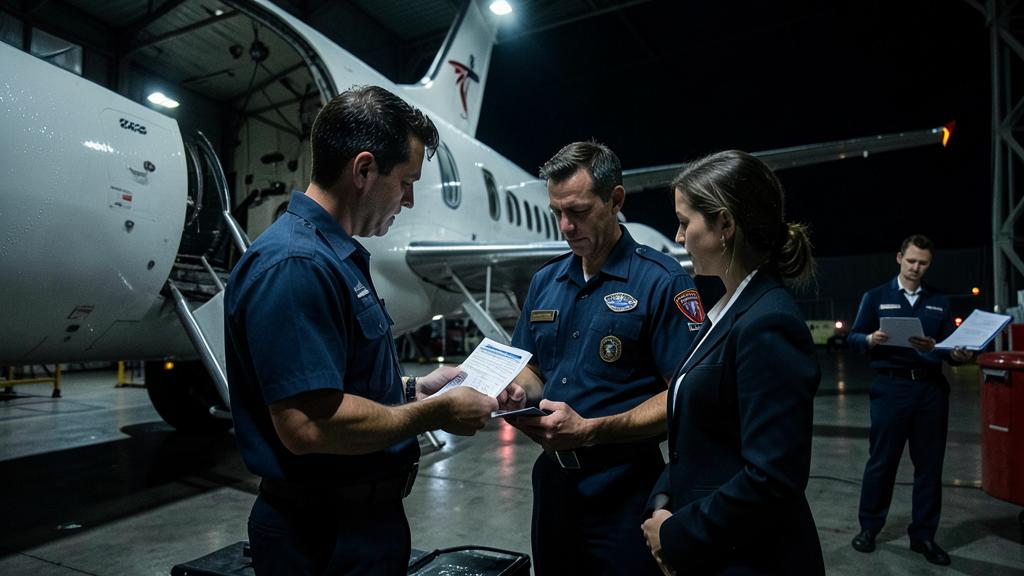
An aircraft with no livery, a flight number sold by one airline, a captain trained and checked by another: at two in the morning, when a technical tolerance expires at an isolated outstation, only one of the two entities can decide that the aircraft departs. Wet leasing transfers capacity, never responsibility for the flight. Restructuring periods, where chartering is used to hold together a schedule the fleet can no longer support, make this boundary both more useful and easier to cross without noticing.
What the contract transfers, and what it never transfers
Market vocabulary is richer than regulatory vocabulary. People speak of dry lease, wet lease, ACMI, the intermediate arrangement known as “damp lease”, or sub-charter; the regulation itself recognises only one switch: does the aircraft come with its crew, or alone? If the flight crew is supplied with the aircraft, the flight is operated under the lessor’s certificate. The aircraft remains listed on the lessor’s operations specifications, its operations manual applies, its minimum equipment list governs, its flight time limitations apply, and its specific approvals — those alone — are available. If the aircraft comes alone, it enters the lessee’s fleet, is listed on the lessee’s own specifications, is brought into the lessee’s continuing airworthiness system and operated under the lessee’s manual; what remains to be settled, when the registration stays foreign, is the transfer of functions between the State of registry and the State of the operator.
The contract can slice up economics, not the certificate. Between the two, the contract can slice up the economics as finely as it likes: guaranteed block hours, positioning flights, crew accommodation, fuel rebilling, punctuality penalties, replacement aircraft, break clauses. It cannot slice up the certificate. There is one operator per flight, only one, and it is the one whose documentation applies on board. Everything else — the brand sold, the livery worn, the uniform, the flight number, the slot used — is commercial dressing and shifts nothing.
| Element | Dry lease | Flight crew only, so-called “damp” | Full crew, so-called “wet” or ACMI |
|---|---|---|---|
| Aircraft | Lessor | Lessor | Lessor |
| Flight crew | Lessee | Lessor | Lessor |
| Cabin crew | Lessee | Employed by the lessee, operated under the lessor’s system | Lessor |
| Continuing airworthiness | Lessee | Lessor | Lessor |
| Aircraft insurance | As allocated by contract | Lessor | Lessor |
| Certificate under which the flight is operated | Lessee | Lessor | Lessor |
| Manual, minimum equipment list, flight time | Lessee | Lessor | Lessor |
| Listing on operations specifications | With the lessee | With the lessor | With the lessor |
| Prior authority approval | Depending on registration and origin | Yes | Yes |
Wet leasing means one airline provides the plane and crew, but another sells the tickets. The first one makes all operational decisions, while the second handles passengers. The contract can divide costs and schedules, but never who’s in charge of safety.
Airline A leases an Airbus A320 from Airline B for a summer route. On a hot day at a short runway (1,800m at 35°C), Airline B’s captain refuses to take off because the performance charts say it’s unsafe. Airline A can’t override this – even if they lose money on the delay. The operational decision stays with the lessor.
Operational control comes down to four decisions
Operational control is about four key decisions. The regulatory formula — exercising authority over the initiation, continuation, diversion and termination of a flight — stays abstract until it is translated into dated, signed acts. Those four verbs take concrete shape in a series of very tangible items: accepting the aircraft on the basis of the technical log and open deferrals, the flight plan and the fuel policy behind it, the mass and balance sheet, checking crew fitness against flight and duty time limitations and rest requirements, the decision to de-ice or to wait, the choice to carry forward a defect under the minimum equipment list, accepting a degraded alternate aerodrome. Each of these acts comes out of the system of one identified operator, with its own forms, thresholds and named delegations. In a wet lease, that system is the lessor’s, from the first act to the last.
Commercial decisions stay with the lessee. What falls to the lessee is not trivial for all that, but it is of a different nature: scheduling, selling, deciding commercially to cancel or postpone, rerouting passengers, arbitrating between two rotations when the day goes wrong, honouring punctuality commitments. The classic mistake is to believe that “cancelling” is a single decision. A commercial cancellation and an operational refusal to depart are two distinct acts, taken by two distinct entities, and either one ends the flight. What can never be shared is the instruction given to the crew.
A single channel to the crew, and it runs through the lessor. A direct call from a station coordinator or a schedule manager to the flight deck looks efficient and never is: it puts the crew in front of a request from an organisation that has no authority over them, and blurs the trail of who decided what. Routing every request through the lessor’s operations control centre, with acknowledgement of receipt, costs a few minutes and saves the analysis that will follow an event.
The boundary, item by item
Written out line by line, the split becomes a list. Written out line by line, the split stops being a matter of principle and becomes a list of documents to produce, each tied to a specific organisation.
| Item | Lessor, operator of the flight | Lessee, contracting carrier |
|---|---|---|
| Documentation applicable on board | Its own, in full | No effect on board |
| Minimum equipment list | Its own | Cannot extend or restrict it |
| Flight, duty and rest time | Its approved scheme | Must build its schedule around it |
| Crew training and checks | With the lessor, including for seconded personnel | Verifies that records exist and are kept up to date |
| Specific approvals | Those it holds, and only those | Its own do not extend to the leased aircraft |
| Security programme | Its own | Checks compatibility at the stations it opens |
| Occurrence reports | Collects and notifies | Only accesses them if the agreement provides for it |
| Ground handling | Procedures applied to the aircraft | Contracts and providers, most often |
| Passenger information | Provides the exact identity of the operator | Communicates it at booking and at every change |
| Compensation and care | Not its responsibility | Its responsibility |
Three lines regularly come as a surprise. The first is occurrence reports: they are collected and notified by the certificate holder, that is, the lessor. Without a sharing clause, the lessee finds out about incidents at best through its own station staff, and its own safety reviews show a gap exactly the size of the chartered fleet. The second is ground handling, where the contracts belong to the lessee but the procedures applied at the foot of the aircraft — fuelling, de-icing, loading, push-back — remain the lessor’s: a handling manual and a commercial contract can perfectly well set different thresholds for the same operation, and it is the ramp agent who discovers the discrepancy. The third is the security programme, which likewise follows the certificate and was not written for the stations the lessee has just opened.
An operator does not lend out its approvals. Low-visibility approach, extended diversion time operations, dangerous goods carriage, performance-based navigation: these authorisations belong to the certificate under which the flight is operated, never to the carrier selling the ticket. Scheduling a winter base known for its fog, or a sector that only exists with extended diversion time, on an aircraft leased from an operator that does not hold the matching approval, produces an unsellable schedule from the first degraded day onward — and the gap shows up in operations, not in the contract.
Two notions of “carrier” that do not overlap
The same word covers two realities. On the safety side, the one who operates is the certificate holder: it is the one the authority oversees, the one accountable for a deviation, the one whose name appears on the operations specifications covering the aircraft. On the passenger rights side, the notion lies elsewhere: the operating carrier is the one that took the decision to perform the flight and to set its routing, assuming the relationship with passengers. On this ground, European case law has excluded the wet lessor: supplying the aircraft and crew is not enough to take on that status if one decided neither the flight nor its route. In other words, in a standard charter, the certificate sits on one side and the compensation liability on the other.
Three figures exist in the relationship. A third figure is added, purely contractual: the carrier the passenger contracted with, who is not always the one that schedules, particularly behind a codeshare. Hence the obligation to inform the passenger of the identity of whoever actually operates the flight, at booking and then at every change, including when the substitution happens the evening before. The practical consequences are immediate: a complaints department that answers “that’s not our aircraft” is wrong, and an operations control centre that thinks it can instruct the crew because “it’s our flight” is equally wrong. The first confuses safety with contract, the second does exactly the opposite.
What the authority actually examines
Approval is prior, named and time-bound. Approval of a wet lease is prior, named and time-bound. Named means it targets a designated operator and designated registrations, not a seat capacity. Time-bound means it is renewed, and renewal is an occasion for re-examination. The review always covers the same points: the validity and scope of the lessor’s certificate, in particular how well its operations specifications match the intended network; equivalence of safety standards where the lessor is from a third country, together with justification of the need — seasonal capacity, an exceptional requirement, an operational difficulty — and a limited duration; insurance cover on both sides; the written allocation of responsibilities; and finally, the point that applicants handle worst, how the lessee integrates this activity into its own management system.
Oversight obligation never disappears. Because leasing does not make the lessee’s oversight obligation disappear: it changes its nature. An operator remains responsible for activities it entrusts to a third party. It must describe in its system how it selects this supplier, how it monitors it, how often it audits it, which indicators it watches and what it does when they deteriorate. What fades away is direct technical control; what appears is supplier oversight, markedly harder to sustain because it bears on an organisation one does not run and on which one is commercially dependent.
Attach an interface matrix, and a precedence rule. Alongside the agreement, a single page listing item by item who decides, who executes and who informs is worth more than thirty pages of clauses. It should carry two entries systematically forgotten: the name and number of a contactable manager on each side at any hour, with their written delegation; and the rule that applies when the two sets of documentation diverge — that of the certificate holder under which the flight is operated prevails, with no improvised arbitration at three in the morning by people who have neither the text nor the authority to decide.
Mixed crews and substitution, the two moving parts
Damp lease is just wet lease with mixed crews. The arrangement the market calls “damp”, where the aircraft and flight crew come from the lessor while cabin crew is supplied by the lessee, has no regulatory existence of its own: it is a wet lease in which part of the personnel is seconded. The consequence is simple and demanding: everyone on board operates under a single set of documentation, the lessor’s. The lessee’s “own” cabin crew must therefore be trained, checked, familiarised, scheduled and monitored under the lessor’s system, whatever their legal employer. The points that make these arrangements fail are always the same: variant-differences training, the location and model of safety equipment, evacuation commands and the common language on board, crew coordination across two procedural cultures, and record keeping — who holds the records, who updates them, who produces them for an inspector.
Substitution reopens the approval question. The other moving part is substitution. The approval names an operator and registrations; it covers neither an aircraft swap decided the same evening, nor a sub-charter from the lessor to a third operator. During restructuring, these movements accelerate: an aircraft is repossessed by its financial lessor, a registration drops off a certificate, a backup operator appears within hours to save a rotation. Each substitution reopens the approval question, and the authority’s timetable is not that of the operations floor. The harshest scenario must also be considered: suspension of the lessor’s certificate mid-contract. No force majeure clause restores a certificate, and the programme stops that same day.
Silent substitution is the most common trap. A struggling lessor that in turn hands the rotation to another operator, a registration swapped because of a maintenance delay, a replacement aircraft of a neighbouring type: in all three cases the flight is no longer the one the authority approved, and the lessee often finds out afterwards, sometimes from the invoice. Require prior written notification for any change of operator or registration, and treat its absence as grounds to refuse the flight, not as a commercial matter to settle later.
What to check in your own file before the season
Five checks avoid most bad surprises. Five checks carried out before the season opens, against documents rather than declarations, avoid most of the bad surprises.
- Your operations specifications and the lessor’s, registration by registration: which ones are listed, which are not, and since when.
- The list of the lessor’s approvals, checked line by line against the network already sold: operating minima at winter aerodromes, diversion time on the longest sector, planned approach procedures, dangerous goods if you sell cargo hold capacity.
- The clause on sharing occurrence reports and flight data, without which your safety reviews will cover a truncated fleet.
- The documentary precedence rule, and the name of the person who applies it at night, on each side.
- The exit scenario: what happens to seconded personnel, the aircraft and passengers if the lessor’s certificate is suspended or the agreement is terminated mid-programme.
One grey area remains that nobody closes off in writing: the boundary between legitimate commercial pressure and operational instruction. A lessee has the right to say that a delay is costing it dearly; it does not have the right to suggest a fuel quantity, a deferral to carry forward, or an alternate aerodrome. This boundary is not drawn on a list, it is checked in the trail of communications: who spoke to the crew, at what time, and about what. It is also the first thing examined when an event occurs on a chartered flight, even before the contract is reopened.
For anyone preparing a type rating or reconstructing a professional logbook, the consequence is very concrete: time flown “for” one airline but under another’s certificate is credited to the real operator, and that is where the training and check records live, even after the contract ends. Questions of experience reconstruction are readily discussed on the FL330 forums, and the compliance and supplier-audit side is covered on the training pages.
This article describes a mechanism and does not replace any official source. The applicable regulation, the lease agreement approved by the competent authority, the operations specifications in force and the approved documentation of the operator under whose certificate the flight is operated prevail over what is written here.
Questions fréquentes
In a wet lease, who answers to the authority in the event of a deviation?
The holder of the certificate under which the flight is operated, that is, the lessor. Its operations manual, its minimum equipment list and its flight time scheme apply, and it is the one the authority oversees. That does not let the lessee off the hook: it remains responsible for selecting and monitoring that supplier under its own management system, and must be able to show evidence of it.
Can the lessee fly the leased aircraft under its own specific approvals?
No. Low-visibility approach, extended diversion time, performance-based navigation and dangerous goods approvals are attached to the certificate under which the flight is operated. The lessor’s approvals must therefore be checked against the intended network before selling seats, not after the first foggy day.
Who owes compensation if a wet-leased charter flight is cancelled?
Compensation and care are owed by the operating carrier within the meaning of passenger rights, that is, whoever decided to perform the flight and set its routing: in practice, the lessee. A lessor that merely supplies the aircraft and crew does not take on that status. The financial split agreed between the two is a matter of contract and cannot be invoked against the passenger.
Which system governs cabin crew supplied by the lessee?
The lessor’s, under whose certificate the flight is operated. Training, familiarisation, checks, scheduling and records follow that system, whatever the legal employer. A mixed-crew arrangement that lets two sets of procedures coexist on board, particularly on safety equipment and evacuation commands, does not pass the authority’s review.
What happens if the lessor changes aircraft or sub-charters to a third party?
The approval targets a designated operator and designated registrations: a substitution falls outside the approved scope. It calls for prior written notification and, depending on the case, an amendment to the approval or a new application. A flight operated outside that scope exposes both parties, including on the ground of insurance and the information owed to the passenger.
Which documentation prevails when the lessor's and the lessee's diverge?
That of the holder of the certificate under which the flight is operated, so the lessor’s in a wet lease. The rule deserves to be spelled out in black and white in the agreement, with the name of the person empowered to decide on each side. Otherwise the call gets made at night, out at the station, by people who have neither the text nor the delegation.


Leave a Reply
You must be logged in to post a comment.