

The first question decides everything that follows. “Why didn’t you go around?” asks for a justification: the person will defend a decision, and defending a decision means reconstructing it neatly, after the fact, with reasons they may not have had at the time. “What did you see at that moment?” asks for a description: it yields the cues available to them, what they concluded from them, what they believed to be true. The second kind of material can be corrected; the first is worthless. A post-event interview is an instrument, and the order of its operations matters as much as its content.
What the Interview Must Produce, and What It Must Never Seek
A post-event interview does not supply objective facts. The parameters, the timings, the configurations, the communications are already somewhere: in the flight recordings, in the exchanges with control, in the maintenance records. Going to fetch them from someone’s memory means using the worst instrument available for a measurement the machine performs better — and risking that an approximate figure gets frozen into the file and, three re-readings later, becomes a fact.
What only the interviewee holds is of a different nature: the picture they had of the situation. Which cues were in their field, which of them they actually perceived, what they concluded from them, which options seemed open to them, which one seemed most costly, what they expected from the other seat, what they took for granted that wasn’t so. None of this can be inferred from a trace. Yet it is exactly this material that explains how an action absurd on paper was, in the world as it presented itself at that moment, the reasonable one.
Everything else follows from this purpose, including the very first sentence spoken. If the goal is to understand how a decision became reasonable for the person who made it, then hunting for fault is not merely beside the point: it is counterproductive. The first thing a person who feels evaluated protects is their version of events. And a protected version is a construction, not a memory.
The interview isn’t about facts—those are already recorded. It’s about what the crew saw, thought, and decided in the moment. If you ask “why,” they’ll defend themselves. If you ask “what,” they’ll tell you the truth.
During a landing on a contaminated runway, the crew might say, “We saw the skid marks but didn’t realize how slippery it was.” The data shows the runway was contaminated, but the crew’s perception—that it wasn’t that bad—explains why they didn’t go around.
Hindsight Bias Contaminates the Questions Before It Reaches the Person
Whoever conducts the interview knows the outcome. That knowledge cannot be set aside by an act of will: it silently reorganises the reading of the sequence. The cues that pointed to the outcome become salient, the others fade; what was experienced as a string of ordinary forks in the road takes on the shape of a slope; the improbable becomes predictable. The phenomenon is robust, it resists being known about, and it infiltrates the vocabulary of the questions first.
“Given that the runway was already contaminated” assumes the information was available, legible and up to date at the relevant moment. “Despite the alert” assumes that one alert among others was received as a signal, rather than as part of the background noise of a busy phase. Each of these premises may well be true; none of them should be planted by the question itself. A simple test catches them: would the question still make sense if you didn’t know how it all ended? If it loses its meaning, it is contaminated.
The preparatory work therefore consists in establishing, before the interview, what was objectively available — messages broadcast, alerts triggered, the sequence of configurations — and never confusing that register with what was perceived. Available and perceived are two distinct sets, and the gap between them is precisely the subject of the interview. That gap is not a failure to be documented: it is a property of any activity conducted under constraints of time and attention.
The trap: opening the trace in front of the person. Laying the flight data on the table from the start seems honest and saves time. It is an irreversible loss. As soon as a person has seen the curve, their memory aligns with it and never comes back: you get a commentary on the trace, which any analyst is capable of producing, and you have destroyed the one piece of information they held. Data is shown at the end of the interview, never before.
Four Phases, and the Order Is Not a Matter of Style
An episodic memory is not delivered on demand, piece by piece: it arrives in associative blocks, in the order in which it was encoded, and every interruption costs a block the rest of the interview will not give back. Closed questions, by contrast, produce short and reliable answers but open nothing. Asked too early, they set up a question-and-answer regime the interview never escapes: the person waits for the next question instead of unspooling their account.
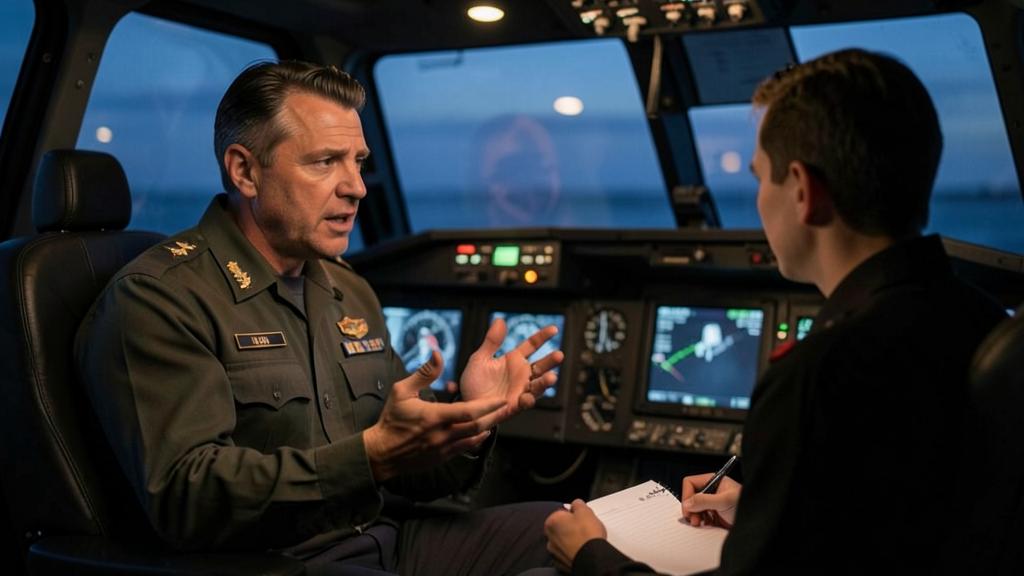
The first phase is the framing. It takes a few sentences and it carries a contract: why this interview is taking place, who will read what comes out of it, what happens to the notes, what happens if a third party requests disclosure, and the fact that the person may ask for a break or to stop. This contract is not a courtesy — it is what determines whether you get a description or a defence. It must be stated, not implied, and it is better for it to be short and true than long and cautious.
The second phase is the free narrative, opened by a single instruction: recount the flight from a point clearly before the event — reviewing the paperwork, the day before, the briefing — with everything that comes to mind, including what seems unrelated. Then be silent. This silence is the technically difficult part of the craft, because it lasts, and because it is uncomfortable for both sides.
The third phase is expansion: the segments are taken up in the order the person gave them, one by one, asking each time what could be seen, what could be heard, what was being discussed, what was expected. The fourth phase combines clarification and playback: closed questions, comparison against the data, then a summary spoken aloud for the person to correct. What they correct at that point is often the most interesting part of the interview.
| Phase | What is sought | Who speaks | The error that ruins it |
|---|---|---|---|
| Framing | The purpose, the recipients, the fate of the notes, the freedom to stop | The interviewer, briefly | Getting into the facts without having said what they will be used for |
| Free narrative | The chronology as it is remembered, gaps included | The person, alone, without interruption | Prompting, rephrasing, or filling the silences |
| Expansion | The content of each segment: cues, options, workload, expectations | The person, guided segment by segment | Imposing one’s own chronology rather than theirs |
| Clarification | Resolving ambiguities, placing events, comparing against the data | The interviewer, short answers | Asking these closed questions from the start |
| Restitution | Checking understanding, announcing what comes next | Summary given, then corrected by the person | Leaving without saying what becomes of the document |
Reconstructing a Chronology Without Ever Supplying It
The spontaneous account has gaps, and these gaps are normal: attention does not record continuously. The temptation is to fill them by supplying the time, the parameter, the sequence — “at that point you were at five hundred feet, do you remember?”. That sentence fills the blank with the investigator’s own memory, and the file will subsequently carry a chronology that looks like testimony when it is actually dictation.
The method consists in bringing missing segments back up through their edges. Material anchors are offered — a radio call, an alert, a configuration change, an action by the other seat — and the person is asked to place the anchor themselves, then what came just before it. Working backwards works better than working forwards, because it breaks the already-reconstructed narrative chain. Three other levers help: running through the sequence in reverse order, changing perspective — what the other seat saw, what a given piece of equipment displayed — and starting again from an irrelevant sensory detail, which serves as a trigger for an entire block.
A gap that does not come back up must remain a gap in the report, written down as such. A missing memory is information; a memory filled in by deduction is a contamination that no later re-reading will be able to distinguish from the rest. The same goes for figures: if the person says “it was coming down fast”, you note “it was coming down fast”, not a vertical speed.
The right reflex: note the question next to the answer. An answer is only as good as the question that produced it, and the same sentence does not carry the same status depending on whether it came spontaneously or after a prompt. Recording both, using the exact wording employed, allows the next analyst to spot what was suggested — and allows you to read yourself back honestly six months later.
Wordings That Close Things Down, and What They Cost
A handful of question families are enough to ruin an interview, and they share the trait of already containing part of the answer. The “why” question calls for a justification; the premise-laden question plants a cause; the double question makes the answer unusable; the requalifying rephrase substitutes the investigator’s technical vocabulary for the person’s own, often more precise, wording; the evaluative question — comparing to what another crew would have done — turns the interview into a judgment in a single sentence.
| Wording that closes down | What it produces | Wording that opens up |
|---|---|---|
| “Why didn’t you go around?” | A justification built after the fact, aligned with an outcome the person now knows | “At that moment, what seemed most likely to you?” |
| “You were tired, weren’t you?” | A compliant acknowledgment, and a cause planted by the investigator themselves | “Tell me about your day, from when you woke up.” |
| “You saw the alert and you carried on?” | A single answer to two questions, impossible to attribute to either one | Two separate questions, the second asked after the answer to the first |
| “So you were below the glide path.” | The person adopts the investigator’s vocabulary and abandons their own, more precise one | “You say it was coming down fast: fast compared to what?” |
| “Would another crew have done the same thing?” | A judgment requested, and the shutting down of anything that might resemble an admission | “What made that option seem obvious at that moment?” |
| “Alright, let’s move on.” after a silence | The interruption of a memory in progress, which will not resurface in this interview | Saying nothing, holding the silence, and letting the next sentence come |
The ranking of question types by what they yield holds from one interview to the next, and it is counter-intuitive. The closed question is reliable but poor. The free narrative is rich and faithful, but full of gaps. The targeted open question, asked about a segment the person has already mentioned, generally offers the best return of the four. The premise-laden question, meanwhile, produces volume without value: the report looks well-fed, and mostly documents the assumptions of whoever conducted the interview.
When the Account and the Data Diverge
Sometimes an account flatly contradicts the recording: a described manoeuvre that does not appear, an alert not mentioned even though it triggered, a reversed order of actions. Treating this divergence as a lie is the costliest mistake in the whole approach, because it closes down the interview and because it misses the real find. An alert present in the data and absent from the account does not mean the person is lying: it means the alert did not reach consciousness, which is a first-order analytical result — about the triggering threshold, about the workload of the phase, about the number of competing alerts.
The divergence is brought back at the end of the interview, without confrontation, and in open form: the recording shows this at that moment, how do you read that? An answer that amounts to not remembering is a valid answer, and one must know how to accept it without pressing further. Both versions stay in the file — what was described, what was recorded — and the gap becomes a line of analysis instead of a dispute to be settled.
The Practical Setting: Timing, Location, Attendance, Records
Timing obeys two opposing movements. Retrievable detail decreases, slowly for the overall thread, quickly for durations and orders of magnitude. At the same time, the reconstructed share of the account increases: conversations with colleagues, reading documents, informal exchanges, hypotheses overheard in the crew room. Past a certain point, the person is no longer recounting the event, they are recounting the account they have already given of it several times over. Yet the very short term is not the right answer either: a person still gripped by what has just happened is not available for the work of recall, and an interview conducted in that state costs both reliability and trust.
Location and attendance matter just as much. A supervisor’s office imposes a disciplinary reading whatever is said about it; a neutral room, with no passing traffic or phone, costs little to arrange. The presence of a third party chosen by the person — a colleague, a staff representative — does not degrade the interview, provided everyone’s role is stated at the start. The presence of a line manager, on the other hand, always degrades it, however well-meaning, because it makes an evaluative stake visible. Two investigators remain the best compromise: one leads, the other takes notes, which avoids the eyes dropping at the exact moment the person broaches the sensitive point.
That leaves the record. Audio recording improves fidelity and frees up attention, but it changes what is said: it is announced, with its destination and retention period, and a refusal must be accepted. Notes, for their part, are de-identified as soon as possible, and the question of what happens if a third party requests disclosure must have been settled before the first interview, not at the occasion of the first sensitive case.
What to Check at Home Before the Next Event
Four points can be read directly out of an operator’s documentation, and their absence is always noticed at the worst possible moment. Who is authorised to conduct these interviews, and on what training? How is the safety channel separated from the disciplinary channel, not in principle but in the actual circuits: who receives what, in what form, at what level of de-identification? How long are the notes kept, and where? What does the organisation do when an authority or a court requests disclosure of an interview document — a question that is prepared, not improvised.
A grey area persists, and it is better to name it. In a small organisation, the same person often combines the safety role with line authority; no opening statement fully neutralises that overlap, and the answer lies in compensating measures — having a peer conduct the interview, outsourcing it, or forgoing the interview rather than running it badly. The same difficulty arises when the person concerned is a subcontractor, self-employed, or employed by a third-party entity under a wet-lease arrangement: the protection they benefit from is not the same, and an interview without this prior clarification exposes them. Finally, an interview conducted in a language that is nobody’s first language loses part of the nuance that has just been said to constitute the whole of the material.
For anyone preparing to take up a role in a flight safety department, the useful exercise is not reviewing a method: it is conducting three interviews on mundane, low-stakes events, and having a peer read them back. What comes up is generally the same thing — silence held too short, the prompt inserted just before the interesting sentence arrives, and the “why” question that keeps creeping back in. Practice exchanges among practitioners on the professional forum and the safety management modules offered by the training catalogue almost always start from real cases, which is the only way to train this skill.
This text describes a mechanism and principles of conduct; it replaces no regulatory framework. The applicable regulation, the authority’s decisions and guidance material, and the operator’s approved documentation — safety management manual, occurrence-report handling procedure, internal just-culture agreements — take precedence over everything above.
Questions fréquentes
How long after the event should the interview be conducted?
Two opposing effects set the window. Retrievable detail decreases with time, especially for durations and orders of magnitude, while the reconstructed share of the account grows every time the person recounts the episode or reads a document about it. Yet an interview conducted immediately after a significant event runs into genuine unavailability. In practice, the aim is the moment when the person has become available again but has not yet settled on a version, and the report notes the delay chosen and what motivated it.
Should the interview be recorded?
Recording improves fidelity and frees the attention of whoever is conducting the interview, who no longer has to write while listening. It does, however, change what is said, and it is only legitimate if announced with its destination, its retention period and who will have access to it. A refusal must be expressible without consequence, which means having planned the fallback: two investigators, one leading and the other taking notes.
Can the person request the presence of a third party?
Yes, and this does not degrade the interview provided everyone’s role is stated at the outset. A trusted colleague or a staff representative often reduces the defensive posture rather than increasing it. The presence to avoid is that of a line manager of the person concerned, even a well-meaning one, because it makes an evaluative stake visible and tips the interview towards justification.
What should be done when the account contradicts the flight data?
The divergence is not treated as a lie. An alert recorded but absent from the account most often indicates that it did not reach consciousness, which is itself an analytical result — triggering threshold, workload of the phase, competing alerts. The divergence is brought back at the end of the interview, in open form, and both versions stay in the file — what was described on one side, what was recorded on the other.
Can the safety interview be used in a disciplinary procedure?
That is precisely what the separation of channels is meant to prevent, and that separation is verified in the actual circuits — who receives what, in what form, at what level of de-identification — not in a statement of intent. The applicable framework and the operator’s documentation define the cases where the protection no longer applies. These limits are stated at the framing, before the narrative: a protection announced as broader than it actually is destroys trust for every subsequent interview.
What should be done when someone is both the safety officer and the line manager?
No opening statement neutralises this overlap in a small organisation. The workable answers consist in handing the interview to a peer, calling on an outside party, or sticking to the objective data when none of these solutions is available. Conducting the interview oneself while hoping the dual role will be forgotten produces a defensive version — that is, a file with no analytical material in it.


Leave a Reply
You must be logged in to post a comment.