
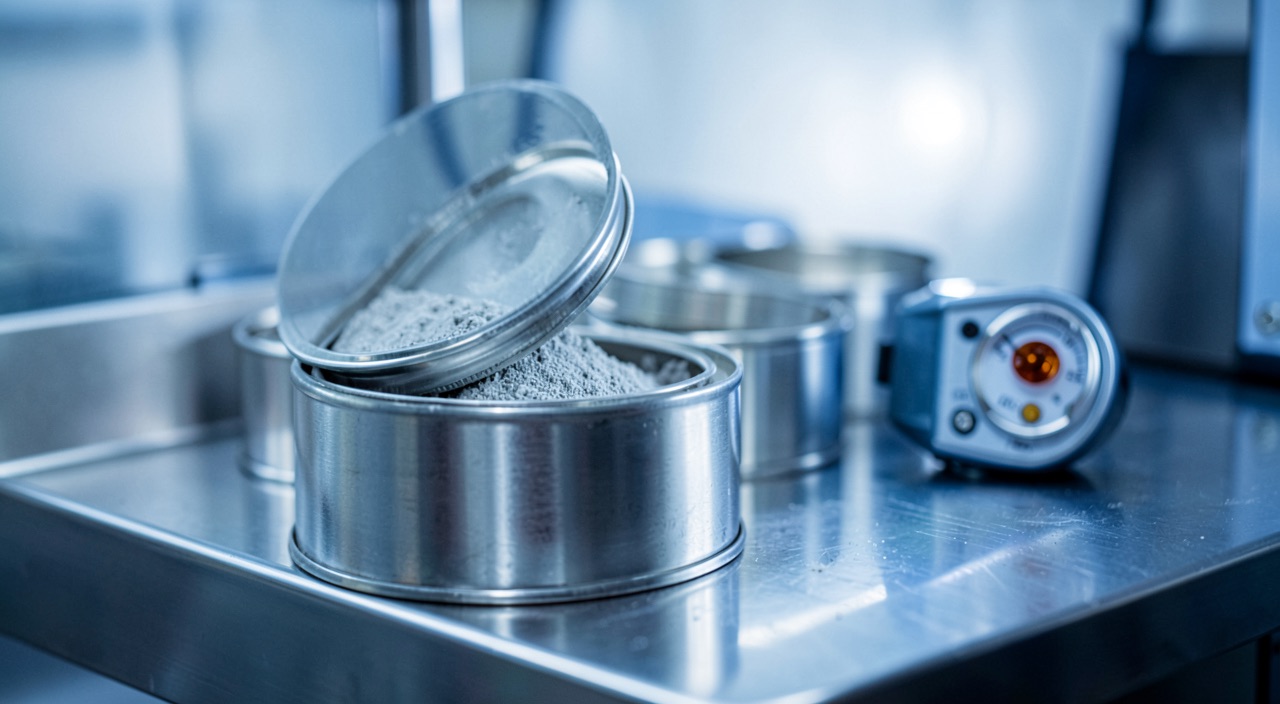
A batch of Ti-6Al-4V emerges from its eighth production. The sieve has retained nothing abnormal, the powder flows well, and the appearance hasn’t changed since the first day. Should it be re-engaged on a structural part? The answer isn’t in the sieve or the eye: it lies in three measured quantities per batch—cycles endured, particle size distribution, and oxygen uptake—and in the ability of the file to chain them without gaps, from the atomization can to the part’s serial number.
What each cycle does to the powder
The powder bed is not a passive consumable. Around the melt pool, ejections continuously fall back into the bed: re-melted particles, oxidized on the surface, often larger and less spherical than the original powder. Radiated heat lightly sinters the adjacent areas. Then come the de-powdering, sieving, and transfer: at each handling, the powder encounters the workshop’s atmosphere and its humidity.
Three drifts thus progress in parallel. A chemical drift: oxygen and nitrogen uptake at the grain surface, adsorbed humidity. A morphological drift: satellites stuck to the grains, particles fused together, degrading sphericity. A granulometric drift: the size distribution shifts and broadens with each cycle. These drifts are cumulative and unevenly visible: the sieve stops oversized particles, but it doesn’t see the chemistry or the shape. A powder can pass the sieve indefinitely and become non-compliant.
Each time you reuse metal powder, it gets worse in three ways: it picks up oxygen, its shape degrades, and its size changes. The sieve only catches the biggest problems, not the hidden ones that make the powder unsafe for critical parts.
On an EOS M 290 machine, a batch of Ti-6Al-4V powder is reused 10 times. After 5 cycles, oxygen content increases from 0.12% to 0.18%, and after 10 cycles, it reaches 0.25%—exceeding the 0.20% limit for structural parts. The sieve still passes it, but the material is now too brittle for flight safety.
- A chemical drift: oxygen and nitrogen uptake at the grain surface, adsorbed humidity.
- A morphological drift: satellites stuck to the grains, particles fused together, degrading sphericity.
- A granulometric drift: the size distribution shifts and broadens with each cycle.
Other workshops resolved this question before additive manufacturing. Composite layup has long managed a perishable material: prepreg has a shelf life outside cold storage, counted, consumed, and tracked ply by ply. Metal powder reaches the same point—it’s a material that ages in service, and this aging must live in the part’s file, not in the workshop’s memory.
Oxygen uptake, a ratchet with no reverse
Why oxygen rather than another indicator? Because on titanium alloys, it acts as an interstitial element: lodged in the lattice, it hardens the alloy and pays for this gain in strength with a collapse in ductility and toughness—low-interstitial grades exist precisely because a few hundredths of a percent change the behavior at cracking. On nickel-based superalloys and steels, the penalty is similar: oxides formed on the grain surface end up as inclusions in the melt, and an inclusion is a crack initiation site.
The uptake stems from a geometric property of the powder: its specific surface area is enormous, and an oxide layer of a few nanometers, insignificant on a massive part, weighs heavily at the batch scale. Each thermal cycle, each oxidized ejection fall, each exposure to humid air adds its contribution—and nothing in the process removes it. Sieving doesn’t see the chemistry; mixing with virgin powder dilutes it without eliminating it. It’s a ratchet: each cycle adds a step, none are taken back.
It’s this irreversibility that makes oxygen a compliance parameter, not just a lab datum. You only control what you measure: the content is dosed by inert gas fusion on a batch sample, and the result is compared to a ceiling from two sources at once—the applicable material specification, and the value demonstrated during process qualification. The most restrictive of the two makes the rule.
Granulometry drifts, and the sieve only sees part of it
Over the cycles, the size distribution deforms in a predictable way: re-melted ejections bring large particles, some fines disappear in the suction circuits, and grains welded in pairs count as double particles. The median diameter slides upward, the distribution broadens. Yet the layer’s spread and packing density were qualified with a given distribution: a layer that packs differently melts differently, and the porosity risk rises without any machine parameter having moved.
In this landscape, sieving does exactly what it exists for: stopping oversized particles and foreign bodies above its mesh. It doesn’t recenter the distribution below, doesn’t restore sphericity, doesn’t detach satellites, and doesn’t see flowability. It’s a barrier, not an acceptance control—and the confusion between the two is the most frequent pitfall in the field.
The pitfall: trust in the sieve. A batch that “passes the sieve” after ten cycles may be out of chemistry and morphology criteria without any workshop signal. Accepting recirculation solely on the basis of sieving means monitoring only the visible drift and letting the other two run—precisely those that degrade ductility and initiate cracks.
From parameter to criterion: four ways to manage the loop
Virgin powder is expensive, and reuse is the economic condition of the process: no one qualifies a powder bed fusion line to discard the material after each build. The industrial question is therefore not to ban recirculation, but to bound it with measured criteria—and to choose where to place the effort: in new material, in testing, or in accepted risk.

| Strategy | Principle | Material cost | Drift control | Testing load |
|---|---|---|---|---|
| Single-use | Virgin powder for each build | Maximum | Total: no cumulative drift | Minimal: supplier’s material certificate |
| Cycles capped | Reuse counter, demonstrated limit in qualification | High | Good within the demonstrated envelope | Moderate: heavy in qualification, lighter afterward |
| Controlled replenishment | Mix of recycled and virgin powder according to a written dilution rule | Moderate | Good, provided sampling is done after mixing | High: chemistry, granulometry, flowability per batch |
| Free loop | Reuse as it comes, sieving only | Minimal | Low: drift invisible until the part | None upstream, deferred to part inspection |
Replenishment deserves a closer look at its arithmetic, because it’s misleading. Mixing virgin powder with an aged batch lowers the average—that’s mechanical—but doesn’t eliminate the aged population: the measured average can comfortably stay below the ceiling while a fraction of the grains exceeds it. As long as the recycled fraction is accounted for and bounded, this tail is controlled; if replenishment is done “by eye,” it grows silently cycle after cycle.
Hence the structure of acceptance tests: full chemistry with oxygen, nitrogen, and hydrogen dosing by inert gas fusion, granulometry by laser diffraction, flowability, and apparent and tapped bulk densities—the whole on representative samples, taken after mixing and at several points in the container. In parallel, witness specimens accompany each build: the powder conditions the process input, the witnesses verify the output, and neither replaces the other.
The right reflex: measure after mixing, and keep the series. Always sample the batch as it will go to the machine, never its constituents before mixing, and attach each oxygen value to the batch identity and the cycle that produced it. An isolated value proves nothing; it’s the series that shows the slope, and the slope that allows declassifying a batch at the chosen moment rather than discovering it out of spec on a busy Friday.
The traceability the file must demonstrate
An acceptance criterion is only worth the genealogy that carries it. For each batch in circulation, the file must be able to state which atomization batch it descends from, how many cycles it has undergone and on which machine, with which batches it has been mixed and in what proportions, which values were measured at each recirculation, and which parts were produced by the builds it fed. The path must also be traversed in reverse: from a serial number, trace back to all the powder batches engaged—that’s the direction an investigation takes.
This formalism meets airworthiness logic: a powder bed fusion process qualifies as a frozen set—machine, parameters, material, reuse strategy included. The powder specification and its acceptance criteria are part of the approved definition, on par with a heat treatment. Expanding a ceiling, changing the dilution rule, putting powder from several machines in a common pot: none of this is a workshop adjustment. These are definition changes, with the demonstration and approval that go with them.
That’s also what an auditor looks at. They don’t ask if the powder is good—they ask how the organization knows it, batch by batch, and what happens when it’s not: is declassification irreversible, are rejected batches physically segregated, can a declassified container materially return to the flying stock? The robustness of a powder system is judged at its exit, not at its entry.
What to check in your own documentation
Five questions cover the subject. Does the powder specification cite measured criteria, or just a cycle counter without associated measurements? Is the mixing rule written, with its dilution accounting? Is sampling defined—where, how much, at what point in the loop? Is declassification made physically irreversible by container marking and a separate storage area? Is the measurement chain itself traced—identified instruments, up-to-date calibrations, methods linked to a test standard?
Remain the gray areas, those left to the organization’s rule by the references—and that’s where a file stands out. The common pot of powder between machines of the same model, averaging different wear histories. The mixing of distinct atomization batches from the same supplier, compliant but with separate genealogies. Cross-reuse between parts of different criticalities, where material should only flow from critical to non-critical. The fate of powder from an interrupted build, exposed without completing its cycle. On each of these points, someone preparing for an audit wins by writing their rule before it’s asked of them.
These references describe the mechanism, not your rule: for any decision to accept, reuse, or declassify a batch, the applicable material specification, the approved definition, and the organization’s quality procedures prevail over this article.


Leave a Reply
You must be logged in to post a comment.