
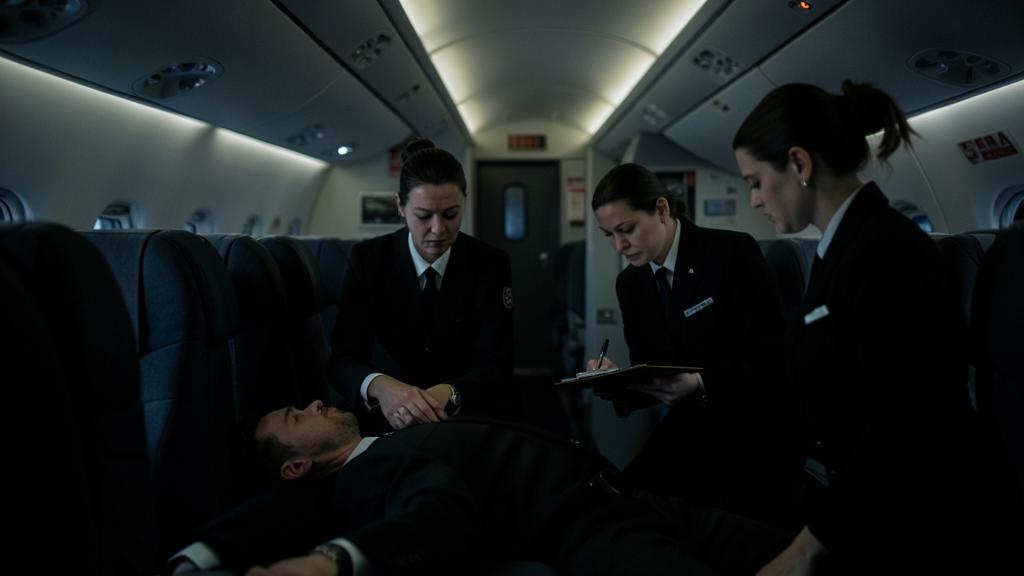
A passenger does not respond, resuscitation has been ongoing for a long time, and someone in the aisle asks the question everyone is avoiding. The honest answer is that no one on board can give it. The cabin crew observes; a doctor or designated authority pronounces. This distinction is not legal pedantry or defensive caution—it changes what you do next, what you write, and what the aircraft encounters upon arrival. Everything else in managing an in-flight death stems from getting that line right.
The line between observation and qualification
The crew is trained to make observations: whether a person responds, whether they are breathing, whether a pulse can be found. These observations are within their scope of practice, they are the basis for any first-aid decision, and they are worth recording precisely.
Pronouncing a death is a different act. In jurisdictions where an aircraft is likely to land, confirming a death is reserved for a doctor or another person named by law to do so—a paramedic in some systems, a coroner, a medical examiner, or a prosecutor in others. Who can do it, and whether verifying the death and certifying its cause are one act or two, vary by country; what does not vary is that the act does not belong to the cabin crew. This reservation exists because the consequences are legal rather than clinical: a confirmed death triggers an investigation, a jurisdiction, a certification, the release of a body, and the settlement of an estate. None of these things can rest on an observation made in an aisle at cruising altitude by someone with no means of examination.
The practical version, for a cabin crew member, is short. You can report that a passenger did not respond, that no breathing was observed, that no pulse was found, that resuscitation was performed and for how long, and that it was stopped at a stated time on a stated instruction. You do not report that a passenger has died, and you do not put a time of death in a log.
The trap. Under stress, language slides toward conclusion rather than observation— »he died at 0342″ instead of « resuscitation was stopped at 0342 on the advice of the ground medical service. » The first sentence is a pronouncement you are not authorized to make, and it will be read months later by people who were not there, in a context you cannot predict.
Cabin crew can only note what they see (no response, no breathing, no pulse) but cannot declare someone dead. That’s a legal decision for doctors or authorities on the ground. Mixing the two can cause big problems later.
On a Boeing 737 at 35,000 feet, a passenger collapses. The crew checks for pulse and breathing, starts CPR, and uses the defibrillator. After 30 minutes, the ground medical team advises stopping. The crew writes: “Resuscitation stopped at 14:22 on medical advice” – not “Passenger died at 14:22.”
What you actually record, and how to phrase it
The report written in the hours after the event will outlast everyone’s memory. It must be dense with observations and free of inferences.
| What you observe | Record it as | Not as |
|---|---|---|
| No response to voice or touch | « Unresponsive to voice and firm shoulder touch at [time] » | « Unconscious » |
| No chest movement, no airflow felt | « No normal breathing observed for ten seconds » | « Not breathing, deceased » |
| No pulse located | « No carotid pulse located by [name] at [time] » | « No pulse, therefore dead » |
| Resuscitation started and continued | « Compressions started at [time], continued by [names], defibrillator connected at [time] » | « We tried but it was too late » |
| Defibrillator advised not to shock | « Device analyzed at [times]; no shock advised on each analysis » | « The machine said he was gone » |
| Resuscitation stopped | « Stopped at [time] on instruction from [source], relayed by the flight deck » | « Death at [time] » |
Two details are often lost, and both are important. The first is names: who did what, and who was present. The second is the proper recording of the automated external defibrillator. The device stores its analyses and, on most models, the underlying rhythm; this data is objective evidence of the passenger’s state throughout the attempt, and it is far more useful to a later medical review than anyone’s memory. It should be preserved rather than reset, and its status should be noted in the report.
Who can stop, and on what authority
The crew begins resuscitation according to training and the operator’s procedure. The decision to stop is where practice diverges, and it is useful to know your operator’s answer before you need it rather than improvising.
Most commercial operators route the decision through one of three channels: a ground-based consultative medical service contacted by the flight deck, a doctor on board who has identified themselves and whose involvement is recognized by the operator’s procedure, or an explicit procedural rule in the cabin crew manual covering the case where neither is available. What the crew does not have is the discretion to stop because the attempt seems futile.
There is a narrow category of exception: signs clearly incompatible with life—the classic examples are obviously non-survivable injuries, established rigor mortis, or dependent lividity in a passenger found long after the event. Even then, most procedures require the finding to be reported and the decision confirmed rather than made alone. When a doctor on board is involved, their identity and the fact of their involvement must be in the report; whether to follow their instruction as medical direction or to treat it as advice to the commander is a question the operator’s procedure resolves, and it varies.
The good habit. Read the two or three lines in your cabin crew manual covering this case now, on the ground. The most common failure in these events is not clinical: it is a crew member having to guess the chain of authority while performing compressions in an aisle.
Continue or divert: a commander’s decision, and rarely a no-brainer
A diversion during a medical emergency is a clinical decision, made because arriving sooner might change the outcome. Once resuscitation has been stopped, that reasoning no longer applies, and the calculus changes entirely—it becomes a question of formalities, the family, and the aircraft.
| Factor | Why it matters |
|---|---|
| Remaining flight time | One hour to destination and eight hours to destination are different problems for cabin management |
| Formalities at possible landing points | Requirements in case of an in-flight death vary widely by state; some involve lengthy procedures and prolonged delays for the aircraft |
| Where traveling companions must be | A diversion can isolate a family in a country where they have no status, no language, and no support |
| Repatriation from the diversion point | Consular and repatriation arrangements are far simpler from some places than others |
| Suspicion of a contagious disease | Changes the problem from a question of facilitation to a question of public health, with its own reporting obligations |
| Any indication the death might not be natural | Preservation of the scene and the jurisdiction of the landing state become paramount |
| Cabin and crew capacity to manage the remaining sector | Load factor, available seats, crew composition, and crew condition |
The commander decides, informed by the operations center, the ground medical service, and the cabin. The cabin crew provides information no one else has: how much of the cabin saw what, whether there is a traveling companion, what space is available, and whether the crew can maintain the remaining sector. Give this assessment honestly. This is not a request for a diversion; it is a contribution.
Managing the cabin around this
Once the clinical phase is over, the task becomes dignity and containment, in that order.
The general approach among operators is consistent even if the details differ. If seats are available, the passenger is moved to a location with the fewest neighbors, seated, secured with the seatbelt, and covered with a blanket. Placement in a lavatory is avoided—the practical reasons include access and the effects of the environment, and the human reason is obvious. Galleys, exits, and any position that would obstruct evacuation are also excluded. If the cabin is full and no relocation is possible, the passenger remains in place, and the neighbors are relocated instead.
Personal effects remain with the passenger as much as possible, and are not searched. Documents may be needed upon arrival, and the operator’s procedure will indicate who retrieves them and how this is witnessed; the principle is that nothing is handled by a single crew member and nothing is handled more than necessary. If an indication that the death was not natural exists, the position becomes even stricter: the seat and its surroundings are an area the authorities will want to see as it was.
The cabin itself requires deliberate management. Passengers who witnessed the attempt have lived through something; passengers who saw only the crew acting decisively will invent an explanation if none is offered. A brief factual announcement—that a passenger became seriously ill, that the crew responded, that medical assistance will meet the aircraft—is generally preferable to silence, and it must never contain a statement of the outcome.
People who need something specific from you
Three groups need different things, and confusing them is the usual mistake.
The traveling companion needs presence, a seat away from the immediate area if they wish, and honesty about what you can and cannot say. The latter is difficult and best done directly: you can say that the crew did everything they were trained to do, that medical advice was sought, and that the authorities upon arrival will be the ones to formally inform them. Saying nothing seems evasive. Saying more than you know seems like a certainty you do not have.
Neighboring passengers need practical relocation and an explanation. A volunteer who helped—often a doctor or nurse—needs their contact details recorded, thanks, and, with many operators, a specific follow-up procedure.
The rest of the cabin needs service to resume at a normal pace. This seems cruel and it is the opposite: an aircraft where service simply stops for six hours becomes a cabin where two hundred people sit in silence with their own imaginations.
Arrival: the aircraft belongs to the authorities first
The handover to ground authorities is where a well-managed event most often breaks down, usually because no one warned the cabin what was about to happen. The sequence below is the common form; how much applies, and how long it takes, is set by the arrival state.
| Step | Controlled by | What the crew provides |
|---|---|---|
| Pre-arrival notification | Flight deck and the operator’s ground organization | Confirmed factual status, seat location, any health concerns |
| Health declaration for the flight | Commander, as required by the destination | Relevant observations for possible contagious disease |
| Aircraft held on arrival | The landing state’s authorities, when they require it | Nothing other than compliance; passengers remain seated until released |
| Authorities board | Police, health authority, or medical examiner as required by the state | Access, seat location, and identification of witnesses |
| Disembarkation of other passengers | The authorities rather than the operator, once they have taken control | Cabin management during a delay of unpredictable length |
| Removal, and return of effects | The authorities | Witness handover, recorded |
| Crew statements | The authorities, and the operator’s own statement | Factual accounts, written before any discussion among crew members |
Two points are worth emphasizing. Passengers will be angry about the delay, and explaining why is generally not the cabin crew’s responsibility; a neutral explanation that the aircraft is being held pending authority clearance is usually all that is available. And statements are more useful when written independently. Crew who debrief first produce a single merged account, which is comfortable and less informative than four honest and partial narratives.
After, and the part that is skipped
The event does not end with the handover. The cabin crew who performed prolonged resuscitation on a passenger, then managed a cabin around the result, has undergone professional exposure that operators are increasingly explicit about supporting—peer support and critical stress programs exist precisely for this, and they work better when used early rather than after a pattern has set in.
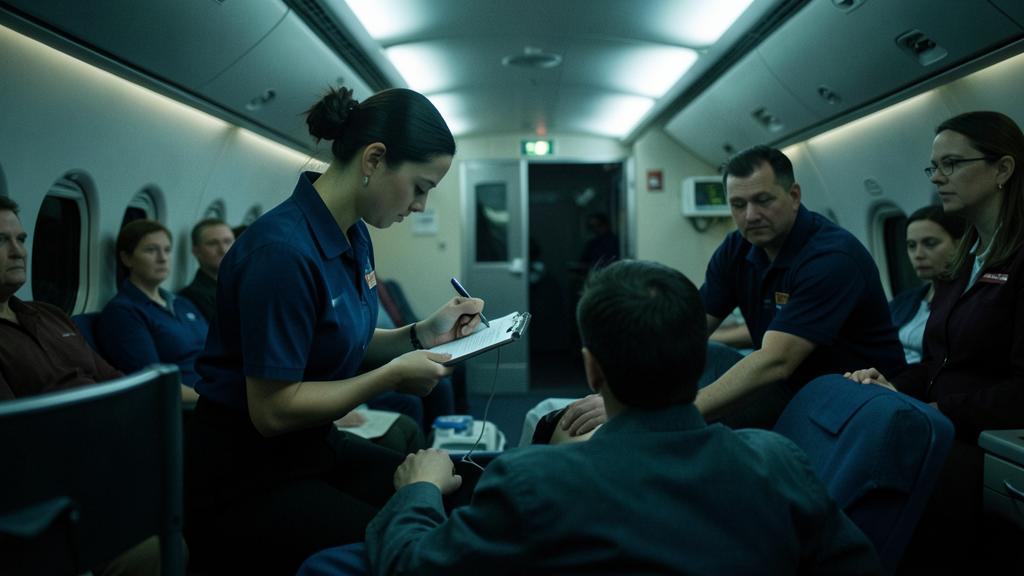
The operational corollary is fitness for duty. A crew member who assesses they are not fit to operate the next sector makes a safety judgment, not an excuse, and the same standard that governs any other impairment applies here. Say it before the sector, to the commander, clearly.
The last thing to remember is the smallest. The discipline of separating what you observed from what you concluded is not paperwork hygiene. It is the thing that protects the family from a bad answer given too soon, protects the crew from a statement they cannot support, and leaves the authority that has the power to decide with a clean set of facts from which to decide. Everything else in this event is variable—the fleet, the destination, the procedure. This line is not. Operators comparing their cabin procedures on this topic will find the discussion continues among the crew on FL330 forums.


Leave a Reply
You must be logged in to post a comment.