
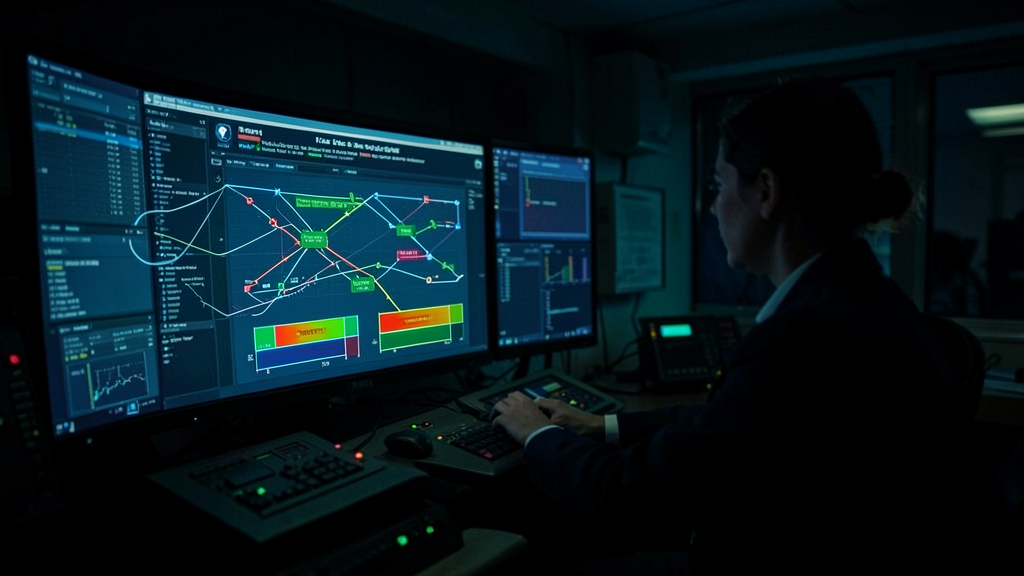
A bow tie makes a claim: that between this threat and this top event there stand four things, and that each of them can stop the sequence on its own. Most diagrams cannot support that claim. They contain controls that act only after another control has acted, controls that share a power supply or a person, and controls that are really training programmes drawn as steel doors. The work that turns a picture into a risk assessment is not drawing more barriers. It is deleting the ones that are not there.
What the diagram is actually claiming
The structure is deliberately rigid. A hazard is something the operation needs and lives with; the top event is the moment control of it is lost; threats on the left are the things that can cause that loss; consequences on the right are what happens afterwards. Between each threat and the top event sit the preventive barriers, and between the top event and each consequence sit the recovery barriers. Escalation factors hang off individual barriers and describe the conditions that degrade them, with their own controls.
Everything in that structure is a proposition that can be true or false. Placing a control on a specific pathway asserts that it acts on that pathway, that it acts before the top event rather than after, and that its failure is not implied by the failure of its neighbours. Placing four of them asserts that four distinct things must fail. If two of them fail together for a single reason, the diagram claims a depth the operation does not have — and the risk register that quotes it inherits the error, usually in the form of a residual risk rating that nobody can reconstruct.
A bow-tie diagram claims that multiple independent barriers exist between a threat and a disaster. But if two barriers actually rely on the same thing (like the same person or power supply), they’re not truly separate. The diagram must show real, standalone barriers, not just hopeful ones.
The four tests a control has to pass
The method arrived from the process industries with a qualifying grid attached, and the published versions of it reduce to the same four questions. They work as a set: a control that fails any one of them is not a barrier on that pathway.
| Test | The question | What it disqualifies |
|---|---|---|
| Specific | Does it act on this pathway, between this threat and this top event? | Generic good practice pasted onto every branch; anything that acts after the top event drawn on the prevention side |
| Effective on its own | If everything else fails, does this alone stop the sequence? | Controls that only improve the odds of another control working; partial chains that detect but do not act |
| Independent | Can it be removed by the same single failure, person, supply or event as its neighbour? | Pairs sharing a sensor, a bus, a database, a supplier, a shift or a decision-maker |
| Auditable | Is there evidence, generated routinely, that it was in place and working? | Barriers whose only proof of existence is that they appear in the manual |
The fourth test is the one that changes practice fastest, because it is answerable without argument. If nobody can name the record, the test, the monitored parameter or the inspection that would have revealed the barrier missing last month, then the organisation does not know whether it has the barrier. It has an intention.
Detect, decide, act — and why most human barriers are incomplete
A barrier that involves people is not a person; it is a sequence. Something has to make the condition perceptible, somebody has to recognise it as requiring action, and somebody has to be able to act in time with the authority to do so. Break any of the three links and the barrier does not exist, however many hours of training stand behind it.
Aviation bow ties are full of two-thirds barriers. An alerting system that annunciates a condition the crew has no procedure for is detection without decision. A procedure that requires a call the crew is not trained to expect is decision without detection. A stabilisation gate that everyone recognises but which arrives too late in the approach to be flown is detection and decision without the capacity to act. Each of these belongs on the diagram — as a degraded barrier with an escalation factor, or as an improvement item — but not as one of the layers being counted.
The trap. “The crew will notice” is not a barrier. It becomes one when the diagram can name what makes the condition perceptible, what tells the crew that this perception requires this action, and how much time exists between the two. If the answer to any of the three is “experience”, the control being drawn is competence, not a barrier — and competence degrades quietly and simultaneously across a whole crew under workload, which is exactly the condition the barrier was drawn for.
On an Airbus A320, the stabilisation call during approach is a barrier. But if the crew is distracted and misses it, or if the aircraft is too low to recover, the barrier fails. The diagram must show that the call alone isn’t enough—it needs procedures, training, and time to work.
Independence is the test everyone skips
Independence is skipped because it is expensive to check and because the diagram looks the same either way. Two boxes side by side imply two failures required; nothing in the picture reveals that both boxes lose power from the same bus, take their input from the same sensor, depend on the same navigation database revision, are performed by the same person twenty seconds apart, or are supplied by the same subcontractor.
The check is mechanical once the habit exists. For each adjacent pair of barriers on a pathway, ask what single event would remove both. Work through supply — electrical, hydraulic, pneumatic, data. Work through information — which sensor, which database, which forecast, which published chart. Work through people — one individual, one crew, one shift, one team under the same pressure at the same moment. Work through time — a maintenance task, a software load, a procedure revision, a training cycle that touched both. If any of those produces a plausible single event, the two barriers are one barrier, and the diagram should show one.
| Drawn as two barriers | Shared dependency | What it really is |
|---|---|---|
| Checklist and crew cross-check | The same two people, in the same phase, under the same distraction | One barrier with a workload escalation factor |
| Standard operating procedure and recurrent training | Training is what makes the procedure work; it does not act by itself | One barrier plus its supporting condition |
| Two alerting functions fed by the same sensor | The sensor, its heating, its wiring, its data bus | One barrier, with the sensor as a single point of failure |
| Ground-based surveillance alert and controller visual scan | The same controller, the same position, the same moment of saturation | One barrier unless a second position is genuinely monitoring |
| Two independent checks by the same technician after a break | The same mental model of the task | One check, whatever the paperwork records |
| Dispatch fuel policy and in-flight fuel checks | Genuinely independent — different actors, different data, different moments | Two barriers; a rare and instructive case of the test being passed |
The last row matters as much as the others. The exercise is not a demolition job; it exists to identify the pathways where the depth is real, so that resources go to the ones where it is not.
What a barrier is made of, and what removes it
Barrier classes are not equally robust, and the ranking is stable across industries. Passive hardware does its job by existing — a firewall, a containment structure, a physical separation, a design that makes an incorrect connection impossible. Active hardware has to detect and operate, which adds failure modes and a need for testing. Active hardware plus a human adds a decision, a workload and a training assumption. A purely procedural barrier has none of the first three and depends entirely on a person doing something in a particular moment.
| Class | Removed by | Evidence that it exists | Typical failure to watch |
|---|---|---|---|
| Passive hardware | Physical damage, modification, corrosion, a design change | Inspection records, configuration control, modification status | Quietly defeated by an approved modification nobody mapped to the bow tie |
| Active hardware | Component failure, inhibition, deferred defect, power loss | Functional test results, built-in test logs, defect history | Deferred under the minimum equipment list with the bow tie never updated |
| Active hardware with a human | Everything above, plus workload, timing and authority | Test results and monitored operational events | Alert present, action absent, because the time available was never measured |
| Human and procedural | Distraction, pressure, a revision, a rostering change, an unfamiliar variant | Line observations, monitored events, audit findings | Counted twice under two different names |
The right-hand end of that table is where most bow ties in an operations manual do their work, and it is also where the illusion of depth is cheapest to manufacture. Four procedural barriers in a row look like defence in depth and behave like one, because the conditions that defeat a procedure — time pressure, an unfamiliar situation, a distraction at the wrong moment — defeat all four at once.
Procedures, training and culture are real, and they are not barriers
This is the point where the exercise meets resistance, so it is worth putting precisely. A procedure does not stop an event; a person following it does. Training does not stop an event; it raises the probability that a person will follow the procedure. Safety culture does not stop an event; it changes how likely people are to report the conditions that degrade everything else. All three are indispensable, and all three sit correctly on the diagram as escalation-factor controls attached to the barriers whose performance they support.
Moving them there is not a demotion, and it produces two useful effects. The barrier count drops to something the organisation can defend, and the escalation factors become visible as a list of the conditions under which the remaining barriers stop working — which is a far more actionable document than the count ever was. An organisation that knows its two real barriers and the six conditions that degrade them is in a better position than one that believes it has eight.
The barrier that was removed on the day
A bow tie is drawn for a nominal configuration and used on days that are not nominal. Every acceptable deferred defect removes or degrades something, and the item that permits it is written in the language of dispatch, not in the language of the risk assessment. The connection between the two is almost never mapped, which means the organisation can dispatch legally with a barrier missing and have no mechanism that notices the risk assessment has changed.
The same applies to temporary states on the ground: an unserviceable lighting system, a suspended surveillance function, a procedure temporarily amended by notice, a maintenance task carried out under a concession, a training exemption. Each is individually reasonable and individually authorised. The bow tie is the only document in the system that would show two of them removing adjacent barriers on the same pathway at the same time, and it can only do so if the mapping between deferred items and barriers exists before it is needed.
The right reflex. Against each barrier, write the one line that would prove it existed yesterday: the test, the record, the monitored event, the inspection. Then write which deferral or temporary condition removes it. A bow tie with those two lines per barrier is a working document; without them it is an illustration, and illustrations do not survive contact with an investigation.
What the corrected diagram changes downstream
The output of the exercise is usually uncomfortable and always useful: fewer barriers, more escalation factors, and a small number of pathways where the depth turns out to be a single control wearing several names. That changes the risk assessment, because a residual risk rating justified by four independent protections cannot survive the discovery that there are two. It changes the monitoring plan, because the barriers that survive need indicators and the escalation factors need to be watched. And it changes where money goes, because adding a fifth procedural barrier to a pathway already defended by four is the most reliable way to spend a budget without changing anything.
It also changes what happens after an occurrence. An event that penetrated every layer of a diagram nobody believed in produces a report about human error. The same event, assessed against a bow tie whose barriers were verified, produces a specific finding: this barrier was inhibited, that one shared a dependency with its neighbour, the third had never been auditable. A safety management system — required under Annex 19 and under the European management-system rules — earns its keep on exactly that difference: whether the organisation can say what was supposed to stop the event and why it did not. Working the method through on real pathways, rather than on textbook examples, is the part that takes practice, and structured treatments of it sit alongside the safety-management material on the FL330 training platform.
The discipline reduces to one refusal. Do not draw a barrier because it ought to be there. Draw it when you can name what it is made of, what it acts on, what single event removes it, and where the evidence lives that it worked last month. Everything else on the diagram is a hope, and hopes do not stop top events — they only make the picture look reassuring in the meeting where the risk is accepted.


Leave a Reply
You must be logged in to post a comment.