
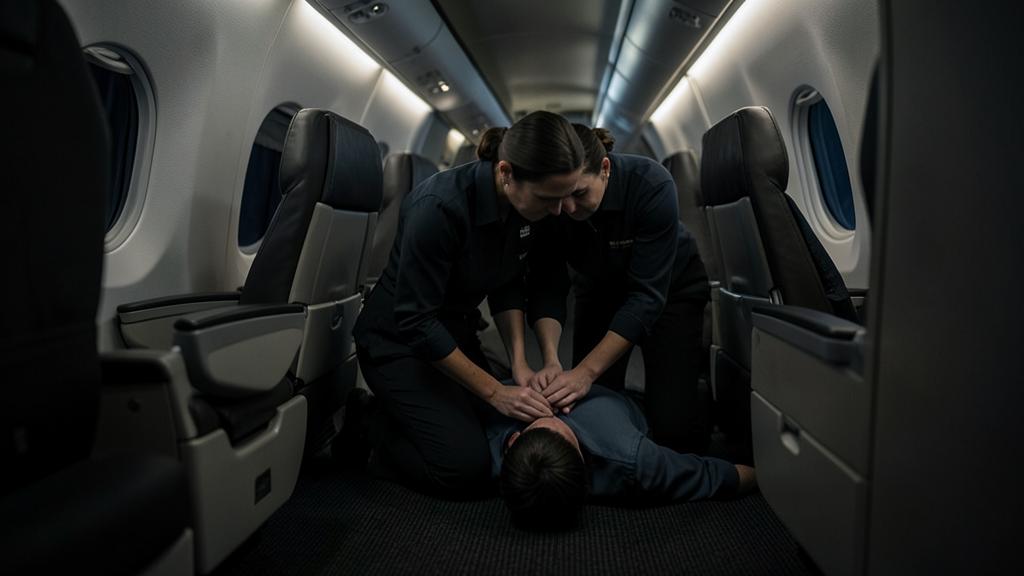
Chest compressions in an aircraft aisle are not the compressions rehearsed on a training-room mat. The aisle is about as wide as the shoulders of the person lying in it, which deletes the standard kneeling position outright. What decides the quality of the resuscitation is a handful of choices made in the first thirty seconds — where the body ends up, which armrests come up, who takes the head end, who is next on compressions — and those choices are geometric before they are medical.
The aisle is as wide as the casualty
Cabin aisle width is a certification dimension, and it is specified at two heights: a narrower minimum close to the floor, a wider one higher up. The reason is visible in the shape of a walking passenger — hips and feet near the floor, shoulders and elbows above. Nothing in that dimension was ever intended to accommodate a rescuer kneeling beside a casualty. On a typical single-aisle jet the usable floor-level width is on the order of forty-five to fifty centimetres, and the shoulder breadth of an average adult male is not far off the same figure.
Put those two numbers side by side and the consequence is arithmetic, not skill. The position taught everywhere — kneel beside the casualty, knees against the chest, shoulders vertically above the sternum, elbows locked — requires the rescuer’s own knee span, roughly another forty centimetres, alongside the casualty’s chest. The aisle does not contain both. Above the floor the situation is worse: even where the casualty fits between the seat bases, the armrests close in at the height where the rescuer’s trunk and arms have to work.
This is why aisle resuscitations degrade in ways the debrief usually blames on stress. Compressions delivered from the side of a body you cannot get above are delivered with bent arms, from the shoulders, at an angle. Depth falls short, recoil is incomplete, and the rescuer tires in well under the interval at which guidelines expect a change of compressor.
The training gap. Most cabin crew first-aid practical work is done on a mat with unrestricted access on both sides — the one geometry that never occurs on board. Crews rehearse the technique and never rehearse the constraint, then discover in flight that the technique does not fit. Ask for at least one practical run in a cabin mock-up with the seats in place.
The aisle is too narrow for standard CPR. You have to adapt your position to fit the space, or the compressions won’t work well. The key is to get the patient onto the floor and use the right body position to push effectively.
On an Airbus A320, the aisle width at floor level is about 45 cm. If a 180 cm tall passenger collapses in a window seat, their shoulders are roughly 50 cm wide. A rescuer trying to kneel beside them would need another 40 cm for their knees, but the aisle only provides 45 cm total. This forces the rescuer to use a straddle or over-the-head position instead.
Why the surface decides before the technique does
Compressions transmit force through the chest only if what is behind the chest does not move. On a seat cushion, a substantial part of the displacement you produce goes into the foam, and the compression the heart actually receives is shallower than the one your hands felt. This is the same reason resuscitation guidance outside aviation insists on moving a patient from a bed to the floor.
An aircraft cabin floor, supported by the floor beam structure, is an excellent surface. That single fact settles the first decision: a passenger in cardiac arrest comes out of the seat and onto the floor. There is no version of effective compressions on a seated casualty, reclined or not, and no amount of urgency changes that.
The corollary is the rescuer’s own comfort, which sounds like a luxury and is not. Kneeling for several minutes on a thin carpet over a hard floor, often with a seat track edge under one knee, produces pain that shortens the useful life of a compressor. A folded blanket under the knees costs three seconds and buys minutes of quality. Put it down while the casualty is being extricated, not afterwards.
Getting the passenger out of the seat
Extrication is the manoeuvre most crews have never physically performed. It is worth breaking into its parts, because each one has a failure mode.
- Release the seat belt. Obvious, routinely forgotten under pressure, and the single most common reason a first attempt fails.
- Raise the armrests. On many seat types the aisle-side armrest lifts fully, but only after a concealed release — a small button or lever inside the hinge pocket, hidden behind the armrest itself. Crews who do not know their own seat type discover this at the worst moment. Find out on the ground, on every fleet type you fly.
- Control the head. The head is the part that gets dropped. With two rescuers, one takes head and shoulders, the other takes hips.
- Slide, do not lift. Cross the casualty’s arms over the chest, pass your forearms under theirs from behind, grasp their forearms, and pivot the body out of the seat and down. You are lowering a mass, not carrying it. The feet can stay under the seats — the airway end matters, the feet do not.
- Point the head at the open end. Whichever direction has more space, galley or cross-aisle, is where the head goes. Airway management, ventilation and the defibrillator all live at the head end and all need room.
Alone, the same manoeuvre works but slower, and the head is controlled by the position of your own forearms rather than by a second pair of hands. Recruit an able passenger before you recruit strength: an adult who can hold a head steady and follow one instruction is worth more than one who wants to help with everything.
Three working positions, and what each costs
Once the casualty is on the floor, only three positions are actually available in a narrow-body cabin, and the choice between them is a trade, not a preference.
| Position | What it requires | Strengths | What it costs |
|---|---|---|---|
| Straddle — one knee either side, rescuer over the casualty’s thighs or hips, working forward onto the sternum | Enough space fore and aft; a rescuer able to hold a half-kneeling posture | Shoulders can be brought vertically above the sternum; arms stay straight; the aisle width is used, not fought | Tiring; awkward to swap out of; blocks the torso for a second rescuer |
| Over-the-head — rescuer kneeling at the crown, compressing downward along the axis of the body | Free floor space at the head end only | Works where nothing else does; leaves the flanks clear; well suited to the single rescuer | Depth is harder to achieve and to judge; it occupies the exact space the airway and the defibrillator need |
| Conventional kneeling, side-on | A cross-aisle, a door area, a galley floor or an exit row vestibule | The rehearsed technique, sustainable, two rescuers can work either side | Requires moving the casualty, and every metre of that move is a pause in compressions |
None of these is a substitute technique invented for aviation. Over-the-head compressions are a recognised confined-space method used by ambulance crews and rescue teams; the straddle is an established answer where lateral access is denied. What is specific to the cabin is that you will use one of them, and that the decision has to be made before your hands are on the chest rather than after.
The move decision: distance against interruption
Moving to a cross-aisle or galley buys the best position and costs compressions. Guidelines are consistent that interruptions must be short and rare, and that the proportion of time actually spent compressing is a determinant of outcome. So the move is not free, and the rule that resolves it is about timing rather than distance.
- Before compressions begin, a move is comparatively cheap. If the casualty is within a couple of rows of a galley, door area or cross-aisle, take them there as part of the extrication.
- Once compressions have started, move only during a pause that was going to happen anyway — the defibrillator’s analysis pause is the obvious one — and only if the destination is a few metres away.
- Never accept a long carry. Over-the-head compressions started immediately where the passenger fell beat perfect compressions started forty seconds later at the other end of the cabin.
A door area is the best floor space on most aircraft and the one that carries a cost: it is an exit. Occupying it is the right call during a resuscitation, and the flight deck needs to know, because it changes the evacuation plan for the landing that may follow. Say it once, early, in the same call that reports the arrest.
The reflex worth having. Decide the destination while you are still walking to the seat. Two rows forward, two rows aft, and where the nearest cross-aisle or galley is — that is a three-second appraisal that removes the worst hesitation of the whole sequence, the one that happens with your hands already on the chest.
The defibrillator in a confined space
The device itself is undemanding; the space around it is not. Put the unit at the head end or on a seat cushion, never loose in the aisle where it will be knelt on, kicked, or lost under a seat. Pads go on a dry, bare chest; a towel and a razor from the medical kit solve moisture and hair faster than persistence does. Avoid placing a pad directly over an implanted device or a medication patch.
Two points are specific to a cabin. First, the analysis and shock phases require that nobody is touching the casualty, and in an aisle the people who might be touching include seated passengers whose feet are in the aisle and whose hands are on the seat backs. The clearance call has to be addressed to the cabin, loudly, not to the crew alone. Second, the analysis pause is the natural moment to change compressor — it is the only interruption the protocol gives you, and in a straddle or over-the-head position you will want it.
Carriage rules diverge, and it matters for anyone flying both sides of the Atlantic. In the United States, an automated external defibrillator is a regulatory requirement for aeroplanes above a payload threshold operating with at least one flight attendant. In Europe, carriage is not mandated by the operating rules in the same blanket way; many operators carry one by policy, and some do not. Know which is true of your fleet, and do not assume a code-share partner’s cabin is equipped like your own.
Rotation, because quality decays faster here
Guidelines expect a change of compressor at roughly two-minute intervals, aligned with rhythm analysis, because compression depth measurably deteriorates before the rescuer feels tired. Both halves of that statement are worse in an aisle: the non-standard posture accelerates the decay, and the rescuer’s subjective sense of effort is a poor guide because the effort is postural as much as muscular.
Swapping is also a geometry problem. Two people cannot pass each other over a casualty in an aisle that narrow without a plan, so the plan is that the relief is already in position — at the head end, or standing astride one row forward — before the swap is called. Count it out loud and make the exchange during the analysis pause. A blind swap in the middle of a compression cycle costs several seconds every time.
| Role | Does | Fails when |
|---|---|---|
| Compressor | Compressions only, in the chosen position, until relieved | Also tries to talk to the flight deck or reassure the family |
| Relief and airway | Head end: airway, ventilation, defibrillator, ready to take over on the next pause | Is drawn away to fetch equipment nobody staged in advance |
| Cabin manager | Moves passengers, clears the working space, finds a medical volunteer, keeps the aisle usable | Joins the resuscitation and leaves the cabin unmanaged |
| Flight deck link | One structured call: what, where, since when, what is being done, what is needed on the ground | Sends fragments over several calls that force the flight deck to reconstruct the picture |
On a single-aisle aircraft at minimum crew, that list already consumes the cabin. A serviceable resuscitation with three or four crew means the rest of the cabin is running on nothing, which is precisely why a medical volunteer, once identified and credentialed to the operator’s procedure, is most useful taking the airway rather than directing the show.
The cases that break the plan
Some positions on board simply do not permit the standard sequence, and each has one specific answer.
- The lavatory. The worst case. Doors on many types open inward and there is an external release behind or beneath the placard on the door. The casualty is extricated into the aisle first; nothing else happens inside the compartment. Expect this to take two crew and to be slow.
- Window seat with two occupied seats between the casualty and the aisle. The neighbours go before the casualty comes. Directing two passengers to stand and step back is faster than any manoeuvre over their laps.
- Galley with carts deployed. Stow or push the carts clear before you start rather than working around them; a cart moving during compressions is an injury waiting to happen.
- A large casualty. Extrication may need three people and the straddle may be unavailable. Over-the-head compressions and a decision to stay put usually beat a heroic move.
- Turbulence. Crew who are not secured are casualties in waiting. This is a flight deck decision as much as a cabin one: the resuscitation needs a stable cabin, and obtaining it may mean a change of level or track. Ask.
What to rehearse on the ground
Very little of this is knowledge; almost all of it is rehearsal, and the rehearsal is cheap. On your next cabin walk-through, do four things. Measure the aisle on the types you fly, so the constraint stops being abstract. Find the armrest release on your seat types and make every crew member operate it once. Time an extrication from a window seat with the number of crew you actually carry. And agree the wording of the swap call so it is the same one on the day.
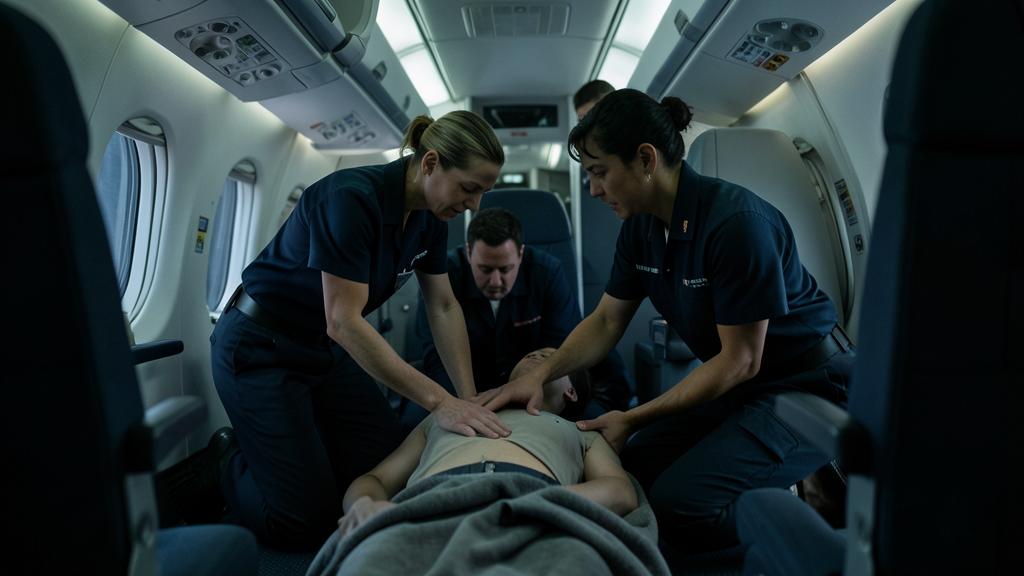
Then decide, as a crew, the two questions that otherwise get decided badly under pressure: where the nearest usable floor space is from each third of the cabin, and who is number two on compressions. Recurrent first aid training is commonly rehearsed on a multi-year cycle rather than annually, which makes the between-sessions rehearsal the one that actually determines performance. The cabin safety material at FL330 training treats the extrication and the working position as the drill, rather than as the preamble to it.


Leave a Reply
You must be logged in to post a comment.