
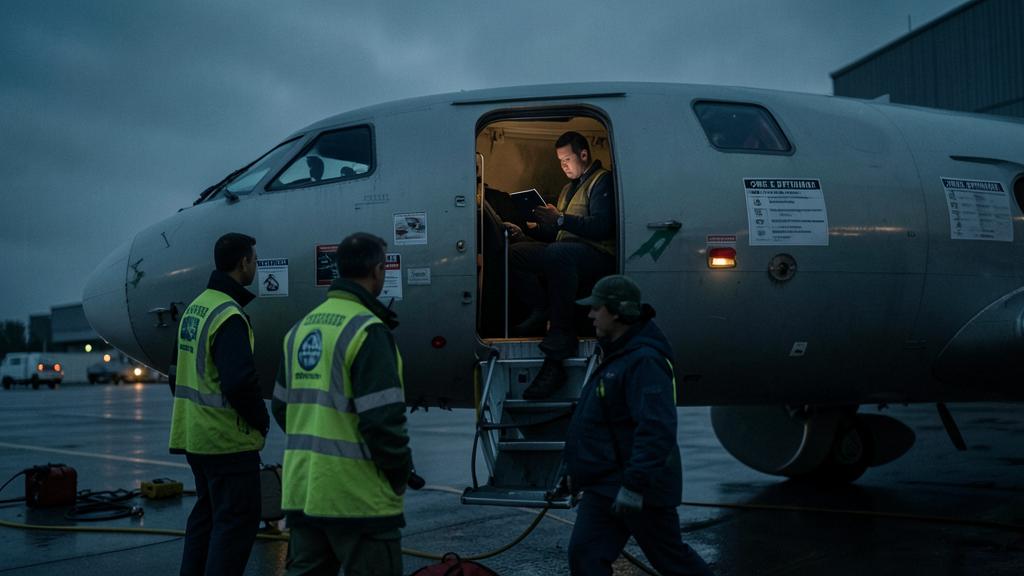
An aeroplane presented for departure with five open deferrals is, item by item, entirely legal. Each entry was found in the list, each proviso was applied, each placard is fitted. What nobody has done is assess the aeroplane as it now stands, because the minimum equipment list was never built to do that: every item in it was analysed against an otherwise serviceable aircraft. The sum of five legal deferrals is a configuration that exists in no document, and deciding whether it is acceptable is an operator responsibility that has to be organised before the crew reaches the aircraft.
What the list is, and what it never claimed to be
A master minimum equipment list is produced by the type certificate holder and approved through an operational evaluation by the certifying authority. It states which items of equipment may be temporarily inoperative for dispatch, under what conditions, and for how long. An operator builds its own minimum equipment list from that master document — never less restrictive, frequently more so — and gets it approved by its competent authority. ICAO Annex 6 requires the document to exist; the European air operations rules require the operator to hold an approved list and to dispatch in accordance with it.
The analytical unit throughout is the single item. When the manufacturer decided that a given system could be dispatched inoperative, the reasoning ran against an aeroplane in which everything else works: what function is lost, what redundancy remains, what the crew must do instead, what the maintenance staff must isolate, and how long that condition may persist. Combinations were not analysed, except in the specific cases where the list says so — an interface note, a prohibition on combining two named items, or a proviso that refers to a system the crew must still have.
This is not an oversight. Analysing combinations exhaustively is not tractable: a list with several hundred items has an astronomically large set of pairs and triples, and almost all of them are uninteresting. The manufacturer therefore does what is possible and leaves the residue where it belongs — with the operator who knows which items are actually open on which airframe, and on what route it is about to depart.
The minimum equipment list only checks each system one at a time, not how they work together. If multiple systems are broken, the operator must check if the plane is still safe to fly.
An Airbus A320 with an inoperative autopilot (Category B) and a faulty standby flight display (Category C) may be legal individually, but together they could overload the pilots, especially during a go-around at a busy airport like London Heathrow.
Where the intervals come from: exposure time, not paperwork
Rectification categories are usually read as an administrative deadline. They are better understood as a control on exposure time. Certification of systems rests on showing that severe failure conditions are sufficiently improbable, and that analysis is only valid if latent failures — conditions present but not annunciated — are cleared at bounded intervals. A deferral is a deliberately accepted latent condition. The interval is the mechanism that stops it accumulating probability.
| Category | Interval as generally defined | What the limit is protecting |
|---|---|---|
| A | As stated in the remarks column — often expressed in flights, flight hours or cycles rather than days | Items where the acceptable exposure is specific to the function and cannot be generalised |
| B | Three consecutive calendar days, excluding the day of discovery | Short-exposure items, typically where remaining redundancy is thin |
| C | Ten consecutive calendar days, excluding the day of discovery | The bulk of the list: real redundancy remains, but not indefinitely |
| D | One hundred and twenty consecutive calendar days, excluding the day of discovery | Items with limited safety significance, bounded mainly to prevent permanent degradation |
Read that way, an aeroplane carrying several category B items simultaneously is telling you something the individual entries do not: the operator is holding several thin-redundancy conditions open at the same time, and the probabilistic argument behind each of them was written as though the others were not there.
Five ways two deferrals interact
Interactions are not mysterious once they are named. Almost all of them fall into five shapes, and each has a question that can be asked in a minute by somebody who knows the aeroplane.
| Shape | What it looks like | The question to ask |
|---|---|---|
| Redundancy overlap | Two items that each remove one layer of protection from the same failure condition | If these two are inoperative, how many independent means are left for the function they both touch? |
| Shared source | Items in different chapters that draw on the same electrical bus, hydraulic system or pneumatic supply | Do these items have a common upstream source, and does the loss of that source now take out more than it used to? |
| Procedure conflict | The operational proviso for one item assumes the use of a system that another item has removed | Read every proviso out loud: does any of them depend on something else on the deferral list? |
| Capability stacking | Each item narrows the envelope — no low visibility operations, no reduced vertical separation, no extended diversion, an icing restriction, a performance penalty | With all restrictions applied together, does the planned route still have a legal destination and a usable alternate? |
| Workload transfer | Each item moves an automatic function to manual monitoring or adds a crew task | Has any crew, anywhere, ever flown this combination — in the aircraft or in a simulator? |
The first three are systems questions and belong to engineering. The fourth is an operations question and belongs to flight planning. The fifth belongs to nobody in most organisations, which is why it is the one that surfaces at the worst moment.
The trap. The dangerous pair is almost never two items in the same chapter — those get noticed. It is two items in unrelated chapters that happen to share an upstream source, or a proviso in chapter 34 that quietly assumes a serviceable item in chapter 22. Nothing in the list cross-references them, and nothing in the technical log displays them side by side unless somebody built that view deliberately.
The stacking that is easiest to miss: capability, not systems
Systems interaction gets the attention because it sounds dangerous. Capability stacking is more common and quietly more disruptive. Individually, each restriction is a nuisance: this item forbids operations in reduced vertical separation airspace, that one removes an approach category, another prohibits extended range operations with two-engined aeroplanes, a fourth imposes a fuel penalty, a fifth restricts flight in known icing.
- This item forbids operations in reduced vertical separation airspace
- That one removes an approach category
- Another prohibits extended range operations with two-engined aeroplanes
- A fourth imposes a fuel penalty
- A fifth restricts flight in known icing
Take them together on a specific route and the arithmetic changes character. The route now needs a level band that is unavailable, so the fuel penalty is applied at a lower cruise altitude, so the diversion airfields shift, and the two that remain are exactly the ones now excluded by the approach restriction because the season’s weather makes a low-visibility capability necessary. Every step was legal. The combination is an aeroplane that can depart but cannot complete the flight as planned.
There is a useful contrast in the neighbouring document. The configuration deviation list, which covers missing secondary airframe parts, normally states explicitly how its performance and fuel penalties are to be combined when several items are carried — addition is the expected operation. The minimum equipment list rarely offers the same courtesy for the risks it defers, because most of them are not additive quantities. The absence of an instruction to combine is not permission to ignore the combination.
The clock, the extension, and the practice that resets it
Most lists permit a single extension for category B, C and D items, of the same duration as the original interval, under a procedure written into the operator’s documents and subject to the approval regime of its authority. Used properly, that provision covers a genuine constraint: the part is on order, the aircraft is away from a base, the manpower is scheduled. Used routinely, it turns a bounded exposure into an open-ended one.
Two practices deserve to be named, because both are recognised failure modes of the scheme under commercial pressure. The first is closing an item and reopening it under a fresh entry so that the interval restarts — a defect does not become new because the paperwork does. The second is re-describing a symptom so that it falls under a different chapter with a longer category. Both leave a signature: repeated short-lived entries against the same system on the same airframe, or a defect history that migrates between chapters without a rectification ever appearing.
The honest response to an interval that cannot be met is either an approved extension or a grounded aeroplane. The intervals are the only quantitative safety argument the whole scheme has; an operator that erodes them has kept the paperwork and thrown away the reasoning underneath it.
Who is actually able to make this judgement
The commander has final authority over acceptance of the aircraft and may refuse it — that is not in dispute, and it is written into both the ICAO provisions and the European rules on the commander’s responsibilities. But treating that authority as the primary control is a design failure. A commander standing at the aircraft at half past five in the morning, with a closing slot and a technical log carrying five entries, has neither the systems documentation nor the time to perform an interaction analysis, and possibly not the training either. Giving somebody a veto is not the same as equipping them to exercise it.
| Actor | Owns | Cannot do |
|---|---|---|
| Type certificate holder | The master list, the per-item analysis, the provisos, the named prohibited combinations | Assess the arbitrary combinations that arise in service |
| Operator’s engineering and continuing airworthiness organisation | The operator’s list, the systems interaction judgement, the trigger rules and the escalation path | Know, unaided, which route the aircraft is about to fly |
| Maintenance control and the technical log | The live picture: what is open, since when, under what category, on extension or not | Weigh the operational consequence of a restriction |
| Flight planning and dispatch | Capability stacking against the actual route, alternates, levels and fuel | Judge whether two systems items interact |
| Commander | Acceptance or refusal, and the workload judgement for the crew and the day | Perform an unaided systems interaction analysis on the ramp |
Designing the trigger: when a review becomes mandatory
Because a case-by-case judgement will not happen reliably at six in the morning, the review has to be triggered by rules rather than by concern. Rules that work in practice share a property: they can be evaluated mechanically from data the operator already holds, so the system raises its hand without anyone having to feel uneasy first.
A workable set includes a count threshold above which any departure requires an engineering sign-off; any two open items in the same chapter; any two items sharing an electrical, hydraulic or pneumatic source, which requires the operator to have mapped that dependency in advance; any item currently on extension combined with any other open item; any item that removes a capability the planned route needs; and any item whose proviso names another system. None of these is a prohibition. Each is an instruction to stop and have somebody competent look, and to record what they concluded.
The right reflex. Build the trigger into the system that prints the technical log, not into a memorandum. A rule that requires a human to remember it at the moment of maximum pressure is not a control. A rule that makes the paperwork arrive already flagged is one.
What the commander can reasonably ask on the ramp
Given that constraint, the useful questions are the ones answerable in two minutes and not requiring a schematic. Have all the operational provisos been read, and does any of them depend on something else on this list? Are the placards actually fitted, matching the entries? Is any item on an extension? Does any item touch a capability this route needs — the approach minima at destination and alternate, the level band, the diversion policy, the expected icing? And the question that most often produces a useful pause: if a single unrelated failure happens today, does anything on this list make the resulting drill harder or the remaining redundancy thinner?
One boundary is worth stating plainly because it is regularly blurred. The minimum equipment list governs dispatch. It has nothing to say about a failure that occurs after departure: continuing, diverting or returning is an abnormal-procedures and commander decision, and a list entry cannot be used retrospectively to justify carrying on. An aircraft that becomes non-compliant in flight has not broken the list; it has left the list’s scope entirely.
What the deferral list says about the operator
Individual deferrals are technical events. The distribution of deferrals is a management indicator, and a fairly sensitive one. The numbers worth watching monthly are the mean open items per airframe, the age distribution of open items against their categories, the proportion of items that reach an extension, the recurrence of the same chapter on the same registration, and the share of departures that crossed whatever review threshold the operator set.
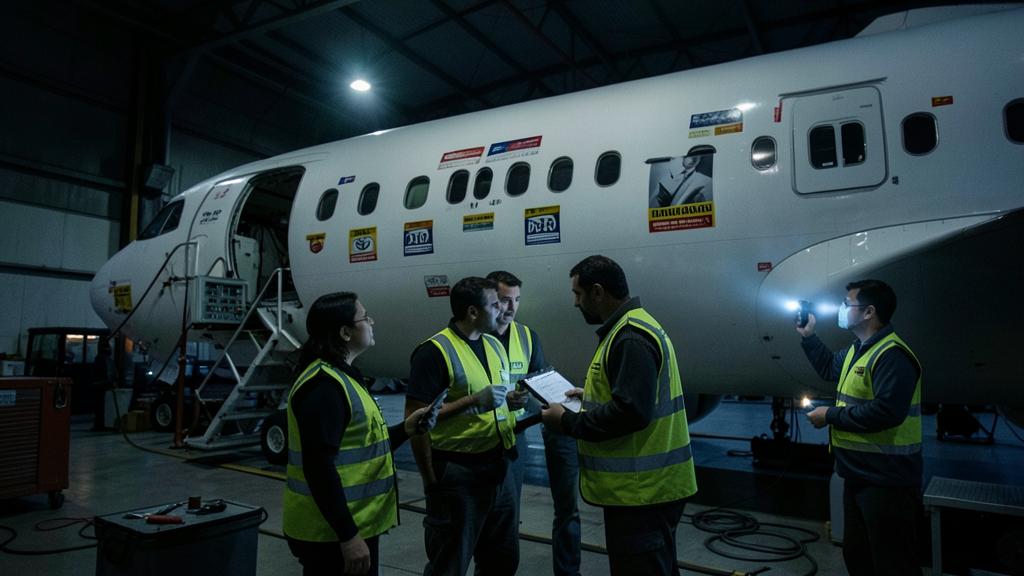
A rising extension rate is generally the most informative of them. It rarely means engineering has become careless; it usually means spares, hangar capacity or scheduled manpower have fallen behind demand, and the shortfall is being absorbed as accepted risk because that is the cheapest place to put it in the short term. That is precisely the kind of drift a safety management system exists to catch, and it is visible in data the operator already generates, which is a rarer property than it sounds. Comparing thresholds and trigger rules between operators — the FL330 forums carry recurring threads on where different fleets set theirs — is usually more instructive than reading another preamble.
The underlying point is simple enough to state and hard to institutionalise. The list defers items one at a time, and its guarantees are stated one at a time. Somebody has to look at the aeroplane, and that somebody has to be given the information, the authority and the time to do it before the crew arrives.


Leave a Reply
You must be logged in to post a comment.