
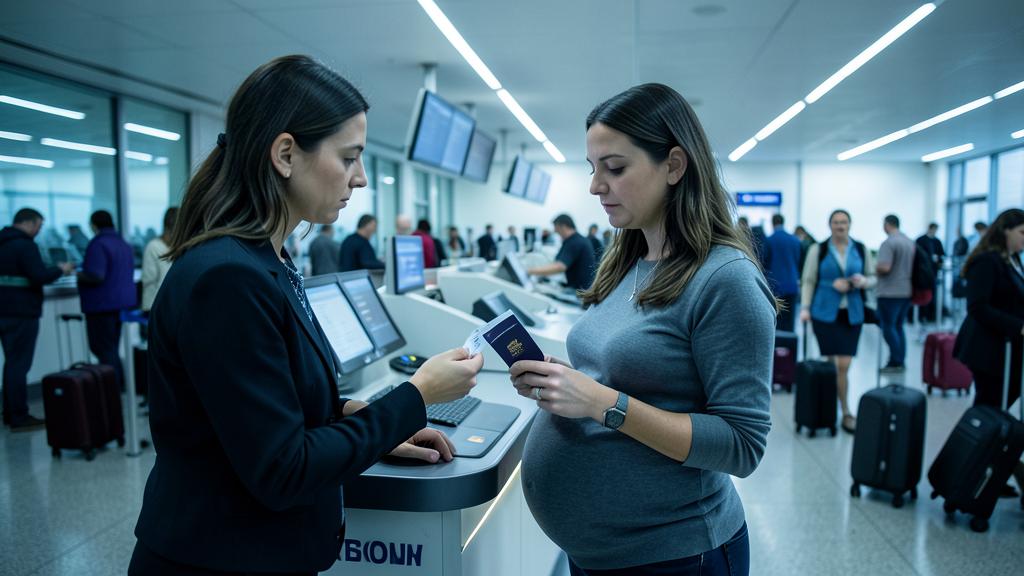
A gate agent glances at a boarding pass, a passport and a woman visibly late in pregnancy, and has perhaps thirty seconds. Whatever is decided in those thirty seconds does not stay at the counter. It arrives in the cabin, at cruise, several hours from anywhere with an obstetric unit, and it lands on a crew who never saw the certificate and were never told. The acceptance rules are thinner than most people assume; they are contractual rather than regulatory, and the practical consequences fall almost entirely on cabin crew. This is the chain, from the counter to the diversion decision and back to the paperwork.
There is no international week limit, and that is the first thing to know
Nothing in the ICAO Annexes fixes a gestational age beyond which a passenger may not fly. Nothing in the European operational rules does either. Annex 6 and the European air operations rules oblige an operator to hold procedures for the carriage of passengers who need special conditions, and they oblige the commander to retain the authority to refuse carriage, but neither writes a number of weeks.
The number lives in the operator’s conditions of carriage: a contract term, published by the airline, applied by ground staff, and varying from carrier to carrier. That single fact explains most of the friction crews encounter. A passenger genuinely accepted on the outbound sector by one carrier can be genuinely refused on the return by another. On an interline or codeshare itinerary, the conditions that apply are those of the operating carrier for each sector, which is not what the passenger was told when the ticket was sold.
| Element | Common industry practice | Source of the requirement |
|---|---|---|
| Early and mid pregnancy, uncomplicated | Carried without documentation | Operator contract; no aviation rule involved |
| Later single pregnancy | Medical certificate commonly required, often dated close to the day of travel, stating the expected date of delivery and the absence of complications | Operator contract, informed by obstetric guidance |
| Multiple pregnancy | Thresholds set earlier than for a single pregnancy | Operator contract; earlier average onset of labour |
| Beyond the operator’s threshold | Refusal of carriage | Operator contract |
| Any pregnancy with a complication, or needing oxygen, a stretcher or an escort | Medical clearance through the operator’s medical department, usually on the industry medical information form | Operator medical clearance procedure |
| Refusal on the day, at the aircraft door | Commander’s authority, exercisable regardless of what the counter decided | Operating rules on commander’s authority |
Read that table the way a crew member should: every line except the last is a commercial term. The last line is the only one with regulatory force, and it is the one that gets used least.
Where the usual thresholds actually come from
Cabin crew are often taught that the limits exist because of cabin altitude. That is a small part of the truth and not the driving part.
A transport aeroplane is certified so that the cabin pressure altitude does not exceed a defined maximum at the aeroplane’s maximum operating altitude, and the classic figure in the large aeroplane certification codes is the equivalent of about eight thousand feet. Composite-fuselage generations hold a lower cabin altitude in normal cruise. The consequence for a healthy pregnancy is a modest fall in maternal arterial oxygen tension, largely offset on the fetal side because fetal haemoglobin binds oxygen more avidly than the adult form and the fetal dissociation curve sits to the left. A healthy placenta absorbs this without difficulty. A placenta that is already marginal, a mother who is anaemic, or a mother with cardiac or respiratory disease, does not — which is precisely why the certificate asks about complications rather than about weeks alone.
The second real factor is immobility in a hypercoagulable state. Pregnancy raises the risk of venous thromboembolism, and the risk stays raised through the weeks after delivery. Long sectors, a cramped seat and reluctance to disturb a sleeping neighbour compound it. This is the part cabin crew can genuinely influence, and it costs nothing: hydration, an aisle seat, and an explicit invitation to get up.
But the week thresholds themselves are not physiological. They are actuarial. They exist because the probability of spontaneous labour rises steeply near term, and because an aeroplane at cruise has no obstetric capability, no neonatal warming, no blood, and no way of being anywhere else for hours. The threshold is not a statement about whether flying is harmful. It is a statement about what happens if the pregnancy ends while the aircraft is airborne.
The trap. A certificate cleared at the counter reads to everyone downstream as reassurance. It is not. It attests fitness on the day it was written, in a consulting room, at ground level, by a clinician who was not asked to predict the next seventy-two hours. It transfers no capability to the aircraft.
Airlines set their own rules for how late in pregnancy someone can fly, not regulators. These rules exist because labor can start suddenly, and planes aren’t hospitals. A doctor’s note only says the passenger was fine when they wrote it, not that they’ll stay fine in the air.
Airline A allows flights up to 36 weeks for single pregnancies, while Airline B stops at 34. A passenger flying with Airline A on the way out but Airline B on the return might be denied boarding despite having the same doctor’s note.
What the cabin actually receives, and what it usually does not
Unless the passenger requested special assistance, there may be no trace of the case in anything the cabin crew see. A medical certificate checked at the counter is generally not forwarded; it satisfies the contract and stops there. The structured route — the industry medical information form, operator medical clearance, a coded entry on the passenger list — is normally reserved for passengers needing oxygen, a stretcher, an escort or a clearance decision. A late but uncomplicated pregnancy typically generates none of that.
The practical consequence is that the only reliable transfer of information is a human one. The purser asks the gate; the gate answers; the crew are briefed. Where that habit exists it works. Where it does not, the first the cabin knows is a call light.
Three placement decisions follow, and all three are cabin crew decisions. A pregnant passenger is not seated at an emergency exit, because exit seat occupants must be able-bodied and able to operate a heavy exit and assist others; this follows from the rules on seating passengers who need special conditions and from every operator’s exit seat policy, and it is not a courtesy. An aisle seat serves mobility and access. And proximity matters in both directions: close enough to a galley that a crew member passes often, and close enough to a lavatory that the passenger is not deterred from moving.
Three events, three completely different demands
Cabin crew are not expected to diagnose. They are expected to recognise a pattern well enough to describe it accurately to someone who can. The three patterns that matter in late pregnancy make very different demands on the aircraft.
| Pattern | What the cabin sees | What crew can genuinely change | Effect on the diversion question |
|---|---|---|---|
| Onset of labour | Regular tightening at shortening intervals, back pain, rupture of membranes | Time the intervals and record them; left lateral position; privacy; early and honest brief to the flight deck | Strong but not always immediate. A first labour is rarely precipitous, and the useful number to give the flight deck is the interval trend, not a guess |
| Bleeding | Fresh loss, often with pain; possible collapse out of proportion to what is visible | No examination of any kind; quantify by counting what is soaked; left lateral; oxygen per ground advice; continuous observation | High and urgent. Concealed loss means the visible volume understates the problem |
| Hypertensive emergency | Severe headache, visual disturbance, upper abdominal pain, sudden swelling; then possibly a seizure | Recognise the cluster and say it out loud; protect from injury if a seizure occurs; left lateral afterwards; nothing by mouth | High. This is the pattern most often first read as anxiety or airsickness, and the one that deteriorates fastest |
The left lateral position appears in all three lines for one reason worth remembering rather than memorising: near term, a supine mother compresses her own inferior vena cava with the weight of the uterus, venous return falls and blood pressure follows. Turning her onto her left side is the single most useful physical action available in a cabin, it requires no equipment and no clinical judgement, and it is reversible if it does not help.
The good reflex. At the pre-flight briefing, ask one question: is anyone on board today whose condition would change how we handle a diversion? Then find out the seat number, tell the crew member working that zone, and note who is sitting next to them. Thirty seconds of briefing buys the only thing a cabin cannot manufacture in flight, which is warning.
The kit you have, and the kit you almost certainly do not
What is carried is fixed by the operating rules and by the operator’s own specification: first aid kits sized to the passenger complement, an emergency medical kit intended for use by a qualified responder on aircraft above defined thresholds, a universal precaution kit, and on many fleets a defibrillator. The contents lists are approved and stable. Obstetric provision is not part of that standard picture. Some operators add a maternity pack, and some do not; the honest position for a crew member is to know which is true on their own fleet before the day it matters.
Two shortages deserve to be understood in advance. The first is oxygen. Therapeutic oxygen is a finite quantity carried for the flight, not a supply. A two-hour diversion during which a passenger is on continuous oxygen consumes a large share of it, and the flight deck needs to know the consumption rate to plan, which means someone in the cabin has to track it. The second is thermal. A newborn loses heat very quickly, and a cabin has neither a warmer nor a way of drying and wrapping to any standard. Blankets, skin contact with the mother and keeping the head covered are the whole toolkit.
There is also a dispatch consequence nobody mentions during the event. Kits that have been opened and used must be restocked, and an incomplete emergency medical kit can affect the aircraft’s ability to depart on the next sector. It is worth recording exactly what was opened, because someone on the ground will need that list within the hour.
The diversion decision is not a medical decision
This is the point most often misunderstood in the cabin. A ground medical advisory service — many operators subscribe to one, reachable by satellite communication — gives advice. It does not decide. The commander decides, and the decision is a composite one in which the medical input is one term among several.
| Actor | Decides | Must supply |
|---|---|---|
| Cabin crew at the seat | Nothing about the flight path | Observation, timings, quantities, trend. Facts, in the order they happened, with the clock attached |
| Senior cabin crew member | Cabin resource allocation, privacy, whether to make a medical call for volunteers | One consolidated picture to the flight deck, and revisions when it changes |
| Ground medical advisory service | Nothing | Clinical interpretation and a recommendation on urgency |
| Operations control | Nothing about the flight path | Airport capability, handling, curfews, receiving hospital distance, crew duty consequences |
| Commander | The diversion, the airport and the timing | The reasoning, recorded |
The composite nature of the decision produces an outcome cabins sometimes read as indifference. The nearest runway is frequently not the best destination. An airport thirty minutes away with no obstetric unit within a further two hours of road can be a materially worse choice than an airport ninety minutes away with a maternity hospital on the perimeter. Landing weight matters too: an aircraft heavy after a short time airborne may need to burn or jettison fuel, and that is time the cabin should be told about rather than left to interpret. So does the crew’s own flight duty period, because a diversion frequently ends the working day and strands the passengers, which is an operational consequence, not a reason to delay.
What the cabin owes the flight deck, therefore, is not a recommendation. It is a description precise enough that the composite decision can be made on facts. « She is bleeding » is not usable. « Fresh loss, four blankets soaked in twenty minutes, pale and cold, pulse fast at the wrist, conscious » is.
Afterwards, the part nobody rehearses
An in-flight obstetric event generates more administrative work than almost any other cabin occurrence, and most of it has to be started while the memory is intact.
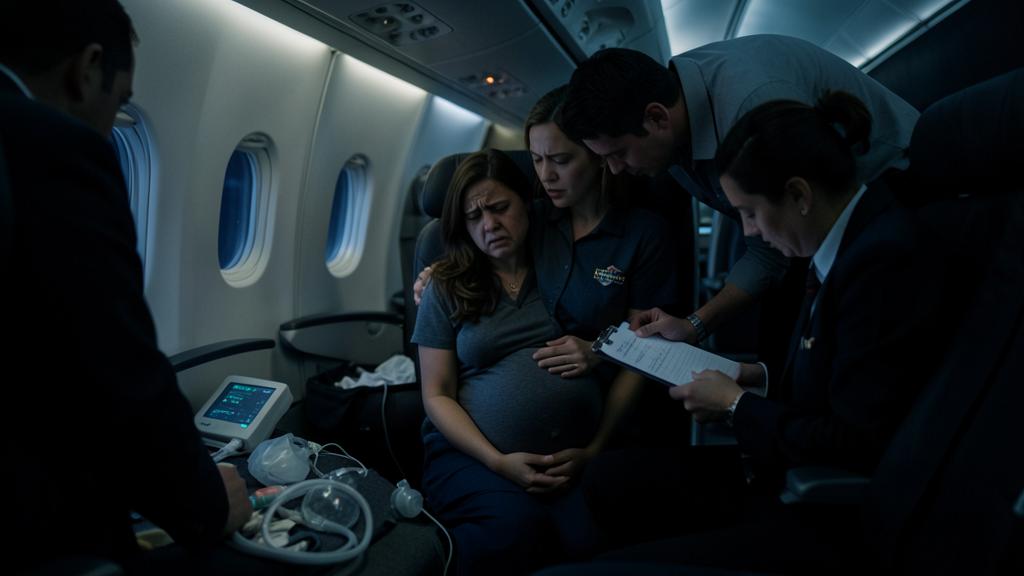
- A written account with times: onset, first observation, first call to the flight deck, first contact with ground medical advice, position changes, oxygen started and stopped, and the state of the passenger at handover.
- The identity and stated qualification of any volunteer responder. Liability protection for medical volunteers exists in some jurisdictions and not others, and the operator’s insurer will want the record either way.
- The list of equipment opened, for restocking and for the next sector’s dispatch.
- A safety report through the operator’s occurrence reporting channel, separate from the medical report. The two exist for different readers and the second one is the one that changes procedures.
The questions crews worry about most — where a child born in flight is registered, what nationality follows — are genuinely not a cabin problem. They are resolved afterwards by reference to the state of registry of the aircraft, the law of the state overflown and the parents’ own nationality law, and they have never once required a decision at altitude. Record the time and the position if you can get it from the flight deck, and let the lawyers do the rest.
The through-line from the counter to the diversion is short and worth stating plainly. Acceptance is a contractual decision made by someone with thirty seconds and no clinical training, and it commits an aircraft with no obstetric capability to carrying a risk that the cabin will have to manage alone. That is not an argument for refusing more passengers. It is an argument for the briefing question, the seat placement and the honest description — the three things that are entirely within the cabin’s control. Crews comparing how their operators handle this in practice will find the discussion running on the FL330 forums.


Leave a Reply
You must be logged in to post a comment.