

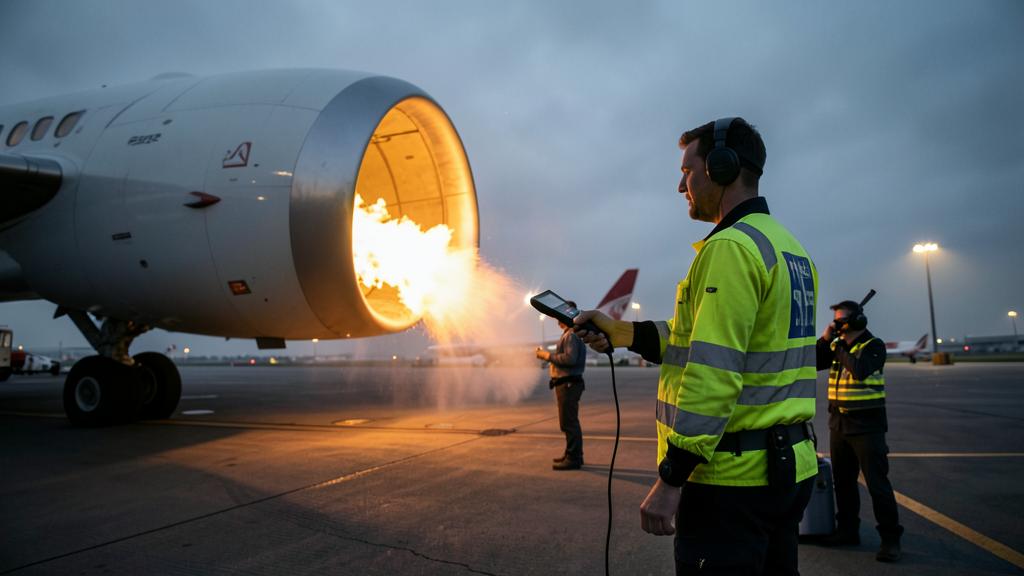
Two ground handlers, same station, same shift. The first spends twenty minutes per rotation near an engine starting and the rest in a moderate environment; the second remains eight hours in constant but significantly lower noise. Upon arrival, it’s the first who exceeds the upper action value. The regulatory calculation doesn’t count decibels, it counts acoustic energy, and this difference in nature explains most misunderstandings surrounding hearing protection on a traffic area.
The dose, not the level
The regulatory indicator is not an instantaneous level but a daily exposure, noted LEX,8h: the continuous A-weighted equivalent level measured during actual working time, then adjusted to a reference day of eight hours. Two distinct operations, often confused. The first is an energy average over the actual working duration; the second is a normalization, which alone allows comparing a six-hour shift and a ten-hour shift.
Behind this construction lies a health assumption, the equal energy principle: two exposures delivering the same amount of acoustic energy to the ear are considered to carry the same risk of hearing loss, regardless of how this energy is distributed over time. The assumption is convenient and reasonably supported for stable noises; it is more debated for highly fluctuating noises, i.e., precisely the regime of a traffic area.
The arithmetic consequence is brutal. A 3 dB increase doubles the received acoustic power: at constant energy, the admissible duration is halved. Eight hours at a given level are equivalent to four hours at that level plus 3 dB, two hours at plus 6 dB, one hour at plus 9 dB. A task that “lasts only a quarter of an hour” can therefore weigh more than an entire quiet day. The order of magnitude matters here more than the decimal: it’s the ratio between tasks, not the precision of the sound level meter, that decides the result.
This exchange rate is not universal: other national regimes, outside Europe, retain a doubling every 5 dB, significantly more permissive for short and intense tasks. Comparing two assessments without verifying the constant used therefore makes no sense.
The key idea is that loud noises for short periods can be just as harmful as quieter noises for longer periods. A 3 dB increase in noise level means you can only be exposed to it for half as long to get the same “dose” of noise. This is why a few minutes near a loud engine can count more than hours of quieter work.
A ground handler spends 20 minutes near an engine at 100 dB(A) and 7 hours and 40 minutes in an 80 dB(A) environment. The 20 minutes at 100 dB(A) contributes about 65% of the total noise dose, while the 7 hours and 40 minutes at 80 dB(A) contributes only about 35%. This shows how short, intense exposures can dominate the total noise exposure.
Hence a language discipline: speaking of the “noise level of a position” means nothing until you’ve stated how long it lasts. A level without duration is not an exposure.
Three thresholds, three obligation regimes
The European system, adopted in national labor law, superimposes three trigger levels. Each is expressed as a pair: a daily exposure and a peak level. The two criteria are independent, and the crossing of either is sufficient to trigger the obligations attached to the threshold.
| Seuil | Exposition quotidienne | Peak level | What exceeding it triggers |
|---|---|---|---|
| Lower exposure action value | 80 dB(A) | 135 dB(C) | Information and training for workers, provision of hearing protectors, access to audiometric testing. |
| Upper exposure action value | 85 dB(A) | 137 dB(C) | Actual wearing of protectors, programme of technical and organisational reduction measures, signage and restricted access to areas where feasible, audiometric surveillance. |
| Exposure limit value | 87 dB(A) | 140 dB(C) | Must not be exceeded. If exceeded, immediate reduction action is required, together with investigation of the causes and review of preventive measures. |
The point least remembered is the following: the two action values are assessed at the workplace, without counting the protector. They describe the noise to which the work organization exposes the agent, not that which reaches their eardrum. The limit value, however, is assessed taking into account the effective attenuation of the worn protector: it is the only one of the three that speaks of the ear.
The asymmetry follows the hierarchy of prevention measures: first act on the source and propagation, with individual equipment only intervening as a last resort. Eliminating the crossing of an action value by distributing headsets would be to remove the obligation to reduce noise at the very moment it arises.
The pitfall. Distributing protectors does not bring a station below the upper action value. The threshold remains crossed, and with it the signaling of zones, the technical and organizational reduction program, and the audiometric monitoring. An assessment that presents an exposure “after protection” and compares it to the action values confronts two quantities that do not have the same definition.
The peak does not dilute into the average
The peak level is not a peak of the average, it is a quantity of a different nature. It is measured with a C-weighted frequency response, flatter in the low frequencies than the A-weighted response, and with a peak detector that follows the instantaneous pressure instead of calculating the effective value. An integrator set to the A-weighted average, no matter how precise, will never correctly restore an event of a few milliseconds.
The arithmetic confirms this: a shock of a few milliseconds weighs only an infinitesimal fraction of the 28,800 seconds of a reference day, and its contribution to the daily exposure is several tens of decibels below its own peak level. An event approaching the peak limit can therefore remain perfectly invisible in the dose calculation.
The lesion mechanism also differs. The dose describes a metabolic fatigue of the hair cells, cumulative and definitive when repeated; the peak describes a mechanical strain, shearing of the stereocilia and sudden stress on the tympanic-ossicular system, with a risk of acute acoustic trauma from a single event. Nothing requires the two criteria to be crossed together, and nothing allows one to compensate for the other.
On the ramp, the peak sources are not the most impressive to the ear: pneumatic tools, purging of an air circuit, slamming of a cowl, falling of a metal element in an empty hold, warning of a handling vehicle. They are brief, common, and often absent from the inventory of noisy tasks because they are associated with a gesture and not a nuisance.
Reconstructing a day that resembles the day
The measurement is not done by guesswork. Standardized methods offer three strategies—task-based measurement, function-based measurement, full-day measurement—and the first is by far the most instructive: it forces the shift to be divided into homogeneous tasks, each timed and assigned its own level. It also produces a debatable uncertainty, which a single figure from a dosimeter worn on a given day does not.
A textbook example suffices to show where the result lies.
| Task | Duration | Equivalent level | Share of time | Share of dose |
|---|---|---|---|---|
| Engine start and pushback | 20 min | 100 dB(A) | 4 % | 65 % |
| Hold loading, APU running | 3 h | 87 dB(A) | 38 % | 29 % |
| Vehicle movement and manoeuvring | 3 h | 80 dB(A) | 38 % | 6 % |
| Equipment room, preparation, break | 1 h 40 | 70 dB(A) | 20 % | less than 1% |
| Whole shift | 8 h | 88 dB(A) | 100 % | 100 % |
Twenty minutes, or 4% of the time, account for nearly two-thirds of the received energy. Three hours of vehicle circulation account for 6%. Removing the engine start task alone would bring the shift down to around 84 dB(A), i.e., below the upper action value, without changing the rest of the day.
This dictates the precision to be sought: a five-minute error in the duration of a 100 dB(A) task shifts the result more than a one-hour error on an 80 dB task. It is also what weakens the notion of a “representative day.” The deicing season, a night freight rotation, an engine test, or a broken boarding bridge that extends ground handling do not average with the rest: they are distinct profiles, to be assessed separately.
The right reflex. Time before measuring. Establish the inventory of tasks and their actual durations over several shifts, then only instrument those that matter. A measurement campaign conducted without a reliable time budget produces a very precise figure based on false data.
What the protector does not do
The attenuation listed on a protector’s packaging is a laboratory performance: trained subjects, controlled fitting, standardized test noise. It does not announce what the agent will obtain on the ramp. Selection methods actually provide a discount, and the calculation of the effective exposure at the eardrum must start from the discounted value, never from the one on the packaging.
A few fitting defects are enough to erase most of the gain. The arms of a pair of glasses slipped under the cushion of a headband open a leak of a few tenths of a millimeter, which is mainly paid for in the low frequencies; a hood, a winter balaclava, or a protective helmet do exactly the same thing. A poorly inserted or deformed earplug, or one deformed by months of use, loses a significant portion of its attenuation without the wearer noticing: the noise remains muffled, the ear thinks the protector is working.
But the first factor, the one that dominates all others, remains the wearing time.
Removing the headset for five minutes per hour, to answer a radio, to be understood by a colleague, or simply because it’s hot, does not cost 8% of the attenuation: it can cost more than half. And the degradation occurs at the worst time, since it’s when the noise is loudest that one feels the need to talk.
The pitfall. A protector advertised at 30 dB and worn 95% of the time does not provide 28 or 29 dB: it provides around 13 dB. The effective protection is read on the fraction of time the equipment is actually in place, not on its packaging. An assessment assuming continuous wear can overestimate protection by about 15 decibels.
Two other limits are worth knowing. The combination of earplugs and headband does not add the attenuations: the gain is a few decibels above the best of the two, with bone conduction imposing a ceiling of around forty to fifty decibels regardless of the equipment. And over-protection is a risk in itself, with the agent too isolated no longer hearing the warning of a vehicle or their own radio: selection methods aim for an effective level at the eardrum within a useful range, typically around 70 to 80 dB(A), and not the lowest possible.
The blind spots of the system
The noise dose answers one question, and only one: the risk of permanent hearing loss. Anything that is not a cochlear injury escapes it.
Speech masking, first. An environment around 85 dB(A) degrades intelligibility long before threatening hearing, and a poorly understood instruction between a marshal, a tug driver, and a crew is an immediate operational risk that does not appear in any noise exposure calculation. The startle response caused by an unanticipated peak near a moving vehicle belongs to the same family.
The A-weighting, then. It deliberately underweights low frequencies, where the ear is less sensitive to moderate levels. A spectrum dominated by an auxiliary power unit or the idle thrust of a jet engine will therefore be described by a relatively low A-weighted figure, while these components pass poorly through protectors and are felt as much as vibration as noise. The difference between the C-weighted and A-weighted levels of the same situation is the indicator that signals a low-frequency spectrum and should guide the choice of protector.
The long term, finally. Exposure is calculated over a day; hearing loss develops over a career. Prediction models cross the level and the number of years of exposure, and the characteristic notch around 4 kHz often precedes by several years the reported discomfort. No noise measurement says what has happened to a given ear: only the audiogram does.
Finally, a persistent confusion must be dispelled. The acoustic certification of aircraft, with its measurement points at takeoff, overflight, and approach, protects the local population. It says nothing about the level received a few meters from an air intake at idle, and no threshold applicable to the traffic area is derived from it. The protection of ground personnel is entirely governed by labor law, in a body of regulations that ignores aviation.
The right reflex. Read the audiometry in trend, not in verdict. An examination still “normal” that shows a progressive drop around 4 kHz from one check to another signals poorly controlled exposure, even though no monitoring threshold has been crossed. It is the only individual feedback available to the entire system.
What to check in your station
A noise risk assessment can be read in a few minutes when you know what to look for.
- The date and scope. Are night operations, the deicing season, engine tests, and degraded operations covered? An assessment conducted on a Tuesday in May describes a regime, not a station.
- The inventory of tasks and their durations, more decisive than the levels themselves.
- The origin of the peak level. Measured with a C-weighted peak detector, or deduced from the average? In the latter case, it is worthless.
- The discount method and the wearing time hypothesis. If the hypothesis is continuous wear, the result is optimistic, typically around ten decibels.
- The status of communication headsets. Protector, radio equipment, or both? The volume of a speech restoration system can return more to the eardrum than the ambient noise.
- The coherence between zone signaling and actual traffic. Marking placed on an outdated circulation plan protects no one.
Remain gray areas that the text does not resolve. On the same ramp, agents working for different employers, each responsible for their own assessment, are all exposed to the noise produced by the others. Transient personnel—crew in exterior turn, technician in punctual intervention, quality controller—are not attached to any stable profile and often find themselves without suitable protection. These situations are resolved by coordination between operators, the quality of which varies greatly from one platform to another; field feedback circulates mainly among practitioners, notably on the FL330 forum.
The type of operation shifts the entire profile, and that is what makes an assessment non-transferable. On a short-haul station, the dose comes from repetition: several rotations per shift, therefore as many engine start and pushback sequences, and an exposure dominated by a few brief tasks that recur endlessly. On a long-haul station, rotations are rare but ground handling is extended, with auxiliary or parking engines running for hours: the dose becomes a continuous background, lower, while peak events become rarer. Night freight combines both difficulties, with often older ground equipment and reduced staff that increases the time each spends near the sources. An assessment copied from another platform is therefore rarely wrong about the thresholds: it is wrong about the distribution, and it is the distribution that makes the dose.
The values, definitions, and obligations recalled here are provided for information. The applicable text, its national transposition provisions, and the operator’s approved documentation prevail in all circumstances over this article.


Leave a Reply
You must be logged in to post a comment.