
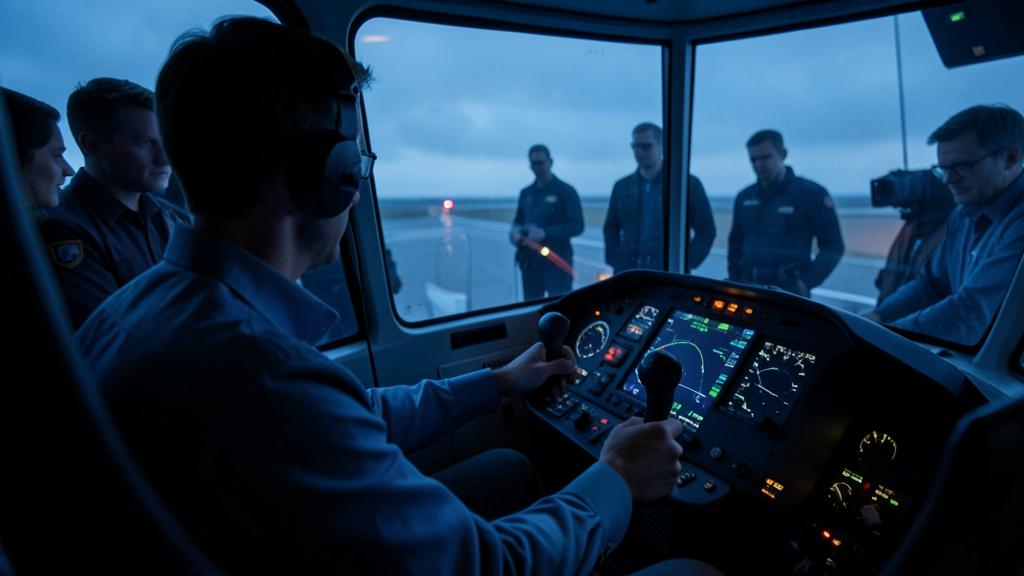
Long absences from the flight deck are ordinary events in a career: parental leave, a medical suspension, a ground posting, a period of unpaid leave, a fleet transition that stalled, an economic pause imposed on a whole airline at once. What is not ordinary is the way the return is handled, because the regulation says remarkably little about it. It fixes the minima that make a licence and an operator qualification valid, and then hands the real question to the operator: how much of a programme does this particular person need, after this particular gap, to be released to the line. Everything interesting lives in that gap between a legal minimum and a professional judgement, and the answer is not proportional to the number of months.
Recency is a floor, not a measurement
The recency rules are precise and narrow, which is exactly what makes them easy to misread. To carry passengers, a pilot must have completed a defined number of take-offs and landings within the preceding ninety days on the applicable type or class — three, in the European and American rules alike — and most authorities allow those to be completed in a suitably qualified full flight simulator, which is how airlines normally restore it. Alongside that, the licence carries a type rating that must be revalidated by a proficiency check at its own interval, and the operator qualification carries a cycle of its own. In the European scheme that means two operator proficiency checks in a rolling twelve months, an annual line check, annual emergency and safety equipment training and recurrent crew resource management; other authorities arrange the same functions on their own intervals.
None of that measures readiness. It measures whether a set of validity dates has been kept alive. A pilot can be entirely legal, having performed three simulator landings and a proficiency check last month, and still be a long way from being able to run a busy arrival into an unfamiliar airport with a junior first officer and a deferred item on the aeroplane. The regulation knows this, which is why the operator’s obligation is expressed as a duty to establish a programme rather than as a table of hours.
There is also a threshold that changes the legal picture entirely. While a type rating is still valid it is revalidated by a check. Once it has expired it must be renewed, and renewal goes through an approved training organisation, which assesses the individual case and sets whatever refresher training is needed before a check can be attempted. That is the point at which somebody with a name has to make a judgement about a specific person, and the quality of the return depends almost entirely on how seriously that judgement is taken.
What decays, and in what order
The intuition that hand-flying goes first is only half right. Gross motor skill and basic instrument scan are surprisingly durable, and pilots returning after a year usually fly acceptable raw-data circuits within a session or two. What degrades faster, and recovers more slowly, is everything that has to be produced quickly and without prompting.
Procedural recall for rarely used items decays first: the memory items nobody has needed for a year, the shape of an abnormal checklist, the sequence of a missed approach. Automation mode fluency goes next — not the knowledge of what the modes do, which survives, but the speed of recognising a mode that is not the one expected. Then comes the thing that matters most and is measured least: spare capacity. A returning pilot flies the aeroplane accurately while spending far more attention on it than a current pilot would, and the deficit shows up not in the manoeuvre but in what was missed while the manoeuvre was being flown.
Pilots returning after a long break lose some skills faster than others. Basic flying skills stay sharp, but quick decision-making and remembering rare procedures fade quickly. The hardest part to regain is the ability to multitask—doing many things at once without missing anything important.
An Airbus A320 pilot returning after 12 months of parental leave might struggle with a rejected takeoff (RTO) checklist at first, even though they remember the basics of flying. In a simulator, they might fly the approach perfectly but forget to brief the first officer about a deferred item, showing their spare mental capacity is still recovering.
Note the last line. Part of what a returning pilot has lost is not a skill at all: it is currency with the organisation. Manual revisions, a new minimum equipment list standard, a modified fleet, new destinations, changed airspace, a different fuel policy. That component is unrelated to the length of the absence and entirely related to what happened during it, and it is the part most often left to the individual to catch up on unaided.
Why the reason for the absence changes the programme
Two pilots returning after fourteen months are not in the same position, and treating them identically is the most common design fault in return-to-line programmes. Someone who spent the period in a ground safety role has kept their technical and company knowledge alive and lost the hands and the tempo. Someone who spent it on parental leave has lost both, but arrives rested and motivated. Someone returning from long-term illness may have a medical certificate to reinstate, a possible operational limitation on it, and — more importantly for the programme — a legitimate anxiety about performing in front of an examiner, which will distort everything the instructor sees in the first session if it is not acknowledged.
An absence caused by a failed check or a suspension is different again, because the objective is not only to restore what was lost but to address what produced the event in the first place, and the programme must be designed by someone who has read that file.
The good habit. Start the programme with a conversation and a self-assessment before booking any device. The pilot generally knows which parts they are least sure of, and a returning pilot who has been asked what worries them will tell an instructor things that no amount of observation will reveal in a four-hour session.
The building blocks, and how they are assembled
Whatever its length, a return package is built from the same set of components. The skill is in choosing which are needed, and above all in their order.
- A change package. Everything that moved during the absence — manual revisions, fleet modifications, procedural changes, new destinations, new equipment — assembled by somebody else, not left as a search task for the returning pilot.
- Technical and procedural refresher on the ground, ending in a knowledge check that exists to direct the training rather than to pass or fail.
- Flow and procedure work in a low-fidelity device. The cheapest hour in the whole programme, and the one most often skipped in favour of going straight to the full flight simulator, where the same rustiness is rediscovered at ten times the cost.
- Full flight simulator sessions, beginning with handling and normal operations, then abnormal and emergency work, then complete line-oriented scenarios flown in real time.
- The required checks — proficiency check, and the recency landings if they were not covered — placed after the training, not used as the training.
- Line flying under supervision, with a defined number of sectors and a line check to release.
- A restricted period after release, with pairing and operational limitations that expire on a date or on a number of sectors.
The order matters more than the volume. A programme that puts a check early, to find out where the pilot stands, reliably produces a worse result than one that trains first and checks afterwards, because a returning pilot performing under assessment in the first session spends their scarce spare capacity on the assessment.
Calibrating by the length of the gap
Operators publish a matrix in their operations manual: an absence band on one axis, a package on the other. The bands and their contents are the operator’s own — no regulation fixes them, which is precisely why they vary so much between airlines. What follows is the shape such a matrix usually takes, not a standard.
| Absence band | Typical package | Release to the line |
|---|---|---|
| Weeks, all validities current | Self-briefing on changes; recency landings if the ninety-day window has run out | Normal line duty, sometimes with a pairing restriction |
| A few months, validities current | Change package, one simulator session covering handling and normal operations | A small number of supervised sectors |
| Several months, one or more validities expired | Ground refresher, procedure trainer, two or more simulator sessions, proficiency check | Supervised sectors and a line check |
| Around a year or more | Refresher training determined case by case, full simulator programme, checks, sometimes elements of the type course | Extended supervision and a line check |
| Type rating expired for a long period | Renewal training at an approved organisation, volume set on the individual case | Full supervised entry, as for a new joiner |
Two modifiers change the answer more than the band does. The first is total experience on the type: three thousand hours on the aeroplane before the gap is not the same starting point as two hundred, and the difference is greater than several months of absence. The second is what changed during the absence — a fleet that was modified, a procedure set that was rewritten, an operation that added a new kind of destination. An absence during a quiet period is a smaller problem than a shorter absence across a major change.
Restoring recency is not restoring competence
Because the ninety-day landing requirement is easy to satisfy in a simulator, it is tempting to treat it as the return programme. It is worth being explicit about what those three approaches actually restore: the legal ability to carry passengers, and a little of the sight picture. They restore nothing about workload management, nothing about mode awareness under time pressure, and nothing about the rare procedures that decayed first.
The trap. A returning pilot who has completed three simulator landings and passed a proficiency check has satisfied every date on the record and may be nowhere near line-ready. Validity dates are the one thing a rostering system can see, which is exactly why they get used as the release criterion. The release decision belongs to a person who has watched the pilot operate, not to a system that has checked a calendar.
Operators running evidence-based training have a better instrument here, because the competency framework gives the instructor something to describe other than manoeuvre outcomes: application of procedures, communication, flight path management by hand and by automation, leadership and teamwork, problem solving and decision making, situation awareness, workload management, and knowledge. A returning pilot’s weakness is almost never in flight path management, and almost always in workload management and situation awareness — which a manoeuvre-based grading sheet has no way of recording.
Line flying under supervision, and the decision to release
The supervised sectors are where the programme either works or is revealed not to have. A minimum number is defined, but the number is a floor and the instructor’s judgement is the actual criterion. Three things are worth watching for specifically, because they distinguish a pilot who is genuinely back from one who is coping well.
The first is the recovery from a change of plan: a runway change, a hold, a late re-clearance. A rusty pilot handles the change correctly but slowly, and pays for it later in the approach. The second is what happens to the briefings and the monitoring when the pilot is flying: is the other seat still being supported, or has all the capacity gone into flying accurately? The third is the tempo of routine communication, which is a reliable and underused indicator of how much attention is left over.
Instructor continuity helps more than instructor seniority. Two or three supervisors who each see one sector cannot see a trajectory; the same supervisor over several sectors can say whether the pilot is improving, and that is the question the release decision actually turns on.
The restricted window after release
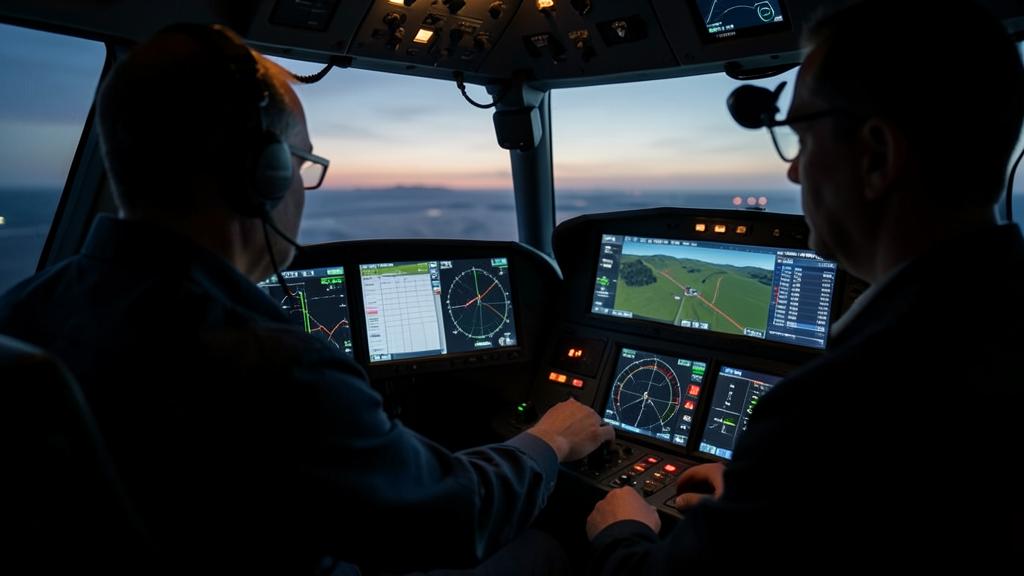
Release to the line is not the end of the programme. Most operators impose a period during which the returning pilot is treated as inexperienced, which is a technical status with consequences: not paired with another inexperienced crew member, not rostered to the most demanding aerodrome category, kept out of low-visibility operations until the specific qualification and its own recency are restored, and sometimes required to apply an increment to the aerodrome operating minima until a defined experience on type is reached.
| Restriction | Why it exists | Usually lifted by |
|---|---|---|
| No pairing with another inexperienced crew member | Two people with reduced spare capacity on the same flight deck | A number of sectors, or a date |
| Restricted aerodrome categories | Demanding aerodromes require a briefing and, sometimes, a prior visit or simulator exposure | Completing the required briefing or exposure |
| No low-visibility operations | The qualification carries its own training and recency requirements | Restoring the specific qualification |
| Roster shaping, avoiding the heaviest patterns | Fatigue interacts badly with reduced spare capacity | The end of the defined window |
The same logic applies beyond the flight deck. Cabin crew who have not operated for a defined period — commonly six months in European rules — require refresher training before being assigned to duties, and licensed engineers must have exercised their privileges within a recent window before they may certify again. In every case the principle is the same: the licence records what somebody was once assessed as able to do, and the operator’s programme is what establishes that they can still do it today. Career and training questions of this kind, including how operators structure their return matrices, come up regularly in the training discussions on the FL330 forums.


Leave a Reply
You must be logged in to post a comment.