
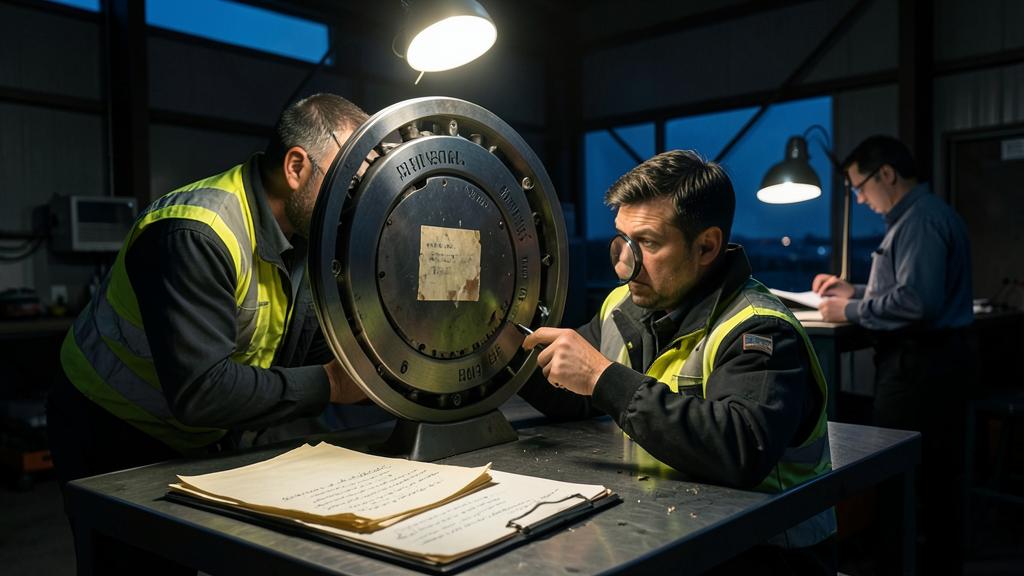
A life-limited part is worth its remaining cycles and nothing else. Remove the record of how many cycles it has already run and you have not damaged the metal, you have destroyed the asset: an engine disc whose history stops mid-way through a lease in 2009 is, in trading terms, a paperweight. Records reconstruction is therefore not administration around the part; it is what turns a physical object back into a certified one. This is how a broken chain is rebuilt from the origin, which substitutions an authority will accept, and the point past which the honest answer is scrap.
Why the paperwork is the part
Life-limited parts are the opposite. A critical rotating part in a turbine engine, and a small family of airframe and rotor components, carry a hard limit expressed in cycles, and sometimes in hours or calendar time. At the limit the part comes off, in perfect condition, and is destroyed. There is no inspection that buys another flight, because the limit exists to keep the part far away from the low-cycle fatigue crack that inspection would not reliably find.
The limit lives in the airworthiness limitations section of the type certificate holder’s instructions for continued airworthiness. It is approved, it is mandatory, and it is not negotiable at operator level. Everything downstream follows from one requirement: at any moment the accumulated count of an installed life-limited part must be known, from a record chain the operator can produce.
That is what makes the trade unforgiving. A serviceable disc with a validated remaining life is priced per remaining cycle; the same disc with an eighteen-month documented gap is unsellable until the gap is closed, because no continuing airworthiness organisation can sign for a count it cannot substantiate.
What « back to birth » actually claims
Back-to-birth traceability is a compact claim with three separable parts, and reconstruction goes wrong when they are treated as one.
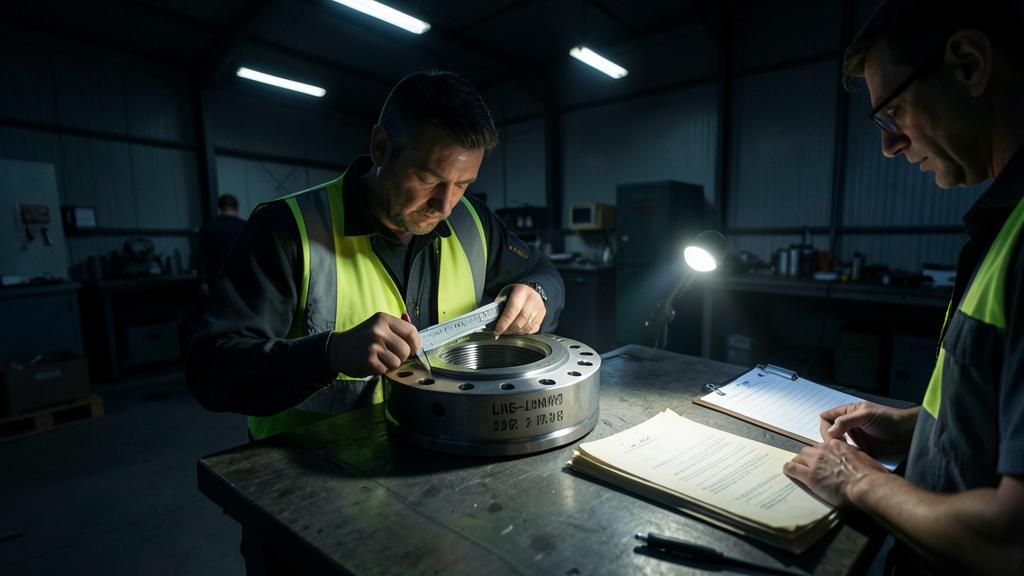
The first is identity: this physical object is the part number and serial number written on the paperwork, it left an approved production organisation as a new part, and it has not been substituted, re-stamped or re-serialised along the way. The second is continuity: from the day it left the factory to today, every period of the part’s existence is accounted for — either installed on a known aircraft or engine accumulating a known count, or in storage accumulating none. The third is arithmetic: the sum of every accumulation period, computed on the correct counting convention, is less than the current published limit.
Identity failures are fatal. Continuity failures are sometimes repairable. Arithmetic failures are simply the answer. Sorting an incomplete dossier into those three buckets before touching anything else is the whole discipline, and the one most often skipped, because chasing missing pages feels more productive than classifying them.
| Document | Proves | Does not prove |
|---|---|---|
| Manufacturer’s certificate of conformity or original release | Origin, part number, serial number, build configuration, ship date | Anything about operating history after despatch |
| Authorised release certificate at each shop visit (EASA Form 1, FAA 8130-3) | That an approved organisation released the part on a date, with the status it declared | That the declared cycle count was itself substantiated |
| Engine or module log book | Installation and removal dates, the assembly the part belonged to | The part’s own count if the assembly’s count and the part’s count diverged |
| Shop visit report, disposition sheet, teardown report | Configuration in and out, what was replaced by what serial number | Nothing about the period between shop visits |
| Operator utilisation records, technical log summaries | Cycles and hours flown by a specific aircraft over a specific period | That the part in question was on that aircraft the whole time |
| Part marking on the hub or bore | Physical identity, when legible and consistent with the records | Any count at all |
No single document carries both the identity and the count. The count exists only where an installation record and a utilisation record overlap on the same dates, which is why reconstruction is a joining exercise before it is a searching one.
Life-limited parts have strict usage limits, and their entire history must be documented to prove they’re safe. If records are missing, experts must reconstruct the history using conservative estimates. If they can’t, the part is scrapped.
A CFM56-5B engine disc with serial number 12345 was last recorded in 2010 with 5,000 cycles. It resurfaced in 2020 in another engine, but records from 2010-2020 are missing. If the authority accepts an estimate at all, the operator must assume a conservative rate, such as 1,500 cycles per year, and declare 20,000 total cycles, even if the actual count was lower. Without acceptable evidence, the disc cannot be returned to service.
Where the holes come from
Gaps have recognisable shapes, and the shape predicts how hard the repair will be.
Operator disappearance. A carrier ceases trading, its continuing airworthiness organisation is wound up, and the archive goes wherever the liquidator sent it. It produces both genuinely unrecoverable periods and, more often than expected, recoverable ones, because the archive frequently survives with a lessor, a former maintenance provider or a national authority that received copies during oversight.
Transfer loss. Records are supposed to move with the aircraft, and in practice a sale transfers the aircraft file while a separately traded engine keeps its own file somewhere else. Life-limited part histories fall through that seam constantly, because the part’s history is engine history, not airframe history, and the two files are maintained by different people.
Media and language decay. Microfiche nobody can read, a database export from a system that no longer exists, entries in a date format the current holder misreads. A file that is technically complete and practically illegible fails the same test as a missing one.
Convention drift. The records exist and are continuous, but they were kept in hours when the limit is in cycles, or they were kept against a counting convention the type certificate holder has since redefined. Nothing is lost, yet the arithmetic cannot be done without a conversion, and the conversion is itself an assumption.
Deliberate manipulation. Rare, and the reason records forensics exists. A gap filled rather than closed — a release certificate whose reference numbers do not fit the issuing organisation’s series, an approval that was not valid on the date shown, a count that decreases across two consecutive documents — puts you in suspected unapproved part territory, with reporting obligations, not in reconstruction territory.
The trap. A tidy, complete-looking file is not evidence of a clean history; it is evidence of a tidy file. The audit that matters runs in both directions — paper to metal and metal to paper. Walk the serial numbers you physically read on the part back into the documents, and separately walk the documents forward to the part. A file assembled to support a sale will survive the first direction and fail the second.
Rebuilding, in the only order that works
Start at the origin, never at the present. Working backwards from today feels efficient because the recent records are the ones you hold, but every backward step compounds an assumption, and you discover the fatal identity problem last, after paying for the rest.
Establish origin first. The type certificate holder can usually confirm, for one of its own serialised parts, that the serial number was issued, what configuration it shipped in, and to whom. That single confirmation resolves identity and gives you a dated starting point at zero. It is also the step most likely to end the exercise early, and cheaply, when the manufacturer has no record of the serial number.
Then build the installation timeline as a chain of intervals, each with a start, an end and an assembly. Every shop visit report is a boundary: a part came out of one engine on a date and went into another on a date. The intervals between boundaries are where utilisation records apply. Where the boundaries are firm and the utilisation is documented, the count is evidence. Where a boundary is firm but the utilisation is missing, you have a bounded gap. Where the boundary itself is missing, you have an unbounded one.
Only then do the arithmetic, and do it on the counting convention the current limit is written against. Some limits count full flight cycles, others weight partial cycles or count against a reference condition. Reconstructing on the wrong convention produces a number that looks precise and means nothing.
The conservative assumption, and what bounds it
A gap is closed by replacing the unknown with a pessimistic value that can be defended. Pessimistic is not a courtesy: it is what makes the reconstruction acceptable, because the reviewer’s question is never « is this the true count » but « could the true count be higher than this one ». If the answer is no, the number can be proposed. Acceptance is not automatic: it has to be agreed by whoever signs for the count, and some authorities will not accept a reconstructed count at all on certain parts.
| Gap | What is known | Defensible substitution |
|---|---|---|
| Installed on a known aircraft, utilisation records missing | Aircraft, dates, route structure | Fleet or type high-utilisation rate applied over the full period |
| Records in hours, limit in cycles | Hours flown, operator’s network | Shortest credible sector length for that operator, giving the highest cycle count |
| Removed on a known date, reinstalled on a known date, whereabouts unknown between | Both boundaries | Assume continuous operation at a high rate for the whole interval, not storage |
| No removal record, next appearance years later in another engine | One boundary only | None available — the period is unbounded |
| Identity of the part unresolved at origin | Nothing usable | None — this is not a gap, it is a different problem |
Two rules govern every line of that table. The gap must be bounded in time, because you cannot apply a rate to an interval of unknown length. And the substituted rate must be defensible from evidence outside the gap — a documented fleet average, a published type utilisation, the operator’s own network — not from the convenience of the result.
The right reflex. Compute the reconstruction twice: once with your chosen conservative assumption, once with an assumption you would consider unreasonably harsh. If the part still has usable life under the harsh case, the argument is over and the review will be short. If the two cases straddle the limit, you are no longer reconstructing a history, you are negotiating one — and that is the moment to stop spending money and reprice the part as scrap.
The three questions that decide it
Every reconstruction ends at the same gate, asked in this order, and a failure at any question makes the following ones irrelevant.
| Question | Answer | Outcome |
|---|---|---|
| Is identity established at origin? | No | Unrecoverable. The part cannot be certified whatever its condition. |
| Is every gap bounded in time? | No | Unrecoverable. No defensible substitution exists for an open-ended interval. |
| Does the conservative count leave usable life? | No | Life expired. The part is not lost, it is simply finished. |
| All three satisfied | Yes | Return to service against the reconstructed count, with the reconstruction retained as a permanent record. |
The distinction in the last two rows is worth holding on to, because it changes what happens next. A life-expired part reached its limit; that is a normal, planned event and the count is trustworthy. An unrecoverable part may have most of its life remaining, and never will be able to prove it. Both go to the same place, but only the second represents destroyed value.
When the part is definitively lost, and what must physically happen
The word to avoid here is « sold ». An uncertifiable part that stays physically intact is a supply-chain hazard: it gets offered again, re-tagged by someone with fewer scruples, and the serial number that failed your audit reappears on a release certificate with a clean history attached.
Disposal therefore means mutilation, not disposal. Both the European and the American systems build their guidance on unsalvageable parts around the same principle: the part must be rendered permanently unusable and unrepairable, in a way that destroys its identity as well as its function, and the destruction must be recorded. Cutting a disc, removing the bore, defacing the serial and part numbers, and photographing the result before the material goes to the smelter is the shape of an acceptable procedure. Storing it « for training » is where trouble starts, because training articles migrate.
Do not lose the paperwork of the part you destroyed. The record of the reconstruction and the destruction is what protects you the next time that serial number appears in the market — and it will appear, because the physical part being gone does not delete it from historical documents.
What the reconstruction is worth in the transaction
Records risk is always priced, and priced badly whenever buyer and seller work from different definitions of « complete ». The reconstruction discipline gives both sides a shared vocabulary: this many life-limited parts are fully traceable, this many are traceable with bounded gaps and conservative substitutions, this many are unrecoverable.
The middle category is where the negotiation happens, because a conservatively reconstructed count is deliberately worse than the truth. The buyer gets a part that is certifiable but carries fewer sellable cycles than it has physically run. That difference is a permanent write-down attached to the serial number for the rest of its life, and it should be visible in the price rather than discovered later.
Practically, the records audit belongs before the technical inspection, and the holdback should be sized against the unrecoverable parts rather than against the file as a whole. Start the origin enquiries with the type certificate holder early: they are slow, they are the pivot of the exercise, and a timetable that leaves them until due diligence closes has already decided to accept the risk. Working detail is traded openly on the FL330 professional forums.
The habit that prevents all of this
Reconstruction is expensive because it is retrospective. The cheap version is a continuing airworthiness organisation that treats the life-limited part file as a separate, permanently retained record rather than as a subset of maintenance records with a retention clock attached. Routine maintenance records can be retired on a schedule. The history of a life-limited part cannot: its retention period runs from the part’s permanent withdrawal from service, not from the date of the entry, precisely because the part outlives the aircraft, the engine, the operator and usually the archive policy.
Two habits carry most of the benefit. Record the count at every removal, in the part’s own file, in cycles, against the current convention, with the source of the figure named — not only in the engine log. And treat every transfer as the moment to prove the chain rather than the moment to hand over a box. A gap found at handover costs a phone call; the same gap found years later costs the part.


Leave a Reply
You must be logged in to post a comment.