
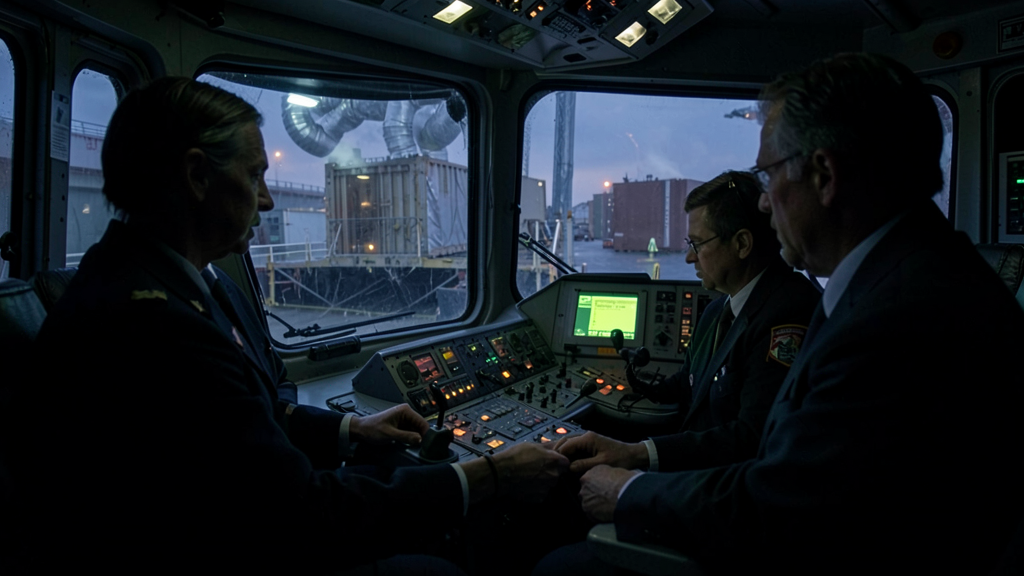
A smoke warning in the cargo hold does not mean the same in the lower deck as in the main deck of a freighter. One class of compartments gives the crew time with a certified amount of extinguishing agent. The other trades it for an assumption about oxygen. Knowing which one is lighting up determines what the first minutes must be.
Two classes, two different promises
The paragraph on the classification of cargo compartments in Part 25 and CS-25 does not sort the compartments by size or position. It sorts them by what can be done in the event of a fire inside. That is why the letters matter operationally and not just for the certification office.
A compartment of class C is negatively defined: the one that does not meet the condition of class A (fire detectable from a crew station, all parts accessible in flight) nor the condition of class B (sufficient access for a crew member to reach every part with a portable fire extinguisher). Since no one can manually fight it, certification requires a substitute: a separate certified smoke or fire detection system, an integrated extinguishing system controllable from the flight deck, a way to keep dangerous amounts of smoke, flames, and the agent itself away from every compartment occupied by the crew or passengers, and — the clause most crews forget — controlled ventilation and airflow within the compartment , so the agent can control the fire. The agent is not a magical gas. It works because the airflow is designed so it can work.
A compartment of class E exists only on aircraft used exclusively for cargo transport. This is the main deck of the freighter. Certification requires a separate certified smoke or fire detection system, a way to shut off the ventilation airflow to or within the compartment with controls accessible to the flight crew, a way to keep dangerous amounts of smoke, flames, or toxic gases away from the flight deck compartment, and emergency exits for the crew that remain accessible under all cargo loading conditions.
Read this list again and notice what is not on it. There is no agent. There is no bottle, no release switch, no measured flow, no certified duration. The class E main deck is a compartment in which a fire is detected, isolated from its air supply, and then left to burn out.
| Position | Class C (typical lower deck) | Class E (freighter main deck) |
|---|---|---|
| Detection | Separate certified smoke or fire detection system, display on flight deck | Separate certified smoke or fire detection system, display on flight deck |
| Extinguishing agent | Integrated system, initial extinguishing, then maintained concentration, controlled from the flight deck | None |
| Certified suppression time | Yes — a specific number for the installation; on long-range flights, it is linked to the approved diversion time plus a safety margin | Such a number does not exist |
| Airflow management | Controlled ventilation and airflow, so the agent can control the fire | Ventilation airflow shut off; compartment vented and depressurized according to procedure |
| Protection of occupied compartments | Keep dangerous amounts of smoke, flames, and agent away from crew and passenger compartments | Keep dangerous amounts of smoke, flames, and toxic gases away from the flight deck |
| Accessibility in flight | No effective access for fire fighting — that is what the class means | Physically possible on some types, operationally almost useless once a stack of pallets is burning |
| Basic assumption | The agent can control the combustion during the certified time | The fire has no independent oxidizer and dies down when starved of oxygen |
Class C compartments have extinguishing agents to control fires, while class E compartments rely on cutting off oxygen to suffocate the fire. The key difference is that class E has no extinguishing system, just detection and isolation.
On a Boeing 747-8F, the lower deck is class C, with a fire suppression system certified for a given duration, while the main deck is class E. If a fire starts on the main deck, the crew must shut off ventilation and depressurize the aircraft to starve it of oxygen, but there is no agent to stop the fire.
Class E does not extinguish. It suffocates.
The logic behind a main deck without extinguishing is worth understanding, rather than regretting. Flooding a widebody main deck with a useful concentration of agent and maintaining it for a diversion would cost a mass of bottles that directly competes with the payload on an aircraft whose entire purpose is the payload — and the deck is filled with pallets and containers that block distribution, so the agent would go where the cargo is not. The design compromise therefore goes in the other direction: Instead of adding agent, the certification basis removes the air and protects the people.
The mechanism has three parts. Shutting off the ventilation airflow removes the fresh-air supply. Depressurization reduces the partial pressure of oxygen in the compartment, slowing the spread of flames even if the oxygen fraction remains unchanged. Directing the remaining conditioned air from the flight deck aft and overboard keeps the combustion products away from where the aircraft is still being flown. The fire is not extinguished; it is expected to burn itself out.
This is a direct descendant of an assumption that has already failed once. Class D compartments relied on sealing and volume limitation to smother a fire without any active system, and the class was removed from transport aircraft after an accident in which the cargo — chemical oxygen generators — brought its own oxidizer; these compartments were converted to class C or class E. Class C got the agent. Class E retained a refined and actively managed version of the suffocation argument because there was no practical alternative on a main deck.
The trap: the rigid barrier at the front end of the main deck is primarily a restraint structure designed for forward inertia loads. The fact that it also represents a certified smoke barrier — and under which pressure differential and airflow configuration it is credited — depends on the type design or a supplemental type certificate. Do not infer smoke protection from the fact that a large, solid element lies between you and the cargo. Consult the aircraft flight manual for your specific configuration.
A lithium cell invalidates the premise
All of this is based on one sentence: The fire has no independent oxidizer. A cell in thermal runaway does not obey this sentence. In a lithium-ion cell, the decomposition of the metal oxide cathode releases oxygen within the cell itself, so the reaction sustains itself in an atmosphere too oxygen-poor to sustain a conventional fire. A lithium-metal cell operates on a different chemistry and is no more susceptible to oxygen starvation. The heat of a cell drives its neighbors into thermal runaway, which is why the event does not stay where it started but spreads through a package, then through a carton, and then from package to package on a pallet.
Two consequences follow, and they are of different importance for the two compartment classes.
In a class C compartment, the agent still suppresses the flaming combustion of the electrolyte and surrounding packaging, but it does not stop the cell-to-cell spread, which is thermal and not a flame front. At the same time, the cells release a flammable gas mixture into a sealed compartment. Large-scale tests leading to the current shipping restrictions showed that this mixture can accumulate and ignite, and the resulting overpressure is a structural problem different from the one for which the compartment linings are qualified: These linings are qualified against flame penetration, not against a pressure impulse.
On a class E main deck, there is no agent to be even partially effective. The only remaining tools are shutting off the airflow and reducing the pressure, and neither of them acts on a reaction that brings its own oxidizer. The suffocation hypothesis is not weakened; it is nullified. The fire will do what its energy allows, on its own schedule, and the aircraft’s only remaining defense is that the flight deck remains usable and the wheels touch a runway before structural failure.
The regulator’s response occurs at the shipping level, not the aircraft level. The technical instructions made binding by Annex 18 prohibit lithium-ion and lithium-metal batteries shipped alone on passenger aircraft, limit the state of charge of lithium-ion batteries shipped in this manner, and restrict the quantity and packaging through the packaging instructions. Each of these measures attempts to keep the class E hypothesis true by controlling what is on the deck. None of them changes the deck.
Three clocks, and only one of them is written
The arithmetic that a main deck fire imposes on a crew has three terms, and confusing them leads to the wrong decision while it can still be made.
| Clock | What triggers it | Where the number is found | Crew influence |
|---|---|---|---|
| Extinguishing clock | Mass of the agent, compartment volume and leaks, required concentration | Only class C: aircraft flight manual and, for long-range flights, the approved diversion time plus a safety margin | None, once discharged — do not open, do not ventilate |
| Smoke clock | Fire growth rate, path to the flight deck, direction of airflow, oxygen and eye-protection endurance | Nowhere. It is not certified and not published | Significant: descent, ventilation configuration, protective equipment discipline |
| Structural clock | Fire load, integrity of the lining, proximity of control circuits, systems, and pressure hull | Nowhere. Unknown in flight | None |
In a class C compartment, the first clock is real and citable: a specific number for the aircraft and installation, linked on a long-range flight to the longest diversion for which the operator is approved, plus a declared safety margin. It does not authorize any delay — the diversion begins immediately — but it gives a budget for choosing the runway.
On a class E main deck, the first clock does not exist. There is nothing to count down. What remains is a smoke clock that no one has measured for your fire and a structural clock that no one can see. The honest formulation of the decision is therefore not « how much time do I still have, » but « what is the shortest way to a runway, and is there something I can do to buy time on the smoke clock. »
The trap: a warning that disappears is not a fire that stops. In a class C compartment, the agent controls the combustion without extinguishing it, and a detector that becomes quiet may only be reading a compartment whose smoke has settled or been vented. On a class E deck, where nothing has been discharged, a warning that disappears is worse news than a persistent warning: The detection conditions have changed, the fire has not. A cleared indication is a reason to re-brief the approach, never a reason to stop the diversion.
Smoke sets the limit, not the structure
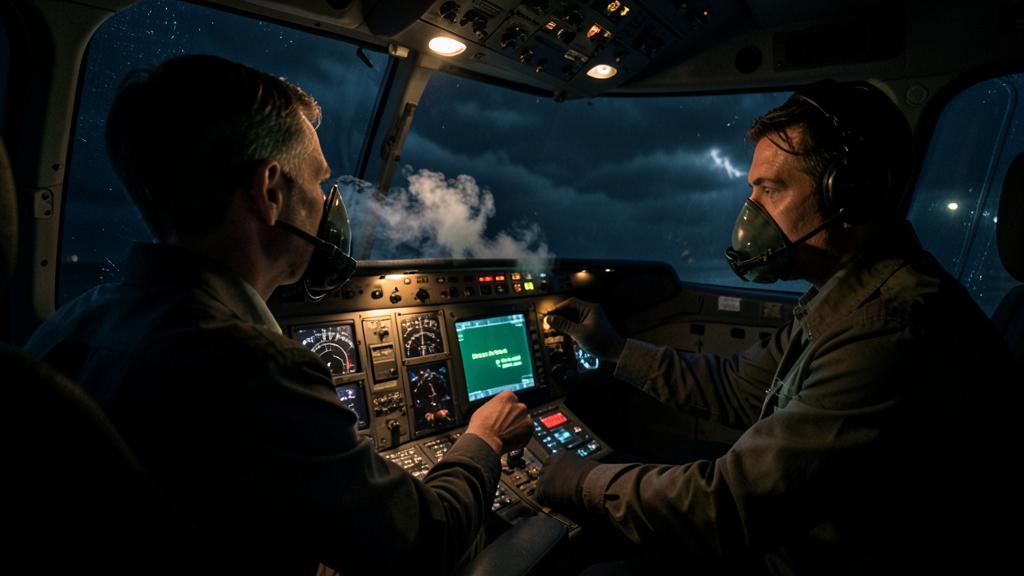
Crews rehearse the structural failure because it is dramatic, and are then surprised by the one that actually ends the flight. Long before any burn-through occurs, the flight deck fills up. The faces of the instruments become unreadable at arm’s length. Reading the checklist — the activity on which the entire procedure is based — becomes slow, then unreliable, then impossible. Communication within the crew deteriorates as soon as the masks are donned.
Protective equipment has strict limits that should be precisely known for your fleet, rather than just approximately. The fixed oxygen supply of the crew is limited, and the selection of the emergency or overpressure setting — exactly what a smoke-contaminated flight deck requires, as it prevents inward leakage at the face seal — consumes this supply much faster than the normal setting. Portable breathing apparatus — that of the flight crew and any equipment worn by supernumeraries — are single-use devices with a certified lifespan measured in minutes, and with no possibility of recharging. All of these duration figures come from certification scenarios; none of them were set by the diversion time you may have to fly.
Therefore the operationally useful statement: On a class E deck, the limiting constraint is almost never the airframe. It is the duration for which a crew can fly an aircraft whose instruments are no longer visible while breathing from a depleting supply.
Masks on and immediate landing are one decision, not two
Here is the failure pattern that the accident archives keep producing. The crew treats the procedure as a sequence: First, you protect yourself, then you assess, then you decide where to go. Each step is reasonable. Taken in this order, they are lethal because the assessment and decision are made by people whose ability to assess and decide deteriorates in the same measure as the smoke rises.
The correct framework is that the reason why you reach for the mask is the reason why the aircraft must be on the ground. There is no state of the world in which a main deck fire warning requires oxygen protection but does not require immediate landing. Therefore, the two actions share the same trigger, and the diversion must — course, descent, announcement, field selected — be initiated in the same breath as the mask, not after an assessment phase. The assessment then continues and can refine the choice of the field. It must not be allowed to come before the turn.
There is a second reason to combine them. Descending to an altitude where the aircraft can be depressurized and the occupants protected without the fixed system costs enormous specific range. The set of accessible airfields shrinks from the beginning of the procedure and shrinks fastest in the first minutes: A field that is available at the beginning of the descent may not survive a few more minutes of deliberation at cruise altitude. Delay costs not only time on the smoke clock — it removes options from the map.
The correct reflex: answer the diversion question at the end of the climb, before it is needed. On every cargo sector, brief the two or three usable fields — landing distance for an overweight landing, forecast wind, available approach in the forecast conditions, rescue and fire category, and how to get there from the top of descent. A class E procedure reduces the available decision time to what the smoke allows. The only way to make a good decision within this time is to have made it mostly an hour earlier.
What the crew can influence, and what they cannot
Separating the two is not an academic exercise. The effort expended in the second column is effort not expended in the first, and in the event of a fire, the currency is seconds.
| Lever | Effect | Limit |
|---|---|---|
| Immediate descent | Enables depressurization, protects occupants without the fixed system, positions for landing | Strongly reduces specific range; reduces the set of accessible airfields |
| Depressurization | Reduces the partial pressure of oxygen in the compartment, slows a conventional fire | Does not act against a reaction that brings its own oxidizer |
| Shutting off the ventilation airflow | Removes replenishment air from the compartment | Also removes the airflow that carried the smoke overboard, depending on the type |
| Airflow direction and differential | Keeps the flight deck breathable — the actual certification advantage of class E | Only valid in the configuration in which it was certified; a door, a leak, or a non-standard airflow selection invalidates it |
| Field selection | The most important determining factor for the outcome | Limited by fuel, descent range, and what is actually landable now |
| Protective equipment discipline | Preserves the smoke clock | The fixed supply is limited; the emergency setting depletes it quickly; the portable equipment is single-use |
| Knowledge of the cargo | Changes the fire model and the ground reaction | Only as good as the notification to the pilot in command; an undeclared shipment is invisible |
| Fire extinguishing | — | Not available. There is no agent on the deck |
Adequate is adequate, and adequate is not suitable
The planning vocabulary gets in the way here, so it is useful to say it correctly. A adequate airfield is one that meets the performance and physical requirements for the aircraft — runway, strength, facilities. A suitable airfield is an adequate airfield where, at the planned time of use, the weather reports or forecasts and field condition reports indicate that a landing can be safely conducted. Neither of these words describes what a crew needs with a burning main deck.
What they need is the nearest place where the aircraft can be set down and stopped. This may be an airfield that does not pass the adequacy test on paper: shorter than the landing distance you would prefer for an overweight landing, without the approach aid you would normally need, with a rescue and fire category lower than required by the length and width of your aircraft’s fuselage. The authority of the pilot in command to take any action required by the situation in the interest of safety — as set out in ICAO Annex 6 Part I and for EASA operators in the responsibilities of the pilot in command according to Part-CAT — exists precisely for this. It is not a loophole; it is the mechanism by which planning categories are set aside when they have stopped describing the problem.
Two practical notes follow. A lower rescue and fire category is never a reason to continue flying with a main deck fire — the fire wins in the additional minutes, and the ground services do not fight it either. It is a reason to plan the landing and evacuation differently: where you stop, in which direction the wind blows, how quickly the occupants are evacuated. And the ground has the same access problem as you. A main deck fire within a closed fuselage is not quickly accessible to any airport fire service; the outcome will largely be decided by the time it takes for the aircraft to come to a stop.
An undeclared shipment changes the assumption, not the aircraft
The aircraft is identical whether the center section pallet contains mechanical parts or two tons of undeclared cells. Same lining, same detectors, same absence of agent. What changes is the accuracy of the crew’s model, and the model is what the procedure is based on.
A properly declared shipment generates a notification to the pilot in command indicating what is on board, in what quantity, under which UN number and packaging instruction, and where on the deck it is located. This document has three functions: It enables the crew to correctly read the fire instead of assuming a conventional fuel load, it links the event to the applicable emergency response guidelines, and it informs the receiving airport what will be in the fuselage when the aircraft comes to a stop.
An undeclared shipment removes all three, quietly. Nothing on the flight deck indicates that the premise of the compartment class no longer applies. The crew performs a correct procedure against a fire that does not behave as the procedure assumes — and comes to the correct conclusion, immediate landing, with a mental model that says there is more time than there actually is.
That is why the acceptance of dangerous goods is not a warehouse formality with an aviation flavor. On a class E deck, it is the only line of defense that exists. Everything downstream of acceptance — detection, shutting off ventilation, depressurization, airflow keeping the flight deck breathable — was designed on the assumption that acceptance worked. Crews who want to discuss this with the people who load aircraft for a living will find the discussion on the FL330 forums, and the acceptance and emergency response side is covered in the dangerous goods material of the FL330 training.
What to take to the next briefing
- Know which compartments in your type are class C and which are class E: Both warnings end in a diversion, but only one of them has a certified time budget behind it.
- Know the certified extinguishing duration for the class C installation — and that no equivalent number exists for the main deck. Never carry one over to the other.
- Treat the oxygen mask and the diversion decision as a single action with a single trigger. If the mask is justified, the immediate landing is justified.
- Brief usable fields at the end of the climb, including landing distance for an overweight landing, wind, and what happens after the aircraft comes to a stop.
- Assume that the smoke clock is shorter than the structural clock because it almost always is.
- Treat a warning that disappears as a change in detection, never as a change in the fire.


Leave a Reply
You must be logged in to post a comment.