
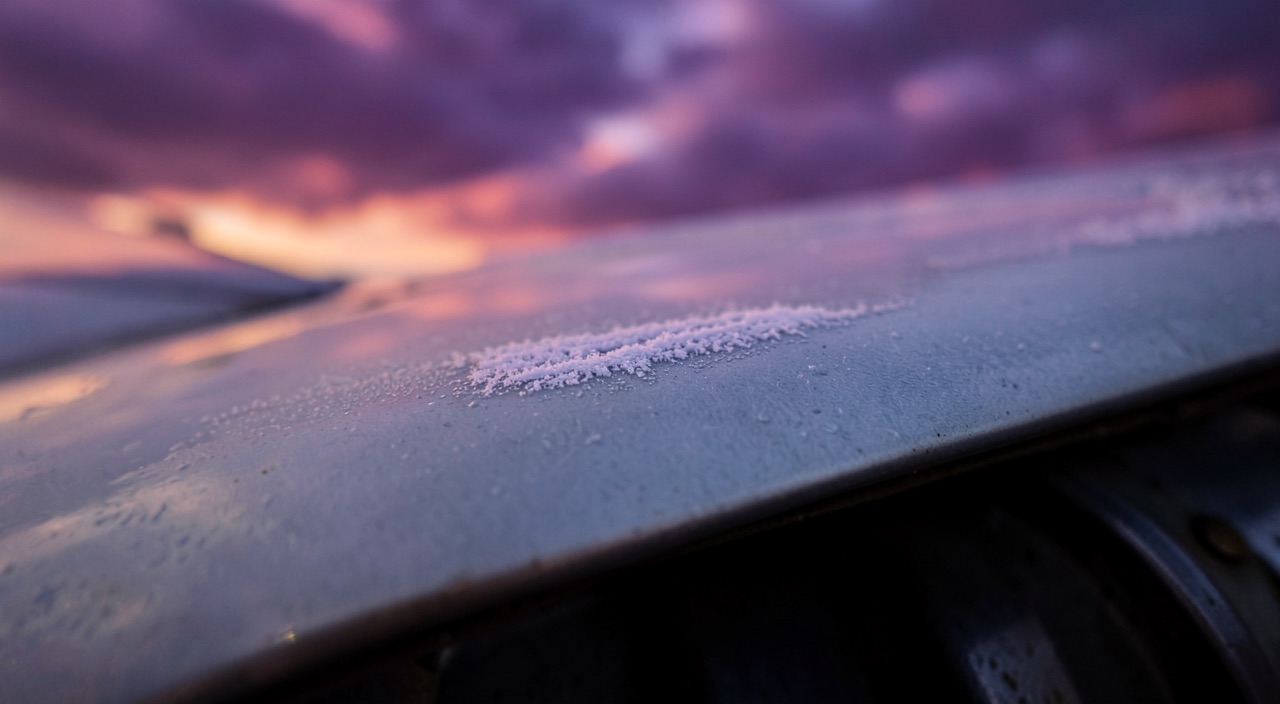
A long-haul aircraft lands at noon, twelve degrees on the ground, clear blue sky, not a drop of rain in three days. Twenty minutes later, a white patch appears on the upper surface, exactly above the tank, while the paint is dry and warm everywhere else. This deposit does not come from the day’s weather: it comes from the fuel, which cools the skin from the inside. And this is, on the wing, the only case where the clean wing principle admits a written exception.
A wing that ices when it’s mild on the ground
In cruise, the fuel stored in the wing tanks is separated from very cold air by only a few millimeters of alloy. On a long leg, the entire mass has time to equilibrate well below the freezing point of water. Upon arrival, this mass does not rise just because the aircraft has landed: several tons of kerosene in a thin tank oppose considerable thermal inertia to heating, and the only available mechanism at the parking stand is natural convection exchange with still air, supplemented by solar radiation on the upper surface and by wind if there is any. The order of magnitude of heating is counted in degrees per hour, not per minute.
The skin then behaves like the fin of a heat exchanger. Wherever it is wetted by the fuel, it takes a temperature very close to that of the liquid, and thus much lower than that of the air. Wherever the tank is empty, above the level, it follows the ambient air to within a few degrees. This detail seems anecdotal: it is what gives the deposit its geometry, and it is by the geometry that it is identified.
The frost itself requires nothing more than two simultaneous conditions: a skin below zero, and an ambient dew point higher than this skin temperature. Water vapor then deposits directly as crystals, without passing through the liquid phase. No precipitation is required, no clouds, no fog — hence the apparent paradox of a deposit forming in fine weather. Conversely, a wing just as cold remains perfectly black and dry in very dry air. It is therefore not the outside temperature that controls the phenomenon, but the humidity; the reflex that consists of reassuring oneself because it is mild on the ground relies on the wrong variable.
The wing can ice up even when it’s warm outside because the fuel inside the tank cools the wing skin. Frost forms when the skin is below freezing and the air is humid, even without rain or clouds. The outside temperature doesn’t matter as much as the humidity and the wing’s temperature.
An Airbus A330 lands in Dubai (ground temperature 12°C, dew point 8°C) after a 12-hour flight. The wing tanks, filled with fuel at -40°C, keep the upper skin below freezing. Two hours later, a thin frost layer appears above the tanks, even though the weather is clear and dry. The frost disappears only after several hours of direct sunlight.
The signature: what the shape of the deposit tells you
Cold-soaked fuel frost, CSFF in the manufacturer’s documentation, is first recognized by its outline. It reproduces the wetted skin surface: it stops abruptly at the rib and spar lines, leaves the forward tank and leading edge dry, and moves with the level. A patch that spreads after refueling is not an anomaly: the level has risen, and so has the wetted surface. Around the imprint, the paint is dry and warm to the touch, which is enough to rule out an atmospheric origin.
Atmospheric frost, on the other hand, makes no distinction. It deposits after a clear night, by radiation to the sky, on everything that has lost heat: the entire upper surface, the top of the fuselage, the horizontal stabilizer, the slats, the probes, and the static ports. It does not draw any figure linked to the tanks, and it appears with an outside temperature close to or below zero. No cold fuel tolerance applies to it, especially not on the appendages: an iced static port is not negotiated, it is treated.
The third case, which is not frost and is the most dangerous of the three: clear ice, formed by liquid water arriving on a skin already below zero. It deserves its own section, because it hides precisely under the circumstances that justify the tolerance.
| Criterion | Cold-soaked fuel frost | Atmospheric frost | Glace claire |
|---|---|---|---|
| Outside conditions | Any temperature, often well above zero; humid air; clear sky possible | Close to or below zero, clear night, light wind | Rain, drizzle, wet snow or fog on a cold-soaked wing |
| Étendue | Tank footprint, sharp edges, set back from the leading edge | Any surface exposed to the sky, fuselage and tail included | Cold area, blurred outline, often the upper surface above the tanks |
| Aspect | Matt white, thin, smooth; rivets and paint lines visible through it | Crystalline white, uniform, sometimes thicker | Transparent; the paint shows through, the surface looks clean |
| Reliable detection | Visual from a raised access point, confirmed by touch | Visual, including from the ground | Tactile check mandatory; the eye alone cannot see it |
| Possible tolerance | Yes, subject to cumulative conditions and if the documentation expressly allows it | No on critical surfaces | Never, under any circumstances |
What roughness does to the flow
The first reflex, measuring the added mass, leads to a false conclusion. A film of one millimeter spread over the imprint of a tank represents, for a large transport, on the order of a few tens of kilograms: strictly negligible compared to the takeoff mass. If contamination killed by weight, it would not kill.
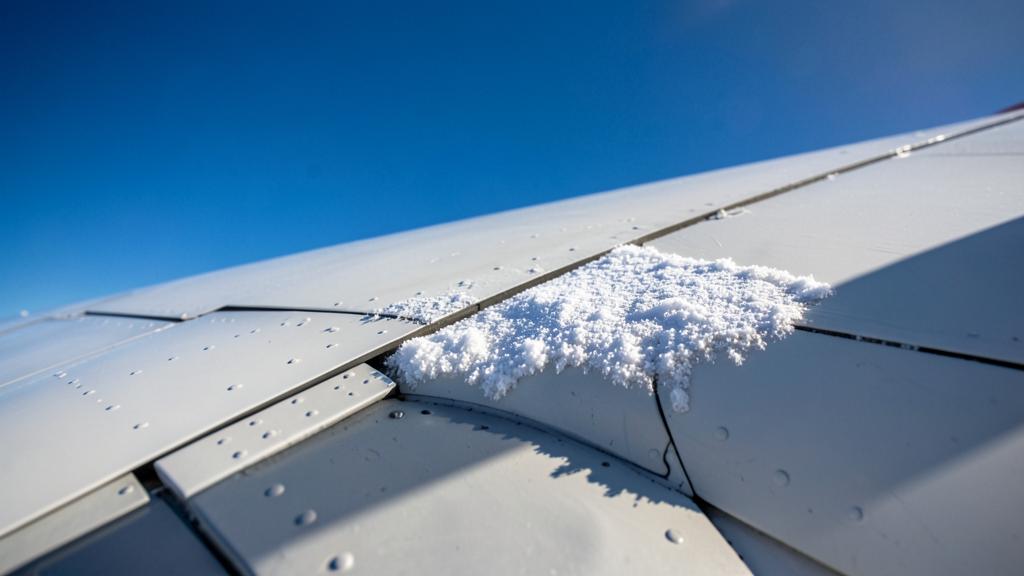
It acts through roughness. An attached boundary layer holds because the energy it retains near the wall allows it to overcome the adverse pressure gradient that follows the depression peak. A rough surface extracts this energy, thickens the boundary layer, and advances the separation point. The order of magnitude long retained in safety literature, for a roughness comparable to sandpaper distributed over the upper surface, is a maximum lift loss that can reach several tens of percent, accompanied by an increase in drag of the same order. We are not talking about nibbling at the margin: we are talking about a different wing.
That is also why the location matters more than the quantity. In front of the front spar, on the first few percent of chord, the boundary layer is very thin and the gradient still favorable: the slightest roughness there triggers a premature transition whose consequences propagate backward. Further back, on an already turbulent and thick boundary layer, the same roughness disappears into the noise. The tolerance is therefore not a leniency: it exploits a verified aerodynamic fact, namely that the tank area is located outside the critical region.
The second effect is more insidious. Low-speed protections — control column vibrator, angle-of-attack protection laws, displayed maneuvering margins – are calibrated on a clean wing. A rough wing stalls at a lower angle of attack than that for which these devices were set: the protection always triggers at the same point, but the aerodynamics, it, has receded. No indicator in the cockpit signals this discrepancy, and the moment it manifests itself is the worst possible – rotation, low height, low speed, maximum angle of attack of the sequence.
The tolerance exists, but its conditions are cumulative
The documents that allow cold fuel frost never allow it in general: they allow it under a set of conditions, each of which is necessary. The formulations vary from one manufacturer to another, but the logic does not.
- The origin is established: cold fuel, and nothing else. This assumes knowing that no precipitation or fog has touched the aircraft since it was cold.
- The layer is thin and smooth. The practical criterion is not a thickness measurement but the readability of the substrate: rivets, joints, and paint lines must remain discernible through it.
- The footprint remains confined to the tank area, aft of the front spar. A deposit that gains the leading edge, a slat, or its track is out of scope.
- No control surface, no flap, no speed brake, no hinge, no probe, no static port, no angle-of-attack vane, no air intake is concerned.
- The aircraft’s flight manual and the operator’s manual expressly authorize the case for the surface in question. The silence of a document is not an authorization.
A nuance appears in almost all documentation: the lower surface is treated more broadly than the upper surface. Under the wing, the aerodynamic contribution of the deposit is less, and a measured thickness, often expressed in fractions of an inch, is allowed in relation to the tanks. Above, the tolerance is narrower, sometimes non-existent depending on the type. Confusing the two regimes is the most common reading error on this subject.
| Zone | What the tolerance can cover | What it never covers |
|---|---|---|
| Lower surface opposite the tanks | A limited thickness of cold-soaked fuel frost, generally the most permissive regime | A deposit spreading onto the flaps, access panels or fairings |
| Upper surface aft of the front spar | A thin, smooth layer, if the flight manual expressly provides for it on this surface | Any rough or thick layer, or one of unestablished origin |
| Leading edge, slats, tracks and seals | Rien | Any deposit, whatever its origin or thickness |
| Control surfaces, flaps, speedbrakes, hinges | Rien | Any deposit, including frost from the adjacent tank |
| Probes, static ports, vanes, air inlets | Rien | Any deposit, however light |
The trap. Four out of five conditions do not give an attenuated tolerance. The set is cumulative: as soon as one condition is not verifiable – because no one could climb up to see, because the weather history of the stopover is uncertain, because the on-board document says nothing about the upper surface – the aircraft goes back to the general case and must be treated. The absence of proof is not proof of absence.
The case that cancels everything: liquid water on an already cold skin
A brief shower, a drizzle, a bank of fog, or simply a very humid night on an aircraft soaked with cold, and the mechanism changes in nature. The water arrives liquid, spreads, then freezes upon contact with a skin below zero. The result is not a white veil but a transparent, adherent ice that hugs the surface and allows the paint to be seen through it. Seen from the ground, it does not exist. Seen from the window, it does not exist either. It occupies the same area as the cold fuel frost, for the same thermal reason, and it can form under a white deposit that hides it.
Three operational consequences follow. The first is that the tactile check of the upper surface, from a high access means, is the only conclusive check as soon as a cold wing may have encountered liquid water. The second is that the protection time tables are established for a skin close to the outside temperature: on a wing significantly colder than the air, the effective protection time is reduced, and the application notes of the tables remind us of this. The third relates to the fluid itself: applied hot on a very cold surface, a deicing fluid runs, dilutes, and can refreeze elsewhere, typically in the control surface articulations where no one looks for it.
The classic error. Noticing white frost above the tank, verifying that it is thin and smooth, and concluding tolerance without having established the weather history of the stopover. If liquid water has touched the aircraft while it was cold, the visible deposit may cover an invisible clear ice – and it is the latter, not the frost, that decides the behavior at rotation.
Conducting the verification and documenting it
Invoking the tolerance means deciding to depart without treatment: it is a positive decision, not an abstention, and it is conducted as such. It requires a trained observer, placed high enough to see and touch the upper surface, an examination that covers both the tolerated area and the areas that are not, and an explicit report to the captain – not a thumbs-up from the tarmac.
Time is critical. The deposit evolves: it spreads if the fuel level rises, it changes appearance if the sun moves, it can be covered with water if a shower crosses the platform. A check done at the beginning of preparation says nothing when the engines are running. The verification is repeated after any additional refueling and after any change in conditions, and the decision is made as close to departure as possible.
The right reflex. Formulating the question in reverse. Instead of “is this frost tolerable?”, ask “what proves that this deposit comes from the fuel and nothing else?”. The first formulation seeks authorization and always finds it; the second seeks proof, and its absence closes the file without discussion.
Reducing the occurrence rather than suffering it
The phenomenon is predictable: long leg, short stopover, humid air, little sun or wind on the wing. When these four factors are present together, the crew and the stopover gain by anticipating the check instead of discovering it at the last moment, with an access means already ordered.
The levers for reduction are real but limited. Refueling with fuel at ambient temperature warms the mass by mixing, all the more so as the quantity embarked is significant compared to the cold residual; a modest addition to a nearly full tank will practically change nothing, and may even extend the imprint by raising the level in contact with the upper skin. The distribution between wing tanks and center tank, when the type allows it, acts in the same way. Parking facing the sun, an orientation that exposes the upper surface, a little wind, also help – but these are aids, not guarantees, and none of them dispense with the check.
The useful reflex at the stopover. Record the fuel temperature upon arrival and compare it to the local dew point before even leaving the cockpit. If the difference is clearly unfavorable, the patch will appear during the stopover: it is better to warn the assistance and reserve the access means right away, when it still costs nothing to the program.
What to go read in your own documentation
This subject is particular in that the rule and its exception do not live in the same place. The clean aircraft principle is carried by the operations regulation; the exception, on the other hand, is carried by the aircraft’s flight manual, taken up – or not – by the operations manual and by the ground deicing program. Three documents, three possible drafts. It is worth verifying four points yourself: the surface in question, upper or lower, with the exact words used; the thickness or smoothness criterion retained; who is authorized to observe and in what form; and whether the tolerance survives a refueling after the check.
There remain gray areas that no one has an interest in filling with optimism: a patch straddling the front spar line, a deposit under a slat track where the eye does not pass, a surface too high to be touched with the available equipment at that stopover. In each of these cases, the only defensible reading is the one that treats doubt as contamination. The subject regularly comes up in exchanges between crews on the professional forum FL330, and it is typically the kind of question that serves as an introduction to a type rating oral, because it tests a rare skill: knowing how to distinguish a rule from its exception without confusing the two. For those preparing an online adaptation or a renewal, it is a good indicator of documentary mastery, more than of aerodynamic knowledge.
Finally, one must accept what this exception says about the rest. It does not weaken the clean wing principle: it gives its reason for being. If a thin, smooth, bounded, and established-origin deposit already requires five cumulative conditions and a tactile verification, then everything that does not fall within this narrow framework is not subject to any assessment.
This article exposes a mechanism and a decision logic; it does not replace any applicable document. In case of discrepancy, the current regulation, the aircraft’s flight manual, and the operator’s approved documentation prevail over what is written here.


Leave a Reply
You must be logged in to post a comment.