
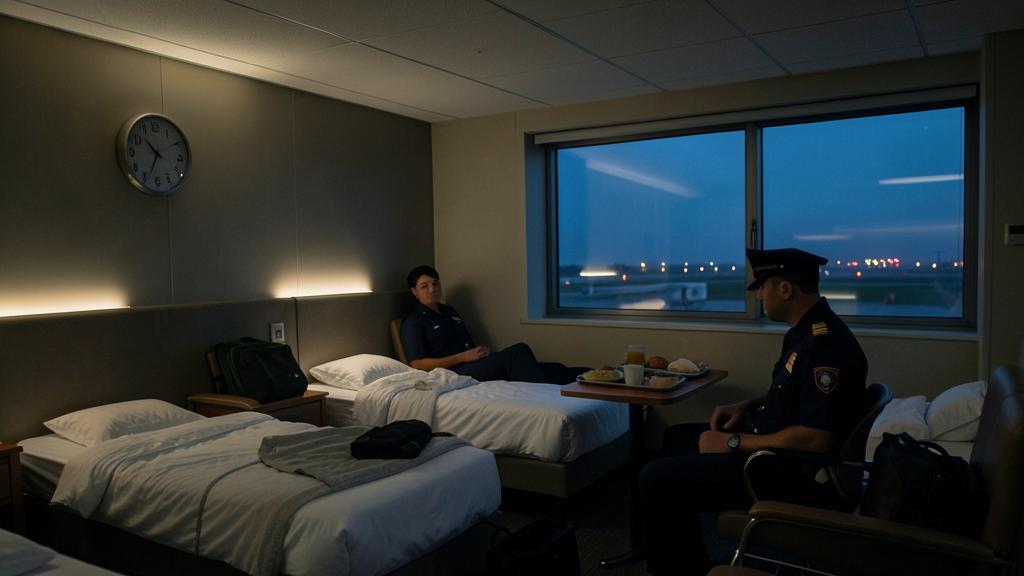
Shortening a layover looks like a scheduling decision and is treated as one in most crew rooms: a line that got tighter, an hour that disappeared, a hotel further from the terminal. It is not a scheduling decision. Reduced rest is a construction an operator has to justify before it may be written into the manual, and the justification is not about the hours removed — it is about what is given back, how the sleep opportunity inside the shortened period is protected, and how anyone would know afterwards whether it worked. This is the reasoning an authority expects to find, and where a file usually fails.
What a rest period is, before anyone shortens it
A rest period is not time off. It is a defined, continuous and uninterrupted span during which a crew member is free of all duties and of standby, whose purpose is recovery from the preceding duty and preparation for the next one. That purpose is the reason the rest period has a minimum length. It is also the reason the length alone never settles the question.
Two properties matter more than the total. The first is where the boundaries fall: rest runs from the end of the duty period, which does not end when the aircraft parks, to the start of the next one, which does not begin at the aircraft. Everything in between — post-flight duties, transport, hotel check-in, transport back, report — sits inside the span while consuming it. The second is the sleep opportunity: the portion of the span in which the crew member could plausibly be asleep, given when it starts, how long the preceding duty was and what body clock the crew member arrived with.
European flight time limitation rules make this explicit by distinguishing rest at home base from rest away from home base, and by attaching a shorter minimum to the latter. The shorter minimum is not a concession. It exists because the away-from-base rest is expected to sit within a specific structure — accommodation provided, transport arranged, meals available — and it presumes that a sleep opportunity of a defined length survives inside it after everything else has been subtracted.
Where a rest period actually goes
Any argument about reduced rest that starts from the total number of hours is arguing about the wrong quantity. What has to be defended is the residue: the sleep opportunity that remains once the fixed costs are paid. Those costs are largely outside the crew member’s control, which is precisely why they belong to the operator’s demonstration rather than to individual professionalism.
| Element | What it consumes | Who actually controls it |
|---|---|---|
| Post-flight duties | Debrief, paperwork, aircraft handover, security and immigration formalities | The operator, through its ground procedures and station arrangements |
| Transport to accommodation | Waiting for the vehicle, then the journey itself, in traffic that varies by time of day | The operator, through hotel selection and transport contract |
| Arrival and settling | Check-in, finding the room, the first attempt to eat something | Shared: the operator’s hotel agreement, the crew member’s routine |
| Wind-down | The interval between arriving in the room and being able to sleep, which does not shrink because the layover did | Physiology, not scheduling |
| Sleep opportunity | The residue — the only part of the period that performs the recovery function | Determined by everything above and by the hotel environment |
| Wake-up and preparation | Alarm margin, washing, dressing, eating before departure | Shared, but compressible only to a point |
| Transport back and report | Vehicle, journey, security, briefing before duty formally starts | The operator |
A rest period is not just about the total hours—it’s about the actual sleep time left after all the necessary tasks. The operator must prove that even with a shorter rest, the crew still gets enough sleep to be safe.
An Airbus A320 crew has a 9-hour layover in Dubai. Post-flight duties take 1.5 hours, check-in 30 minutes and wind-down 30 minutes. If the hotel is 30 minutes from the airport each way, the crew gets about 5 hours 30 minutes of sleep opportunity. If it is 1 hour away, that drops to about 4 hours 30—far too little to recover.
Read that column of controls and the shape of the demonstration appears on its own: almost every fixed cost inside a shortened rest is an operator decision. A hotel forty minutes from the terminal instead of ten removes an hour of sleep opportunity per layover without a single line of the roster changing.
Reduced rest is not a shorter rest — it is a compensated one
The regulatory logic behind reduced rest is not permissive. It rests on a trade that the operator has to make explicit: the period is shortened, and something identifiable is given back, in a form that plausibly restores what the shortening took. An operator that describes the reduction without describing the compensation has not written a procedure, only a shorter number.

The compensations recognised in practice are cumulative rather than alternative. The reduction at issue here is the away-from-base one, where the operator supplies the surrounding structure and can be held to it. The accommodation has to deliver sleep rather than merely provide a room. Travel time has to be short enough that the residue survives, which means an explicit maximum written into the hotel selection criteria rather than left to procurement. The rest that follows has to be increased, so the deficit is repaid rather than carried forward. And the arrangement is expected to sit inside an active fatigue risk management process, because a reduction granted on an argument has to be verified against outcomes.
| What is taken | What has to be given back | How the operator shows it happened |
|---|---|---|
| Total length of the rest period | An increase in the following rest period, defined in the scheme rather than negotiated case by case | Roster records showing the pairing of the reduction and the subsequent extension, not just the individual periods |
| Sleep opportunity, through fixed costs | A shorter and guaranteed transfer, and accommodation that meets the higher standard | Measured door-to-door transfer times, hotel audit records, contractual criteria |
| Placement of sleep relative to the body clock | Restriction of the reduction to duty patterns where the sleep opportunity falls in a usable window | Pattern-level analysis, not sector-level compliance checks |
| The crew member’s margin for the unexpected | A defined limit on how often the arrangement may be applied, and to whom | Counters in the crew management system, auditable per individual |
| Certainty that the scheme is conservative | Active monitoring with defined indicators and a defined point at which the arrangement stops | The fatigue risk management record, including what was done when an indicator moved |
The right habit. When assessing a proposed reduced rest arrangement, compute the sleep opportunity, not the rest period. Take the scheduled end of duty, add the real post-flight and transfer times measured at that station at that hour, add a realistic wind-down, subtract the wake-up and outbound transfer, and look at what is left and at what local time it falls. That residue is what the arrangement is actually asking a crew member to live on.
What « suitable accommodation » is doing in the argument
Flight time limitation rules define two neighbouring terms, accommodation and suitable accommodation, and reduced rest hangs on the second. Its definition is functional rather than commercial: a separate room for each crew member, in a quiet environment, with a bed, sufficient ventilation, a means of regulating temperature and light, and access to food and drink. Every one of those attributes maps to a known determinant of sleep quality, which is why the term carries weight in a reduced rest file and why a hotel’s star rating carries none.
The distinction matters most where rest is shortened, because a shortened sleep opportunity has no tolerance for a bad environment. A crew member with a long rest absorbs a noisy corridor, a room facing a service yard, curtains that admit daylight: the sleep fragments and the total remains adequate. Under a reduced arrangement the same defects remove the margin entirely, and the crew member reports for duty having slept materially less than the arrangement assumed while remaining, on paper, compliant.
An authority reviewing a proposal therefore looks at how the operator selects, audits and de-selects hotels, and at what happens when the contracted hotel is full and the crew is placed elsewhere. A scheme that depends on accommodation quality without owning it rests on a supplier’s goodwill.
The demonstration file, item by item
Reduced rest is not something an operator grants itself. It lives in the flight time specification scheme that the competent authority reviews, and its conditions come from the applicable certification specifications, not from the operator’s judgement. What the authority is being asked to accept is a safety argument, and safety arguments have a recognisable anatomy: a claim, the evidence supporting it, the mitigations, and the means of knowing whether the claim held.
| Element of the file | What it has to establish | Where it commonly fails |
|---|---|---|
| Operational need | Why the rosters cannot be built without the reduction, in specific route and station terms | Stated as commercial preference rather than as an operational constraint |
| Scientific basis | That the sleep opportunity retained is sufficient for the duty pattern it precedes | Generic references to fatigue literature with no link to the operator’s actual patterns |
| Scope | Exactly which pairings, stations, crew categories and duty patterns are covered | Written broadly, so that the arrangement drifts into patterns never assessed |
| Mitigations | The full compensation set, each one specified in a way that can be audited | Mitigations expressed as intentions — « hotels close to the airport » — with no measurable criterion |
| Monitoring plan | The indicators, the collection method, the thresholds, and who acts on them | Indicators chosen because they are easy to collect rather than because they measure fatigue |
| Stop conditions | The point at which the arrangement is suspended and the pattern reverts | Absent entirely, which is the single most common gap |
| Consultation | That crew representatives were involved before the scheme was submitted | Treated as a formality after the roster was already built around the reduction |
Monitoring that proves something, and monitoring that only looks like it
The weakest part of most reduced rest files is the monitoring plan, because monitoring is where the operator has to accept the possibility of being wrong. A plan that cannot produce a negative result is not a plan.
Indicators that carry weight share one property: they are collected close to the crew member and close to the event. Subjective sleep reports for the specific pairings, comparing obtained sleep with the opportunity the scheme assumed. Fatigue reports against those pairings, read as a rate per rotation rather than a raw count. Actual transfer and post-flight times measured at the stations concerned, not the contractual ones. Roster stability, since a reduction that is robust on time may be indefensible on a day with a two-hour delay.
Indicators that look reassuring and prove little are equally recognisable. The absence of fatigue reports, in a culture where reporting fatigue is understood to be unwelcome, measures the culture and not the fatigue. Compliance counts restate the roster back to the operator. Sickness absence moves too slowly and has too many causes to attribute. Satisfaction surveys measure how crews feel about the company, which is a different thing entirely.
The trap. Building the roster first and writing the justification afterwards. Once a rotation depends commercially on the reduction, the monitoring plan will be designed — usually without anyone intending it — so that it cannot produce a result that would stop the rotation. The order matters: the arrangement is proposed, assessed, bounded and given stop conditions, and only then does planning get to use it. A file assembled in the other order is detectable, and authorities have learnt to detect it.
What the crew member can legitimately ask
A crew member rostered under a reduced rest arrangement is entitled to know which provision is being applied and what conditions attach to it. Four questions are reasonable and answerable.
Which provision, and under what approval
Reduced rest is not a default. The manual should name the provision, state whether it forms part of an approved variation, and set out its scope. A rest shorter than the standard away-from-base minimum that the manual does not explain is a question for crew planning, not for the day of operation.
Whether the following rest has been increased
The compensation is part of the arrangement, not an optional courtesy. A reduction that is not paired with the increase the scheme specifies is not the arrangement that was approved.
What the transfer time actually is
The gap between the contractual transfer time and the one observed at that station at that hour is the operator’s problem, and crews are its only source of measurement. That is a reason to report it.
How to report an inadequate rest
A rest period that failed to deliver its sleep opportunity — noise, a room that could not be darkened, a transfer that ran long, a hotel substitution — belongs in a fatigue report even when the flight that followed was uneventful. That report is the only mechanism by which the assumption behind the arrangement gets tested against reality, and its absence is read, correctly, as evidence that the arrangement is working. Discussions of how different operators handle this are a recurring theme on the FL330 forums.
Where the systems diverge
Reduced rest as described here is a European construction, sitting inside the flight time limitation framework of Part-ORO and its certification specifications, and resting on a flight time specification scheme the competent authority has reviewed. ICAO Annex 6 obliges States to set limits and operators to manage fatigue, within prescriptive limits or through an approved fatigue risk management system, but leaves the detail to the State.
The American framework for scheduled passenger operations was rebuilt around a fixed minimum rest period containing a protected, uninterrupted sleep opportunity, and offers no equivalent operator-specific reduction that can be assumed to transfer. A crew member moving between systems should treat the two as different regimes with different vocabulary, not as dialects of one rule — one of the more practical reasons to keep recurrent regulatory training current rather than nominal.
What the operator is really being asked
Strip the file down and one question remains. The rules set a minimum rest away from home base because evidence says recovery becomes unreliable below it. An operator asking to go lower is asking to be treated as a special case, and what makes a special case defensible is a demonstration that the conditions it operates under restore what the general rule protected.
That demonstration is not about hours. It is about a sleep opportunity that survives the fixed costs, an environment that lets it be used, a repayment that actually occurs, and a monitoring system honest enough to say when the argument stopped holding. An operator that can show those four things has a case. One that can show only the first has a roster.


Leave a Reply
You must be logged in to post a comment.