
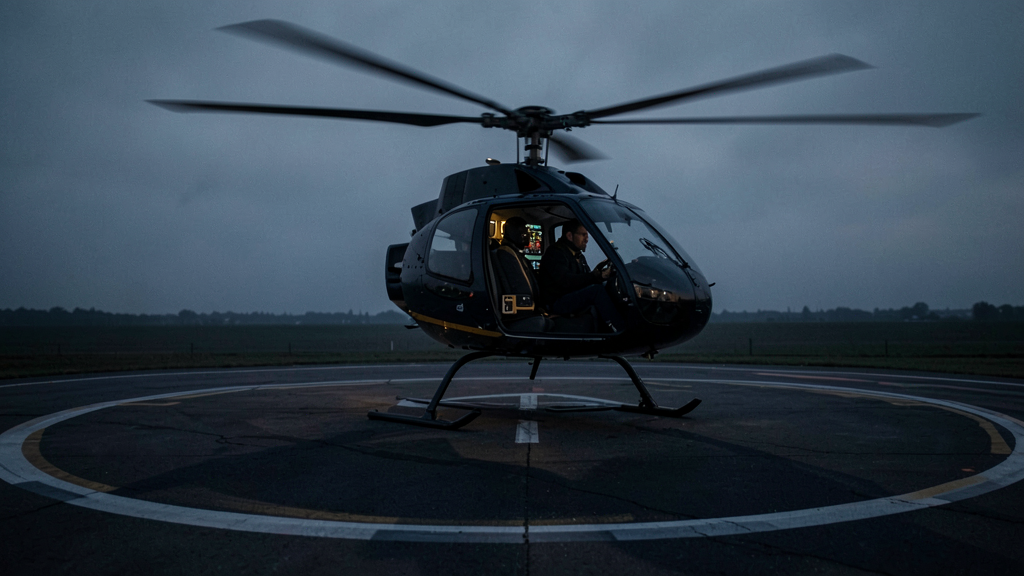
Two identical aircraft on the same platform, the same type certificate, the same Category A supplements in the flight manual. One takes off in performance class 1. The other takes off under an approved exposure period — a few seconds during which the loss of an engine does not have a guaranteed survivable outcome. Nothing in the aircraft structures differs. Everything in the two flights does.
A certified aircraft and an operation flown are not the same object.
The confusion is almost universal, and survives type qualifications. Category A is a property of the aircraft. It is a certification category — the CS-29 / Part 29 standard, extended to smaller rotors through the Category A annex of CS-27 / Part 27 — which covers a multi-engine rotorcraft built with engine and system isolation, and, the operationally important part, provided with programmed performance data derived from a critical engine failure concept. Category B is defined by exclusion: any rotorcraft, single-engine or multi-engine, that does not fully meet this standard — without guaranteed capability to stay in the air after a failure, and an unprogrammed landing assumed.
Performance class is a property of the flight. It belongs to the operational rules — ICAO Annex 6 Part III, and in Europe the CAT.POL.H performance subpart — and describes what will happen if the critical engine fails at the worst moment of this takeoff, at this mass, on this surface, in today’s air. According to European operational rules, Category A certification is the ticket for Class 1 and Class 2 — a necessary condition. It is never a sufficient condition.
Hence the phrase that most crews never hear aloud: a Category A helicopter flown outside its Category A scheduled performance data offers, for that takeoff, nothing of what the certification promised — the guarantee lives in the data, not in the structure. The certification has not evaporated; it simply has nothing to offer at this point on the graph.
Where the profiles come from: a decision point measured in flight tests.
The takeoff decision point and the landing decision point are not design objectives. They are results. During certification, a test crew cuts the critical engine at progressively worse moments, and the manufacturer demonstrates two outcomes on either side of a limit:
- Before the decision point — the takeoff can be rejected and the aircraft stopped within the required rejected takeoff distance on the surface that this profile assumes.
- At or after this — the aircraft can accept a height loss, accelerate to the takeoff safety speed, and depart in climb, clearing obstacles with the margin that the operational rule requires, using the short-duration OEI ratings for which the engine is certified.
The decision point is then published as a height, a speed, or both. Everything around it — rotation attitude, doors, the climb rate to see at a given height, the acceleration segment — is part of the number, not a comment. The demonstration is flown by pilots who know the failure will occur; the RFM technique is what replaces this foreknowledge when the failure is real.
The trap. A decision point flown from memory instead of the profile is not a decision point. If the TDP is defined by a height and a speed, reaching the height too slowly means a rejected takeoff you did not plan, on a surface you may have already overrun.
Three profiles, three sets of numbers, not interchangeable.
This is where logic often collapses. Category A is not a single capability. The manufacturer executes the demonstration separately for each surface geometry, because the rejection must end at a different place in each case. The names vary by manufacturer — clear area, helipad, elevated helipad, vertical, short field, offshore — but the families are stable.
| Profile family. | Assumed surface. | Where a rejection ends. | What the continuation costs. | Normally limited by mass. |
|---|---|---|---|---|
| Clear area. | A long, obstacle-free strip: runway, large FATO, open field. | Forward, on the surface, within the required rejected takeoff distance. | A modest height loss and a long, gentle acceleration. | Obstacles beyond the surface, and the WAT limit. |
| Elevated helipad or helistation. | A platform above the surrounding surface, with usable drop space below the edge. | Back on the platform, from a backward or sideways profile. | A drop below platform level before the climb stabilizes. | The actual drop height available below the platform. |
| Confined or vertical (at ground level). | A small surface surrounded by obstacles, with no clear air below. | Back on this same small surface. | A pronounced, power-demanding vertical segment before translation. | Available OEI power at temperature and altitude. |
Three profiles, three tables, three decision points. Applying a clear area mass to a roof is a category error, not a small optimization: the clear area rejection ends far down the surface, and a roof has no far end. The reverse error is quieter but costs money — a vertical profile mass from a large FATO leaves payload on the ground without any safety gain.
In short. A helicopter’s Category A certification does not automatically guarantee total safety. It depends on the takeoff profile used (clear area, helipad, etc.) and the actual conditions. A helicopter may be Category A certified, but if the conditions (mass, temperature, wind) do not match the profile, the safety guarantee is no longer valid.
An Airbus H145 helicopter takes off from an urban helipad with a mass of 3,500 kg. At 7:00 AM, the temperature is 15°C, the wind is 10 knots headwind, and the helicopter is light on fuel. The takeoff is in Class 1, as the conditions match the helipad profile. At 3:00 PM, the temperature has risen to 30°C, the wind is light, and the helicopter is heavier. The mass exceeds the Class 1 limit for this profile, so the takeoff must be in Class 2 with exposure, with a window of a few seconds where an engine failure could be fatal.
What the exposure actually concedes.
Class 2 is often described as « Class 1 with a hole. » It’s close, but the important distinction is finer, and the approval hinges on it.
| Class. | Critical engine failure at the worst moment. | Assumed surface below. | Required approval. |
|---|---|---|---|
| Class 1. | Rejection on the surface, or continuation and departure in climb, clearing obstacles. | Irrelevant after the decision point — the aircraft departs in flight. | None beyond ordinary performance rules. |
| Class 2. | Forced landing during a defined window, before the DPATO or after the DPBL. | Suitable for a safe forced landing. | None specific to exposure. |
| Class 2 with exposure. | Forced landing within the window, on a surface that will not make it safe. | Water, a roof, a street, a congested area. | Yes — an operational approval from the competent authority. |
| Class 3. | Forced landing required at any time in flight. | Suitable at any time — non-hostile environment as a rule. | Any deviation from this rule requires a specific approval. |
Plain Class 2 already concedes a forced landing. What the exposure rule — EASA calls it operations without guaranteed safe forced landing capability — concedes in addition is the survival of the landing itself. For a window measured in seconds, there is no acceptable outcome if the critical engine fails. This is not a regulatory decoration; it is the honest description of a takeoff from an offshore platform or a hospital roof at a mass that the Class 1 table does not support.
The trap. « We were in Class 2, so we had a forced landing option » is only true where the surface below could absorb one. Over open sea in February, or on a boulevard at forty meters, plain Class 2 was never available: the operation was in Class 2 with exposure, whether someone wrote it or not.
Why the number is in seconds, not half-minutes.
The concept of exposure is arithmetic derived from reliability engineering, and the arithmetic is linear. The regulation took an assumed turbine failure rate — on the order of one per hundred thousand flight hours — and a target probability for the unacceptable outcome per takeoff or landing several orders of magnitude smaller than that. Dividing the target by the rate gives a time budget, and at these magnitudes the budget comes out in seconds rather than tens of seconds. That’s why approved windows are counted in seconds, and why the regulation ties any longer window to the demonstrated reliability of the engine and the usage or trend monitoring of the specific engines involved.
Two consequences follow. Because the relationship is linear, doubling the window doubles the probability: there is no threshold below which it no longer counts. And the seconds must be real seconds — they come from the flight manual profile at the planned mass, not from an impression of the takeoff duration. An approval built on a figure, flown with a technique that produces half again as much, no longer describes anything.
What the operator must have approved.
Exposure is not a decision of the day’s pilot. It is a pre-existing approval in which the crew operates, and every element of the file limits the takeoff:
- Site survey — FATO and TLOF dimensions, surface strength, obstacles in each relevant sector, and the drop volume below the platform, documented and not memorized.
- A limited exposure time, derived from the flight manual profile at the actually planned mass, with the mass limitation that keeps it limited.
- Risk assessment that covers third parties in addition to occupants — on a roof, the volume you would descend into is inhabited.
- Engine reliability evidence, down to engine usage tracking, where the window exceeds what simple statistics support.
- Initial and recurrent training in the specific profile, not in Category A in abstracto: a helipad rejection and a clear area rejection are different maneuvers.
- Operations manual procedures that declare the technique, doors, and abort criteria, so that « we flew the profile » is a verifiable statement.
The right reflex. Before accepting a site, ask which profile the mass was calculated for, and whether that profile matches the surface you are going to. Most exposure events are not failures of airmanship on the day; they are a clear area figure applied to a helipad geometry, weeks earlier, in a planning spreadsheet. Operators who build this into recurrent training will find the FL330 training catalog a good starting point.
How mass, temperature, and wind consume the margin.
The Class 1 mass limit is not a number stored in the aircraft. It is the result of a calculation that consumes margin from several directions at once, and the crew controls exactly one input.
| Variable. | Physical effect. | Effect on the Class 1 mass limit. | What does not change. |
|---|---|---|---|
| Mass. | More power for hover, longer acceleration to safety speed, deeper drop. | Directly limiting — the input the crew can most easily trade, normally through fuel. | The geometry of the published decision point. |
| Temperature and pressure altitude. | Density altitude increases; short-duration OEI ratings provide less shaft power. | Decreases, faster than intuition suggests near the WAT limit. | Obstacle heights, surface dimensions. |
| Wind. | Headwind shortens the acceleration segment and the exposure window. | Increases, but only up to the credit allowed by the flight manual. | Turbulence and downwash that wind causes around obstacles. |
| Obstacle environment. | Establishes the climb gradient that the continuation must achieve. | Lower where the takeoff sector is obstructed. | Decisive in the rejection case. |
| Configuration and bleed. | Anti-ice, air conditioning, and bleed air extraction reduce available power. | Decreases — often overlooked because selected, not observed. | The mass the aircraft actually weighs. |
Note the last column. None of these changes modify the geometry of the decision point or the size of the platform. They only change whether the aircraft can honor the guarantee in that geometry — that’s why « we are Category A » is not an answer to a performance question.
The same machine, Class 1 at 7:00 AM and exposed at 3:00 PM.
Take a twin on a hospital platform on a summer day. At seven, the temperature is low, a useful headwind blows down the takeoff sector, and the aircraft is light on fuel after a short positioning flight. The platform profile supports the actual mass with margin: the takeoff is genuinely Class 1, and a failure at the decision point ends either back on the platform or in climb above the city block.
At three in the afternoon, nothing in the aircraft has changed and every input has. The air is fifteen degrees warmer, so the engine reaches its temperature limit earlier and the short-duration OEI ratings provide less shaft power. The wind has become variable and light, so the flight manual credit has disappeared. The aircraft is heavier with a patient, a doctor, a nurse, and their equipment, plus more fuel for a destination unknown in the morning. The Class 1 mass limit for the platform profile has dropped below the actual mass.
Three honest options remain: reduce the mass, normally through fuel; wait for the temperature to drop or the wind to return; or take off under the operator’s exposure approval, within its declared limit, having accepted what a failure in the window means. The fourth — taking off with the morning’s mental model and continuing to call it Class 1 — is the one that fills accident reports. Crews who compare how different operators handle this in practice will find the discussion active in the professional FL330 forums.
Offshore: the drop is the plan, not the failure.
A helistation platform is the cleanest case in theory and the messiest in practice. The geometry helps in a specific way: the drop occurs over water instead of over land, and ICAO Annex 14 Volume II maintains a sector around the platform free of obstacles for the approach and departure path. The certified offshore platform profile deliberately uses the space below platform level — one expects the aircraft to descend below platform level after the decision point while accelerating. Offshore Class 1 does not mean the aircraft never descends; it means the outcome is guaranteed either way, back to the platform or away with the published platform edge clearance.
Two things then make Class 1 arithmetically difficult. A low platform offers little drop height, so the permissible mass can be well below what the payload requires. And offshore mass is rarely negotiable in small increments: passengers come in whole numbers, and fuel is set by the sector, the reserves and the alternate platform.
Where offshore differs sharply from land is in the classification of what is below. The sea is not automatically hostile: the sea state, water temperature, protection against immersion, flotation equipment, and search and rescue response can combine to make a ditching survivable, and the operational rules recognize this — while the European definition also treats open sea areas beyond about 45° latitude, north or south, as hostile where the corresponding state has so designated. This classification, and not any aerodynamic property of the aircraft, decides whether a takeoff is plain Class 2 or Class 2 with exposure. The same aircraft, the same platform, the same mass: hostile in December, potentially not in July.
The hospital roof: where the rule bends by design.
A helistation on a roof in a city inverts every offshore advantage. The environment is congested and hostile, exactly where Class 1 is nominally required. But the platform was built to fit an existing building, the FATO is often smaller than what ICAO Annex 14 Volume II would suggest for the aircraft using it, obstacles surround most takeoff sectors, and the volume the aircraft would descend into is a street.
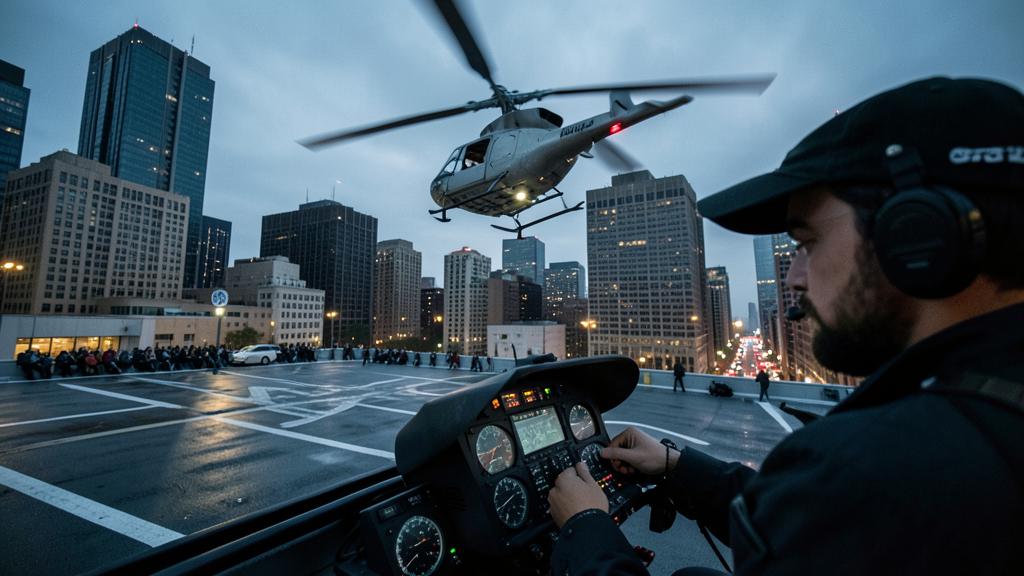
Hence the public interest site provision, which allows operations to and from such sites without the guaranteed safe forced landing capability that the rule otherwise requires, under an operator approval, with a mass limited so that the exposure is as short as the geometry allows and the crew specifically trained for that site. It is worth being clear about what this provision is: a transitional recognition that these sites existed and served a public purpose before the performance rules were written, and that closing them would cost more lives than the exposure. A documented, delimited exception — not a legal loophole.
Three second-order realities follow. The rejection is limited by the platform, not the aircraft: on a roof TLOF, it must be contained within a surface sized around the helicopter itself, which is why helipad and vertical profiles demand so much power. The wind at platform level is not the wind the ATIS reports, because the building generates its own turbulence and downwash in the takeoff sector. And the mass changes between arrival and departure by design — a helicopter that arrived in Class 1 and empty may depart with a patient, a doctor, and their equipment, off the Class 1 table, on the same platform, forty minutes later.
Both cases point to the same discipline. The aircraft certification tells you which guarantees are available to be purchased. The mass, the air, and the surface tell you which one you are buying today. Writing « Category A twin » in the operations manual solves the first question and none of the others.


Leave a Reply
You must be logged in to post a comment.