
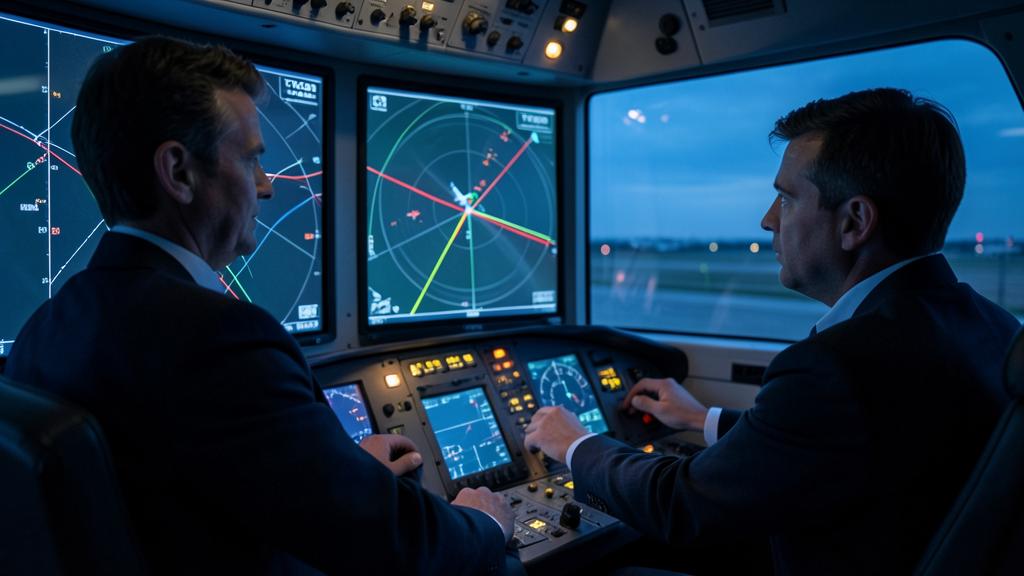
A resolution advisory does not require permission. Once activated, the task distribution that regulated the flight changes hands: The crew controls the vertical, the controller’s responsibility for the separation of this aircraft pair ends, and for a moment, neither can see what the other is doing. What happens in this interval decides the rest — whether a third aircraft is involved, whether the response occurs within the time assumed by the logic, and whether the incident leaves a report that someone can categorize.
Transfer without transfer
The warning comes approximately 15 to 35 seconds before the next waypoint. This period has nothing to do with inaccuracy: The logic is based on the projected time until the next waypoint, not just the distance, and uses a shorter horizon at low altitude, where maneuvering space is limited. That is the entire budget. Within it, the crew must recognize, follow, maintain, and communicate the warning on the frequency.
What moves at this moment is not just the flight path. Under ICAO provisions, the controller is no longer responsible for the separation of the aircraft responding to the advisory from other aircraft directly affected by the maneuver. Nothing is negotiated: Responsibility shifts because the advisory exists, whether or not this is known on the ground. It only returns when the controller acknowledges a report that the aircraft has resumed the current clearance, or when they issue an alternative clearance that is read back.
The mutual obligations are just as direct. The crew follows the advisory, even if it contradicts a valid clearance, and never maneuvers in the opposite sense. The controller does not attempt to change the aircraft’s flight path before the crew indicates that they are clear of conflict — and the term used is flight path, not altitude: A heading is also an instruction. What remains available from the ground is traffic information, often the only thing the crew does not have.
| Moment | Radio | Who has the separation |
|---|---|---|
| Advisory announced on board | Nothing yet — the crew acts first | Crew, for the aircraft affected by the maneuver |
| Crew reports | « TCAS RA » — the controller responds « ROGER » | Crew |
| An instruction crosses the advisory | « UNABLE, TCAS RA » | Crew — the instruction is not followed, and reporting is the goal |
| Conflict resolved, return in progress | « CLEAR OF CONFLICT, RETURNING TO (assigned clearance) » | Crew, until confirmation |
| Clearance restored | « CLEAR OF CONFLICT, (assigned clearance) RESUMED » — « ROGER » | Controller, from the acknowledgement |
Read the last two lines together. « Clear of conflict » describes the event; it does not transfer responsibility. This happens in a later exchange, and a crew that stops speaking after the first call leaves the sector uninformed for as long as the recovery takes.
Clear. When a TCAS issues an advisory, the crew must follow it immediately, even if it contradicts a controller’s instruction. The controller must not issue any instructions while the advisory is active. Everyone must communicate clearly to avoid additional conflicts.
An Airbus A320 on approach at 10,000 feet receives a climb advisory. The crew climbs at 1,500 ft/min. Meanwhile, another aircraft is 1,000 feet above, legally separated. The TCAS did not see this aircraft, so the crew climbs. The controller, who does not see the advisory, issues an instruction to the other aircraft, creating a collision risk.
What the controller sees and how late it is
The honest answer, in most control rooms, is nothing. The advisory is an on-board event: No symbol appears, no label blinks, no alarms sound. The display continues to show an aircraft at a cleared altitude with a routine trend arrow, until the monitoring chain notices that the aircraft has moved.
There is an exception, and it is useful to know if your airspace has it. Mode-S transponders carry a register in which the advisory is reported in the downlink, and some service providers decode this and mark the label. Where this is implemented, the ground knows within one interrogation cycle before a radio call is made. Where it is not, the ground reads an altitude displayed in 100-foot increments, updated once per antenna rotation — on the order of ten seconds on an en-route radar — with additional track filtering.
Let’s use numbers. A climb advisory typically brings the aircraft to about 1,500 ft/min, or 25 feet per second: After one en-route update, it may have moved 250 feet, two or three displayed increments, where a single increment means nothing. The controller’s first reliable indication is not the radar. It is the radio call, and the call takes less than two seconds.
Two words precede all others. Follow the advisory, then say « TCAS RA » — no sentence, no explanation, no apology. All the controller needs to stop working against you is in these two words, and they reach the ground faster than any monitoring chain.
The silence that builds the second conflict
Here is the mechanism that turns a routine advisory into an event with two losses of separation. The on-board logic resolves the geometry it can see: the threat or the few threats its own monitoring has detected. It knows nothing about the aircraft that the controller has legally separated from your aircraft by a thousand feet, exactly where the advisory sends it. It may react to this third aircraft — but late, from a worse geometry, with fewer options, and possibly by reversal.
Meanwhile, the controller sees an aircraft leaving a cleared altitude without explanation. Two reflexes are available, and both are bad. The first is to address the deviating aircraft: a level or rate instruction that directly fights the logic and arrives when the crew has less capacity to arbitrate. The second is to move the third aircraft on an assumption — that the deviation stops or that it continues — and an assumption is exactly what the controller cannot make, because nothing on the screen separates an advisory from an altitude deviation or a faulty autopilot.
The call breaks the cycle. Once « TCAS RA » is heard, the controller stops giving you flight path instructions and begins working around the third aircraft — the only action that helps, and the only one still legally available. This is an exchange worth repeating on both sides of the radio; the joint sessions discussed in the FL330 forums are where each party finds out what the other sees and does not see.
The trap is the double silence. The controller says nothing because there is nothing to see; the crew says nothing because they are busy. For eight to twenty seconds, the sector is managed on a model of your aircraft that is no longer true, and any instruction given to a third aircraft is based on it. A second loss of separation rarely occurs due to the maneuver itself. It occurs due to the maneuver that no one on the ground knows about.
When a TCAS advisory happens, the crew must act immediately, and the controller must wait until the crew reports the advisory. If the controller gives instructions during this time, it can make the situation worse by interfering with the TCAS system.
An Airbus A320 is climbing at 1,500 ft/min when a TCAS advisory tells it to climb. The controller, unaware of the advisory, instructs another aircraft to descend, creating a conflict because the TCAS system didn’t account for the second aircraft.
Five seconds, then two and a half
The response times are not recommendations. They are design assumptions built into the miss distances the logic attempts to achieve, and it behaves as if they are met. An initial corrective advisory allows about five seconds for detection and reaction, and an acceleration of about a quarter g to the ordered rate. Any subsequent advisory — an increase, a reversal, a change in the ordered rate — allows about two and a half seconds and a stronger acceleration, as less time remains.
| Initial correction warning | Subsequent advisory: increase or reversal | |
|---|---|---|
| Assumed crew response time | About 5 s | About 2.5 s |
| Assumed acceleration to the rate | About 0.25 g | About 0.35 g |
| Typical ordered rate | On the order of 1,500 ft/min | On the order of 2,500 ft/min |
| Target vertical miss distance | A few hundred feet, varying by altitude range | |
| Tone marker | « Climb », « Descend », « Level off » | « Increase », or the word « NOW » |
The arithmetic is what you should take into the cockpit. At 1,500 ft/min, you gain 25 feet of separation per second, so three seconds of hesitation cost 75 feet against a target measured in a few hundred. This is not rounding error, and that is why a delayed and a partial response fail the same way by different routes.
A partial response — correct sense, insufficient rate — is invisible to the controller and obvious to the logic, which monitors your actual vertical speed: It issues a subsequent advisory, and a subsequent advisory allows two and a half seconds, not five. A response in the opposite direction is worse than doing nothing, because coordination between two equipped aircraft has already assigned the directions — you were told to go in one direction, on the explicit basis that the other would go in the other. Maneuvering against your direction wastes both halves of the miss distance simultaneously. This is the geometry of the Überlingen mid-air collision in July 2002, where one crew followed the advisory and the other followed a controller working against it.
The opposite error is quieter and much more frequent. Preventive advisories — those that ask you to keep your vertical speed outside a forbidden band, rather than changing it — do not require maneuvers. A crew that « does something » creates a deviation, a declaration, a report, and occasionally a conflict that did not exist.
Reversals and the call that was removed
A reversal occurs when the geometry continues to close despite the advisory: The other aircraft is not equipped or does not respond and crosses the resolution, or it is equipped and coordinated but maneuvers against its own advisory. The logic sees that the projected miss distance is being used up, and reverses its direction, announced with a word that exists only for this purpose: now. « Climb, climb NOW » is not an emphasis. It is a different command with a different clock — two and a half seconds — flown against the inertia of the aircraft.
Two changes define the current version of the standard, and both come from this family of errors. The first extended the reversal logic to the case where one aircraft of a coordinated pair simply does not follow its advisory — the case assumed to be non-existent. The second removed an aural annunciation: the one that asked the crew to adjust the vertical speed. Observations showed that a significant number of crews responded by increasing the rate, reading it as a request for more energy rather than less, and turning a moderate corrective advisory into an escalation of the encounter.
The replacement names the objective state rather than the change: level off. There is no sign to interpret and only one thing to fly. The lesson generalizes beyond this call — an instruction formulated as a delta requires that the recipient knows the sign, and under pressure, the sign disappears first.
The daily case: high rate at cleared altitude
Set aside the real conflicts. One of the largest families of advisories in operator statistics is not a conflict in itself: It is an aircraft approaching its cleared level with a high vertical rate, with legally separated traffic a thousand feet away. Almost all are avoidable, and each costs what a real event costs — a disrupted sector plan, a declaration, a report, sometimes a forced altitude adjustment for someone else.
The mechanism is relentless. The logic projects the aircraft’s current vertical rate to the closest point of approach; it has no access to the selected altitude and no reason to believe that the aircraft intends to stop. At 3,000 ft/min, it bridges the last thousand feet in twenty seconds — on the order of the advisory horizon itself. A normal stabilization and an altitude deviation are not distinguishable until the stabilization occurs, with the advisory already activated.
| Rate in the last 1,000 ft | Time to bridge it | What the on-board logic can conclude |
|---|---|---|
| 3,000 ft/min and more | Less than 20 s | Nothing reassuring — the projection penetrates the threshold, and the advisory is activated |
| On the order of 1,500 ft/min | About 40 s | The projection remains outside the threshold in most stabilization geometries |
| 1,000 ft/min, as many operators require | About 60 s | Buffer for stabilization and for traffic that must also stop |
The published guidelines recommend keeping the rate low in the last thousand feet of a climb or descent when approaching a cleared level with known traffic a thousand feet away — on the order of 1,500 ft/min in ICAO documents, with many operators being stricter. The number is less important than the reason: You do not reduce the rate because the aircraft would otherwise exceed the level, but because no system in either aircraft can know that it will not. The only available evidence for them is the rate itself.
On the ground, the same event has a cheap solution and an unavailable one. « Reduce the climb rate to a thousand feet per minute, » issued early, costs a transmission and preserves the thousand feet. After the advisory is activated, it is a flight path instruction to an aircraft responding to an advisory that the controller no longer has the right to give — a window that closes, and closes silently.
What the records preserve and what only you can add
Some of the data survive without your help, for a while. The flight data recorder stores the pressure altitude, vertical speed, pitch angle, and state of the autopilot, and in aircraft certified to the latest parameter lists, the discretes for the advisory itself. The service provider stores the surveillance recording, the radiotelephony recording, and, if the downlink is decoded, the report of the advisory.
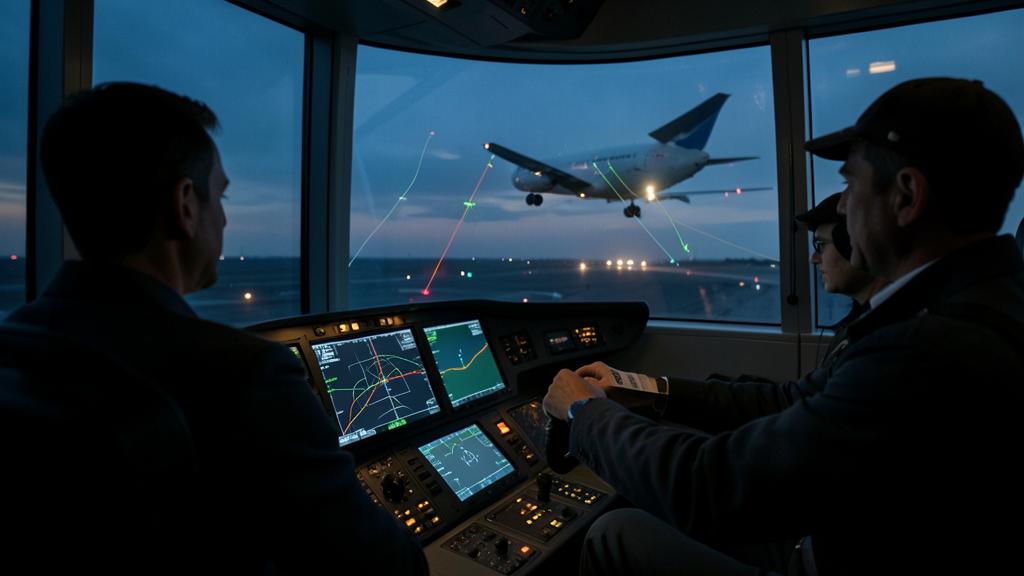
Two things erode quickly. The cockpit voice recorder stores the aural annunciations and the crew coordination — the richest source for any advisory event — and in short-duration installations, it is overwritten long before anyone decides that the event is interesting. And no record anywhere stores the thinking.
| Already in the data | Only in your report |
|---|---|
| Altitude, vertical speed, pitch angle, autopilot engaged or not | Which advisory, in what order: initial, increase, reversal, stabilization, clear of conflict |
| The track of the other aircraft’s transponder | Whether the traffic was visually acquired and whether the display of the geometry matched |
| The radio traffic, in the ANSP recording | What the crew understood from the clearance and whether an instruction crossed the advisory |
| Time, position, altitude, and rate before the event | Whether the response was manual or controlled by an autopilot mode, and whether it was complete, partial, or delayed |
The reporting obligation is not discretionary. In the European system, a resolution advisory is in the list of occurrences that must be reported under Regulation (EU) 376/2014 and the implementing regulation that carries the list; elsewhere, the obligation comes from the state’s own scheme and the operations manual, and it exists in any case. The service provider submits its own report on the same event, and the two are later reconciled — that is why a UTC time to the minute, the sector or frequency, and the identification of the other aircraft, if known, are more valuable than a page of description. This habit costs a line in a recurrent training briefing; the classification work it feeds, of the type addressed in the FL330 training platform, cannot be restored once the data is gone.
The difference that matters is between an advisory that has resolved a real conflict and an advisory that was activated due to a rate. No one can make this call from the flight data alone: It requires the geometry, the intent, and the sequence of announcements, and these exist in only one place. A report stating « TCAS RA, followed, clear of conflict » is compliant and worthless — it cannot be classified, cannot feed the work on vertical rate, and cannot say whether the system protected the aircraft or simply interrupted it.


Leave a Reply
You must be logged in to post a comment.