
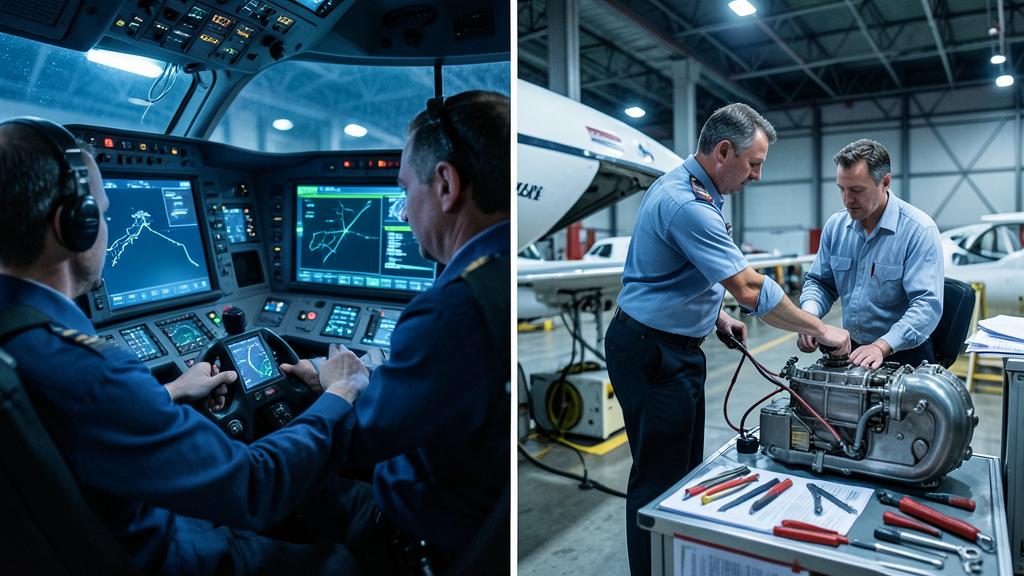
Put a pilot and a line engineer in front of the same aeroplane and ask each what the hydraulic system is. One will describe what happens to the controls when a pump fails and how the flight deck tells you about it. The other will describe where the pump is, what drives it, which connector feeds it and what the task card says about torquing the line. Both answers are complete. Neither is a partial version of the other, and that is the whole point of two type courses that never converge.
Two courses built around two different questions
A pilot type rating course exists to answer one question: what does this aeroplane do, and what do I do about it? Everything in the syllabus serves that. Systems are taught to the depth required to predict behaviour, recognise a degraded state, and select the correct procedure. Below that depth, the course stops deliberately — not because the detail is uninteresting, but because it does not change any decision the crew will make.
A maintenance type course exists to answer a different question: where is it, how is it built, and how do I work on it without breaking something else? Here the depth goes the other way. The topology matters: routing, segregation, access, adjacent systems, the fasteners, the torque values, the special tooling, the sequence in which panels come off and go back on.
The two syllabi share a subject and almost no content. A pilot can hold a type rating for fifteen years and never have seen a wiring diagram for the aeroplane. An engineer can be authorised to release that same aeroplane and never have seen the flight-deck workload during an engine failure after V1. Neither gap is a training failure. Each is what the other course was designed to leave out.
Pilots learn how the plane behaves and what to do in emergencies. Engineers learn how to fix and maintain it. Neither needs the other’s knowledge because their jobs are completely different.
On an Airbus A320, a pilot learns that a hydraulic pump failure will trigger a warning light and reduce control redundancy. An engineer learns how to locate the pump, remove it, and replace it with the correct torque settings—without damaging nearby wiring or components.
What the flight crew course actually teaches
In the European system, the type rating is a Part-FCL privilege delivered by an approved training organisation. Its structure is not left to the school: the operational suitability data produced by the manufacturer as part of type certification defines the minimum training content for the type, and the course is built on that baseline. This is why type rating courses for the same aeroplane look broadly similar across providers, and why any reduction of the course for a candidate’s previous experience has to come from the approved credit provisions rather than from the school’s own judgement.
The sequence runs from theoretical knowledge, through fixed-base and full-flight simulator sessions, to a skill test conducted by an examiner. What the skill test proves is narrow and precise: that this pilot can operate this type to a defined standard, in normal, abnormal and emergency conditions, as part of a crew where the type is certified for multi-pilot operation.
Two consequences follow that surprise people outside the profession. First, where the simulator qualification, the training approval and the pilot’s own prior experience all allow it, zero flight time training lets a candidate complete the rating without flying the aeroplane at all. The first contact with the real machine is then a line sector under supervision, flown under the additional conditions that route carries. Second, the rating on its own does not authorise line flying. The operator’s conversion course, its own procedures, its safety and emergency equipment training, crew resource management, line flying under supervision and a line check all sit between the type rating and the right-hand seat on a commercial sector.
What the maintenance type course actually teaches
On the maintenance side, the licence is the Part-66 aircraft maintenance licence, categorised by scope of work: category A for limited line tasks, B1 for mechanical and structural, B2 for avionics and electrical, B3 for smaller piston aircraft, C for base maintenance certification. For large aeroplanes and other complex types, the specific type is endorsed on the licence, and that endorsement requires type training — theoretical and practical — with the examination standard defined in the regulation itself rather than by the training provider.

The theoretical element walks the systems in a way a pilot would find relentlessly physical: locations, components, interfaces, operating logic at the level of what drives what, and — crucially — the fault behaviour of each item as seen from the outside, because that is what the troubleshooting manual will ask about. The practical element is where the course separates itself entirely from the flight crew world. It requires exposure to representative tasks across the systems: removals, installations, functional checks, adjustments, inspections, recorded and assessed. For a first type in a category, on-the-job training under supervision follows, documented task by task.
The examination is written and, for the practical part, assessed. What it proves is also narrow: that this person can carry out maintenance on this type correctly, using the approved data, without inducing a new defect.
| Flight crew type course | Maintenance type course | |
|---|---|---|
| Question answered | What does it do, and what do I do about it? | Where is it, how is it built, how do I work on it? |
| Depth of systems teaching | Down to observable behaviour and crew action; stops there | Down to component, interface and access; stops above design theory |
| Baseline content set by | Operational suitability data from type certification | The type-training and examination standard in the licensing regulation |
| Delivered by | An approved training organisation | An approved maintenance training organisation, or an approved course under the competent authority |
| Assessed by | Skill test with an examiner, in the aircraft or a qualified simulator | Written examination plus assessed practical element |
| Result on the licence | Type rating entered, with a validity period | Type endorsement added to the maintenance licence |
| Still needed before working | Operator conversion course, line flying under supervision, line check | Certification authorisation issued by the maintenance organisation, within its approval scope |
The paper is not the permission
This is the symmetry that both professions understand about themselves and rarely about each other: in both systems, the licence document establishes competence, and a second, organisational act establishes permission.
A Part-66 licence with the type endorsed on it does not allow anyone to sign a certificate of release to service. The maintenance organisation issues a certification authorisation, limited to the scope of its own approval, to the tasks the organisation has assessed the holder against, and often to a specific station. Move to another employer and the licence travels with you; the authorisation does not. In base maintenance, the aircraft release is issued by category C certifying staff, supported by B1 and B2 staff who ensure the work in their own disciplines is completed to standard — a division of responsibility that has no equivalent on the flight deck.
Conversely, a type rating in a pilot licence does not permit commercial line operation on it. The operator’s conversion training, the checks, and the operator’s own approval to release the pilot to the line all sit in between. Both professions carry a document that says what they know and depend on an organisation to say where they may use it.
The trap. The two systems diverge sharply between regulators on the maintenance side. The FAA certificate has airframe and powerplant ratings but no type endorsement: type-specific competence is administered through the operator’s or repair station’s approved training programme and the individual’s authorisation. On the pilot side, type ratings exist in both systems. Treating « type rated » as meaning the same thing on both sides of the Atlantic, for both professions, is how transfer-of-credit conversations go wrong.
Two different libraries
The clearest evidence that these are separate disciplines is what each person reads at work. There is almost no overlap, and the documents are not written to the same purpose. Crew documentation is procedural and time-critical: it is designed to be used with a fire warning illuminated. Maintenance documentation is referential and exhaustive: it is designed to be used with the aeroplane opened up and hours available.
| Flight crew | Purpose | Maintenance | Purpose |
|---|---|---|---|
| Flight crew operating manual | System description to behaviour level, limitations, normal and non-normal procedures | Aircraft maintenance manual | Approved procedures for removal, installation, servicing, functional checks |
| Quick reference handbook | Immediate action and checklist use in flight | Troubleshooting or fault isolation manual | Structured fault trees from observed symptom to component |
| Flight crew training manual | Technique and rationale behind the procedures | Illustrated parts catalogue | Part identification, effectivity, interchangeability |
| Operations manual parts A and B | Operator policy, procedures and type-specific operating rules | Wiring diagram manual | Electrical topology, routing, connector and pin identification |
| Performance and mass and balance data | Departure and landing calculations, limitations | Structural repair manual and component manuals | Damage assessment, allowable limits, repair schemes, shop procedures |
Where the two syllabi genuinely touch
There are exactly two places where the courses stop being parallel and start being interdependent, and both are where the accidents live.
The first is the minimum equipment list. A single MEL item can carry an operational procedure and a maintenance procedure — the familiar (O) and (M) annotations. The (M) is performed and certified by maintenance; the (O) is applied by the crew for as long as the item is carried. Neither profession is taught the other’s half in any depth, yet a dispatch under that item is only legal if both halves were correctly done and correctly recorded. The classic failure is not a technical one: it is an item deferred with the (M) procedure incomplete, or with the crew never made aware that an (O) procedure applies to them for the next ten days.
The second is the technical log. It is the only document both professions write in, and its whole value comes from the quality of a defect report written by someone with no training in the system’s topology, read by someone with no experience of what the flight deck looked like at the time. « Autopilot dropped out » and « autopilot disconnected at 3,000 feet in turbulence with a master caution and this specific message, twice, both times on the same channel » cost the same amount of time to write and represent completely different amounts of work at the other end.
| Document | What the crew does with it | What maintenance does with it | Where it breaks |
|---|---|---|---|
| Minimum equipment list | Confirms dispatch is permitted, applies the (O) procedure and any performance penalty | Applies and certifies the (M) procedure, sets and tracks the rectification interval | One half done, the other assumed; interval start date miscounted |
| Technical log | Records the defect as observed, accepts carried items before flight | Records rectification or deferral, issues the release | Symptom described without conditions, phase of flight or messages |
| Configuration deviation list | Applies the operating limitation or performance penalty | Confirms the missing part and its conditions | Treated as an MEL item, with the wrong interval logic applied |
Two recurrency clocks that do not tick alike
Flight crew currency is dominated by calendar and by checking. An aeroplane type rating is revalidated on a twelve-month cycle through a proficiency check; the operator’s own proficiency checks recur more frequently than that, at intervals set in the air operations rules; recent experience requirements govern take-offs and landings; recurrent training runs on a rolling programme. The consequence is that a pilot away from the line for a long period faces a defined, structured path back.
Maintenance currency works on a different principle. The licence document has its own validity, but the operative conditions are recent maintenance experience within a defined window and continuation training through the maintenance organisation, which must also keep its own assessment of each authorised individual current. There is no periodic skill test equivalent to a proficiency check. The organisation’s assessment carries the weight instead — which puts a great deal of responsibility on the quality of that assessment, and makes the return from a long absence a matter of organisational judgement rather than a single defined event.
What neither course covers, and who ends up paying
Neither syllabus teaches the interface. Pilots are not taught how a fault is isolated, what a no-fault-found actually costs, or why a component swap based on a vague report is both expensive and unlikely to work. Engineers are not taught what the flight deck was doing when the report was written, or why the crew’s description used the words it used.
The operators who close that gap do it deliberately and cheaply: line engineers in the simulator for a session, pilots in the hangar during a check, joint debriefs on repeat defects, and defect reporting taught as a skill rather than assumed. None of it is required by any regulation. All of it shows up in no-fault-found rates and in the length of the carried-forward list.
For anyone choosing between the two routes, the honest framing is not that one is more technical than the other. It is that one profession is trained to act correctly under time pressure with incomplete information, and the other is trained to be exhaustively correct with the data open and the time available. The FL330 training resources lay out both paths with their prerequisites; the choice is about which kind of correctness suits you, not about which aeroplane you like.


Leave a Reply
You must be logged in to post a comment.