
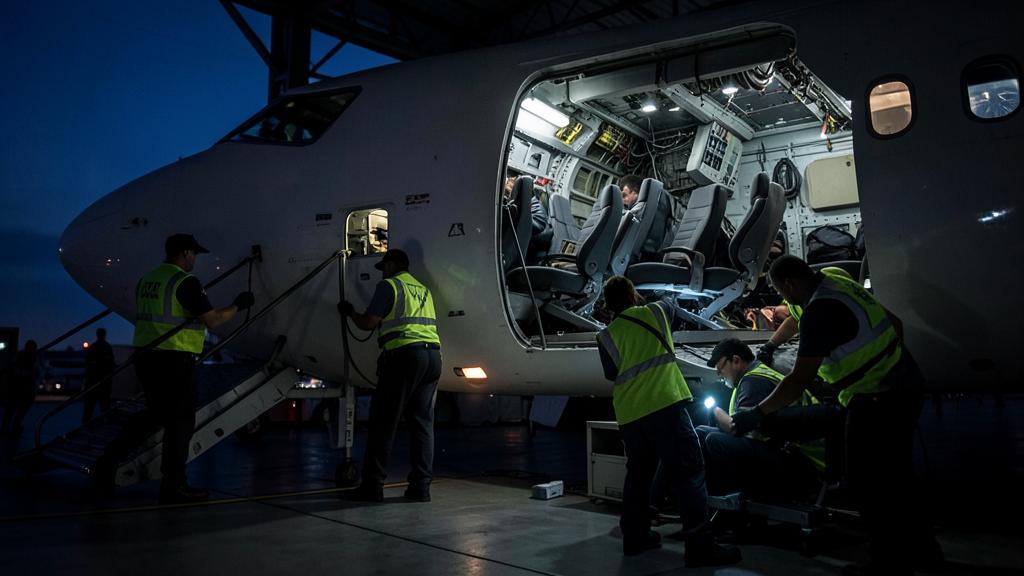
At 04:50 a ramp agent reports that the forward left door of an aircraft parked overnight on a remote stand was found unlatched, and nobody can say since when. Two words are now on the table: check and search. They are not the same task performed with more or less diligence, and choosing between them is not a matter of how nervous anyone feels. One assumes the aircraft was protected and asks you to confirm that nothing visible was left behind; the other assumes somebody had unsupervised time and asks you to look where a person would hide something. What follows is the logic that separates them, the situations that force the step up, and the record each level has to leave behind.
Two words that name two different tasks
The international vocabulary is deliberately narrow. An aircraft security check is an inspection of the interior of the aircraft to which passengers may have had access, together with an inspection of the hold, in order to discover prohibited articles and signs of interference. An aircraft security search is a thorough inspection of the interior and the accessible exterior of the aircraft, with the same purpose. Those definitions appear, in almost identical wording, in the ICAO security annex and in the European implementing rules built on Regulation (EC) No 300/2008.
Read them side by side and three differences fall out. The check is bounded by accessibility: it covers what a passenger could plausibly have reached. The search has no such boundary, which is why it takes longer and usually needs someone other than a cabin crew member. And only the search names the exterior. A check performed with exemplary care on cabin, galleys, lavatories and hold is still not a search, because it never left the fuselage.
The difference is therefore one of scope and hypothesis, not of effort. Telling a crew to « do a thorough check » is an instruction that does not exist. It either was a check, or it was a search.
The variable that decides is continuity, not tension
The common misreading is that the threat level decides. It contributes, but it is not the primary variable. The primary variable is whether the protection of the aircraft was continuous and demonstrable from the moment it was last inspected until now.
Aircraft protection is itself a defined regime: doors closed or access controlled, steps and loading bridges removed or guarded, the aircraft under surveillance or in an area whose access is itself controlled. When that regime holds without interruption, the previous inspection is still valid and no new one is normally due. When it holds but with a change of custody — a night stop in a controlled area, a crew change, a cleaning team going through the cabin — a check re-establishes the state of the accessible areas. When the regime breaks, or when you cannot prove it did not, the hypothesis changes: someone may have had unobserved time on board, and unobserved time is what makes concealment possible. That is the trigger for a search.
Stated as a single sentence: a check verifies that nothing was left; a search assumes somebody had the opportunity to hide something and goes looking for it. The threat level raises the bar by making the state’s appropriate authority require searches in circumstances that would otherwise call for a check, and by extending the areas covered. It does not change the underlying logic.
A check is like tidying up after a party—you look where guests could have left things. A search is like investigating a break-in—you look everywhere, even hidden spots, because someone might have snuck in.
An Airbus A320 is parked overnight at a remote stand. At 04:50, the left forward door is found unlatched. The last inspection was at 22:00, but no one can confirm continuous protection. The crew performs a search, checking void spaces, gear bays, and panels—taking 90 minutes instead of the 20 minutes a check would require.
| Dimension | Aircraft security check | Aircraft security search |
|---|---|---|
| Underlying hypothesis | Protection held; an item may have been forgotten or left in plain reach | Protection lapsed or cannot be proven; an item may have been deliberately concealed |
| Interior scope | Areas accessible to passengers, plus the hold | All interior areas, including those no passenger can reach |
| Exterior | Not covered | Accessible exterior — gear bays, fairings, panels, service points |
| Concealment depth | Visible and reachable without tools: seat pockets, under cushions, bins, lavatory bins, galley stowages | Behind and under: seat cushions lifted, panels and covers opened as far as the procedure allows, void spaces addressed |
| Typical performer | Cabin and flight crew, or ground staff, trained for the task | Security staff certified for aircraft search, often with crew or engineering support for access |
| Duration order of magnitude | Minutes, scaled to the cabin | Substantially longer, and it is a schedule event, not a turnaround task |
The situations that force the step up
Every state writes the detail into its national civil aviation security programme, and every operator writes its own version into its security programme, so the list below is a logic rather than a legal citation. The point is to recognise the shape of the situations, because they recur in every set of national rules.
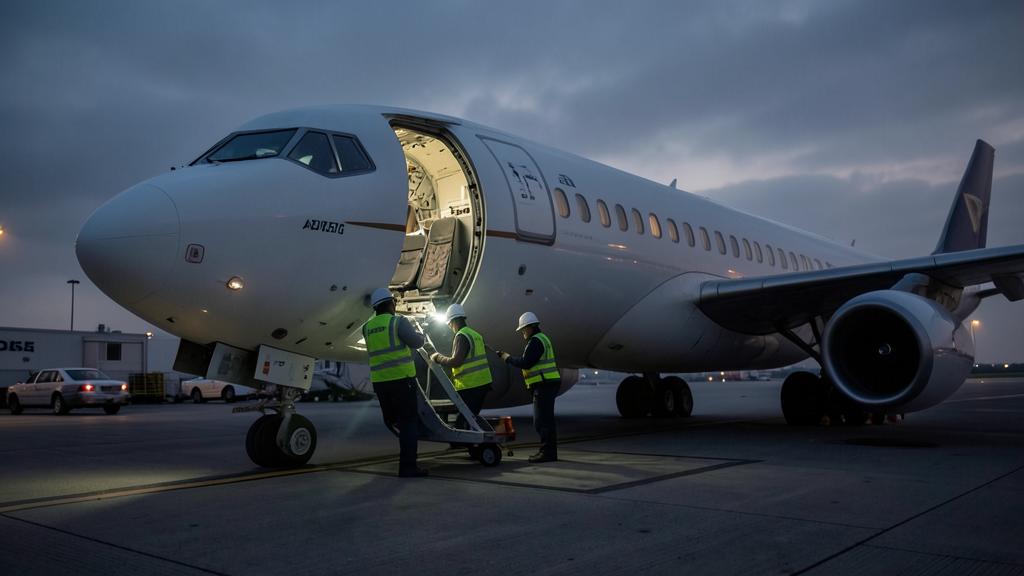
A break in protection is the archetype: a door found open, a seal broken, a hold left accessible, an aircraft parked outside a controlled area with no surveillance. Its defining feature is a period of time nobody can account for. The duration matters less than the fact of it: five unaccounted minutes are enough to place an object, and the inspection has no way of knowing whether it was five or fifty.
A specific threat against the flight, the aircraft, the route or the operator moves it up regardless of protection, because the hypothesis is no longer generic. A specific threat usually also brings requirements the crew cannot decide alone: coordination with the appropriate authority, a decision about whether the search happens at an isolated parking position, and a decision about whether it happens at all before the aircraft is moved.
An act of unlawful interference, or a credible report of one, is the case where an aircraft becomes evidence as well as an aircraft, and where the security decision passes out of the operator’s hands.
A declared increase in the threat level by the appropriate authority is the case where the rules themselves change under you: measures that were conditional become systematic, and the operator’s programme should already say what that looks like rather than improvising it on the day.
Two further cases recur. Aircraft returning to service after a period outside the protected regime — a third-party maintenance input, a long parking, a ferry with non-security-cleared personnel aboard — are normally searched before their first commercial flight rather than checked. And arrival from an origin whose standards are not recognised as equivalent raises the level for the onward sector in several national programmes.
| Situation | What is unknown | Level normally required |
|---|---|---|
| Continuous protection since the last inspection, no access | Nothing | None due; the previous inspection stands |
| Routine turnaround, passengers disembarked, protection maintained | What passengers left behind | Check |
| Cleaning or catering team on board under access control | Nothing structural; accessible areas disturbed | Check |
| Door or hold found open, period unaccounted for | Whether anyone boarded, and for how long | Search |
| Aircraft parked outside a controlled area without surveillance | The entire custody chain | Search |
| Return from maintenance at a third-party facility | Who had access, and to which void spaces | Search |
| Specific threat against the flight or the aircraft | Nothing is generic any more | Search, coordinated with the authority |
| Threat level raised by the appropriate authority | Set by the state, not by the operator | As the programme prescribes |
The trap. « The aircraft was in a restricted area » is not by itself proof of continuous protection. A restricted area controls who enters the area; it does not control who approaches a particular aircraft once inside it. Where the operator’s programme relies on area control instead of aircraft-level protection, that reliance has to be written down and accepted, not assumed at the stand at four in the morning.
Who may perform each level, and what training means here
A check is normally within the competence of the operating crew, because it maps onto areas they know and objects they can recognise as out of place. That competence is not automatic: it comes from the security training required of crew members, which is separate from safety and emergency training and follows its own recurrent cycle. The person performing the check has to know what a prohibited article looks like, what « out of place » means in a galley they did not stow themselves, and — most importantly — what to do when they find something, which is to stop, not to move it.
A search is a different qualification. It requires knowledge of the aircraft type’s void spaces and access panels, of what may and may not be opened without an engineering release, and of the sequence that guarantees full coverage. Many operators contract it to the airport security provider or to a specialist team; a few train their own. Where crew are involved, it is normally to provide type knowledge and access, under the direction of the certified searcher.
The rostering consequence is usually discovered too late. A search performed properly on a narrowbody is not a turnaround activity, and on a widebody it is a substantial block of time. Treating the two levels as interchangeable in a schedule produces a predictable outcome: pressure on the person holding the list to declare a search complete when it is not.
Traceability: the problem of proving a negative
Both levels produce the same kind of result almost every time: nothing found. That is the difficulty. A record that says « nothing found » carries no information unless it also establishes what was looked at, by whom, when, and against what list. An inspection whose only trace is a signature has, in evidential terms, not happened.
The elements below are the ones that make a record usable a week later, when someone asks whether the aircraft was inspected before a particular sector. They are also the ones that survive a security audit.
| Element | Check | Search | Why it is there |
|---|---|---|---|
| Aircraft identity and location | Registration, stand | Registration, stand or isolated position | Ties the record to one airframe, not one flight number |
| Time | Completion time | Start and completion time | A search has a duration that should be plausible for the type |
| Performer | Name or crew identifier | Name and certification reference | Establishes competence, not just presence |
| Reference list used | Type-specific check list | Type-specific search list, area by area | Defines the scope that « complete » refers to |
| Areas covered | By zone, at minimum cabin, galleys, lavatories, hold | Area by area, signed off individually | Partial coverage becomes visible instead of invisible |
| Trigger | Routine, or the event that caused it | The event, and who decided | Links the level chosen to the reason for choosing it |
| Outcome | Nil, or the item and the action taken | Nil, or the item and the action taken | Turns a finding into a traceable event |
| Protection afterwards | Seal numbers if applied, doors secured | Seal numbers, position of the aircraft, custody handover | Starts the next period of validity |
The right reflex. Record the trigger, not only the result. A record that says « search, nil » tells a later reader nothing about whether a search was the correct level. A record that says « door 1L found unlatched at 04:50, protection not demonstrable since 22:10, search ordered by the duty security manager, completed 06:35, nil » is a defensible decision as well as a completed task.
Seals, and the hours that follow the inspection
An inspection is a photograph of a state, and states decay. What preserves the value of a completed check or search is the protection applied immediately afterwards and the ability to demonstrate it later. That is what tamper-evident seals are for: not to prevent entry, which they cannot do, but to make a subsequent entry visible and to give the next person a verifiable starting point.
Seals only work under three conditions, all routinely missed. Their numbers must be recorded, otherwise an intact seal proves only that a seal is present. They must be checked against the record, not merely observed to exist. And the person applying them must know which doors and hatches the programme actually requires to be sealed, since sealing the passenger doors while leaving a service panel open produces confidence rather than security.
The other half is custody. When an aircraft moves between organisations — a tow, a handover from crew to ground staff, a change of handling agent — the security state should move with an explicit handover, not an assumption. Most unexplained breaks in protection are not intrusions; they are gaps between two organisations each believing the other held the aircraft.
Three failure modes worth naming
- The first is the upgraded check: a crew told that the situation is serious performs a check with unusual care and records it as a search. Nothing dishonest is intended, and the record is nonetheless false, because the exterior and the inaccessible interior were never covered. The correction is procedural rather than moral: give the crew a way to say « this needs a search and we cannot do it » that does not cost them the departure slot on their own authority.
- The second is the rolling assumption of protection. Each shift assumes the previous one maintained the regime, and nobody has a record establishing when it was last positively demonstrated. This is why the validity of an inspection should be anchored to a documented protection period rather than to elapsed time alone.
- The third is finding something and moving it. The single instruction that matters most in both levels is that a suspicious item is not touched, not moved, not opened, and not discussed on an open channel. Every subsequent option — evacuation, isolated parking position, specialist response — depends on the item still being where and as it was found. Training that spends ninety per cent of its time on where to look and ten per cent on what to do next has the ratio backwards. Operators reviewing that training will find the two levels worth revisiting with crews at FL330 training as reasoning, not as a checklist.
What the crew should be able to answer
Three questions, on any stand, in any state. Was protection continuous and demonstrable since the last inspection? If yes, nothing new is due; if not, or if you cannot tell, the level goes up. Which level does the programme require here? That answer lives in the security programme, not in judgement. What will the record establish? If the answer is « that I signed it », the record needs more than a signature. None of this requires deciding how dangerous the world is that morning — only whether the last few hours can be accounted for, which is a factual question, and answerable.


Leave a Reply
You must be logged in to post a comment.