
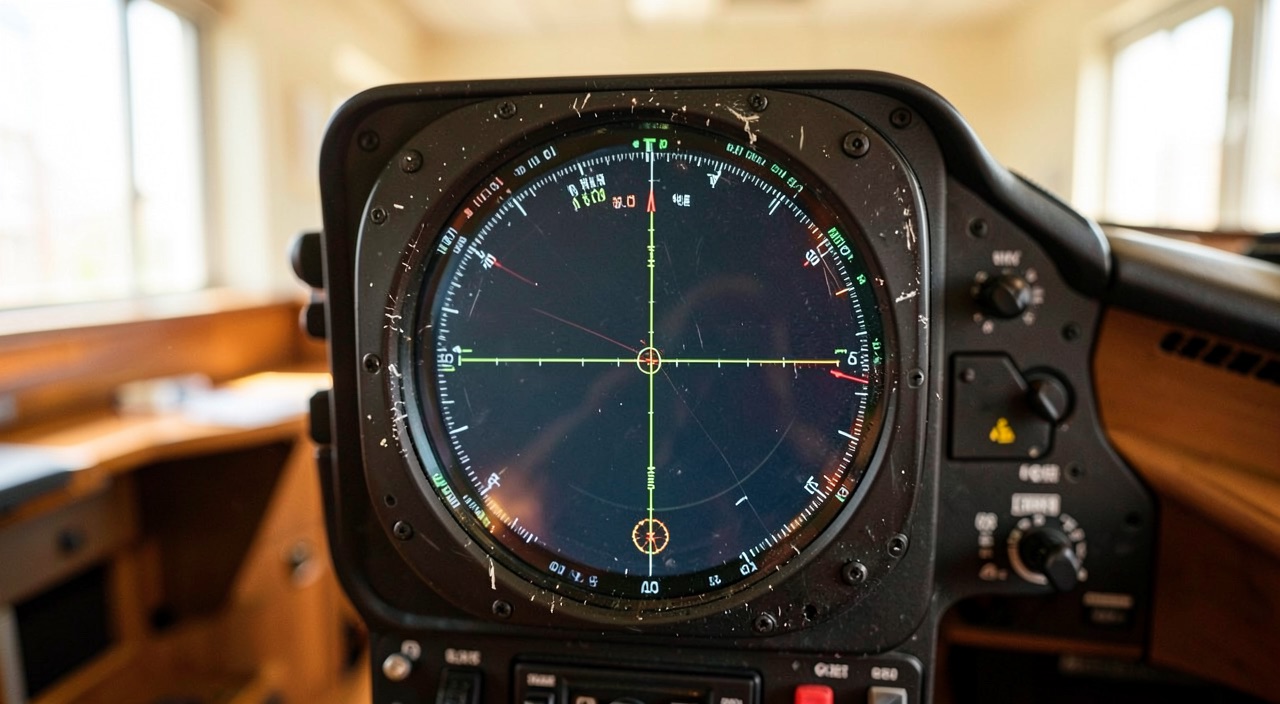
The autopilot drops out at the top of the climb, the pitch attitude is steeply nose-up and the airspeed is collapsing; or a wake vortex has rolled the aircraft past the vertical and the nose has gone below the horizon while the speed runs away. Same controls, same seconds. What separates a clean recovery from a loss of control is not the delicacy of the input, but the box the situation was filed into before acting: the two sequences use the same levers in the opposite order.
What an upset actually covers, and why the box comes before the input
Training manuals keep a deliberately coarse definition: you are in one as soon as pitch attitude exceeds roughly twenty-five degrees nose-up, about ten degrees nose-down, or bank angle exceeds roughly forty-five degrees. A fourth, less visible case is added to these: staying within those limits while flying at an airspeed inappropriate for the conditions. These are not structural limits but recognition thresholds: beyond them, the deviation can no longer be caught by an ordinary correction.
Recognition is therefore an act in its own right, with its own cost in time, and it calls for two indications: pitch attitude and the trend of the airspeed. The attitude indicator alone reads badly once the sky-ground split has left the frame, because the very cue that tells up from down is the one an extreme attitude removes. Airspeed, for its part, settles the matter: it collapses in a nose-high upset, it runs away in a nose-low one.
Call the box, not the manoeuvre. A spoken “nose high” or “nose low” commits both pilots to a known sequence and gives the pilot monitoring a criterion for intervening: he knows which input comes first, and therefore which one is missing. Without the call, nothing prevents two different sequences from being applied to the same controls.
When an aircraft is out of control, pilots must first recognize whether the nose is too high or too low. Each situation requires a different order of actions. Calling “nose high” or “nose low” helps the crew follow the correct steps without confusion.
An Airbus A320 at 20,000 feet loses autopilot control. The nose pitches up to 30 degrees, and airspeed drops from 250 knots to 180 knots. The crew calls “nose high,” disengages automatics, pushes forward to establish a nose-down rate, reduces thrust, and banks to help lower the nose. If they had instead tried to level the wings first, the elevator would have been less effective, making recovery harder.
Nose high: push first, bank afterwards if you must
The sequence opens with disengaging the autopilot and the autothrottle. An automatic system still pursuing its own law while the crew is acting creates two contradictory wills on the same control surface, and it has just trimmed nose-up against a decaying airspeed.

Then comes the nose-down input. The objective is not an attitude, it is a rate: you push until a downward rotation of the nose is obtained, and you hold it. The distinction changes the dosage: a target attitude invites you to release as soon as it appears, a rate requires you to keep going until it establishes itself. At high angle of attack the elevator loses authority and stick force alone may prove insufficient.
Thrust comes next, and not in the direction instinct suggests. With underwing nacelles it acts below the centre of gravity and produces a nose-up moment: applying it in the middle of a nose-high recovery amounts to pulling on the stick by another route. With tail-mounted engines the effect is small or reversed. In any case it only responds once the engines have spooled up, well after the second in which angle of attack is decided.
That leaves the lever instinct refuses: bank. Banking moves the lift away from the vertical; the component that was supporting the aircraft decreases and the nose comes down without asking any more of an already saturated elevator. In a nose-high upset, bank is a tool.
The trim left nose-up. An automatic system that has been fighting a deceleration leaves a strongly nose-up trim setting. The push force then becomes heavy and unrelenting, and the pilot who judges his action by the force he feels pushes too little. The trim must be relieved deliberately, otherwise the aircraft pitches back up at the first relaxation.
Nose low: wings level before any pull
The mirror sequence opens the same way, automatics off, then immediately diverges. First triage: is the wing stalled? For as long as it is, no control produces what is asked of it, and the stall takes priority over attitude, over bank and over proximity to the ground.
Then comes roll, by the shortest path to wings level, including past ninety degrees if that is the shorter path. The elevator only comes into play afterwards, with nose-up trim if the force becomes excessive, thrust reduced and speedbrakes extended.
The reason for this order is geometric and can be quantified. Only the vertical component of the lift raises the nose, and it equals the cosine of the bank angle: eighty-seven per cent at thirty degrees, half at sixty. The remainder goes into tightening the spiral, while the load factor needed to stop descending varies as the inverse of that cosine. Pulling before the wings are level means paying in load factor and in angle of attack without buying any recovery of the nose.
| Item | Nose high | Nose low |
|---|---|---|
| Signature | Steeply nose-up attitude, airspeed falling | Nose below the horizon, airspeed rising |
| Automatics | Disengaged at once | Disengaged at once |
| First triage | Obtain a nose-down rate | Unload the angle of attack if the wing is stalled |
| Elevator | First in rank, it opens the sequence | Last in rank, it closes the sequence |
| Bank | Backup if the elevator saturates | Precondition for an effective pull |
| Thrust | Reduce with underwing nacelles | Reduce, to idle if needed |
| Trim | Relieve the nose-up trim left by the automatics | Nose-up if the force becomes excessive |
| Speedbrakes | Not applicable, the energy is lacking | Useful, the energy is in excess |
| Price paid | Altitude | Airspeed and load factor |
The transfers that make things worse, one by one
The error almost never consists in inventing an input, but in using in one situation the one that belongs to the other. Each lever has one rank in one sequence and another in the second; it is the rank that does the damage.
| Input | Right in | What it produces in the other case |
|---|---|---|
| Pulling on the elevator | Nose low, wings level | The angle of attack rises and the stall precedes any drop of the nose |
| Applying thrust | Recovery complete | Nose-up moment with underwing nacelles, and a delayed effect |
| Rolling the wings level straight away | Nose low | Removes the only lever left when the elevator saturates |
| Banking to bring the nose down | Nose high | Moves the lift away from the vertical and tightens the spiral |
| Extending the speedbrakes | Nose low | Adds drag to an energy state that is already insufficient |
The most costly transfer remains the premature pull in a nose-low upset, because it comes dressed as prudence and rests on a false sensory reading: in an established spiral, the load factor is positive and the seat feels normal. Nothing in the body signals the bank; only the horizon tells it.
A spiral is not felt, it is read. The high rate of descent and the positive load factor mimic a pull-out already under way, and the reflex is to pull harder. Every additional effort tightens the turn, increases the angle of attack and moves closer both to the stall and to the structural limit, without raising the nose. Until the bank has been dealt with, the elevator is not working for you.
Energy: two opposite currencies
Nose high, the aircraft is short of kinetic energy and the only reservoir that can be drawn on within the second is altitude, thrust being a slow reservoir. The recovery therefore costs feet, necessarily, and the difficulty is not the input but accepting that expenditure in advance, matched to the height available.
Nose low, the excess is on the other side: the conversion of altitude into airspeed is continuous and accelerating, and it must both be stopped and the speed already gained dissipated. At altitude the two limits move closer together and the available thrust is low: a nose-high recovery is paid for almost entirely in altitude, and the pull-out of a nose-low recovery must stay gentler, the margin before buffet closing up as the load factor rises.
The crossover point: the first sequence creates the second
A successful nose-high recovery ends nose low: it consists in bringing the nose below the horizon to rebuild airspeed. The crew changes problem without changing flight and must move from one sequence to the other at the right instant. Pushed for too long, the aircraft goes well past the horizon and the second recovery starts at a higher speed, with the residual bank already in place to help.
Hence an end criterion that is not “nose below the horizon” but “flight path regained, airspeed returning, bank dealt with”. That is what is most often missing: the first sequence is well flown, then nothing says when it stops.
What the simulator shows, and what it cannot make you feel
A simulator’s aerodynamic model is tuned on tests flown inside the envelope. Beyond the stall and at high bank angles it extrapolates, and that is precisely where the exercise is played out: the recent stall-modelling requirements answer this very point.
The second shortcoming is physiological. A cab on actuators cannot sustain a load factor and has nothing to offer in reduced load factor, whereas it is precisely that sensation of lightness, unfamiliar and unpleasant, that causes the push force to be under-applied. A trainee who has never really pushed learns the order of the actions without learning its cost.
This is the whole point of advanced training in an aeroplane, required by European regulation before a first multi-pilot type rating and prepared for in the corresponding training courses. What is acquired there is not an aerobatic figure: it is the delay between surprise and the first correct action.
What to go and check in your own documentation
Four points deserve a careful reading of the type’s operating manual. Thrust: must it be reduced in a nose-high recovery, or merely adjusted, and how far? Roll: is going past ninety degrees to reach wings level explicitly provided for? Then trim, and the end-of-manoeuvre criterion, often the vaguest of the four.
A grey area remains on fly-by-wire aircraft: the angle-of-attack and bank protections belong to normal law, and an upset often occurs after the failure that brought that law down. The sequence is then the one for fully manual flying, trim included, on a machine whose behaviour is not the one that daily training has instilled.
For anyone preparing for a rating, the consequence is immediate: the examiner looks at the call and at the rank of the actions before the smoothness of the flying. An approximate recovery in the right order passes; an elegant recovery in the wrong order does not, and the exchanges between practitioners confirm it session after session.
The applicable regulation, the manufacturer’s specifications and the operator’s approved documentation prevail over the above: this article sets out mechanisms, it replaces neither a procedure nor a training programme.
Questions fréquentes
How do you decide between nose high and nose low when the attitude indicator is saturated?
By cross-checking two indications instead of one: the direction of the sky-ground split on the attitude indicator, including the standby instrument, and above all the trend of the airspeed. An airspeed that collapses signs a nose-high upset, an airspeed that runs away signs a nose-low one, and that information stays readable when the attitude has driven the reference cue out of the frame. The spoken call then locks the sequence in for both pilots.
Does thrust really have to be reduced in a nose-high recovery?
The position of the engines governs the answer, and the type’s operating manual settles it. With underwing nacelles, thrust acts below the centre of gravity and creates a nose-up moment that works against the nose-down input: reducing it then becomes a means of control, temporarily, for as long as it takes to obtain the rate. With tail-mounted engines the effect is small and the question does not arise in the same terms.
May you roll past ninety degrees to bring the wings level?
Yes, when that is the shortest path, and many manufacturers’ documents provide for it explicitly. The criterion is not the elegance of the manoeuvre but the time spent banked, since for as long as the bank lasts the lift is not supporting the aircraft and the nose keeps dropping. You must check the wording adopted by the operating manual of your own type before applying it.
What does a degraded control law change in these two sequences?
It removes the angle-of-attack and bank protections at the very moment they would be useful, and it makes manual trimming decisive. The sequence keeps the same order, but the dosage and the stick forces are no longer the ones daily training has instilled. This is a point to prepare type by type, by identifying what becomes of each protection in each degraded law.
Is the simulator enough to cover this training?
It covers the order of the actions, the reading of the instruments and crew coordination, which already amounts to the essential part of the reasoning. It reproduces neither a load factor sustained over time, nor the reduced load factor of a firm nose-down input, nor genuine surprise. That is why European regulation requires advanced training in an aeroplane before a first multi-pilot type rating.
How much altitude does a nose-high recovery cost?
No single figure makes sense: the loss depends on the type, on the mass, on the altitude, on the attitude reached and on the promptness of the nose-down input. What matters is to have decided before the flight what expenditure you accept according to the height available, because at low altitude the trade-off between angle of attack and the ground becomes the central question. The data in the type’s operating manual and the training sessions give the order of magnitude applicable to your own machine.


Leave a Reply
You must be logged in to post a comment.