
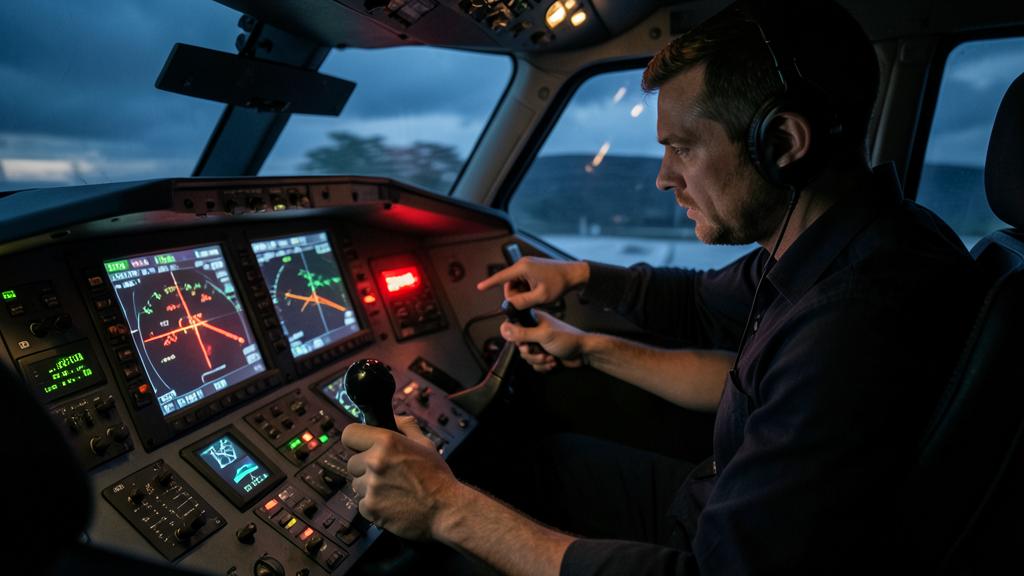
Upset recovery is now a fixed part of recurrent training, and the device in which it is taught was never built for it. A full flight simulator is a machine to reproduce an aircraft within the envelope where that aircraft was flight-tested. Take it out of there — beyond the stall, in a large sideslip, under a sustained load factor — and it continues to produce motion, sound and instrument indications with the same confidence, while the underlying data has lost its foundation. The exercise is still worthwhile. It is simply worth doing differently, and knowing where the device stops being evidence is what separates a session that builds judgment from one that builds a comfortable illusion.
What does « qualified » really certify?
The qualification of a simulator is not a statement that it flies like the aircraft. It is a statement that, in a defined list of test points, under defined conditions, its response matched the flight test data within defined tolerances. That list is in the qualification test guide, and the evaluation that grants and renews the qualification level is a comparison with it. Everything outside those points is an engineering extrapolation of a model that was adjusted to fit them.
The validation data comes from the aircraft manufacturer’s flight test campaign, and that campaign explored the certified flight envelope. No one deliberately tests a transport aircraft in the post-stall region, at forty degrees of sideslip, or beyond the structural load factor limit. Therefore, there is no measured behavior to which to fit a model, and the model in the device is built from wind tunnel work, computational predictions, and engineering judgment — often good work, but a different class of evidence.
Regulators recognized this after the loss-of-control accidents of the late 2000s. Additional device features were specified so that stall training beyond the first indication could be conducted on a sound technical basis: an aerodynamic model extended up to and through the stall for the specific configurations to be trained, and an instructor feedback tool that shows, at the instructor station, when the student has flown the device into a region that the model does not support. Where those features exist, they cover named configurations and entry conditions. They do not turn the device into a general-purpose aerobatic trainer, and an operator’s training department needs to know which configurations its own devices actually cover.
A simulator is only certified to match real flight data within a specific range. Beyond that, it’s just an educated guess, not real-world behavior.
A Boeing 737 simulator might be qualified for stall and upset recovery training within a validated envelope, but not for spins or extreme sideslips. If a pilot practices spins in that simulator, they’re practicing with a model, not real aircraft behavior.
| Region or indication | Basis in the device | What a session there can prove |
|---|---|---|
| Normal envelope, up to the first stall indication | Validation data from flight tests, qualification test points | Handling, technique, procedure — the device is evidence |
| Stall and immediately post-stall, in the covered configurations | Extended aerodynamic model where the device is qualified for it | Recognition and the first correct action; behavior broadly representative |
| Large bank and pitch attitudes within structural limits | Extrapolated from validated data | Recognition, decision, control strategy — not precise aircraft response |
| Large sideslip, spin entry, post-stall gyration | Little or no validation; frequently outside the model | Nothing about the aircraft; only whether the student recognized the situation |
| Sustained positive or negative normal acceleration | Not producible by a synergistic motion platform | Nothing physiological; control input feels free of consequences |
The indication that cannot be produced
The most important limitation is not aerodynamic at all — it is mechanical. A six-degree-of-freedom motion platform has approximately one meter of usable travel per axis. It generates onset cues and then eliminates them below the perception threshold, and produces sustained specific force by tilting the cabin so that gravity does the work. That trick works for longitudinal acceleration, where a modest tilt convincingly substitutes for a push in the back. It cannot work for sustained positive g: tilting redirects the 1 g that gravity provides, it cannot add to it, so the load factor above 1 has no physical representation in the device at all.
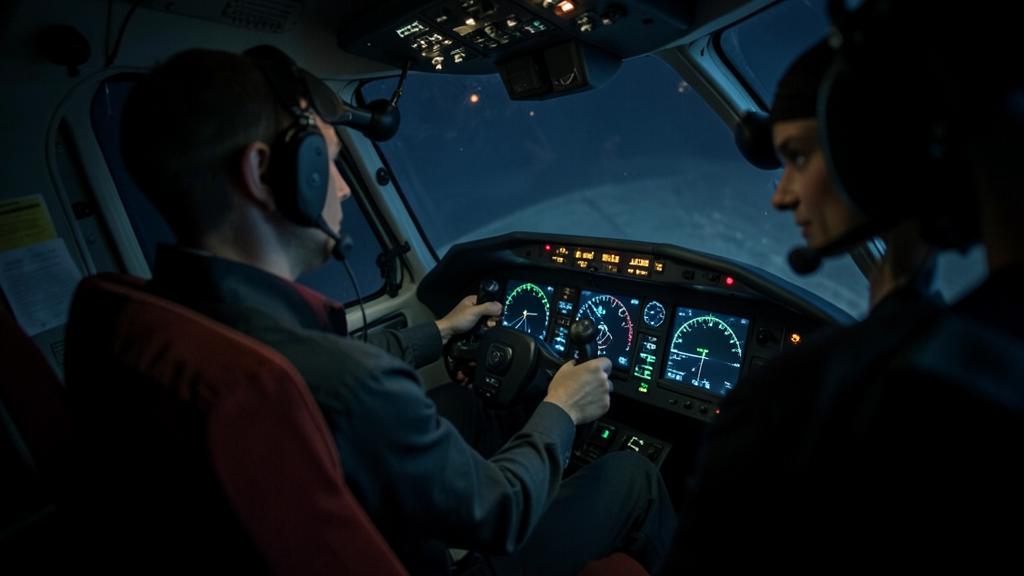
The practical consequences are severe and all point in the same direction. A recovery that would load the structure to the limit feels identical to a gentle one. Negative g — loose objects leaving the floor, the seat harness bearing the load, the cabin briefly becoming a hazard in itself — does not exist in the device at any intensity. Greying out and loss of consciousness do not exist. Neither does the physical difficulty of moving an arm under load, nor the « seat of the pants » cue that tells a pilot in the aircraft that the aircraft is being asked for more than it should give.
This is exactly why the European scheme puts an aircraft in the program. The advanced upset prevention and recovery training course that a pilot must complete before a first multi-pilot type rating includes flight instruction in an aircraft, and the reason is not tradition: g loading, disorientation and the physical experience of an unusual attitude cannot be delivered by a device on jacks. Operator recurrent training does not repeat that aircraft element, so for most pilots the physical dimension of an upset is experienced once, at the beginning, and never again.
The trap. Because the device cannot load the student, the most common negative outcome of an upset training session is a control input that would have overstressed the real aircraft, delivered by a pilot who felt nothing and was told nothing. Unless the instructor is monitoring load factor and control surface rates as parameters in their own right, that input is not only ungraded — it is rewarded, because it worked.
The surprise survives exactly one briefing
Startle and surprise are central to the accident record and almost impossible to program. By the time an exercise is briefed, the crew knows what is coming, and what remains is a demonstration of a maneuver: useful for building a motor pattern, useless as evidence of how that crew would respond to an unannounced event. Worse, a crew that has practiced the same entry every cycle recognizes the entry rather than the situation, and the recognition step — the one that actually fails in accidents — is skipped without anyone noticing.
The mitigations are partial and must be honestly described as partial. An upset embedded in a line-oriented scenario, at a moment the crew does not control, preserves some surprise. Varying the entry between cycles — incorrect trim, wake turbulence encounter, automation reversion, icing, high-altitude thrust asymmetry — prevents pattern recognition from substituting for diagnosis. Adding a concurrent workload, a radio call or a cabin interruption reproduces the attentional saturation that makes real events difficult. None of these reproduces the physiological startle response, and no ethical training design attempts to do so. Surprise is also a consumable: once a crew has been surprised in a particular way, that exercise is spent.
The negative training that follows, and what removes it
Each limitation above generates a specific way in which the session can teach the wrong lesson. They are predictable, which means they can be designed out.
| What the device teaches by accident | Why it happens | Framework that removes it |
|---|---|---|
| Large and rapid control inputs are free | No load factor indication, no structural feedback | Show and debrief load factor and control rates; call an exceedance the same way you would call an exceedance on the line |
| Recovery always works | The model returns the device to controlled flight from almost anywhere | Clearly state that the result shown is not a prediction; grade the input, not the recovery |
| Loss-of-height figures are meaningful | Students remember the altimeter reading | Do not publish or compare the loss of height from an extrapolated region |
| Recovery matters more than prevention | Recovery is dramatic and easy to program | Dedicate most of the session to energy state awareness, automation mode, and buffet margin |
| Any attitude is survivable | No fear, no fatigue, no consequences, and a reset button at the operating station | Avoid repositioning during the exercise; let a bad decision play out to its logical conclusion within the valid region |
| The aircraft responds like this at high altitude | Control authority and margins at high altitude are difficult to model and easy to misinterpret | Treat high-altitude exercises as prevention and awareness training, not as handling tests |
Frame an exercise to keep it honest
A well-framed upset exercise begins with a statement and ends with a limit. The statement belongs in the briefing and takes about twenty seconds: this device is validated to a defined point; beyond it, we are using a model, not measured data; the purpose is recognition and decision, and the numbers you see beyond that point are not the aircraft’s numbers. Some instructors resist saying this, on the grounds that it undermines the exercise. It does the opposite. Crews already suspect that the device is lying to them somewhere, and being told exactly where restores confidence in everything on the valid side of the line.
The limit belongs to the exercise design. Where the device is qualified only to the stall and a short way beyond, the exercise stops there — the objective was recognition and the first correct action, and both have been achieved. Flying beyond to a region that the model does not support to make the demonstration more impressive turns a training event into entertainment, and that is where negative training is manufactured.
The sequence follows the same logic. The prevention elements are the ones the device models correctly and the ones the accident record actually rewards: energy management in a decelerating approach, automation mode confusion, incorrect trim during a manual segment, a wake turbulence encounter, buffet margin at cruise, thrust asymmetry. They are undramatic, entirely within the validated envelope, and address the part of the causal chain where the outcome is still cheap to change.
The correct reflex. Ask your training department one question about each device: for which configurations and entry conditions is the extended stall model qualified? The answer is a documented property of that device, differs between devices in the same operator’s fleet, and defines exactly where the program should stop. Instructors and training managers comparing how their operators answer this will find the topic well covered in the FL330professional forums.
What can be legitimately evaluated
The measurement problem is the insidious one. A grade awarded on a maneuver flown outside the validated envelope is a grade on the student’s ability to fly a piece of software. That is not a defensible competency assessment, and if recorded as such it will not withstand serious review.
What can be assessed is what the device reproduces faithfully: how long recognition took, whether the first control input was in the right direction, whether the crew correctly identified the energy state, whether roles were called and taken, whether the recovery was flown as a decision or as a reflex, and whether the crew stopped when the aircraft was under control rather than continuing to fight it. Under a competency-based framework, these map cleanly to application of procedures, flight path management, situation awareness, workload management and communication. Under an evidence-based training program, the same elements are graded as behaviors rather than maneuvers, which fits this topic better than any maneuver-based grid.
Loss of height, precise recovery time, and maximum attitude must be recorded for the debriefing and excluded from grading whenever they come from an extrapolated region. Recording them without grading them is not a contradiction: the trend in a fleet of students is useful for the training department even when the individual figure means nothing about the individual.
Where the requirement is found, and how it differs
The obligation to teach this material is not written the same way on both sides of the Atlantic, and an instructor moving between systems should not assume that the program transfers.
| European system | U.S. system | |
|---|---|---|
| Where the requirement is found | Licensing rules — an advanced upset prevention and recovery training course under Part-FCL, plus operator recurrent training | Airline training program rules, such as extended envelope training within the approved program |
| Aircraft element | Required within the advanced course, in an aircraft suitable for the exercises | Not required; the training is conducted in a qualified device |
| When it applies | Before a first type rating in a multi-pilot aircraft, and subsequently through the operator’s program | Within the airline’s recurrent and qualification curricula |
| Instructor qualification | Instructor-specific training and standardization for upset training content | Instructor qualification specific to the approved program and its curriculum |
The instructor’s line
All of the above comes down to a habit. The instructor must know, before the session begins, where the device stops being evidence, and must be willing to stop the exercise at that line even when the crew is engaged and the scenario is going well. It is an unnatural instinct — the temptation is always to let it run, because the demonstration is more vivid on the other side.
The trained pilot who leaves the session knowing that recognition is the hard part, that the first input matters more than the recovery, and that the device flattered them in at least two specific ways, has received something lasting. The one who leaves believing they have recovered from a deep upset in a transport aircraft has received a false memory, and false memories in this field are paid for by someone else, later.


Leave a Reply
You must be logged in to post a comment.