
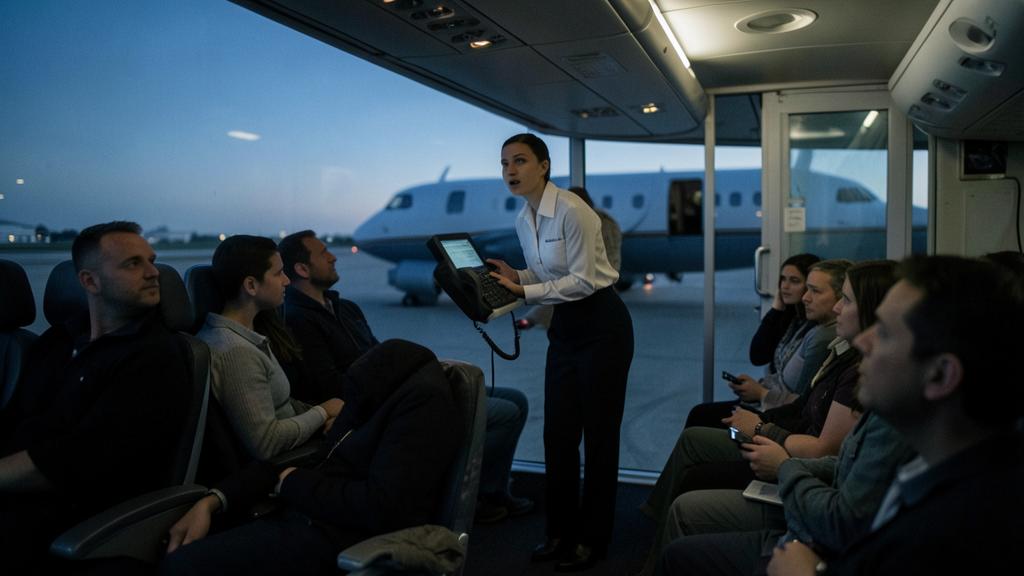
The announcement nobody wants to make is the one where you do not know the answer. The temptation is to wait until you do, and that instinct is precisely wrong: a cabin that says nothing is not perceived as a cabin that is waiting for information, it is perceived as a cabin that has information and is keeping it. Incomplete news, delivered on time and stamped with the moment it was true, calms a cabin better than complete news delivered late. The same incomplete news, delivered without a source and without an expiry, becomes a promise you did not intend to make and will be judged against.
Why silence costs more than bad news
Research on how people experience waiting has been remarkably stable for forty years, and it says four things that matter on a delayed aircraft. Unoccupied time feels longer than occupied time. Anxious waits feel longer than calm ones. Unexplained waits feel longer than explained ones. And uncertain waits feel very much longer than waits of known duration, even when the known duration is worse.
That last point is the one that governs a delay announcement. A passenger told nothing does not assume a short delay. They assume an unbounded one, because an unbounded estimate is the only one that is never contradicted. They then start building the consequences of that unbounded delay — the missed connection, the missed meeting, the child at the other end — and they build them out of the worst case, because they have nothing else to build them from. By the time the cabin finally speaks, it is speaking to people who have already spent forty minutes constructing a scenario, and the announcement has to dismantle that scenario before it can deliver its actual content.
An early, partial, honest announcement does something specific: it replaces an unbounded private estimate with a bounded shared one. That is the whole of its value, and it is why the announcement is worth making before there is anything satisfying to say.
Silence makes people imagine the worst, while even a vague update gives them something concrete to focus on. The key is to give partial info with a clear source and a time when you’ll update again.
On a delayed Airbus A320 at Paris Charles de Gaulle, a 30-minute wait with no announcement leads passengers to assume a 2-hour delay. A quick update saying “Air traffic control just gave us a slot around 15:30, but this can change” immediately reduces anxiety, even if the delay later extends to 16:00.
The difference between an estimate and a promise
Two sentences can carry the same information and create entirely different obligations. The difference is not the number. It is whether the sentence tells the passenger where the number came from and how long it is good for.
| What is said | What the passenger hears | What happens when it slips |
|---|---|---|
| “We will be departing in about twenty minutes.” | A commitment made by the airline, with a deadline | The airline broke its word; every later announcement is now discounted |
| “As of a few minutes ago, air traffic control had given us a slot around twenty past. That is their estimate, and it can move.” | A fact with a source, a time and an acknowledged uncertainty | The estimate moved, which the passenger was told could happen; credibility is intact |
| “It shouldn’t be long now.” | Nothing, or worse — that the crew is managing them rather than informing them | Whatever happens, it confirms the suspicion that the cabin knows more than it says |
| “We do not have a departure time yet. I will come back to you at ten past whether or not I have one.” | An honest absence of information plus a firm commitment the crew fully controls | Nothing slips, because the only promise made was to speak again |
The fourth line is the one worth internalising. It contains no information at all about the departure, and it is nonetheless the most reassuring of the four, because it is the only one that makes a promise the person speaking can keep unilaterally.
Dating the information is what makes partial honest
An estimate without a timestamp cannot decay. It just sits there being true until it is suddenly and visibly false. An estimate with a timestamp — as of now, at the last update, when I last spoke to the flight deck — carries its own uncertainty in its grammar. It tells the passenger that the picture is moving, that they are being given a snapshot of a moving thing, and that another snapshot will follow.
This also protects the person making the announcement. A crew member who says “we are told” is reporting, not committing. A crew member who says “we will” is committing on behalf of an operation they do not control. Over a career, that distinction is the difference between being the person who tells people what is happening and being the person who was wrong three times in a row.
The right reflex. Every delay announcement carries three elements: what is known, what is not known, and the time of the next announcement. The first two vary. The third is non-negotiable and is the only part the cabin fully controls.
Keeping the next-update promise when you have nothing
The next-update promise only works if it is kept when there is nothing to report, and this is where most delay handling quietly fails. The crew promises an update at ten past, ten past arrives with no new information, and the natural instinct is to stay silent rather than announce a non-event. From the crew’s point of view that is considerate. From row 24 it is the promise being broken.
An empty-handed update takes fifteen seconds and does more work than any other announcement of the delay. It confirms that the process is running, that somebody is watching, and that the absence of news is not the absence of attention. It also renews the clock: a new next-update time is issued, and the cabin buys another interval of calm.
The other side of this is that the interval has to be realistic. Promising an update every ten minutes on a delay that will run for two hours guarantees the promise gets broken somewhere in the middle, usually during the service. Promise the interval you can actually sustain given the workload, and stretch it deliberately as the delay lengthens.
How credibility is actually lost
The trap. The slipping estimate. Twenty minutes becomes another twenty, then another fifteen, then another half hour. Each individual announcement was honest and each was made in good faith with the information available. The cumulative effect on the cabin is nonetheless worse than a single announcement of two hours would have been — because the passenger is no longer tracking the delay, they are tracking whether the crew can be believed, and by the third revision the answer they have arrived at is no.
The technique that limits the damage is to name the previous estimate when you replace it. “I told you twenty past. That has moved to five to, and here is why.” Acknowledging the prior figure signals that the crew is keeping count too, and that the passenger is not the only person in the aircraft who noticed. Issuing a new estimate as though the old one never existed is what converts a slipping delay into a credibility problem.
The second technique is to widen rather than repeat. If two short estimates have already gone by, the third should not be another short one. Either give a longer window with an explicit range, or stop giving departure estimates altogether and switch entirely to next-update promises. A cabin that is told “we are not going to guess again, but I will speak to you every twenty minutes” is being treated as adult, and it generally responds accordingly.
What the cabin may say about cause, and what it may not
The cause of a delay is the most requested piece of information and the most dangerous to supply, for three reasons that have nothing to do with each other.
-
The first is technical accuracy. A cabin crew member relaying a maintenance issue at second hand will simplify it, and the simplification will be repeated, photographed and posted. A passenger with some technical background will find the simplification wrong, and the correction will circulate faster than the original.
-
The second is attribution. Naming a third party as the cause — air traffic control, the handling agent, the previous crew, the caterers, the airport — feels like transparency and functions as blame-shifting. It rarely satisfies anyone, it damages relationships the operator depends on, and it invites the obvious follow-up question about why the airline did not plan for it.
-
The third is legal. Under the European passenger rights regulation, whether a delay arises from extraordinary circumstances determines whether compensation is payable. That characterisation is made by the operator through a defined process, and sometimes by a court. It is not made over the public address system, and an announcement that appears to concede or deny it can be produced later as evidence. The safe formulation says what the delay is, not what category it belongs to.
What the cabin can always say is what it directly observes and controls: that the crew is on board, that the doors are open, that water is being offered, that the toilets are serviceable, that the flight deck is in contact with the operations centre. Observable facts are never wrong and never need retracting.
Three phases of a delay, three different announcements
A delay is not one situation. The passengers’ options, and therefore what an announcement needs to give them, change completely depending on where the aircraft is.
| Phase | What the passenger can still do | What the announcement must contain |
|---|---|---|
| At the gate, doors open | Leave the aircraft, use the terminal, buy food, rebook, make calls | Whether they may disembark and by when they must be back; an honest floor on the delay so they can decide |
| Doors closed, on stand | Almost nothing except wait; phones still work | The next-update time above all; the state of the cabin service; whether doors will reopen if the delay grows |
| After pushback or on the taxiway | Nothing at all | Frequent, short, low-key updates; explicit acknowledgement of the loss of control; what happens if the wait exceeds the operator’s threshold for returning to stand |
| Delay resolved, departure imminent | Prepare, reassess connections | A revised arrival time, a word on connections, and one sentence acknowledging the wait without over-apologising |
The third row is the one that generates complaints, and the reason is the loss of options rather than the loss of time. A passenger who has been sitting on a taxiway for an hour has no exit, no information source of their own and nothing to do, which is the exact combination the waiting research identifies as maximally unpleasant. That phase justifies a shorter update interval than any other, even though it is the phase where the crew usually has the least to say.
Language, repetition and the passengers who compare
On a multilingual flight, the announcement is made twice or more, and a meaningful fraction of the cabin understands both versions. If the second version is shorter, vaguer or missing the estimate, that is noticed, and it is read as one group being told the truth and another being managed. Whatever is said in one language is said in all of them, at the same length, with the same figures.
The same applies between the flight deck and the cabin. Two announcements giving two different departure estimates within ten minutes of each other does more damage than either would alone, because it tells the cabin that the aircraft does not have a single version of events. Agreeing who speaks, about what, and with which figure, takes thirty seconds on the interphone and prevents the most avoidable category of delay complaint there is.
The idea worth keeping
Partial information repairs when it is dated, sourced and paired with a commitment to speak again. It turns against you when it is undated, unsourced and phrased as an intention — because at that point it has stopped being information and become a promise, and promises are kept or broken rather than updated. The reliable move is to give away as much of the picture as you honestly have, and to commit only to the one thing you control: that you will be back at a stated time, with or without news. Crews compare how their operators word this, and exchange notes regularly on the FL330 professional forums.



Leave a Reply
You must be logged in to post a comment.