
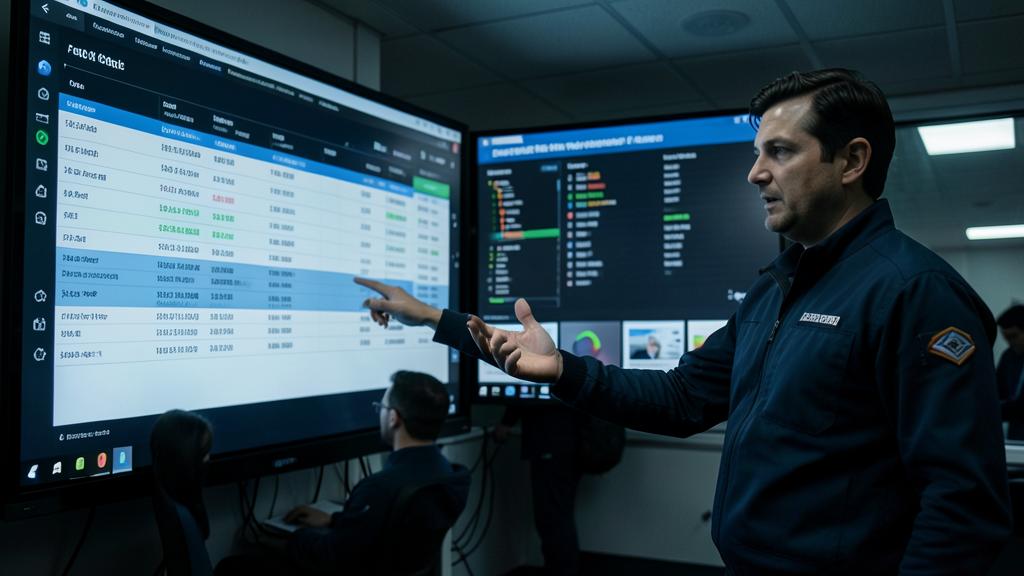
A prescriptive limit and a fatigue risk management system answer the same question and answer it in opposite directions. One fixes the numbers in advance, once, for everybody, and asks the operator to stay inside them. The other lets the operator set its own numbers and asks it to prove, continuously and with data, that the resulting risk is acceptable. Moving from one to the other is often described as gaining flexibility. What actually moves is the burden of proof, and with it the cost, the paperwork and the liability.
Two ways of answering the same question
Both regimes exist to keep a crew member’s fatigue below the level at which performance degrades enough to matter. They differ in when the safety argument is made and by whom.
Under prescriptive limits, the argument was made once, by the regulator, before any particular flight existed. Someone examined the science, made assumptions about a population of crew members, and produced tables: maximum flight duty period by report time and sector count, minimum rest, cumulative ceilings over rolling windows, rules for night duty, standby and time zone crossings. The operator’s task is arithmetic. A roster either fits inside the numbers or it does not, and an inspector can settle the question from records alone.
Under a fatigue risk management system, the argument is made continuously, by the operator, about its own operation. There are no tables to hide behind. The operator asserts that a particular pattern of work produces an acceptable level of alertness in its own crews, on its own routes, with its own rest facilities, and it must hold evidence for that assertion at all times. The authority approves the system that produces and defends the assertion, not each roster the system emits.
The distinction that matters is not strictness. A prescriptive limit is not inherently more conservative, nor an FRMS more permissive. It is that one regime has already spent its evidence and the other must keep spending it.
What a prescriptive limit really is
A prescriptive limit is a risk assessment that has been frozen. It reflects what was known and negotiated at the time it was written, applied to an imagined average crew member, and it is deliberately blunt: a single table has to cover a short-haul operation of six sectors, a long-haul flight with in-flight rest, and everything between.
That bluntness has two consequences that any line crew member will recognise. It forbids some patterns that would in fact be safe, because the table cannot see that a particular rotation gives good sleep opportunity. And it permits some patterns that are demonstrably fatiguing, because they happen to fit: a run of consecutive early starts, a late finish followed by a minimum rest and an early report, a duty that crosses the window of circadian low with a rest facility nobody sleeps in. The European rules place that window in the small hours of the acclimatised night, and a duty that straddles it is not the same duty as one that does not, whatever the table says about its length.
This is the honest case for something else: not that limits are too strict, but that legality and safety are two different properties, and a table can only certify the first. The European scheme itself acknowledges this by requiring fatigue risk management alongside the limits for certain categories of operation, and by allowing an operator to apply for an individual flight time specification scheme that deviates from the standard tables, supported by scientific principles and by a demonstration of equivalent safety.
| Prescriptive limits | Fatigue risk management system | |
|---|---|---|
| Who made the safety argument | The regulator, once, for a population | The operator, continuously, for its own operation |
| What compliance means | The roster fits inside published numbers | The measured risk stays at or below an acceptable level |
| Evidence required | Rosters, duty records, rest records | Everything above, plus fatigue data, analysis, mitigations and their effect |
| What an inspector examines | Records, against tables | The system: data quality, analysis, decisions taken, whether they worked |
| Response to a bad pattern | Not required, if it is inside the numbers | Detection is the point; the mitigation is the deliverable |
| Cost profile | Low and fixed | High and permanent: data, expertise, governance |
| Characteristic failure | Legal but fatiguing | Documented but unrepresentative |
| Exposure | Bounded by compliance with the rule | Squarely with the operator |
Prescriptive limits set fixed rules for duty times, while fatigue risk management (FRMS) lets operators prove their own schedules are safe. The key difference is who carries the burden of proof: regulators for prescriptive limits, operators for FRMS. Both aim to keep crews safe, but FRMS requires constant data collection and analysis.
An airline operating Airbus A350s on a 12-hour flight from Paris to Singapore under prescriptive limits must follow fixed duty time rules. Under FRMS, the same airline might prove that a 13-hour duty with better rest facilities is safer, using sleep data and performance tests. If a crew reports fatigue on a 12-hour duty, the airline under prescriptive limits can only argue compliance, while under FRMS, it must investigate and adjust.
What an FRMS asserts instead
An FRMS is a management system in the same family as the safety management system it must be integrated with, and it has the same four-part shape: a policy that says what the organisation is committed to and who is accountable; the risk management processes that identify fatigue hazards, assess them and mitigate them; the assurance processes that check whether the mitigations actually worked; and the promotion processes that train people and keep the reporting channel alive.
In practice the visible organ is a group, usually called a fatigue safety action group, that sits between rostering and safety, includes crew representation, and owns the analysis. Its output is not opinion. It is a documented loop: a pattern is proposed or observed, data is gathered on it, a level of risk is assessed, a mitigation is applied if needed, and the effect of the mitigation is measured. A pattern that has not been through that loop is not covered by the system, however normal it looks.
Two things follow, and both surprise operators considering the move. The first is that an FRMS is a source of restrictions as well as permissions. A system that only ever produces longer duties is a system whose data is not being read. The second is that the assertion has an expiry date. Fleet mix changes, network changes, hotel contracts change, commuting patterns change, and the evidence base decays. Approval is not a milestone that closes the file.
The burden of proof, and who carries it
The difference is clearest on the day something goes wrong: a serious incident, an occurrence report naming fatigue, an inspection triggered by a complaint.
Under prescriptive limits, the operator’s defence is documentary and finite. The duty was inside the maximum. Rest was provided. Cumulative windows were respected. If all that holds, the operator has done what the rule required. The adequacy of the rule is not the operator’s to defend, and the discussion moves on.
Under an FRMS, that defence does not exist, because there is no external number to have complied with. The operator must show that the pattern flown was inside its own approved envelope, that the envelope was derived from data, that the data was current and representative, that the specific hazard was identified or that its absence from the analysis was reasonable, and that the assurance process would have caught it had it been present. The question is no longer « did you obey » but « did you know, and if not, why did your system not know ».
That is the whole trade: flexibility bought with permanent evidentiary exposure. Operators who describe an FRMS as a way to roster more aggressively have understood half of it. Those who describe it as a way to roster more intelligently, and who have costed the analysis function, have understood both.
The data the system has to hold
The evidence base is where FRMS projects succeed or quietly fail, because every class of data has a blind spot and no single class is sufficient.
| Class | Typical instrument | What it establishes | Its blind spot |
|---|---|---|---|
| Planned exposure | Published roster, duty and rest records | What the operation intended | Says nothing about what happened |
| Actual exposure | Actual on and off times, delays, extensions, standby call-outs | What crews were really subjected to | Often held in a system that never meets the roster data |
| Sleep obtained | Actigraphy, sleep diaries | Whether the rest opportunity became sleep | Burdensome; volunteers are rarely representative |
| Subjective state | Karolinska Sleepiness Scale, Samn-Perelli ratings | How crews felt at defined points in a duty | Self-report drifts with culture and with fear of consequence |
| Objective performance | Reaction-time testing, such as the psychomotor vigilance task | Measured degradation rather than reported feeling | Intrusive in flight; measures one narrow capacity |
| Operational proxies | Flight data monitoring events, occurrence reports, ATC events | Whether degradation reached the aircraft | Rare events, weak statistics, contaminated by other causes |
| Reports | Fatigue reports from crew | Where crews think the danger is | Dies instantly if reporting has a cost |
The join between the first two rows is where most programmes break. Planned duty lives in rostering, actual duty in operations, and if the two are never reconciled the system analyses an operation that did not take place. The second break is voluntary sampling: crews who complete sleep diaries on a difficult rotation are not a random sample of those who fly it.
The trap. Absence of fatigue reports is routinely presented to a board as evidence that fatigue is under control. It is evidence of one thing only: that reports are not being made. A reporting rate that falls after a roster change is the signal to investigate hardest, because the two most likely explanations are opposite and only one of them is good news.
Biomathematical models, and how they are over-read
Every FRMS discussion reaches a model. The widely used families predict alertness from sleep and circadian inputs and produce a score across a duty. They are genuinely useful: thousands of candidate patterns can be screened before anybody flies one, the effect of a report time becomes visible, and rostering and safety acquire a common language.
They also invite a specific misuse: treating a score as a measurement. These models predict the average of a population under assumed sleep behaviour. They do not predict the individual crew member, they do not know the hotel, they do not know the commute, and the sleep they assume is the sleep the schedule allowed rather than the sleep anybody obtained. A model output is a hypothesis about a pattern, to be confirmed or refuted by data from the operation. Regulatory guidance is consistent on this point, and it is the point most often lost between a technical team and a planning department that wants a green number.
The practical test of maturity: has a model output ever been overturned by operational data here, and what happened when it was? A programme in which the model has never been wrong is one in which the model is not being checked.
Nobody switches everything
The word « switch » is misleading: in practice an operator runs both regimes at once. The FRMS is approved for a defined scope — a set of routes, a pattern family, an ultra-long-range operation, a standby arrangement — and everything outside it stays prescriptive.
Scope discipline is not administrative fussiness; it is the whole safety argument. The evidence supports the operation it was gathered from. A dataset built on a westbound ultra-long-range pairing with a good rest facility says nothing about a six-sector domestic day, and using it there is not a stretch of the approval, it is a different claim with no support. The commonest scope failures are the quiet ones: a route added to an existing pairing, a fleet swap that changes the rest facility, a hotel change that moves crews forty minutes further from the aerodrome. None of these looks like leaving the approved scope. All of them change the population the data described.
This is also why the alternative route — an approved individual scheme that deviates from the standard tables on specific points, while everything else stays prescriptive — suits many operators better than a full system. It concentrates the evidentiary burden on the handful of deviations that matter commercially, rather than spreading it across the whole operation.
How each regime fails
The two regimes do not fail in the same way, and recognising which failure you are looking at is more useful than preferring one regime over the other.
| Regime | Failure | How it presents |
|---|---|---|
| Prescriptive | Legal but fatiguing | A pattern repeatedly flagged by crews, defended solely on the ground that it complies |
| Prescriptive | Limit as target | Planning to the maximum by default, so every disruption consumes a margin already spent |
| FRMS | Unrepresentative data | Conclusions drawn from volunteers, from good months, or from planned rather than actual duty |
| FRMS | Frozen evidence | An approval granted years ago, never re-derived against a network that has changed |
| FRMS | Captured governance | A fatigue group with no crew voice, or one whose recommendations never survive contact with planning |
| Both | Silent reporting | Reports fall to near zero and the fall is read as improvement |
The right reflex. Before asking which regime an operator uses, ask what happened the last time its own data contradicted a commercially attractive pattern. The answer tells you more about the fatigue risk you are exposed to than the name of the regime does.
What does not change either way
Three obligations survive the transition intact, and they are the ones crew members can act on directly.
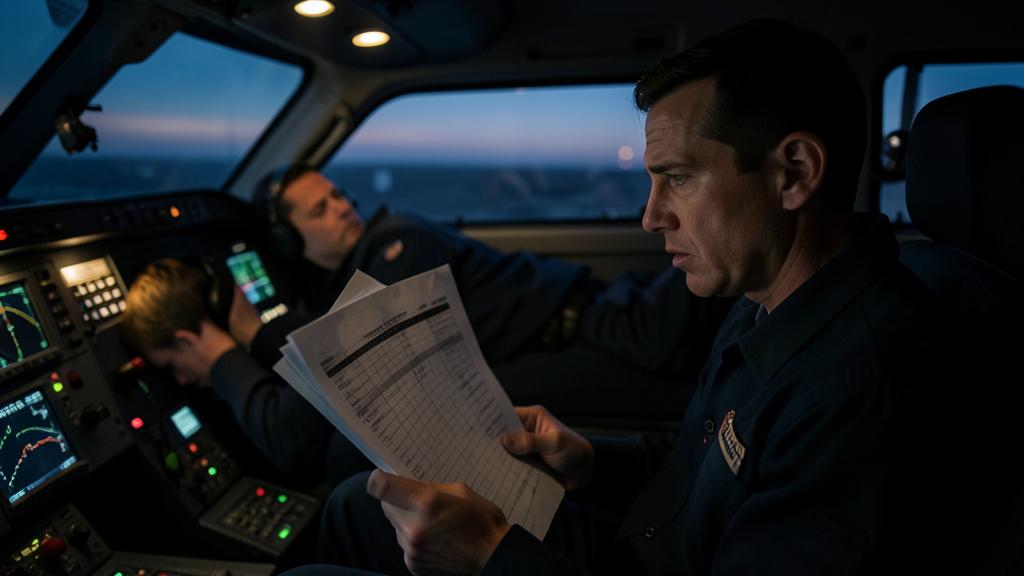
The individual duty of fitness for duty is unaltered. Neither regime licenses a crew member to report for a duty they are not fit to perform, and neither transfers that judgement to a table or to a model. The obligation to use a rest opportunity for rest is equally unaltered, and it is one of the few places where an FRMS makes an explicit demand on the individual, since its evidence base assumes it.
The reporting obligation is unaltered, and under an FRMS it becomes load-bearing. Under prescriptive limits a fatigue report is a safety input. Under an FRMS it is a measurement, and a suppressed report is a corrupted dataset. That is why just culture is not a soft accompaniment to an FRMS but a precondition for it: an organisation that penalises fatigue reports has not merely damaged morale, it has destroyed the instrument its regulatory permission rests on.
Finally, the integration with the safety management system is unaltered in principle and much heavier in practice. Fatigue hazards feed the same risk register, the same accountable manager and the same assurance cycle as everything else. An operator whose fatigue work sits in a separate file, discussed by different people, has an FRMS on paper only. Crew members who want to read their own roster against these criteria will find the underlying material in the operations and safety modules at FL330 training.


Leave a Reply
You must be logged in to post a comment.