

A few weeks after a flap speed exceedance reported the same evening, the notice of a disciplinary hearing arrives. In the file handed over at the meeting is a printout of the occurrence report, internal system header included. Protection for the reporter exists, it is written down, and yet the document is there. Here is the route it took, what the rules actually prohibit, and what an operator can close off on its own.
What goes into a file is not a fact, it is an item of evidence
Protection for the reporter is not an amnesty. It is written as two distinct prohibitions, and confusing them is costly. The first bears on the data: information gathered by an occurrence reporting system serves safety, and nothing else. The second bears on the person: an employer may not subject a member of staff to any detriment on account of the information that person has supplied. The first lock targets a use, the second targets a measure.
Neither of the two erases the occurrence. If the same deviation reaches the operator through a record produced independently of the reporter — operational data, a technical log entry, a maintenance message, a ground recording —, the fact is established without the occurrence report having served any purpose at all. Protection closes off one evidential route; it does not make the occurrence non-existent and it shields no one from the consequences of a fact established elsewhere.
This is the first source of misunderstanding in real cases. The crew who report believe they have bought immunity; they have bought the inadmissibility of a document. The managers who receive the report believe they can use it since the fact is admitted; they are using a document that no procedure should be able to produce. Both reason about the fact, whereas the system reasons about the route.
Protection doesn’t erase the mistake—it just stops the report from being used against you. Other records (like flight data) can still prove the mistake happened, but they’re not protected.
A crew reports a flap speed exceedance on a Boeing 737. Later, the operator finds the same event in the flight data recorder. The report is protected, but the FDR data can still be used in disciplinary action.
The four doors through which an occurrence report reaches human resources
When information from the safety system ends up in the hands of someone who decides on employment, it has taken one of four routes. They cannot be challenged in the same way, and three of them leave almost nothing to challenge.
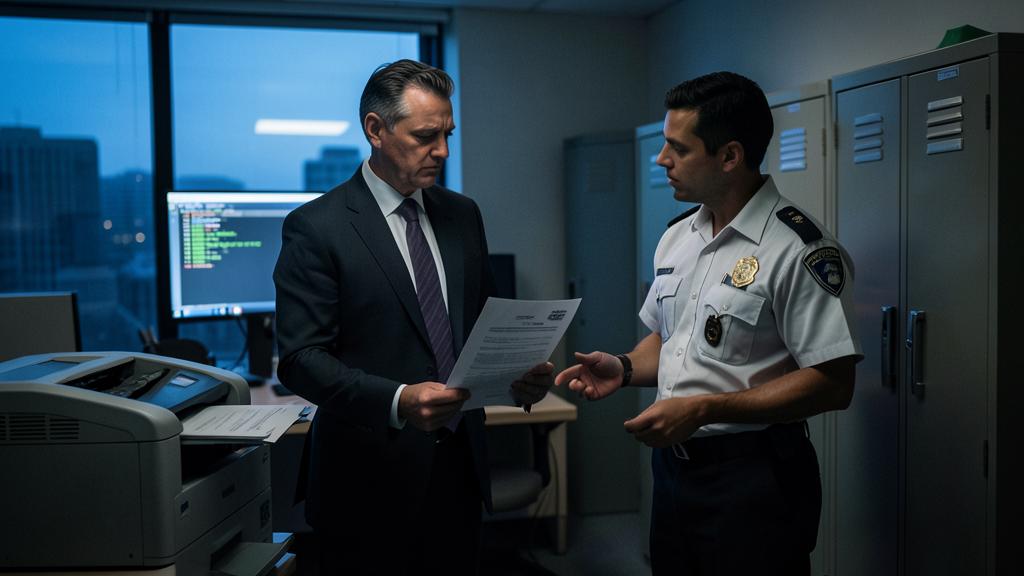
- The document itself. Printed, forwarded, attached to an email. This is the most visible route, and therefore the easiest to strike down: the identified version had no business leaving the safety function, and saying so is often enough.
- The oral account. A manager summarises the content to a section head, who forms a conviction from it. Nothing is written, nothing is dated, nothing can be proved. It is the most frequent route and the only one that no legal text reaches.
- The parallel source. Operational data, technical log, ground recording: these exist independently of the occurrence report, arrive through an admissible route, and it is on them that a solid case is built.
- The feedback interview. Feedback to the reporter is a normal link in the analysis; it changes in nature the moment someone who decides on employment sits down at the table. The wording of the invitation does not change, the scope of the answers does: asking in writing for the purpose of the meeting, the capacity of each participant and the fate of the record that will be made of it is enough to settle the question.
The third door deserves a detour, because it is legitimate and it is also the most poorly framed. The flight data monitoring programme is not an occurrence reporting system: it falls under its own requirements, which make it a non-punitive scheme and impose safeguards for the protection of sources agreed with the staff representatives. De-identification is the rule there, but a key always exists somewhere — one has to be able to contact a crew in order to understand an occurrence. What matters is therefore not the existence of that key, it is the written text that says who holds it and in which cases it is used.
The trap: the request for further details by email. A few weeks after filing, a message from management asks you to “clarify a point” or to “complete” the report. The reply leaves from the work mailbox, outside the occurrence reporting system: it is a fresh written statement, produced in the management channel, that nothing attaches to the protected scheme and that no one will de-identify. A supplement to the analysis is filed in the system, under the reference of the original case; if a reply really must be sent by email, there is nothing to write other than a pointer to that reference.
The exception: who draws the line, and at what moment
Every just culture architecture stops at the same place: protection covers neither a deliberate violation nor a manifest and gross disregard of an evident risk. Put that way, the criterion looks clear. Applied, it is far less so, because it is assessed after the event, by someone who already knows the outcome — and a risk always looks more evident once it has materialised.
Hence the tests that serious decision-making bodies impose before moving a case outside protection. The substitution test: would a professional of the same qualification, in the same situation, with the same information available at the same instant, have acted differently? The procedure test: did it exist, was it known, was it workable in the time available? The antecedents test: is the behaviour repeated, documented, already raised with the person concerned? Three questions that shift the examination from the outcome to the situation.
The threshold is not moral, it is evidential. Invoking the exception amounts to asserting that the person concerned saw the risk and chose to override it. That assertion has to be demonstrated, with something other than the occurrence report — and that is where the loop closes: a case whose only evidence is the reporter’s own statement has nothing with which to establish intent.
| Source of the information | Protection of its own | Usable for an employment measure | Who controls access to it |
|---|---|---|---|
| Occurrence report, mandatory or voluntary | Purpose limited to safety, de-identification on transmission | Only if the exception is invoked and supported by other means | Safety function, then competent authority |
| Flight data monitoring programme | Non-punitive character and safeguards agreed with the staff representatives | Only in the cases provided for by those safeguards | Programme manager |
| Onboard recordings intended for the investigation | Regime specific to safety investigations | No, outside the framework of the investigation | Investigation body, judicial authority |
| Recording of ground communications | Regime of the air navigation service provider | On formal request, according to national law | Service provider |
| Technical log, maintenance message | None | Yes | Operations |
| Third-party testimony, passenger complaint | None | Yes | Operations |
The judicial route does not follow the same rules of evidence
The prohibition on using an occurrence report for purposes other than safety is addressed first of all to the operator and to the administrative authorities. Criminal proceedings, for their part, apply their own rules on the gathering and admission of evidence. The European scheme lays down as a principle that States refrain from instituting proceedings in respect of unpremeditated or inadvertent infringements brought to their attention solely through the occurrence reporting channel, while reserving deliberate conduct. But the concrete articulation with a judicial investigation depends on advance arrangements between the safety authority and the judicial authority, and those arrangements are not written the same way from one State to another.
Two practical consequences. The court seised is not necessarily that of the State where the occurrence report was filed: a flight crossing three airspaces may bring together the State of occurrence, that of the operator and that of registry. And above all, an occurrence report is a written statement in the reporter’s own hand. Even where its direct use is barred, the existence of a text in which a person describes their own act weighs on the conduct of their defence.
Hence a drafting discipline that is in no way defensive in the bad sense of the word, since it also improves the value of the report for safety: observable facts, times, a configuration, parameters, what was displayed, what was said. No legal characterisation of one’s own conduct, no intent attributed to a third party, no name where the role is enough. A useful occurrence report describes a situation; it passes verdict neither on oneself nor on others.
The right habit. Write what a recorder would have seen: times, configuration, parameters, indications displayed, the terms actually used. Leave the cause to the analysis, and keep the acknowledgement of receipt with the case reference — it is what proves that you reported, and on what date, on the day protection comes up for discussion.
Employee, seconded, self-employed: protection follows the contract
The lock that prohibits subjecting the reporter to detriment is written for an employment relationship. It targets the employer, and the measure it targets is the one that employment law frames: sanction, transfer, termination. A seconded crew member, a contract captain, a freelance instructor report through the same system, but what strikes them does not bear the name of a sanction. It is an assignment that does not come back, a disappearance from the rostering list, a framework contract that is not renewed.
The difference is not merely a legal nuance: it removes all the traceability that makes a challenge possible. No summons, no written grounds, no meeting, hence nothing to argue against. Protection still exists on paper; there is simply no longer any procedure in which to invoke it.
This is the point to check before signing, more than the daily rate: do the operator’s internal just culture rules cover all personnel operating under the certificate, whatever their contract? The sentence exists at some operators, it is missing at many others, and its absence is almost never deliberate — no one has asked the question. Those who work on independent assignments would do well to have it raised while the terms are still under discussion.
What an internal agreement can lock down, and what it cannot
The European scheme entrusts the organisation with adopting internal rules describing how the principles of just culture are guaranteed and implemented within it, after consultation of the staff representatives. It is the only part of the edifice that the operator writes itself, and therefore the only one on which a crew can have any influence.
One point is almost always forgotten there: the clocks. The occurrence report does not only feed safety, it brings the facts to the knowledge of the organisation — and under many employment laws, that knowledge opens a relatively short window for initiating proceedings. Reporting quickly, which is good for safety, may therefore start a countdown that has nothing to do with it. A serious agreement addresses the question head-on: it designates who, within the organisation, is deemed to have knowledge of the facts, and avoids making the safety function the starting point of a time limit that it has no business managing.
The rest is written by contrast with what happens when nothing is written.
| Point to settle | Without written internal rules | With a negotiated agreement |
|---|---|---|
| Access to the identified version | Local practice, varying with whoever holds the post | Named list by role, kept up to date and verifiable |
| Opening of a procedure | The occurrence report may be enough to trigger it | Prohibition on opening one on that document alone |
| Moving to the exception | Management decision, with no obligation to state reasons | Identified body, written reasons, a professional of the trade present |
| Identified flight data | De-identification in practice, with no defined key | Holder of the key and cases of use set out in writing |
| Non-salaried personnel | Outside the scope by default | Scope extended to all personnel operating under the certificate |
| Retention | Indefinite, drafts and mailboxes included | Fixed duration, auditable purge |
An agreement cannot do everything. It does not reach the corridor conversation, it does not bind a judge, and it will not stop managers from wanting one day to make an example of someone. What it does, and it is already considerable, is to make every departure from the rule one has set oneself visible: without a text, a breach is arguable; with a text, it is simply observed.
What you need to have read before you need it
Three documents, to be opened now rather than on the day of a summons. The part of the Operations Manual that describes the occurrence reporting system, where one looks for the sentence on the purpose of the information and on its non-use for disciplinary ends. The internal just culture rules, often an annex or a separate charter, rarely circulated with the rest. The instruction governing the flight data monitoring programme, which sets out de-identification and its exceptions.
Three questions to ask next, preferably in a meeting and in writing. Who, named by role, has access to the identified version of an occurrence report? Which body decides that a case falls outside protection, and does a professional of the same trade sit on it? Does the text cover non-salaried personnel? The answers fit in three lines when they exist, and silence is in itself a piece of information.
What nothing will close off remains: oral reformulation, and an articulation with the judicial side of uneven robustness from one State to another. What also remains is the effect that a visible management reaction produces on the flow of reports — it never stops all at once, it first empties itself of what is awkward, then takes a long time to come back up. On this point, peer exchanges are often more informative than an internal memo.
This article describes mechanisms, not your situation. The applicable rules, the approved internal rules and your operator’s documentation prevail over everything above; it is on reading them that the course of action depends.
Questions fréquentes
Can my occurrence report appear in my personnel file?
The principle is that it has no business being there: information from an occurrence reporting system has a safety purpose and the identified version is not meant to leave the safety function. If the document is nevertheless there, its presence is open to challenge, and it is the easiest route to strike down. A fact established by a source independent of the report, on the other hand, remains usable.
If I do not report, can the operator still open a procedure?
Yes, and the position is even worse. Occurrences subject to mandatory reporting must be reported: failing to do so is a breach in its own right. Besides, the deviation most often comes up by another route — operational data, technical log, ground recording — so that you lose the protection without reducing the exposure.
Can flight data monitoring data contradict my occurrence report?
It exists independently of you and describes the same parameters, so yes, a discrepancy between the two shows up. The programme is nevertheless non-punitive and its safeguards for the protection of sources are negotiated with the staff representatives. What matters is knowing who holds the de-identification key and in which written cases it is used.
Am I protected if I am self-employed or seconded?
Protection against detriment is written for an employment relationship, and the measure that hits you is then called neither a sanction nor a dismissal: it is an assignment that does not come back. There is therefore neither a summons nor written grounds to challenge. You need to check that the operator’s internal just culture rules extend expressly to all personnel operating under its certificate.
Can a judge obtain my occurrence report?
The prohibition on use is addressed first of all to the employer and the administrative authorities, whereas judicial proceedings apply their own rules of evidence. States undertake not to prosecute unpremeditated infringements known solely through the occurrence reporting channel, but implementation goes through advance arrangements between the safety authority and the judicial authority, whose robustness varies from one State to another.
What should I do if a feedback interview changes in nature midway through?
Ask on the spot for the exact purpose of the meeting and the capacity of each person present, then have it confirmed in writing. Also ask what will become of the record that will be made of it and who will have access to it. If someone deciding on employment is taking part, the meeting is no longer a link in the safety analysis, and the internal just culture rules must say who arbitrates that switch.


Leave a Reply
You must be logged in to post a comment.