
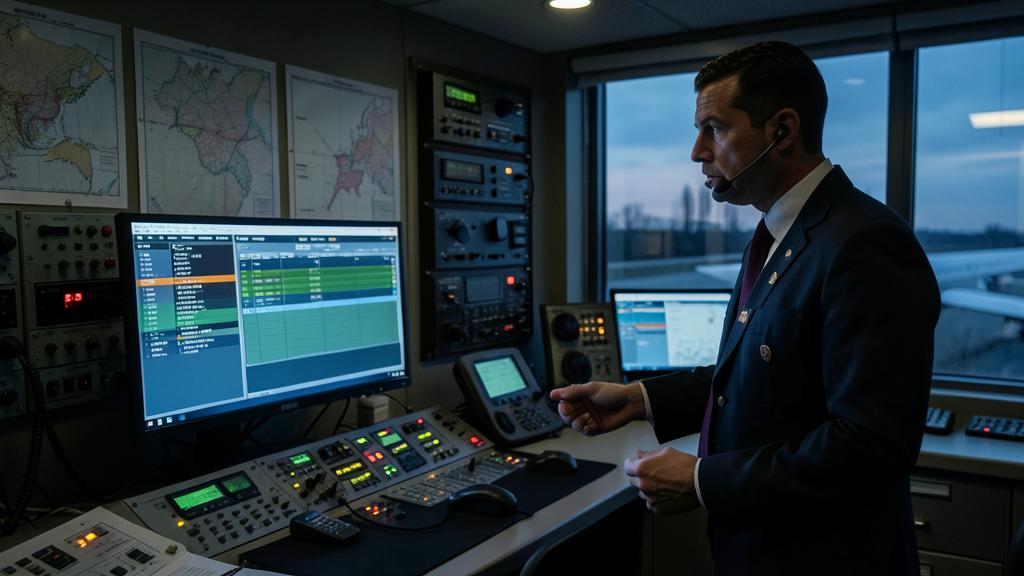
A co-owner calls the night before to move their departure up by two hours. The manager replies that the crew will not have had their rest, offers another slot, and the aircraft departs at the originally scheduled time. Who just made that decision? The answer is written neither on the certificate of registration nor in the title of the management agreement: it is written in the record of that refusal. And it is that record, not the title deed, that places the flight on the side of private operation or commercial air transport — and, between the two, a gap in obligations that touches the aircraft, the organisation and the crew alike.
Two cumulative conditions, and only one is ever in dispute
Commercial operation is not defined by the amount that changes hands, but by a pair of conditions: a consideration — remuneration or any other valuable benefit — and, alternatively, an operation made available to the public or carried out under a contract between an operator and a customer who exercises no control over that operator. Remove either one, and the flight falls outside the scope of commercial air transport.
In a fractional ownership programme, the first condition is almost never in doubt: a monthly management fee, an hourly invoice, shares that unlock a bank of hours, a substitute aircraft supplied when the owner’s own is grounded. Each of these flows is a consideration, and the valuable benefit reaches well beyond money: an exchange of hours between co-owners is one, as is cross-provision between companies of the same group.
Everything turns on the second condition, which has two branches. The public branch is settled quickly: if hours, seats or the aircraft are offered to whoever asks for them, listed on a marketplace or quoted to a walk-in customer, the discussion ends there. The contractual branch is the only one that leaves any room, and it comes down to a single question: does this customer have control?
Two neighbouring concepts overlap at exactly this point. The European text speaks of the customer’s control over the operator, an authority relationship between two parties; the annexes of the International Civil Aviation Organization speak of operational control, the authority exercised over a given flight. Authorities read the two together, for a simple reason: a customer who has no say over the conduct of their own flights is, in fact as in law, the customer of a carrier.
If you pay for a flight but don’t control when, where, or how it happens, it’s likely commercial air transport. If you own part of the plane and make those decisions, it’s private. The key is who really calls the shots in practice, not just what the contract says.
A Gulfstream G650 owner in a fractional programme requests a flight from Paris to Moscow. The manager’s dispatch denies it due to weather, despite the owner insisting. The manager’s decision prevails, proving operational control lies with them. The flight is commercial, even if the owner pays a management fee.
Operational control comes down to four verbs
Operational control has an internationally agreed definition, and it comes down to four verbs: it is the exercise of authority over the initiation, continuation, diversion and termination of a flight, in the interest of the safety of the aircraft and of the regularity and efficiency of the flight. The wording is closed, and that is what makes it useful: it speaks neither of ownership nor of financing, only of decisions and of who takes them.
It is not the same thing as the pilot-in-command’s authority, the final authority exercised on board over a flight in progress. Operational control is organisational and continuous: it is exercised before the flight, when the decision is made that it will take place, during it, when the decision is made that it continues, and after it, when its consequences are assumed. Answering « the pilot-in-command is in control » is answering a different question.
In practice, the concept breaks down into a handful of acts, each of them dated and each of them recorded somewhere:
- designating the crew and checking their qualifications, currency and availability;
- issuing the departure clearance after reviewing weather, fuel and loading;
- accepting, or refusing, to depart with an item deferred under the minimum equipment list;
- setting the route, alternates and fuel policy for the flight;
- deciding on a diversion or a termination, and being able to impose it on whoever is paying;
- cancelling, and bearing the cost of the cancellation;
- providing the operational documentation the crew applies, and answering for it.
None of these acts is theoretical: each leaves a dated trace in a system, a message thread, a flight file or an invoice. Operational control is not delegated by a clause; it is proven, or disproven, by these acts.
The body of evidence, as it is actually read
No authority classifies a flight on the strength of a contract alone: it builds a body of evidence, compares what is written against what was actually done, and weighs the indicators unequally. Two of them carry more weight than all the others: where the crew comes from, and who can cancel without asking permission.
| What is examined | Control stays with the co-owner | Control sits with the manager |
|---|---|---|
| Crew | recruited or contracted by the co-owner, who checks qualifications and currency | assigned by the manager’s crew-scheduling department, on its own criteria and roster |
| Departure clearance | prepared by the crew, accepted by the co-owner or their representative | issued by a dispatch function that can refuse it without having to justify itself |
| Weather or technical cancellation | decided by the co-owner, who bears the cost | decided by the manager, who imposes it on the co-owner |
| Documentation applied | documentation specific to the aircraft, kept on the co-owner’s behalf | the manager’s operations manual, applicable across its whole fleet |
| Deferral under the minimum equipment list | accepted by the co-owner after technical advice | arbitrated by the manager according to its own deferral policy |
| Invoicing | actual costs apportioned, expenses justified item by item | a flat hourly rate, all-inclusive, guaranteed in advance |
| Insurance | taken out by the co-owner, private use declared | the manager’s policy, with the co-owner listed as a passenger |
| Aircraft actually used | the co-owner’s own, except by a one-off documented agreement | whichever aircraft the fleet assigns that day |
A single indicator settles nothing on its own: buying maintenance, training or departure handling from the manager is not the same as handing over authority. It is the convergence that decides, and above all the consistency between the two columns. A file where the contract says one thing and every trace says the other is more fragile than a frankly commercial file: it adds to the irregularity the appearance of having organised it.
The billing method deserves a careful reading of its own, because it is often the first document requested. Re-billing pro rata to costs actually incurred — fuel, charges, crew salaries, maintenance reserves — reads as the apportionment of the running costs of a jointly held asset. A flat hourly rate, guaranteed in advance and due even when the aircraft is unavailable, reads as the price of a service. The first describes a co-ownership that functions as such, the second a customer.
What the switch adds, line by line
Classification is not an administrative label: it is a stack of obligations that changes height. The form changes first. Non-commercial operation of a complex motor-powered aircraft is declared; commercial air transport is certified. A declaration commits the operator to complying with the rules; a certificate is examined, names accountable managers, sets operations specifications and opens a planned surveillance programme. One moves from a regime where compliance is asserted to one where it is demonstrated before flying.
The content follows the form. Flight and duty time limitations, framed in a markedly less prescriptive way on the non-commercial side, become a binding framework that structures the entire crew-scheduling function: they stop being a matter of common sense between the manager and its crew and become a planning constraint, logged and auditable. Performance criteria tighten where it matters most, at the moment of deciding where one may land: private operation calls for compliance with the flight manual data, commercial air transport requires comparing the usable landing distance against a calculated distance increased by a margin, itself widened on a wet or contaminated runway. A short strip accessible on a private flight can thus become inaccessible under a certificate with the same aircraft, the same runway and the same crew — often the first concrete consequence a programme discovers once it switches. Alternate selection and the classification of demanding aerodromes become documented requirements.
Personnel switch along with the aircraft. Beyond a certain number of seats, cabin attendance stops being a service and becomes a certified crew member, trained, checked and counted within the minimum crew. The pilot can no longer fly on private licence privileges alone: as soon as there is consideration, that door closes. They enter an operator’s programme — conversion, base and line checks, recurrent training, a transferable record — which is a cost, and also what makes a career legible elsewhere.
Continuing airworthiness does not change physics, it changes circuit. Maintenance programme, contracts with approved organisations, traceability of deferrals and the return-to-service chain all refer to the declared use of the aircraft, never to the name on the title deed. An aircraft that switches carries its airworthiness file with it, and the operation is neither instant nor free.
What remains are the consequences outside safety, which often decide which structure is chosen. Commercial air transport requires an operating licence, with its conditions of financial capacity, good repute and insurance. Liability changes regime: the passenger of a carrier falls under air transport rules and their baseline for compensation, that of a private flight under ordinary law. Fuel taxation and value-added tax regimes also distinguish commercial from private use — and that is where most hybrid arrangements originate.
Two honest ways to close the question
The first is to recognise that the co-owner genuinely keeps operational control, and to impose on them, as well as on the manager of their programme, a safety baseline clearly raised above private flying. This is the American route: a dedicated regime, inserted into general aviation regulations, that expressly apportions responsibilities between co-owner and manager, frames aircraft interchange between programmes, and imposes landing, weather, training and monitoring criteria that private flying does not know. The co-owner there is an assisted operator, not a passenger.
The second is to accept that control sits with the manager and to operate the programme under an air operator certificate. This is the route most often followed in Europe, for lack of a dedicated regime: the ownership share becomes a means of financing and priority of access, every flight falls under commercial air transport, and the question no longer arises. It costs more in structure, but has a rare virtue: it reads clearly to an inspector, an insurer and a judge, in that order.
| Point of comparison | Control kept by the co-owner | Programme operated under certificate |
|---|---|---|
| Co-owner’s status | operator assisted by a manager | passenger of an air carrier |
| Administrative title | dedicated regime, no air operator certificate | air operator certificate and operating licence |
| Safety baseline | raised above private flying by requirements specific to the programme | that of commercial air transport, in full |
| Crew | supplied by the manager but acting for the co-owner | the operator’s crew, within its own training programme |
| Aircraft exchange between co-owners | explicitly framed by the regime, with its own conditions | not applicable: every flight is a commercial air transport flight |
| After an accident | apportionment of liability to be established between co-owner and manager | carrier liability, a regime known in advance |
| What the pilot’s hours are worth | general aviation experience, to be documented with the file in hand | experience under certificate, directly legible to a recruiter |
The arrangement to avoid is the one that borrows from each model whatever is convenient: the rhetoric of retained control, the organisation of a carrier, and neither set of obligations. It holds up for exactly as long as nobody looks at it.
The arrangements that trigger an investigation
The files that end up under investigation resemble one another, and the first goes by a borrowed name: the dry-lease arrangement of convenience. The co-owner takes the aircraft on lease without a crew, which genuinely shifts control to them. Then the crew arrives: supplied by the manager, by a sister company, or by an agency to which the manager provides rosters and procedures. At that point, the dry lease is nothing more than a label, and it is not the legal structure that is at fault, it is the gap between it and the facts.
The other classic cases fall on the same axis. Hour-swapping between co-owners of two different aircraft: whoever is flying is no longer aboard their own asset, they are being carried on someone else’s for consideration. Ferry flights billed to the next customer: they follow the regime of the flight they serve. Cost-sharing stretched beyond the strict conditions that keep it non-commercial. Cross-provision between companies of the same group, finally, judged on the same grid: who pays what, to whom, and who decides.
The trap of a clause that says the opposite of the record. A contract can state in so many words that the co-owner exercises operational control; if crew scheduling comes out of the manager’s system, if the weather cancellation is notified by its dispatcher, and if the invoice is a flat hourly rate, it is the body of evidence that will prevail. The pilot is on the front line of that re-reading: licence privileges exceeded the moment there is consideration, insurance cover disputed on actual use, and personal liability that is never shared with the company that drafted the arrangement.
What triggers an investigation is almost never a spontaneous audit of the arrangement. It is a ramp inspection that asks for the applicable documentation and the operator’s name; a claim, even a minor one, where the insurer re-reads the use clause; a complaint from a certified operator losing flights; or a reportable occurrence, which forces someone to write down, in black and white, under which regime the flight was operated.
What to check before boarding
The right instinct: the cancellation question. Faced with a flight whose regime is not obvious, ask a single question and look for the answer in writing: if the crew decides not to depart, who can overrule them, and who bears the cost? If the answer is the manager in both cases, the flight falls under commercial air transport whatever the colour of the contract, and it should be treated as such from the preparation stage — not after the fact.
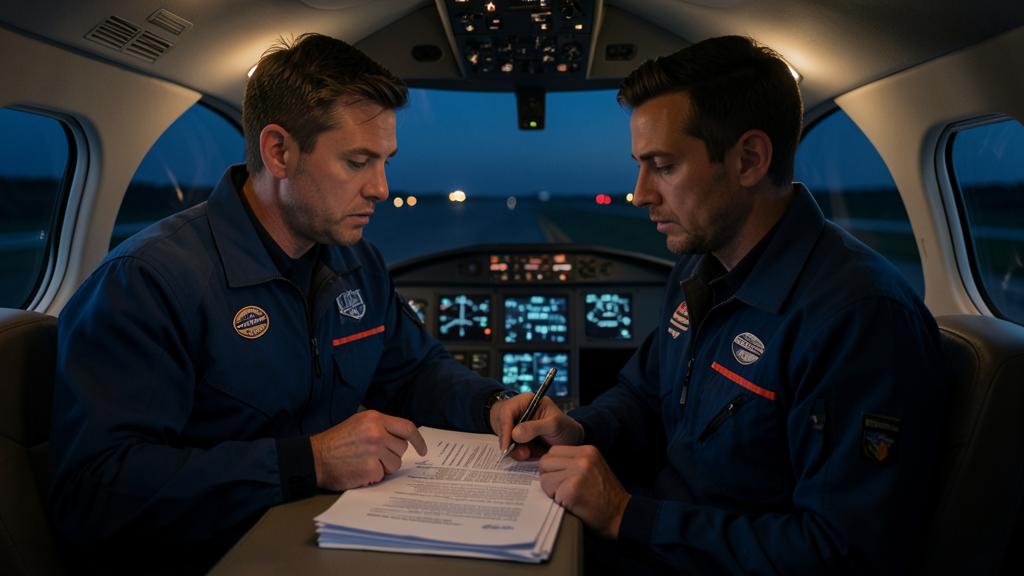
For the crew, the check comes down to four questions, asked before the flight and not after: which operational documentation applies, and where is its current version kept; who issued the departure clearance, and in the name of which entity; what use is stated on the insurance certificate; under which training programme were the last checks completed. Four consistent answers make for a clean file; a wavering answer is a flight not to be accepted without first putting in writing the question asked and the answer received.
For certifying staff, the same logic applies at return to service: the use under which the aircraft flies determines the maintenance circuit, the approvals required and the programme applied. An aircraft that flies sometimes for its co-owner, sometimes for third parties, without the airworthiness file reflecting that dual use, is a non-conformity visible from the first serious inspection.
For anyone preparing a type rating or running a recruitment process, the subject has a very concrete consequence for the logbook. The hours look alike but are not worth the same in selection: a certified operator looks at experience gained under certificate, the checks passed within an approved programme and the traceability of the training record. A career built within a well-run programme brings all of that; the same career within a murky arrangement brings hours that are hard to qualify and, at times, a file that nobody can produce any more. Real-world cases are discussed on the FL330 forums, and preparation for operational duties is covered on the training side.
The grey area that remains is not in the texts, it is in the evidence. No authority publishes a scoring table for the body of evidence: two comparable files can be read differently on either side of a border, and the classification can be reassessed after the fact, in the least favourable circumstances — after an accident, when every email becomes an exhibit. The only protection is to write down beforehand who decides what, then to check that the record confirms it: that is what separates a defensible programme from one that is not.
This article describes a classification mechanism and does not replace any official source. The text applicable in the State of registry and in that of the operator, the position of the competent authority, the programme’s contracts and the operator’s approved documentation prevail over what is written here.
Questions fréquentes
Is owning a share of the aircraft enough to make the flight private?
No, because ownership is not a classification criterion. Classification rests on the existence of consideration and on where control sits: a co-owner who pays an hourly rate, does not choose their crew or aircraft, and has the manager’s decisions imposed on them is, in fact, the customer of a carrier. One can therefore be carried in commercial air transport aboard an aircraft one partly owns.
Does a dry-lease agreement shield the co-owner?
Only if it matches the facts. A lease without crew genuinely transfers control to the lessee, provided the lessee designates the crew, issues the departure clearance, arbitrates delays and bears the cost of cancellations. If the crew comes from the lessor or a related company and decisions flow out of its systems, the agreement protects nothing and even worsens the assessment.
Does the pilot-in-command exercise operational control?
No, they exercise final authority over the conduct of the aircraft, which is a distinct concept. Operational control is organisational: it covers the initiation, continuation, diversion and termination of the flight, and it is exercised both before and after the flight. The two coexist without merging, and one never dispenses with designating the other.
What does a pilot risk when flying under an arrangement reclassified as commercial air transport?
They risk having flown beyond their licence privileges if the flight involved consideration, having their insurance cover disputed over the actual use of the aircraft, and taking on a personal liability that the structure which designed the arrangement will not share. Reclassification usually strikes at the worst moment, after an event, when every message and every invoice becomes an exhibit.
Does an empty ferry flight change the classification?
It follows the regime of the flight it serves: a ferry flight to pick up a customer, or to return home after dropping one off, is part of the service. Billing it separately, or presenting it as a technical flight, does not detach it from the whole. A ferry flight to a maintenance shop decided and paid for by the owner, however, relates to the management of their own asset.
Why are European programmes most often operated under a certificate?
Because Europe has no dedicated regime recognising that the co-owner keeps operational control, unlike US regulations. Yet the interchange of aircraft between co-owners, which is the very commercial point of these programmes, makes every flight look like the carriage of a third party for consideration. The air operator certificate closes the question from the outset, at the price of a heavier structure.


Leave a Reply
You must be logged in to post a comment.