

An inspector boards, greets the crew, takes the aft jump seat and doesn’t make a single note throughout the service. On disembarking, the assessment turns on three moments that the cabin crew member under check had not identified as moments of examination: coming on duty, the cabin secure call, and the way a tiny deviation was handled between the galley and the flight deck. A line check does not assess what is most visible — it assesses what keeps safety intact when no one seems to be watching.
What a line check measures, and what it does not
A line check is not a knowledge test in disguise. Knowledge is verified elsewhere, in recurrent training, on evacuation, fire and first-aid exercises, in an environment where the clock can be stopped and the exercise restarted. A line check asks a different question: on an ordinary commercial flight, with real passengers, a tight turnaround and a crew that was not hand-picked, is the operator’s procedure actually applied, or merely known?
This distinction is central to understanding what is observed. A cabin crew member can recite the manual door-opening sequence flawlessly and still fail the check because they announced the cabin ready while a bag remained unstowed in the rear row. Conversely, a hesitation over a minor point of nomenclature, corrected spontaneously and with no operational consequence, carries almost no weight.
Second peculiarity: the observed flight is, most of the time, entirely routine. There is no failure, no difficult passenger, no turnback. The observer therefore cannot wait for an event to make a judgement. Attention is concentrated on the phases where the procedure carries the most weight, that is, those in which an uncorrected error is paid for immediately: preparation, critical phases, transitions. The service itself is background noise — it is only watched as a window onto workload management and priority-setting.
A line check isn’t about knowing the rules—it’s about doing them right in real flight conditions. The inspector looks for small mistakes that could become big problems, especially when no one is watching.
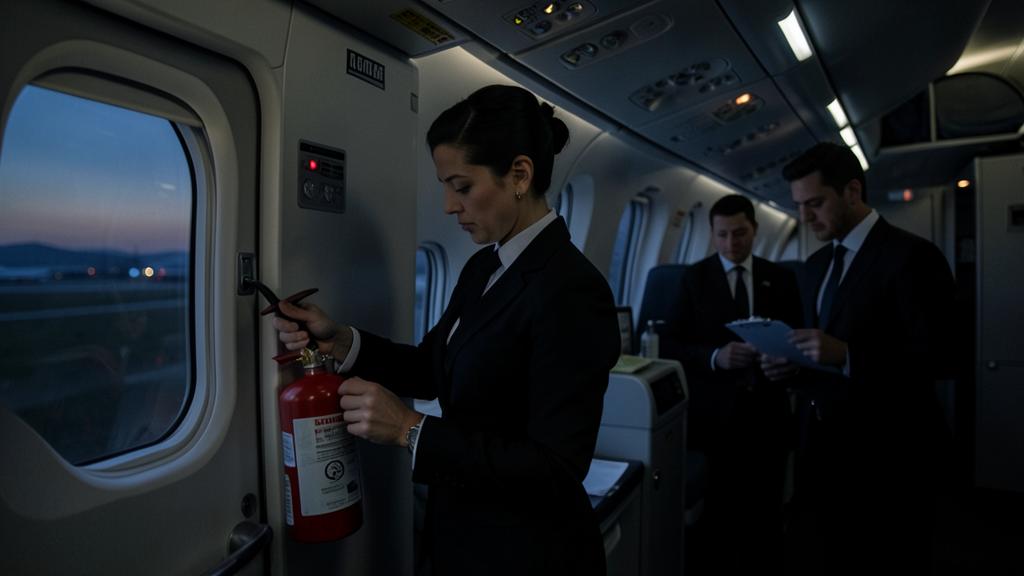
On an A320 with 180 passengers, a cabin crew member fails to check a fire extinguisher seal before takeoff. The inspector notes this not because the extinguisher was faulty, but because the crew member didn’t follow the procedure—even though nothing went wrong.
Coming on duty: the least performed part, and the most closely read
Many checks are decided before pushback, and this part is often underrated because it is experienced as administrative. It is in fact the most legible part for an observer, because it is almost entirely made up of voluntary actions.
At the briefing, what is observed is not the recitation of the questions asked by the senior cabin crew member, but what each person brings: the particularity of the day, an item from the minimum equipment list that affects the cabin, a deactivated door, a passenger with reduced mobility, an unaccompanied minor, a security-sensitive station, a crew reduced to the regulatory minimum. A crew member who spontaneously flags that they have never flown this cabin variant, or that they are returning after a break, scores a point: it shows they are assessing their own exposure before the flight, not after.
Next comes the check of safety and emergency equipment. What matters at this point is not knowledge of where the equipment is, which everyone has, but the action itself: is the check genuinely carried out, or is the station declared checked because it always is? What is observed is the order in which it is done, the attention paid to the state of a seal, the check of a bottle’s pressure, and above all what is done about anything missing. Missing equipment is not the fault of the crew member who finds it; failing to report it, or reporting it without stating what consequence it has for departure, is.
The grid: competencies, not a task list
Recent observation grids are, at a growing number of operators, built around competencies, each described by observable behaviours. The logic is borrowed from competency-based assessment approaches developed on the flight-deck side, and it has the same consequence: the assessment is not built by ticking off successfully completed tasks, but by accumulating observations that converge on a single conclusion.
| Competency observed | Reassuring marker | Worrying marker |
|---|---|---|
| Application of procedures | Sequence maintained even without a witness; the shortcut is refused when time is short | Procedure adapted to the circumstance without being announced; the order is changed to save time |
| Situational awareness | Regular cabin scan; anticipates an announced turbulence before the flight deck’s call | Absorbed in one task; discovers the state of the cabin only when asked about it |
| Communication | Brief, complete message, with acknowledgement of receipt; distinguishes information from a request | Information passed under one’s breath, with no clear recipient, or left for later |
| Teamwork and authority | Asks for help at the right moment; gives a clear order to a passenger in a degraded situation | Waits for an instruction to act within their own remit; or acts alone where coordination is required |
| Workload management | Interrupts the service when the priority changes; announces the interruption | Continues the service while cabin securing is falling behind the flight profile |
| Decision-making | Chooses, states the reason, reports back; accepts revisiting the choice | Decides with no explicit criterion, or fails to decide and lets the situation dictate the outcome |
This structure explains a phenomenon that surprises candidates: the same error can be marked twice, in very different ways. Taken alone, it is a fact. Repeated across two linked competencies — for instance a delayed piece of communication and a poorly maintained priority — it becomes a pattern, and it is the pattern that tips an assessment over.
Cabin securing and the report to the flight deck
If only one object of observation had to be retained, it would be this one. Cabin securing is one of the few acts by cabin crew on which a flight-deck decision directly depends: the flight crew has no direct view of the state of the cabin and acts, essentially, on trust in a report.
The mechanism observed is a loop, not a tick-box. The flight deck announces a deadline or a timeframe. The cabin is checked according to the operator’s sequence. If a point remains open, it is dealt with, and if it cannot be within the timeframe, it is escalated before the report, not after. Only then is the set phrase pronounced.
The trap. Announcing the cabin ready “so as not to cause a delay”, telling oneself it will be finished during taxi. The observer does not judge the badly stowed bag, they judge the gap between what was declared and what was true. An inaccurate report makes false a piece of information on which the flight deck bases its decision — and this is one of the rare findings that, on its own, is enough to tip an assessment towards unsatisfactory.
The question of timing deserves clarification, because it is often misunderstood. Announcing too late is not free: it consumes ground time and can constrain the flight deck. But announcing a delay is almost always better regarded than simply enduring it. “Two minutes, rear row” is a professional answer; silence, followed by a late call with no explanation, is not.
The deviation: what counts is not the mistake, it’s what follows
No line check ever goes by without a deviation. No one flies a full day of duty without an omission, a swap, a piece of information passed at the wrong moment. An experienced observer knows this, and their assessment therefore does not turn on whether the deviation existed, but on two properties: was it detected, and by whom; was it recovered, and how.
The top-left cell, fortuitous recovery, deserves particular attention. The flight ends well, the deviation has disappeared, and yet the assessment takes it into account: if a colleague quietly caught it, or if the situation resolved itself, competency was not demonstrated. The same reasoning applies to silent recovery — correcting without announcing. On the outcome side, it is flawless; on the team side, the information never circulated, and no one can verify that the correction actually happened.
The right instinct. Verbalise the recovery, however minor, even when it is awkward: “seatbelt not checked on the first pass through the rear row, done now.” A three-second sentence turns an invisible deviation into proof of situational awareness, and it closes the loop for the team. It is the gesture that most clearly distinguishes, on a grid, a candidate who is in control of their check from one who is enduring it.
Communication: listened to more than it is watched
The aft jump seat is an excellent listening post and a poor observation post. The inspector sees only part of the cabin, but hears everything: the announcements, the interphone calls, what is said between colleagues in the galley, the tone used with a passenger who refuses to stow their bag.
Three things are listened to in particular. First, the structure of messages to the flight deck: a brief piece of information identifies the subject, the state, and what is expected of the recipient. Then the confirmation loop: an order received is restated, not merely acknowledged, in situations where a misinterpretation would have a consequence. Finally, register in a degraded situation: the same person must be able to switch from a commercial tone to a short, directive order, and back again. The inability to switch register — staying polite and interrogative when an order is needed — is a classic ground for reservation, and one candidates rarely anticipate.
Upward communication deserves particular attention. Many observed deviations are not execution deviations but escalation deviations: a piece of information that stays within the cabin because it seemed minor. A brief odour, a passenger asleep beyond what is reasonable, equipment resisting closure: these are exactly the elements whose absence, later, will make an event report incomprehensible.
The debrief, and what remains in writing
For most operators, the debrief follows a stable pattern. A self-assessment is asked for first, and this question is not mere politeness: the ability to identify one’s own deviations is itself part of the assessment. A candidate who says “everything went fine” after a flight in which three points were noted has just provided information about their situational awareness.
Next comes the factual account: which moment, which action, which consequence. A defensible assessment rests on dated facts, not impressions; this is also what makes it possible to contest usefully. Then the outcome, which generally falls into three families: satisfactory; satisfactory with points to work on, recorded; unsatisfactory, with the follow-up laid down by the operator’s programme — targeted supplementary instruction, then a new check, with precise rules on who may conduct it.
| Criterion | Line check | Periodic ground check |
|---|---|---|
| Purpose | Actual application of procedures in operation | Mastery of gestures, drills and knowledge |
| Environment | Commercial flight, real passengers, unscripted contingencies | Mock-up, cabin trainer, reproducible exercises |
| Control over the scenario | None: the observer takes the flight as it comes | Total: the difficulty is calibrated and identical for everyone |
| What makes the difference | Priorities, communication, handling of deviations | Accuracy and speed of execution |
| Role in a real emergency | The observer can become an active crew member | Not applicable |
| Record | Named report placed in the competency file | Exercise result and training certificate |
These records are not decorative. They feed the individual file the operator needs to demonstrate, to its authority, that every cabin crew member assigned to an aircraft type is genuinely competent on it. It is this file, not seniority, that authorises assignment to a flight: an interrupted currency cycle is not made up simply by accumulating hours, it is made up through training and a new check, under arrangements each operator has approved. Useful preparation therefore works on reading the grid as much as on the gestures themselves — which is what to look for in a course, whether it comes from the airline or from a provider listed on formations.fl330.com comes from, because that is where experienced candidates most often trip up.
What to go and check in your own documentation
An observation grid is not universal: it is approved operator by operator, and the same words do not cover the same expectations from one to another. Before a check, four points deserve verification in your airline’s own documents, not in a memory of a training course.
- The exact list of competencies in the current grid, and the wording of the assessment levels. Some operators mark by competency, others give an overall assessment supported by observations: the preparation strategy is not the same.
- The cabin securing sequence as it is written, including the order of checks and the exact wording of the report. This is where line habits diverge fastest from the text.
- The documented handling of missing or degraded equipment: who decides, what note is made, what consequence it has for departure. Many candidates know the consequence without knowing the process.
- The follow-up to an unsatisfactory check: the delay before a new check, who may conduct it, what is recorded and for how long.
One grey area remains that no one fully clarifies, and that is better anticipated: the status of the observer during the flight. They occupy a seat, they know the aircraft, and in a genuine emergency they are no longer an observer. Knowing whether your documentation counts them as part of the minimum crew, where they sit, and what they do during an evacuation, avoids a costly hesitation — and the question, asked at the briefing, is itself a good signal sent to the checker.
Finally, for anyone preparing a first type qualification or returning after a break, the order of preparation is better reversed compared with intuition: the physical actions are trained on the ground and picked back up quickly, whereas reading priorities and reporting discipline are only acquired on the line. It is this second register, more than the drills, that comes up most often in exchanges between professionals, on forums.fl330.com and elsewhere.
This article describes a common observation mechanism; it does not replace any regulatory text. In case of divergence, the applicable regulation, the training and checking programme approved by the authority, and your airline’s operations manual take precedence over everything stated above, including the best-established line practices.
Questions fréquentes
Is the cabin service actually marked during a line check?
It is, but indirectly. The service is not assessed for its own sake: it acts as a window onto workload management and priority-setting. A tray served flawlessly while cabin securing falls behind will be read as a failure of priorities, not as a commercial success.
Does a mistake made during the flight cause the check to fail?
No, and an experienced observer knows that no flight goes by without a deviation. What is valued is detection and recovery: a deviation spotted, announced and corrected demonstrates competency instead of casting doubt on it. The costly deviation is the one no one saw, or the one corrected in silence without the team being informed.
What should be done if a piece of safety equipment is missing during the pre-flight check?
The missing item is never held against the person who discovers it. What is observed is the process: immediate escalation to the senior cabin crew member and then to the flight deck, a note in the documents the operator requires, and a clear statement of the consequence for departure. Not knowing this process is a more serious flaw than the missing item itself.
Is it better to announce a delay in cabin securing, or hold the deadline at all costs?
Always announce the delay, with the reason and a rough time estimate. A cabin ready report that does not match reality makes false a piece of information on which the flight deck bases its decision, and this is one of the rare findings that on its own is enough to tip an assessment. A few announced seconds cost less than an inaccurate commitment.
What actually happens after a check judged unsatisfactory?
The follow-up is defined by the operator’s approved training and checking programme, not by local practice. It generally involves targeted supplementary instruction on the competencies concerned, then a new check, with precise rules on who may conduct it and what is recorded in the file. Until this sequence has been completed, the operator cannot regard competency as restored for assignment to a flight, and seniority changes nothing about that.


Leave a Reply
You must be logged in to post a comment.