
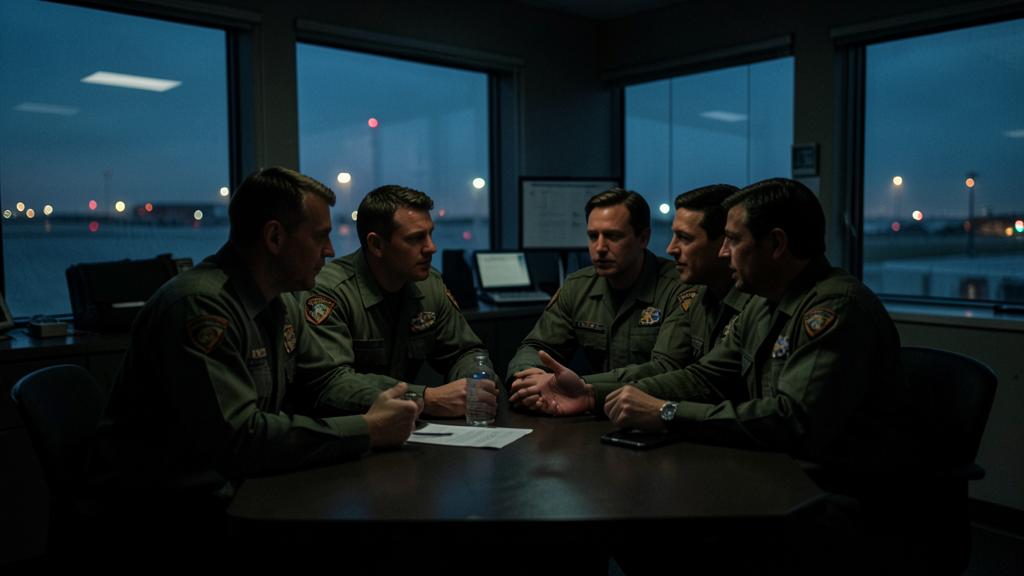
A first officer files a voluntary report on a poorly managed descent that he himself caused. A few days later, a line manager mentions it in front of two colleagues, anecdotally, naming him. No disciplinary action was taken, the just culture charter has not changed by a single line, and yet the flow of voluntary reports from that base withers for weeks. Nothing has changed in the text: the text has just been contradicted by an observation, and an observation carries more weight than a promise.
The policy in force is the one set by the last case observed
A just culture charter states a promise: what you report will not be used to hold you at fault, and your employer will not cause you detriment for having reported. That promise is invisible day to day, by construction. When it is kept, nothing observable happens: the report goes off, the analysis is carried out, no one hears about it. When it appears to have been broken, the event is immediately visible, tellable, dated and attributed to a known person.
This asymmetry is enough to explain the essentials. The reporting population has no access to a rate of disciplinary follow-up; it has a small number of cases it has heard about, and draws an estimate from them. Cases handled in line with the charter leave no trace, so they never enter the sample; hostile cases all enter it. With an identical charter and identical management, two bases of the same operator can therefore live under two different policies, not because the manual differs, but because the available sample differs.
People judge safety culture by what they see, not what’s written. A single bad example sticks in their minds, while good examples go unnoticed. That’s why one mistake can make people stop reporting, even if the rules haven’t changed.
The corollary is unpleasant for management: a policy is not restored by restating the policy. An email repeating the charter adds a promise to the file, not an observation. It weighs nothing against the story going round, because it does not play in the same category of evidence. This is also why the age of a scheme does not protect it: years of correct operation have produced no collective memory, whereas one corridor incident produces one for a long time.
What circulates, and why it becomes an instruction
The story does not travel like a memo. It goes through briefing rooms, layovers, crew transport, the night shift’s break and private message threads — channels whose route and rhythm the operator knows nothing about. It is carried by people who have a reason to tell it, since the story is directly useful to whoever is listening; it therefore circulates without any effort being spent on pushing it.
It also distorts in a constant direction. At each retelling it loses whatever excused the manager — fatigue, clumsiness, a misunderstood sentence, a wider file the listener knew nothing about — and keeps whatever is useful to the receiver. After a few relays, what remains is no longer an anecdote but a rule of conduct, short and applicable: at this base, you do not put your name to that. It is this compressed form that reaches the greatest number, and it is the one that governs behaviour.
The reach is not the whole company: it is the group that shares a roster, a base, a workshop, a type rating. That sounds reassuring and is not, because that group is precisely the population whose reports document the risks specific to that place — particular approaches, station constraints, local arrangements in a workshop, the habits of a fleet. The loss of information is therefore concentrated exactly where it is least replaceable by another source.
The type of operation shifts that reach without changing the mechanism. In a maintenance organisation or a small structure, the team sharing a hangar sometimes makes up the entire reporting population: a single episode then covers the whole of the body concerned, and there is no other group to spontaneously provide a counter-example. Conversely, an operator with several bases sees local regimes take shape: the same charter produces an abundant flow here and silence there, a gap that consolidation at company level erases entirely. The first useful breakdown for reading a reporting flow is therefore neither the fleet nor the severity, but the group that talks to itself.
At a regional airline, a captain mentioned a first officer’s report about a missed approach in the crew room. Within a week, other first officers stopped filing voluntary reports about their own errors. The base’s reporting rate dropped by 40% for three months, even though the airline’s just culture policy hadn’t changed. The captain’s comment outweighed the official rules.
What the system loses, and why the figures do not show it
The under-reporting that follows is not uniform, and that is what makes it hard to see. Mandatory reports barely move: they cover events appearing on a list, most often detectable by other means — flight data analysis, workshop records, a maintenance message, a report from the other crew, from the control body or from the ground handling agent. Failing to file them is noticed, and noticed quickly.
What disappears is the rest: the voluntary report, the one describing a near-nothing, the one documenting a threat that had no consequence, and above all the one in which the author implicates himself. The latter is already the costliest to write in normal times; it becomes impossible as soon as the question “who is going to read this, and what will they do with it?” no longer has a reassuring answer. Yet that is precisely the category carrying the most information: a deviation that nothing else recorded, described by the only person who knows why it happened.
The result is a flattering dashboard. Total volume barely falls, the breakdown by severity hardly moves, and the rate per unit of activity may even improve, since the numerator loses its minor cases before the others. The safety review therefore sees a favourable trend at the exact moment when the ability to see has just been cut back.
The trap: reading the fall as an improvement. A quarter with no voluntary report at a base is not a quiet quarter, it is a quarter without data. The only useful check compares the composition of the flow, never its volume: if the share of reports in which the author describes his own error collapses while the mandatory ones hold, the cause does not lie in operations, it lies in what was observed.
Two signals, two economies
Comparing the episode and its repair term by term shows why the second costs so much: it must produce, with slow means and a captive audience, the effect a corridor conversation produced for free.
| Criterion | Hostile episode observed | Corrective gesture |
|---|---|---|
| Perceived sender | An identified person, in front of witnesses | The organisation, through an official channel |
| Channel | Informal, person to person | Meeting, memo, feedback |
| Effort to spread | None: the story is useful to whoever hears it | Entirely borne by the sender |
| Time to cover the base | A few days | Several weeks, if repeated |
| Form retained by the audience | A short, applicable instruction | A general principle, quickly forgotten |
| Persistence | Long, reactivated by every new case | Short, unless a fact reactivates it |
| What cancels it | A contrary case, visible and dated | Not applicable |
The last row is the most useful. An episode is not cancelled by a denial, but by a case pointing the other way, as concrete and as observable as it was — that is, by another event, not by a statement of intent. Until that case has occurred, the sample available to the workforce remains the one everyone knows.
The gestures that restore something
Four conditions recur in situations where the flow recovers, and they all bear on the form of the gesture, not on its content.
- The same audience. A one-to-one apology repairs the relationship with the reporter and changes nothing for all those who heard the story. The repair must reach the witnesses, which first requires knowing how far the episode travelled — a question that has to be asked, and which those concerned answer readily.
- The same level, or above, naming the fact. A reminder issued by a cross-functional department weighs nothing: it has no authority over the person who produced the episode. The gesture counts when it comes from the one who spoke, or from his superior saying that it will not happen again.
- An act, not a principle. A dated decision, an amended instruction, an anonymised case told with its conclusion, a report shown to have changed something in the procedure. The workforce assesses observable facts; it must be given some.
- Quickly. After a few weeks, the episode has ceased to be news and has become a character trait attributed to management. You are no longer correcting an event, you are correcting a reputation, and the cost is no longer of the same order.
Conversely, three frequent reactions have no measurable effect. A written reminder of the policy and refresher training on just culture add promises to a file that was not short of them. Publishing a review showing that very few disciplinary actions were taken asks people to believe an unverifiable figure against a story heard from a colleague — and, in a population that assesses risk for a living, the story wins.
The right reflex: the first public feedback bears on the fact, within the week, and says what was decided — not what was felt. The word to the reporter comes in addition, never instead, and the author’s name appears in neither. An anonymised case given back with its conclusion is worth more than ten reminders of the charter, because it is of the same nature as what did the harm: an observation.
What can be measured without waiting for the statistics
The event rate per unit of activity is an output indicator: slow, noisy with operations, it will say nothing for several quarters. Three much earlier quantities can be read in any reporting system, with no additional tool.
- The share of reports in which the author describes his own error. It is the first to drop, because it is the most exposed gesture.
- The delay between the event and the filing. It lengthens before the volume falls: first people hesitate, then they give up.
- The share of anonymous filings, in a system that accepts both forms. A rise is not good news: it signals that the protection promised is no longer judged sufficient, and it deprives the analyst of the chance to call the author back to understand.
Finally, there is a qualitative test that nothing replaces and that takes a quarter of an hour. Ask three people at the base to name the last case they heard about, and what became of the person concerned. If they can name a case without knowing its outcome, the organisation has let a rumour circulate without ever publishing a verdict — and a rumour deprived of a conclusion concludes itself, in the least favourable direction.
What to go and check in your own documentation
Three questions arise for the manual, and the answer is not always in it. First, who draws the line between error, gross negligence and wilful misconduct? The principle appears in the European regulation on occurrence reporting and in most charters; the procedure that applies it, far more rarely. A manual that designates no one leaves the classification to the line manager, that is, to the person who also appraises the individual concerned.

Next, is that decision written down and given back? An organisation that rules without ever publishing anything, even in anonymised form, condemns itself to having the only cases known to its personnel be those that leaked — hence the most spectacular and the least representative. Comparing your charter and your practices with those of other organisations, on the FL330 professional forums or through a network of safety managers, quickly reveals what the manual left in the dark.
Finally, is the body that assesses behaviour separate from the management line that manages careers? Few schemes provide for this explicitly, and it is the most solid grey area of the subject: the line manager is at once the first recipient of the report, the first possible commentator, and the appraiser of the person. The charter almost never says how those three roles are held at the same time, nor what to do when they come into conflict.
For anyone taking up a first management post, the practical consequence is immediate: the first reports you receive weigh far more, in the policy actually in force at the base, than the content of the manual. What you say in the days following the first of them counts for more, as an observable effect, than the entire chapter devoted to the safety management system.
These pointers describe an observed mechanism; in the event of divergence, the applicable regulations, the just culture charter and the approved procedures of the operator or organisation prevail over what is written here.
Questions fréquentes
Does the protection of a report cover wilful misconduct?
No, and that is the limit every just culture charter states: the protection covers error, not wilful misconduct or gross negligence. The difficulty does not lie in the principle but in the procedure: the manual must say who classifies the behaviour, against which criteria and with what traceability. When it does not, the classification falls in practice to the line manager, who is also the appraiser of the person concerned. An organisation that wants its charter to be believed therefore writes that procedure before it has to use it.
How can you tell that the reporting flow has dropped off, without waiting for the annual indicators?
By looking at the composition of the flow rather than its volume. Three quantities move much earlier: the share of reports in which the author describes his own error, the delay between the event and the filing, and the share of anonymous filings when the system accepts both forms. All three series already exist in the reporting database and can be extracted with no additional tool.
Is an apology to the reporter enough to repair the damage?
It repairs the relationship with the person concerned, which is necessary, but it changes nothing for the witnesses of the episode, who will never hear about it. The repair must reach the same audience as the fact, come from the same level of management or above, and take the form of a verifiable act: a dated decision, an amended instruction, an anonymised case given back with its conclusion.
Should the follow-up given to a report be published, at the risk of identifying its author?
What is published is the fact and the decision, never the person. An anonymised case, stripped of the elements that would allow a particular flight or team to be traced, given back with what it changed in the procedure, fulfils the function without exposing anyone. Without that feedback, the only cases known to the workforce are those that leaked, that is, the least representative.
Can the line manager both receive a report and appraise the person?
In practice that is the case in many organisations, and it is the most solid grey area of the subject. The just culture principle requires that the classification of a behaviour not be left to the isolated judgement of the person who manages the career, but few manuals designate a separate body. This is the first point to check in your own safety management system chapter: who classifies, under what procedure, and with what traceability.
Is anonymous filing a good solution when trust has been dented?
It preserves the signal, which is better than silence, but it is expensive to process: the analyst can no longer call the author back to clarify a point, and the organisation can no longer give feedback. A rise in anonymous filings should therefore be read as a symptom to be treated, not as a satisfactory arrangement in steady state.


Leave a Reply
You must be logged in to post a comment.