
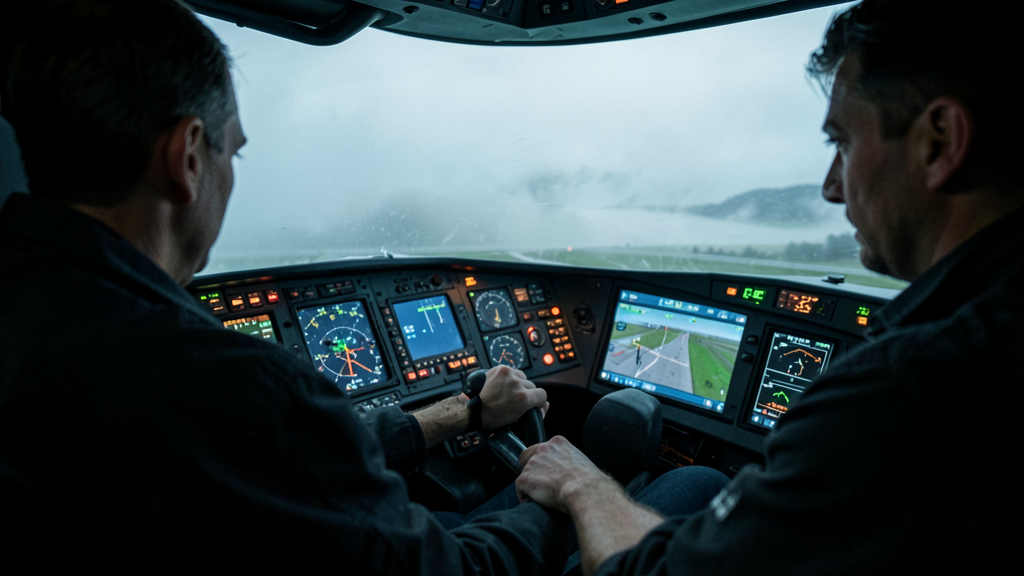
A pilot can finish a type rating, walk out of the building, and fly a revenue sector on an aeroplane type they have never physically been aboard. That is not a loophole and it is not a cost-cutting concession — it is a specific approval that rests on a chain of evidence about one particular simulator, one particular course and one particular candidate. The credit is not granted because the device feels convincing. It is granted because its behaviour is traceable to flight-test data of the actual aeroplane, and because the line is required to pay part of the training back afterwards.
What the aeroplane session used to provide — and what it really provided
Before zero flight time, a type rating ended with a short session in the aeroplane: circuits at a quiet airfield, an instructor in the other seat, a handful of takeoffs and landings. It is worth being honest about what that session actually taught. The aeroplane was near-empty and therefore far below any realistic operating weight. The airfield was chosen for its lack of traffic. The weather was chosen to be benign, because an instructor is not going to introduce a first-ever landing on a contaminated runway in a gusting crosswind. The exercise proved that the candidate could flare and roll out a very light aeroplane in easy conditions.
Those circuits were also expensive in a way that has nothing to do with training value: an aircraft out of revenue service, fuel, crew, slots, and a spare aeroplane in the plan to absorb the disruption. The economic pressure to remove them is obvious. The interesting question is what had to be true before removing them was defensible — and the answer is not that simulators became more realistic. It is that a specific evidentiary framework grew up around them.
Credit is granted to a data loop, not to a feeling
The single most misunderstood point about a high-level full flight simulator is where its authority comes from. Instructors and candidates describe devices as realistic or unrealistic, and that judgement is meaningful for training design and worthless for qualification. What the authority evaluates is whether the device’s response matches recorded aeroplane behaviour within stated tolerances, across a defined set of test conditions.
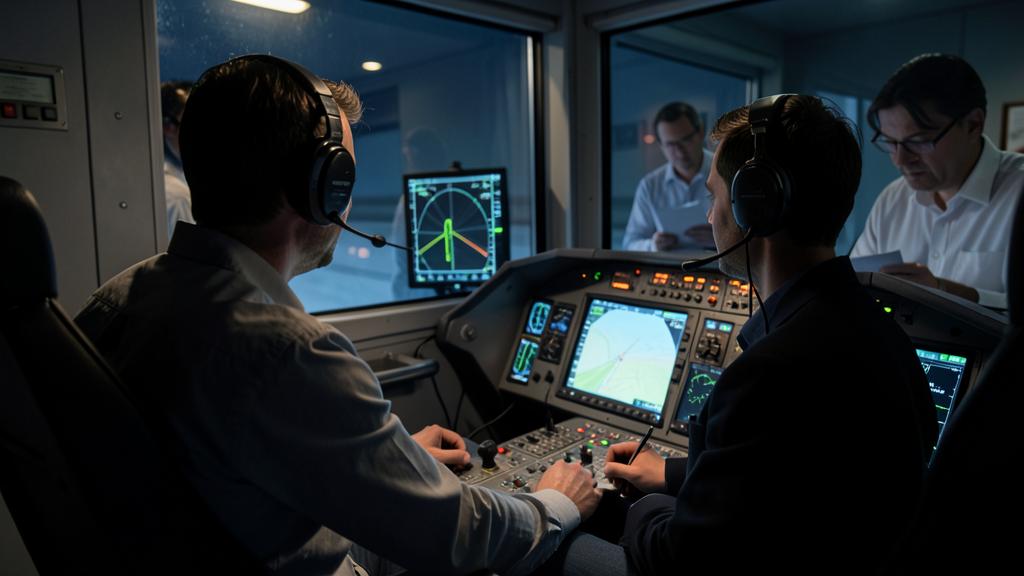
The chain runs roughly like this. The aeroplane manufacturer produces validation data from flight test and from its own engineering simulations, and packages it with a document that identifies, for each required test, which data source is being offered and why. The simulator manufacturer builds models from that data. The device is then run through the full set of tests and the results are recorded, becoming the master reference for that specific simulator. The authority’s evaluation team examines those results, runs its own selection of them, and then adds the part no data can settle: a qualified pilot flying the device to judge whether it handles like the aeroplane in situations the objective tests do not cover.
Three things follow from this. First, the qualification belongs to a device, not to a model of device — two simulators from the same production line are qualified separately. Second, the qualification is against a specific aeroplane configuration; a device qualified for one variant, engine fit or avionics standard is not automatically qualified for another. Third, the qualification is perishable, because a simulator drifts and because the aeroplane it represents changes.
| Aspect | Objective testing | Subjective and functional testing |
|---|---|---|
| Question asked | Does the device’s measured response match the aeroplane’s recorded response within tolerance? | Does the device behave like the aeroplane to a pilot who knows the aeroplane, and does everything work? |
| Basis | Validation data from flight test, engineering simulation or an accepted alternative source, identified test by test | The judgement of the evaluating pilot, applied against a defined list of manoeuvres, systems and malfunctions |
| Typical content | Performance, handling qualities, control response, motion and visual system characteristics, latency between input and cue | Ground handling, flight deck functionality, systems logic, malfunction behaviour, instructor station, environment and weather effects |
| Recorded in | The test guide, retained as the master reference for that individual device | The evaluation report and the qualification certificate, with any restrictions stated on it |
| Failure mode | Results outside tolerance, or a data source that cannot be justified | A device that passes every number and still does not fly like the aeroplane |
A simulator is approved because it behaves exactly like the real plane, not because it feels real. Engineers test it against real flight data, and pilots check it for things the data can’t measure, like how it feels to land.
An Airbus A320 simulator must reproduce validated flight-test data for key manoeuvres such as the takeoff rotation, stall behaviour and the landing flare. If its results fall outside the tolerances set by the qualification standard, it fails qualification.
What zero flight time leans on hardest
If the aeroplane session that has been removed was circuits and landings, then the parts of the simulator that must carry the load are precisely the ones that were historically the weakest: the last fifty feet, the touchdown, and the rollout.
That means ground effect modelled from flight-test data rather than from theory. It means a landing gear and tyre model that reacts correctly to a firm arrival, an off-centre touchdown and asymmetric braking. It means a motion system that reproduces the onset cues a pilot uses to judge sink rate, and a visual system whose field of view is continuous across the flight deck so that both pilots see a coherent scene during the flare — at that moment the peripheral cue matters at least as much as the forward image. It means latency between control input and the corresponding motion, visual and instrument response held to a budget small enough that a pilot’s closed-loop control is not learning a false timing.
It also means sound and control feel, which sit awkwardly between the objective and subjective camps. Control loading is measured against aeroplane data; the sense that the aeroplane is heavy on the controls at low speed is judged by a pilot.
The trap: a device can be qualified at the top level and still carry restrictions on its certificate. Qualification is granted against a specific aeroplane configuration and a specific list of capabilities, and a device may be qualified for the type while excluded from some credit — a particular low-visibility operation, a particular variant, a particular malfunction set. Read the certificate and its limitations before assuming the course you have designed can be run on that device. The level on the door is not the whole answer.
Three approvals, not one
A pilot who completes a zero flight time course is relying on three separate approvals that lapse in three separate ways. Conflating them is the most common source of confusion when something goes wrong administratively.
| Approval | What it proves | How it is kept alive | What its loss does |
|---|---|---|---|
| The device qualification | That this individual simulator reproduces this aeroplane within tolerance, at a level that permits landing credit | A continuing qualification programme run by the device operator, plus recurring evaluations by the authority | Training already completed remains valid; new training cannot be conducted for the affected credit |
| The training organisation’s course approval | That this syllabus, with this sequence, duration and content, satisfies the type rating requirements without aeroplane flight | Oversight of the organisation, with changes to the course requiring approval | The course cannot be delivered as a zero flight time course, whatever the device is capable of |
| The instructor and examiner qualification | That the person teaching and the person testing hold the type rating instructor and examiner privileges for the type, with the required currency | Individual revalidation and standardisation | The session does not count, regardless of device or syllabus |
Who is allowed onto a zero flight time course
The candidate is part of the evidence, not a passive recipient of it. The rules restrict zero flight time courses to pilots who already bring something the course is not going to teach them: multi-crew operating experience on aeroplanes of a broadly comparable class, so that the training can concentrate on the type rather than on the fundamentals of large-aeroplane handling and crew operation.
The precise gate — how much prior experience, on what kind of aeroplane, and whether the requirement changes according to the qualification level of the device used — is split between the licensing rules and the operational training rules that go with them, appendices included, and it is one of the areas where authorities have historically differed and where the detail has been amended. It is also an area where operator summaries circulate as folklore. Read the applicable text, in the edition currently in force in the state that issues the licence, rather than a slide.
The right reflex: when planning a transition, establish the eligibility gate before anything else in the file. Course design, device booking and line planning all depend on whether the candidate qualifies for the zero flight time route, and a candidate who does not will need an aeroplane session that has to be scheduled months in advance. Discovering this late is a rostering problem, not a paperwork problem. Pilots comparing transition routes will find the practical experience in the FL330 forums more useful than any brochure.
What the line pays back
The aeroplane exercise is not abolished. It is moved, and it is moved into an environment that is more demanding than the circuits it replaced, under supervision that is more structured.
The mechanism has three layers. First, a defined number of takeoffs and landings in the aeroplane must be completed under the supervision of a type rating instructor occupying the other seat, within a defined period after the skill test. These are not circuits; they are normally revenue line sectors, at real weights, into the operator’s actual destinations. Second, line flying under supervision continues for a number of sectors set by the operator’s approved training programme, with a line check at the end. Third, until the pilot is considered consolidated, the operator applies restrictions — the specific list varies, but crosswind and contamination limits, restrictions on low-visibility operations and on certain aerodromes, and rules preventing two inexperienced crew members from being paired together are all standard.
| Removed from the course | Replaced in the line by | Why the replacement is harder |
|---|---|---|
| Circuits in a near-empty aeroplane | Supervised revenue sectors at operational weights | Real weight, real centre of gravity, real fuel state and real consequences for a go-around |
| An uncongested training airfield | The operator’s network | Traffic, arrival management, terrain, noise procedures and slot pressure |
| Deliberately benign weather | Whatever the day offers, inside the imposed restrictions | The restrictions bound the exposure; they do not remove the variability |
| An instructor with no other duty | A type rating instructor operating as a line crew member | The supervision is genuine but shares the flight deck workload of a commercial sector |
Seen this way, zero flight time is less a removal of aeroplane training than a redistribution of it: the easy aeroplane exercise is deleted, the difficult one is retained and supervised, and everything that can be trained better in a device — rejected takeoffs, engine failures at the worst moment, degraded systems, weather that no instructor would create deliberately — is trained where it can be repeated and stopped.
Where the regimes diverge
It is tempting to describe this as a single global system, and it is not. European rules address zero flight time training explicitly, but they spread it out: the device conditions, the candidate experience gate and the supervised landings owed afterwards do not all sit in the same regulation. The United States reaches a comparable outcome through a different route: device qualification sits in its own regulation, while the credit for landings without the aeroplane is granted through the operator’s approved training programme, including under advanced qualification arrangements that allow a carrier to justify a programme against its own data.
The consequences are practical. Terminology differs, the qualification levels are not perfectly interchangeable, and a device qualified under one framework may need additional evaluation to be used for credit under another. For anyone building a course across jurisdictions, or for a pilot whose licence and employer sit under different authorities, this is the first thing to establish and the last thing to assume. Structured guidance on how the two frameworks map onto each other is part of what a serious type transition course should cover, and it is worth checking before enrolling in one — FL330 training maintains material on this.
What a professional should take from this
The honest summary is that the aeroplane was never magic and the simulator is never a substitute in the abstract. What makes the substitution legitimate is an evidence chain: manufacturer data with a stated provenance, a device tested against it and kept tested, a course approved for that device, instructors qualified to deliver it, a candidate who already knows how to operate a large aeroplane in a crew, and a line phase that puts the person back into the aeroplane under supervision before letting them loose.
Break any link and the credit is not merely weakened — it does not exist. That is the useful way to think about it, and it is a far better answer to the sceptical question than any claim about how convincing the simulator felt.


Leave a Reply
You must be logged in to post a comment.