
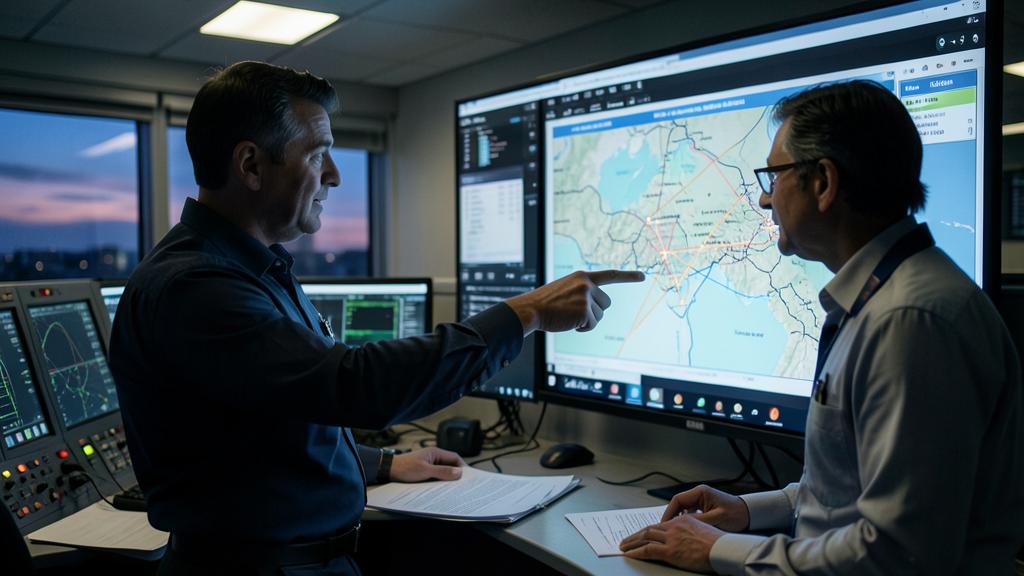
A line pilot moving to a ground post arrives with something no assessment centre can manufacture: thousands of hours of decisions taken with incomplete information and no possibility of postponement. That asset is real, and it is almost never presented in a form an operations recruiter can score. The gap is not one of merit but of language: a flying career is recorded in hours, types and route structures, while a ground vacancy is written in competences, evidence and accountabilities. This is how to perform the translation, and which parts of the record genuinely refuse to be translated.
Fifteen years is not a qualification
The first correction is uncomfortable. A logbook total is a measure of exposure, not of capability, and a recruiter filling an operations control seat knows it. Two captains with identical totals can have opposite profiles: one has spent fifteen years inside a stable network with a mature procedure set and has rarely been the person who decided anything contestable; the other has spent the same period on irregular operations, diversions and aircraft-on-ground days and has a portfolio of judgement calls behind them. The logbook does not distinguish them. The application has to.
What a ground manager is buying is a repeatable decision process under time pressure, with the reasoning visible enough to be audited afterwards. That is why the phrase to strike from the covering letter is any variant of “I have seen it all”. Having seen it is not evidence; having handled it in a way that can be described, justified and repeated by someone else is. The move from flight deck to ground post is, in recruitment terms, a move from an experience claim to an evidence claim, and candidates who never make that move interview badly for reasons they rarely understand.
A pilot’s hours don’t prove skill—they just show time spent. Ground jobs need proof of how you made decisions, not just that you flew a lot.
A pilot with 12,000 hours on a narrow-body jet may have never faced a major diversion, while another with 8,000 hours on a regional aircraft may have handled multiple emergencies. The second pilot’s logbook shows real decision-making experience, not just time.
What actually crosses the fence
Several things transfer cleanly, and they are worth naming precisely rather than gesturing at.
- Normative literacy. A line pilot has spent a career operating inside a document hierarchy: the operating rules, the operator’s manual, the aircraft flight manual, the minimum equipment list, the route manual. Knowing that a limitation has a source, that sources rank, and that a local practice does not override a manual is the single most transferable habit a pilot owns. Ground functions — dispatch, compliance monitoring, ground operations, safety — are built on exactly that reflex, and most candidates from outside aviation do not have it.
- Decision-making with a deadline and a cost. Every fuel decision, every continuation decision, every technical acceptance is a live trade between safety margin, commercial cost and time, taken once and owned. Operations control does the same thing from a desk, with more information and less physical stake. The reasoning structure is identical; only the seat changes.
- Cross-role coordination. A pilot has worked with cabin crew, engineers, load control, handling agents and air traffic services, and has had to obtain things from people who do not report to them. That is the daily reality of an operations coordinator, who has authority over almost nothing and influence over almost everything.
- Calibrated communication. Standard phraseology, briefings, technical log entries and occurrence reports train a habit of saying exactly what happened in a form another professional can act on. Written clarity is a scored competence in most ground roles and is quietly rare.
The right reflex. For each competence you claim, prepare one dated situation with the decision you took, the information you had at the time, and what you would have needed to decide better. Interviewers score the reasoning, not the outcome — a well-explained decision that turned out imperfectly beats a lucky one described vaguely.
What stays on the flight deck
Three assets do not travel, and pretending otherwise is the fastest way to lose credibility in an interview.
Command authority. The commander’s authority is a legal construct attached to a specific aircraft, a specific flight and a specific set of operating rules. It does not follow the person. An ex-captain in an operations centre issues no orders to a crew; they provide information and support to a commander who retains the decision. Candidates who describe the ground role as “still being in charge of the flight” are describing a job that does not exist, and they are describing it to people who spend their working lives respecting that boundary.
Type-specific tacit knowledge. Deep familiarity with one aircraft is valuable for a training or technical post and close to worthless for a network-wide function that handles several types, some of which the candidate has never seen. It also decays: a knowledge asset that depends on recency is a wasting asset from the day the last sector is flown.
Seniority. Rank on a flight-crew seniority list buys nothing outside it. Ground departments have their own hierarchies, usually shallower, and a new arrival with fifteen years of flying starts as a new arrival. It is a common source of friction in a first ground year, and an entirely predictable one.
| What the record says | What the recruiter needs | Usable evidence |
|---|---|---|
| Type rating and hours on type | Technical depth that survives contact with an unfamiliar fleet | Ability to read a minimum equipment list entry and state its operational consequence, on any type |
| Command upgrade | Accountability under scrutiny | A decision taken against commercial pressure, with the rationale recorded at the time |
| Line training or supervisory flying | Assessment and feedback skill | Structured debriefs delivered, standards applied consistently, a trainee record you can describe |
| Occurrence reports filed | Contribution to the safety system | A report that led to an identified change, and your understanding of what happened downstream of it |
| Union, roster or committee work | Working within a management system | Negotiated outcomes, documents produced, constraints understood from both sides |
The ground roles and what each of them is really buying
“A ground job” is not a destination; it is at least five different labour markets with different entry conditions. Choosing before applying is what separates a targeted file from a scattershot one.
Operations control and flight dispatch buys real-time decision throughput and regulatory fluency. It is the most natural landing point for a line pilot and also the most demanding on shift tolerance. Crew planning and rostering buys mastery of flight and duty time limitations and the ability to defend an unpopular roster with a rule reference; a pilot who has lived under those limits has an advantage, provided they can show they understand them as an employer rather than as a crew member. Safety and compliance buys analytical patience: reading occurrence data, running investigations that do not attribute blame, tracking corrective actions to closure. It is the role where an ex-pilot’s credibility with crews is worth the most, and where the temptation to rely on that credibility instead of evidence is strongest.
Training buys instructional competence, and it is the one family where the flying qualification remains directly usable — instructor and examiner certificates sit inside the licensing rules, not outside them. Ground operations and load control buys process discipline and an eye for the interface between the aircraft and everything that touches it.
| Family | What is actually assessed | Where the flying record helps | Where it does not |
|---|---|---|---|
| Operations control / dispatch | Speed and quality of decisions across many flights at once | Fuel, weather, technical status, alternates | Network economics, ground resource constraints |
| Crew planning | Rule application and defensibility of the plan | Lived understanding of duty limits | Optimisation tooling, industrial agreements |
| Safety management | Analysis, evidence discipline, follow-through | Reporting culture, credibility with crews | Data handling, human factors method, audit technique |
| Training and standards | Instructional and assessment competence | Direct: licence privileges carry over | Courseware design, evidence-based training method |
| Ground operations | Process control across contracted providers | Aircraft limitations, turnaround realities | Contract management, station-level labour issues |
Where a licence is required, and where it is not
This is where candidates most often assume a rule that does not exist, in either direction.
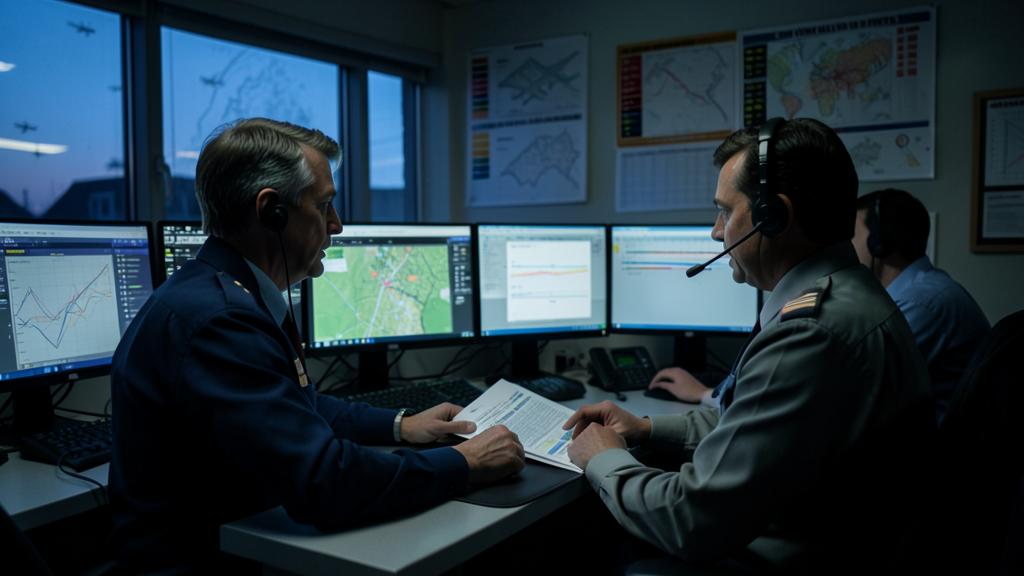
For flight operations officers and flight dispatchers, ICAO Annex 1 does define a licence, and Annex 6 places obligations on operators using a method of control and supervision of flight operations. But whether a State issues that licence varies: the United States issues an aircraft dispatcher certificate through the FAA, whereas in the European system there is no equivalent Union-wide personnel licence for dispatchers — the obligation falls on the operator to train, check and record the competence of the staff performing the function, under its approved organisation requirements. A European applicant who assumes a licence exists will look for a course that is not a legal gate; an applicant who assumes none exists anywhere will misread a job advertisement written for a different jurisdiction. Read the vacancy against its own authority.
For maintenance, the boundary is hard, but its legal shape varies with the authority. In the European system, the staff who sign a certificate of release to service in an approved maintenance organisation hold a maintenance licence for that purpose; elsewhere the privilege may be attached to the individual, to the approved organisation, or to both. What does not vary is that a flying background opens no route to that signature. Ex-pilots are employed in maintenance control, in continuing airworthiness monitoring and in technical liaison, but the release itself belongs to licensed engineering staff.
For training, the picture reverses. Instructor and examiner certificates live inside the flight crew licensing rules, and they are the one asset the pilot already holds or can obtain on the basis of the career just completed. Whether the underlying medical certificate must remain valid depends on the specific certificate, the privileges being exercised and the authority — simulator-only instruction is treated differently from instruction in an aircraft, and the detail belongs to the applicable licensing rule rather than to a rule of thumb.
The trap. Letting the licence lapse before the ground role is confirmed. Revalidation is a cost; regaining a lapsed licence and medical after a gap is a much larger one, and it removes the option of a partial return, an instructor certificate or a seasonal contract. Treat the licence as an option you are paying to keep open until the new post is past probation.
Rewriting the record as evidence
A flying curriculum vitae is organised chronologically around aircraft and employers. A ground application should be organised around the competences named in the vacancy, with the flying career supplying the evidence. That inversion is the whole exercise.
Three practical rules. First, every claim gets a locatable situation: a date, a route or a context, a decision, a consequence. Second, every number is one a reader can act on — the size of the operation you worked in, the number of people you briefed, the number of reports you filed and what came of them. A total of flight hours is not one of these numbers. Third, the vocabulary of the target department replaces the vocabulary of the flight deck, without pretending to a fluency you do not have.
| Weak formulation | Why it fails | Evidence formulation |
|---|---|---|
| “12 000 hours, three types” | Measures exposure, not capability | “Operated three types under two operating certificates; familiar with reconciling differing procedures for one fleet” |
| “Strong safety culture” | Unverifiable and universal | “Eleven occurrence reports filed in four years; two resulted in a procedural amendment I can describe” |
| “Used to pressure” | Claims a trait, not a method | “Diverted with a commercially costly outcome; the reasoning and the information available are documented” |
| “Team player” | Says nothing about influence without authority | “Coordinated a technical delay across engineering, handling and crew control with no line authority over any of them” |
How the experience is tested in the room
Operations interviews rarely test knowledge; they test process under interruption. The common format is a scenario delivered incompletely, with new information injected while the candidate is answering, and four things are typically scored: stating the decision to be taken, naming the information missing to take it, identifying who owns the decision, and saying what would make you revisit it. A pilot does all four instinctively in the aircraft and frequently forgets to say any of them out loud in an interview.
The second common test is a written one — an email to a station manager, a note to a commander, a short occurrence summary. It is scored for accuracy and for tone, and it is where candidates from a flight-deck background either shine or reveal a habit of terseness that reads as brusque from a desk.
The third is the question about authority, usually phrased as “what do you do if the commander disagrees with you”. There is one correct shape of answer: give the information, state the constraint, record it, escalate through the operator’s own chain, and accept that the decision is not yours. Candidates who answer otherwise are declining the job in front of the panel.
The first ninety days
The predictable shocks are worth rehearsing before they arrive. You become one input among many, and your recommendation will sometimes be overruled by a commercial argument you find weak. Your working day acquires a duration that is not a duty period and a rhythm that is not a roster. You will be measured on things a pilot is never measured on: response times, queue depth, ticket closure, audit findings cleared. And the people you now work with have their own fifteen years, in a discipline you are entering as a beginner.
The candidates who settle fastest are the ones who spend the first months asking how the department decides rather than explaining how the flight deck decides. The flying experience keeps its value on exactly one condition — that it is offered as evidence when asked for, and not as rank.
Discussion of specific transitions, role by role and operator by operator, continues on the FL330 forums, where several of these paths have been documented by people a year or two ahead.


Leave a Reply
You must be logged in to post a comment.