
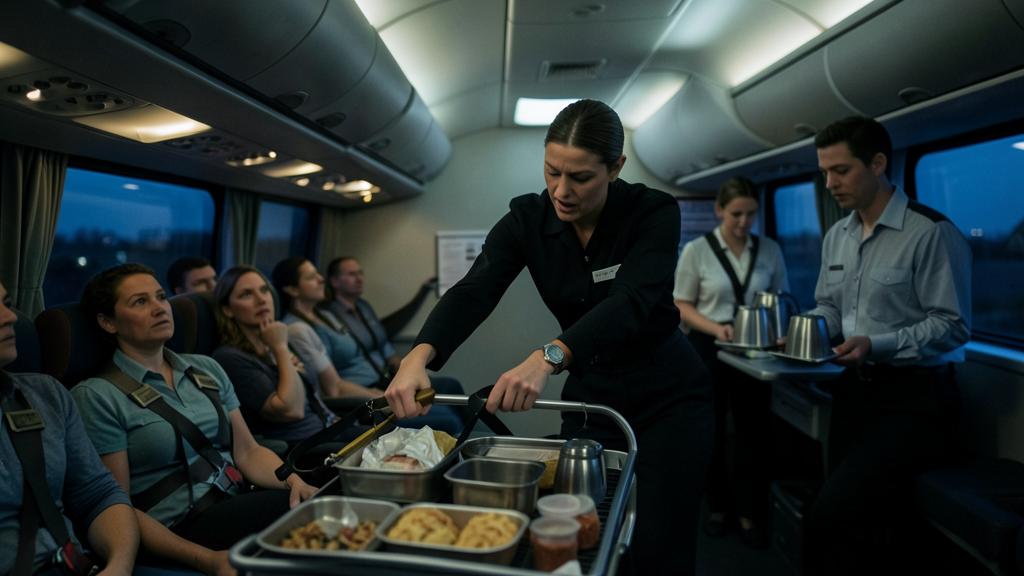
The injuries that turbulence causes in a cabin are almost never caused by the turbulence itself. They are caused by the state the cabin was in when it arrived: a trolley in the aisle, a crew member standing with a pot of hot coffee, a passenger walking back from the lavatory, an overhead bin that someone opened thirty seconds earlier. By the time the aircraft moves, none of those situations can be fixed — a loaded trolley is already a mass in motion and a standing person is already unrestrained. Everything that protects a cabin in turbulence therefore has to happen before the first jolt, which makes stopping the service a forecasting decision rather than a reaction. It also makes it a decision that has to be explained, because to a passenger sitting in perfectly smooth air, a service that stops for no visible reason looks arbitrary.
The hazard is the twenty seconds before, not the event
Consider what is loose in a cabin during a meal service. A full-size trolley loaded with meals or beverages is of the order of a hundred kilograms; its brake holds it against taxi and normal manoeuvring loads; it is not a restraint against a vertical excursion that briefly unloads its wheels. Hot liquids are open on trays. Cabin crew are standing, working with both hands, usually facing across the aisle rather than along it. Passengers are eating, which means their tables are down and their belts are frequently unfastened.
That configuration takes time to undo. Securing a galley, stowing and latching trolleys, collecting open hot liquids and getting the crew into harnesses is not instantaneous, and the last item on the list is the crew themselves — they secure the cabin before they secure themselves, which is precisely why cabin crew are over-represented among the serious injuries in turbulence occurrences across the industry. The clock, not the intensity, is what determines whether that sequence completes.
So the operational question is never « is it rough? ». It is « how many minutes do we have, and does the crew need more than that? ». Anything else is a reaction, and a reaction is always late.
The real danger isn’t the turbulence itself, but the state of the cabin right before it hits. If crew or passengers aren’t secured in time, they can get hurt. The key is to act before the turbulence starts, not after.
On a Boeing 737 flying at 35,000 feet, the crew receives a warning of moderate turbulence in 10 minutes. They immediately stop hot beverage service, stow trolleys, and secure the cabin. When the turbulence hits, everyone is safe. Without this preparation, a standing crew member could be thrown across the cabin.
Where the information comes from, and what the radar cannot see
The flight crew’s picture of turbulence ahead is assembled from several sources, and they differ enormously in lead time and in reliability. Significant weather charts and area forecasts give the strategic view before departure. SIGMET messages give warnings of severe turbulence and of the phenomena that produce it. Reports from aircraft ahead on the route are often the single most valuable input, because they are recent and specific. Automated turbulence reporting derived from aircraft data has improved this considerably where it is fitted and shared.
The on-board weather radar is a critical tool and a frequently misread one. It detects precipitation. It infers convective hazard from what precipitation is doing. It does not see turbulence in dry air. That is not a limitation to be worked around; it is the reason clear-air turbulence exists as a separate category — mountain wave downwind of terrain, shear near the jet stream and the tropopause, the dry margins of a convective system — and it is why an announcement can be entirely justified while the sky ahead is blue and the radar is clean.
The trap. Treating a clear radar and a calm cabin as evidence that a warning was unnecessary. The most consequential turbulence encounters in commercial operations are frequently the ones with nothing to see beforehand, and a crew that learns to distrust anticipatory warnings will one day be standing up when it matters.
Intensity is a description; the action level is a decision
Two vocabularies are constantly confused, and separating them removes most of the confusion in cabin turbulence procedures.
The first is meteorological intensity — light, moderate, severe — which describes the phenomenon and is defined internationally so that reports mean the same thing between crews and forecasters. It is a description of what the air is doing.
The second is the operator’s action level, which is a decision about what the cabin does. Operators build these levels themselves, in the operations manual, and their names and thresholds vary: some use numbered levels, some use colour codes, some use a pair of standard calls. What is universal is that the mapping from intensity to action is not one-to-one, because the action depends on how much warning exists, how long the encounter is expected to last and what the cabin is in the middle of doing.
| Question | Meteorological intensity | Operator action level |
|---|---|---|
| What does it describe? | The behaviour of the air and of the aircraft in it | What the cabin and the crew are required to do |
| Who defines it? | Internationally standardised terms used in reports and forecasts | The operator, in its operations manual |
| Is it comparable between airlines? | Yes, that is the point | No — names, thresholds and calls differ |
| What drives the choice? | Observation and forecast | Intensity, plus available warning time, expected duration and cabin state |
| Common failure | Reporting intensity loosely, degrading the value for the next aircraft | Assuming a crew member from another operator shares your definition of the call |
The timeline, read backwards from the first jolt
The useful way to build a turbulence procedure is to start at the encounter and work backwards, asking what must already have happened. Doing this once, in a briefing, converts a set of rules into a sequence that people can actually execute under time pressure.
| Moment | What must already be true | Who acts |
|---|---|---|
| The encounter | Crew seated and harnessed, trolleys stowed and latched, galley secure, passengers belted | Nobody — the time for action has passed |
| Roughly one to two minutes before | Final cabin check complete, cabin secure reported to the flight deck | Senior cabin crew member |
| Several minutes before | Trolleys returned and stowed, hot liquids collected, bins verified closed, lavatories checked and empty | All cabin crew |
| Before that | Passenger announcement made, seat belt sign on, lavatory queue cleared | Flight crew and cabin crew together |
| Earlier still | Flight deck has told the cabin what is expected, when, and for how long, with a stated time by which the cabin must be secure | Flight crew |
| Before departure | Route weather briefed jointly, likely turbulence areas identified, service plan adjusted around them | Whole crew at the pre-flight briefing |
The line that matters most in that table is the last operational one. A flight crew that says « we may get some turbulence shortly » has communicated a feeling. A flight crew that says « expect moderate turbulence in about twelve minutes, lasting around fifteen; I need the cabin secure in eight » has communicated a plan, and the cabin can work to it.
Hot liquids and the trolley stop first
Not everything in a service carries the same risk, and a stop that treats all of it identically wastes the warning time it was given. Two categories dominate the injury record and should be the first to go.
- Hot beverages are a recurrent source of injury in a rough cabin, and one of the few that appear at intensities well below those that throw people about: the injury is a scald rather than impact trauma. They are also the easiest to stop, because a hot beverage service can be suspended without ending the rest of the service. Many operators require hot liquids to cease at a lower threshold than everything else, and this is a rule with a clear physical justification: a jolt that merely spills a cold drink scalds someone if the cup was hot.
- Trolleys are the mass problem. A stowed and latched trolley is part of the aircraft; a braked trolley in the aisle is not. The stow decision must therefore be taken early enough that the trolleys can physically reach a galley, which on a long single-aisle cabin in mid-service is a genuine constraint and not a formality.
The right reflex. When the warning arrives mid-service, ask one question before anything else: can the trolleys reach a galley in the time available? If they cannot, that answer must go back to the flight deck immediately, because it may change what the flight crew requests or how they fly the next few minutes.
Coordination means a time, not a willingness
The commonest coordination failure in this area is not a missing procedure but a missing number. « Secure the cabin as soon as you can » transfers the decision to the person with the least information about the timing. « Cabin secure by twenty-five past » is a task.
The return path matters just as much. Cabin crew must be able to say, without hesitation and without it being heard as a challenge to authority, that the cabin will not be secure in the time offered. That report is operational information: it tells the flight crew that the aircraft is about to enter turbulence with people standing, which is a fact they may be able to act on by requesting a level change, a heading offset, a speed reduction or simply by delaying nothing else until the cabin is ready.
The same applies after the event. The cabin knows things the flight deck cannot see — whether anyone was hurt, whether the galley is intact, whether a passenger is distressed — and the flight crew know things the cabin cannot — whether more is expected, whether a diversion is being considered. Neither picture is complete alone.
The announcement that prevents the sense of arbitrariness
A passenger who is told nothing and whose drink is removed in smooth air draws the obvious conclusion: the crew has decided to stop working. The resulting behaviour is worse for the cabin than the interruption itself — people get up precisely when they should not, argue in the aisle, and ignore the belt sign because it appears disconnected from anything real.
An announcement that prevents this has an identifiable structure, and each element is doing a job.
| Element | What it does | What happens without it |
|---|---|---|
| Timing: delivered before the movement starts | It is heard calmly, and it establishes that the crew knew in advance | It sounds like an excuse produced after the fact |
| A named source of authority | Links the instruction to the flight crew’s information rather than to cabin preference | The stop reads as a crew decision to stop working |
| A concrete cause | Gives the invisible reason a physical form — an area of unstable air, a mountain wave, a report from an aircraft ahead | « For your safety » explains nothing and is heard as a formula |
| An expected duration | Converts an open-ended restriction into a bounded one, which people tolerate far better | Passengers assume it is indefinite and act accordingly |
| A statement of what happens next | Confirms the service is deferred, not cancelled | Complaints, and pressure on crew to resume early |
| A last call for the lavatory, made early | Clears the queue before the belt sign matters | A queue forms at exactly the wrong moment |
Two habits of language help more than any script. Say what will happen rather than what is forbidden — « we are stopping the service now so that nothing is left out on the tables » is heard as competence, « the service is suspended » is heard as a penalty. And give the time in ordinary units: « about fifteen minutes » is information, « shortly » is not.
Afterwards: resuming, checking and reporting
The end of an encounter is a decision, not an observation. Restarting a service the moment the air smooths and then stopping again eight minutes later destroys the credibility of every subsequent instruction, so the resume call belongs to the flight crew with the forecast in front of them, not to the cabin’s impression of the ride.
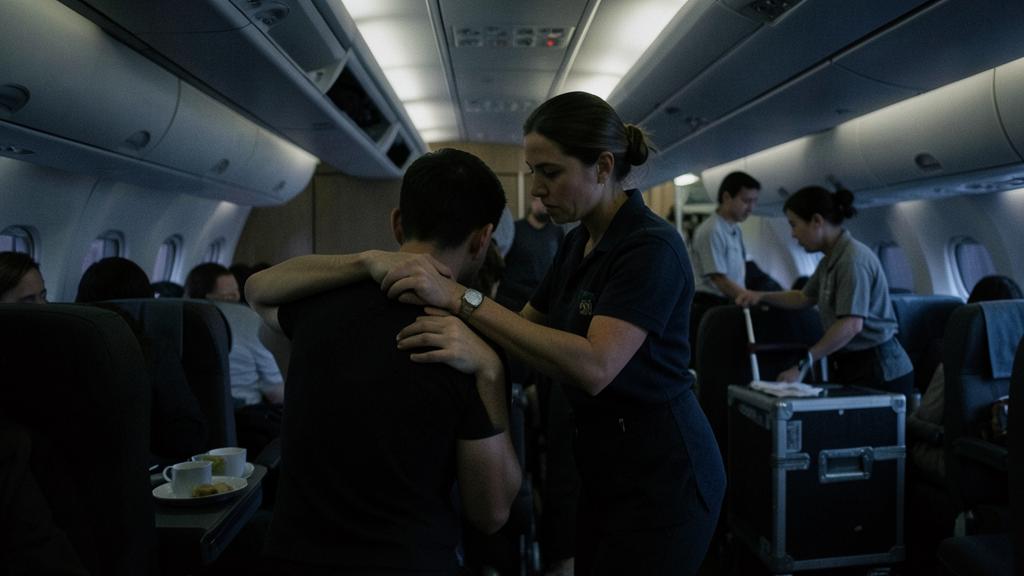
Before service resumes, the cabin needs a deliberate check. Injuries in turbulence are frequently not reported by the person concerned, particularly minor scalds and back or neck strain that becomes apparent later, and passengers travelling alone are among the least likely to volunteer it. A walk-through that asks rather than looks is what finds them.
Finally, the paperwork is not administrative overhead. Turbulence encounters above the threshold set by the applicable reporting rules are notifiable occurrences, and the value of the report is not to the flight that filed it — it is to the route. Reports of intensity, position and level are what populate the forecasts and the automated turbulence picture that give the next crew their warning time, and the honesty of the intensity assessment matters more than its precision. An operator that treats these reports as a chore is degrading the very information supply on which its own anticipatory decisions depend. Crews comparing how different operators structure their action levels and their announcements will find the subject discussed at length in the cabin sections of the FL330 forums.


Leave a Reply
You must be logged in to post a comment.