
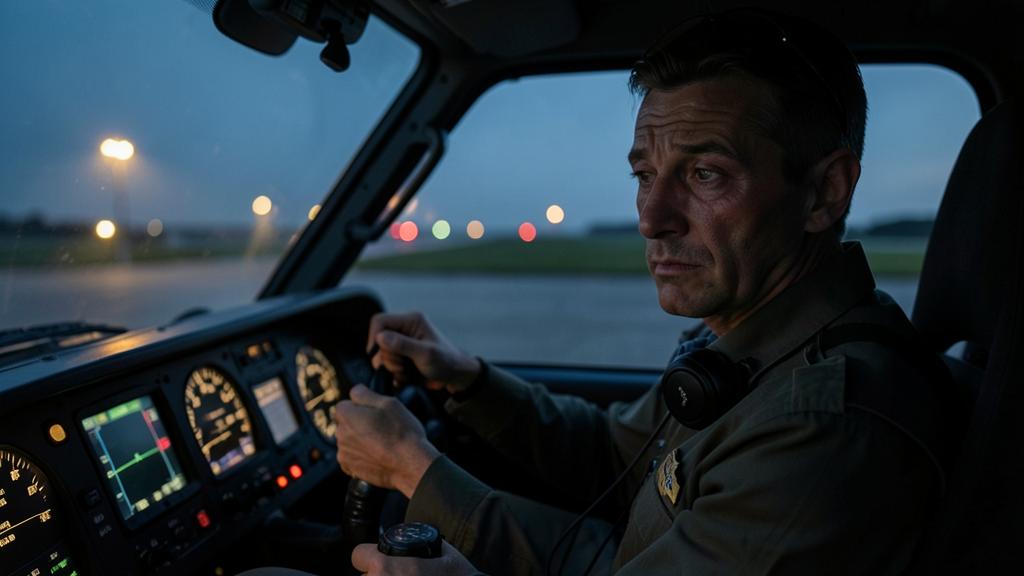
Fourth day of the week, four sectors, report at four in the morning after five hours of sleep, and you feel perfectly capable of going again. That is exactly where the problem lies: the sense of being fit is produced by the very function that fatigue degrades first. Early in a career, this bias is compounded by a second, quieter one — the absence of any point of comparison. Here is what self-assessment actually measures, what it misses, and how to remove yourself from a flight cleanly.
What a self-assessment measures
The scales in use across airline operations — the ones that ask you to rate your sleepiness on seven or nine levels before, during and after duty — are valid instruments. They were built, validated and correlated against objective measures. But they measure a feeling, and a feeling is not a performance.
The mechanism is simple and it is unpleasant. Sleep deprivation strikes the executive functions first: sustained attention, working memory, inhibition of an automatic response, flexibility. But monitoring your own performance — knowing that you have just missed something — belongs to that same group of functions. The same resource performs the task and judges how it was performed. When it declines, both decline together, and the gap between what you are doing and what you think you are doing is perceived by no one on the inside.
The consequence is observable in the laboratory as well as on the line: the subjective rating levels off while performance keeps falling. After prolonged deprivation, a subject rates their state much as they rated it several hours earlier, even though their reaction times have lengthened and their lapses have multiplied. The estimation error does not cancel out with habit: it grows with fatigue.
When you’re tired, your brain can’t judge how tired you are. The more tired you get, the worse this gets. You might feel fine, but your performance is actually dropping.
This does not condemn self-assessment. It sets the terms of its use: it is reliable in the range where you do not need it, and it breaks down in the range where you would like to rely on it. An “I feel fine” at the twelfth hour of wakefulness is not worth what the same “I feel fine” is worth at the third.
Why a newly qualified pilot gets it wrong more often
Rating your own state is a comparative exercise. You do not read off an absolute value: you place the present moment within a personal library of previous states. “I am more worn down than the day before yesterday, less than after last week’s trip.” That library takes years to build, and the one held by a pilot just released to the line has three defects.
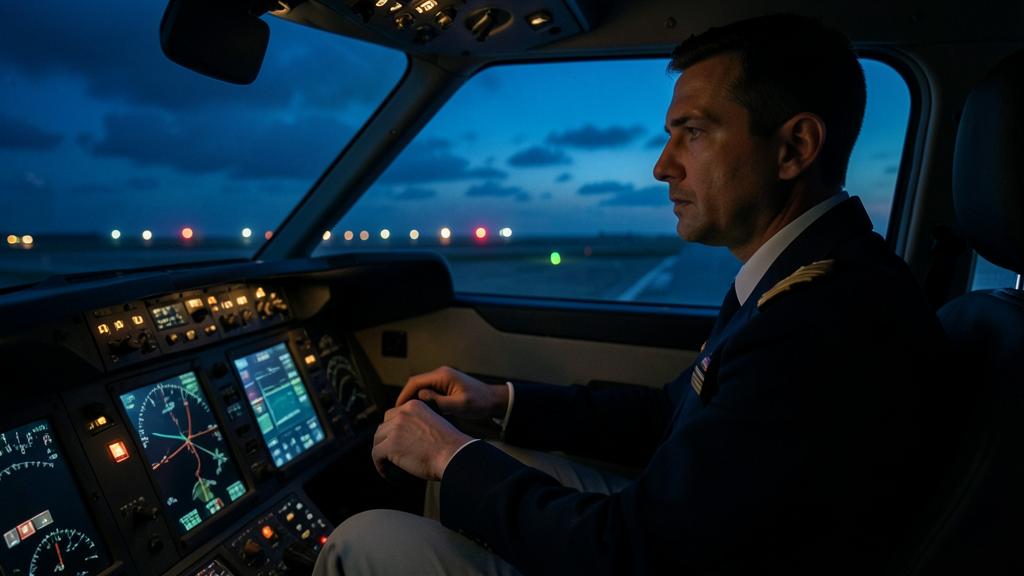
A newly qualified pilot on a short-haul roster with four sectors in a day, reporting at 0400 after five hours of sleep, might feel fine during the first sector but make repeated selection errors by the fourth. Their perception of their state hasn’t changed much, but their performance has degraded significantly.
It was filled under the wrong conditions. Flight school, training, the simulator: situations in which the cognitive effort was at its maximum, but in which sleep remained more or less normal. The beginner has long experience of mental workload and short experience of sleep debt. The two therefore get confused, and in both directions: what in fact stems from three curtailed nights is put down to “I am new, of course it is hard”, and what is only the ordinary workload of a first month on the line is put down to fatigue.
It is masked by arousal. A high workload raises alertness; an approach in bad weather wakes you up. As long as the flight is demanding something, the perceived state holds steady or improves, while physiological fatigue keeps climbing. The rebound arrives exactly when the demand falls away: settled cruise, the end of the last sector, and above all the journey home. The drive home after the last leg of the night is the point in the duty where the gap between the real state and the perceived state is widest — and it is the only one where you are alone.
It is calibrated on the group. Lacking a personal threshold, you adopt the one you see applied around you. If the crew in place carries on without saying anything, you carry on without saying anything. But the group threshold is not a physiological figure: it is an average of habits, often built by people who do have the library.
Three contributions that we call a single fatigue
Speaking of “the” fatigue prevents you from choosing the remedy. There are three, distinct, and they add up.
- Homeostatic pressure builds with the time elapsed since the last sleep. It is monotonic: it only comes down by sleeping. It is what caffeine acts on most directly, by blocking the sleep-onset signal rather than restoring anything — it masks, it does not repay.
- Circadian position modulates. The body keeps its own clock, set to the time zone it is acclimatised to and not to the one the aircraft happens to be in. It carves out a window of low activity in the hours following the middle of the biological night, typically between two and six in the morning. Within that window, the same debt produces markedly more degraded performance. That is why a short duty can cost more than a long duty placed in daytime.
- Cumulative debt shifts the starting point. It builds up over several days of shortened sleep and is not repaid in one night. A day off spent recovering from a time-zone shift is not a day off; it is the partial repayment of an overdraft.
To this is added sleep inertia, which is not fatigue but resembles it: on waking from deep sleep, performance remains degraded for a period in the order of fifteen to thirty minutes, longer if waking occurs at the circadian trough. Two practical consequences. A nap in the cruise is placed and ended so that the inertia has dissipated before descent preparation. And a self-assessment made with your eyes barely open is worth nothing, in either direction.
Acute, cumulative: two regimes, two courses of action
The distinction is anything but academic. The two regimes are not detected by the same signs, are not treated by the same means and are not declared at the same moment.
| Criterion | Acute fatigue | Cumulative fatigue |
|---|---|---|
| Origin | prolonged wakefulness, an isolated short night, a single long duty | deficit accumulated over several days or several trips |
| Kinetics | rapid rise, within the duty | slow rise, from one duty to the next |
| Dominant sign | outright sleepiness, yawning, microsleeps | irritability, flat mood, slow decision-making, repeated selection errors |
| Effect of one night of sleep | clears most of it | repays only a fraction of it |
| Effect of caffeine | masks effectively for a few hours | weak effect, and worsens the debt if it delays sleep onset |
| Who detects it first | the individual, late | those around them, before the individual |
| Course of action | controlled rest, redistribution of tasks, reduction of workload | declaration before the duty, adjustment of the roster, written report |
The trap. The day off that is not one. A duty that ends at four in the morning is followed by a rest period whose first half is spent sleeping in daylight, in sleep that is shorter and more fragmented. The roster shows a free day; the physiology records a night half repaid. The newly qualified pilot reads the roster, arrives at the next duty believing they are starting from zero, and has no earlier state against which to compare what they feel.
The balance between the two regimes depends on the type of operation, and a newly qualified pilot sometimes moves from one posting to another without revising their reference points. On a short-haul, multi-sector roster, the dominant contribution is cumulative: repeated early reports, wake-ups placed before the usual hour, nights shortened at their start as much as at their end, and a debt that builds across the week without any single day looking hard in isolation. On a long-haul roster, it is the circadian component that dominates: few sectors, but an internal clock still set to a time zone you have left, duties that fall anywhere in the biological night, and in-flight rest whose quality varies completely with the position of the bunk, the noise and the moment it is taken. So the signs to watch for are not the same. On short sectors, the selection error and the mood that flattens out at the end of a block of days; on long-haul, the inertia on coming out of the bunk and the trough of the last hour of flight, the one where the workload rises again while the biological night is still running.
Watch the behaviour, not the feeling
If introspection breaks down, you need cues that do not pass through it. They exist, they are observable, and they appear earlier than the feeling.
On the task side: reading the same line of a checklist twice, selecting one value instead of another — an altitude in place of a heading, one flap setting for another —, dropping a readback, fixating on one parameter while the rest drifts, accepting without discussion a late runway change that would normally have prompted a question. That last point is the most telling: fatigue does not remove the actions, it removes the challenge. A tired crew is a compliant crew.
On the person side: monosyllabic answers, humour that disappears, prolonged silence for no reason, a lag between the moment information is given and the moment it is processed.
And the sign you cannot attribute to yourself: the microsleep. A few seconds of sleep intrusion, eyelids open or closed, with no memory of it. You do not remember what you never encoded; the person concerned therefore has nothing to declare. Only the other seat sees it.
Hence the only useful question on the flight deck, which is not “are you all right?”. That one calls for an automatic answer, produced without consulting anything. A question that tests requires a reconstruction: which alternate did we select, how much fuel on arrival, what is the next altitude constraint and why. If the answer is slow, if it comes back wrong, if it is looked up on the screens when it should be in memory, you have a measurement — not an opinion, and not a judgement about the person.
The right habit. Test yourself with a task, never with an impression. Before leaving home, reconstruct from memory the day’s routing, the two alternates and the order of magnitude of the planned fuel. If putting it together takes an unusual effort, or if it comes back wrong, your self-assessment has just been contradicted by a measurement — and it is the measurement that wins.
Removing yourself from a flight: a mechanism, not a favour
The medical rule applicable to flight crew does not require certainty: the holder of a licence does not exercise its privileges from the moment they know or suspect that their condition does not allow them to do so safely. Doubt is enough to ground the withdrawal, and it is part of the system — it is not an admission of weakness, it is the clause that makes the rest coherent. Fatigue falls within that framework in the same way as an illness or a course of medication.
The moment matters more than the wording. A call made before the start of the duty period leaves the operator the option of drawing on standby cover; a withdrawal announced at the briefing costs the flight, or delays it enough to put connections at risk. That is never a reason to go anyway, but it is a reason to assess early, once sleep inertia has dissipated, and not to put the decision off until the car park at base.
In form, stay factual and do not practise medicine. You state a condition and what supports it: “I am not fit to operate this duty”, followed, if you are asked, by the actual hours of sleep over the last three days and the wake-up times. No diagnosis, no apology, no commitment as to when you will be back.
Finally, distinguish two things that are often confused. Declaring yourself temporarily unfit removes you from the flight; the fatigue report feeds the operator’s analysis. They do not replace one another, and many manuals require both. The first protects that flight, the second protects the ones that follow — including those of another crew on the same sequence.
What the system expects of you, and why the beginner counts double
Flight and duty time limitations set a framework built on populations, with margins. A roster can be perfectly compliant and nonetheless fatiguing for the individual who flies it: that residue is explicitly what the fatigue risk management system is meant to handle. That system works as a loop — reporting, analysis, modification of the roster or of internal rules, verification of the effect. Without reporting, the loop is open and corrects nothing.
A newly qualified pilot finds themselves, without having chosen it, exactly where the data is most useful: standby, short-notice callouts, multiple sectors, minimum layovers, sequences that seniority does not allow them to avoid. Those are precisely the ones the analysis needs to see. Two years of silence, driven by the fear of drawing attention during the period when you believe you are being judged, deprive the system of its most informative observations.
A useful report does not write “I was tired”. It gives dated facts: wake-up time, actual sleep duration — and not the time you went to bed —, number of awakenings, the position of the duty relative to the biological night, operational events that lengthened the day, and, where applicable, the behavioural cues observed on the flight deck. One more line, one more possible analysis.
Three things to open in your own documentation
Do it now, not on the day you need it at four in the morning.
First, the fatigue withdrawal procedure: who do you call, on what number, within what time, on what grounds, and who records the declaration. The difference between a clean withdrawal and a badly handled one rarely lies in the substance; it lies in a call made to the wrong person.
Next, the operator’s just culture policy. It is written down. Read what it protects and what it does not protect — the line generally sits around intentional misconduct and deliberate risk-taking, not around error or good-faith reporting — and read who arbitrates it.
Finally, the internal provisions on controlled rest on the flight deck: permitted or not, in which phases, maximum duration, prior briefing, method of waking, delay before resuming duties. Many newly qualified pilots do not know that the practice is regulated and deprive themselves of an effective tool, simply for not having read the page. The courses preparing for the first line assignment gathered at formations.fl330.com cover these three readings; failing that, they are done alone, and in a hurry.
One area remains that nothing measures. The calculation of duty times ignores the commute between home and base, the house move under way, the child who does not sleep through the night, the night before a line check — that last one, early in a career, is a very real debt factor and completely invisible in a roster. No one but you holds that data. That, and not modesty, is why self-assessment cannot be done away with: it is poor, but it is the only sensor placed in the right spot. It must therefore be contradicted by measurements, not replaced by rules.
This article sets out mechanisms; it is not a substitute for anything. The applicable text, the approved limitations and the operator’s documentation prevail in all circumstances over what is written here, and it is the current edition of the operations manual that governs.
Questions fréquentes
Can declaring myself temporarily unfit for fatigue harm me during my probationary period?
The just culture policy written into the operations manual covers this point precisely: it protects good-faith withdrawal and reporting, and reserves sanction for intentional misconduct or deliberate risk-taking. What genuinely exposes you is a flight operated in a condition you knew was degraded. Reading that policy before you need it and keeping a factual record of your sleep puts your file on the right side.
When should you assess your condition before a duty?
After sleep inertia has dissipated, which is in the order of twenty to thirty minutes after waking, and before leaving home. Any earlier, and the inertia distorts the reading in both directions. Any later, and withdrawal no longer costs a replacement but a delayed or cancelled flight, which weighs on the decision at the wrong moment.
Is controlled rest on the flight deck permitted?
It is regulated, not forbidden in principle, and the conditions are set out in each operator’s operations manual: prior briefing, maximum duration, method of waking, delay before resuming duties, one pilot at a time and the other seat manned. The duration allowed is short, precisely to avoid entering deep sleep and paying an inertia penalty at the moment of preparing the descent.
How do you put the question to the other pilot without putting their back up?
Do not ask “are you all right”: the answer is automatic and consults nothing. Ask for information that requires a reconstruction, such as the selected alternate, the planned fuel on arrival or the next altitude constraint. The delay and the accuracy of the answer constitute a measurement, and the information is obtained without having had to pass judgement on the person.
Does caffeine make it possible to get through a last sector?
It masks part of the homeostatic pressure for a few hours, with little effect on the circadian component and none at all on accumulated debt. It buys time, it repays nothing. Taken too late, it delays sleep onset in the following rest period and worsens the debt for the next duty, which makes it a poor tool at the end of a trip.
Can a roster that complies with the limitations still be fatiguing?
Yes, and the regulatory framework acknowledges it explicitly: the limitations are calculated on populations, with margins, and not on a given individual. That is the whole purpose of the fatigue risk management system, which handles that residue through reporting, analysis and then modification of the roster or of internal rules. Without crew reports, that system has nothing to analyse.


Leave a Reply
You must be logged in to post a comment.