
A trainee flies two clean recoveries in an upset attitude session, is marked “achieved”, next session. A few months later, on the line, an autopilot disconnect in turbulence leaves him with an aircraft well nose-high, and his first instinct is to pull. Nothing in the motion cab had ever made him pay for that input: not the weight on his shoulders, not his narrowing field of vision, not the physical conviction that the wing has a limit. The simulator remains the most powerful tool in modern training, but its boundaries fall exactly where loss of control in flight is decided.
A model is only worth as much as the region in which it was measured
A full flight simulator is not an aircraft: it is a data set and a set of equations whose conformity with real behaviour has been demonstrated by comparison with flight test records. That demonstration covers specific test points, within a specific envelope — that of normal flight, extended by a reasonable margin. Certification testing explores the approach to the stall and its identification; it does not seek to document a sustained post-stall condition, still less an autorotation, and a simulation database therefore cannot be derived from it for that part of the envelope.
Beyond the stall angle of attack, in marked sideslip, at high bank combined with a degraded attitude, the model no longer reproduces: it extends. It produces a plausible, continuous — and unverifiable — response. That is precisely the region in which an upset takes place.
The specifications applicable to training devices have evolved on this point. For a device to be qualified for full stall training, they require validation of the model beyond the stall angle of attack — most often based on wind tunnel data supplemented by computation — and a means of informing the instructor, at the instructor station, that the simulation has left the demonstrated envelope. That indicator is not a formality: it tells the instructor that what the trainee feels from that second onwards is backed by very little.
Simulators use data from normal flight to create their models. But when an aircraft is in an extreme upset, like a deep stall, the simulator’s predictions are just educated guesses. It can’t show you exactly what will happen in real life.
In a Boeing 737, if the angle of attack exceeds 25 degrees (the usual stall limit), the simulator’s response is based on wind tunnel tests, not real flight data. If the aircraft then enters a spin, the simulator’s behavior is an extrapolation, not a precise replication of reality.
The training consequence is clear. The entry into the stall — the buffet, the degradation of control effectiveness, the need to unload — is faithful and deserves to be trained without reservation. What follows — the magnitude of the nose drop, the tendency to roll off, the asymmetry — belongs to reconstruction. What is trained is a recognition and a first action, not a complete choreography.
The platform can only lie for a few seconds
The cab rests on six actuators. The travel of those actuators is bounded by mechanics, whereas the manoeuvre to be reproduced moves the aircraft through hundreds of metres. The motion cueing filter resolves that conflict in only one way: it renders the beginning of the movement, the initial acceleration, then slowly returns the platform to neutral at a rate below the perception threshold. You feel the onset, never the sustained part.
For longitudinal acceleration, the platform does better than give up: it tilts the cab backwards and lets gravity press the pilot into his seat. In other words, it deliberately exploits the somatogravic illusion, the very one that, in real flight, creates the sensation of pitching up during a go-around. The tool uses as a resource a mechanism it is supposed to teach pilots to defeat.
What remains structurally out of reach can be put in one sentence: a load factor greater than unity sustained for several seconds, and symmetrically a lasting unloading. Yet the pull-out from a developed nose-low attitude is precisely a matter of load factor held over time, between two limits — buffet on one side, the structural limit on the other. In the motion cab that corridor does not exist. The input costs nothing, neither to the pilot nor to the airframe, and it is that absence of cost which is learned alongside the technique.
Surprise can be trained, fear cannot be simulated
Two things that everyday language conflates must be separated. Startle is a brief, involuntary reflex triggered by a sudden stimulus; it is very short and is paid for in muscular stiffening and spurious control inputs. Surprise is cognitive: it is the gap between what the aircraft is doing and what the mental model expected, and it is paid for in time, the time needed to rebuild a usable representation.
The simulator can produce the second, and it does so well. An unannounced scenario, a briefing that does not detail the failure, a malfunction introduced during an already busy phase: all of this creates a genuine mental model gap, and training to close it is useful. What the device does not produce is the involvement of the body. The trainee knows that the session is on the programme, that the ground is a texture and that the image can be frozen. Expectation bias is not a weakness of character, it is a property of the medium.
This weighs first of all on the weak link in the chain, which is not the recovery but the recognition. An upset does not announce itself; it develops, often slowly, while the crew is looking elsewhere. The interval between the first available indication and the first correct action is what decides the outcome, and it is also the only quantity the simulator measures without distortion.
The trap. A successful recovery in the motion cab validates a sequence of actions, not an ability to act under physical constraint. A trainee who pushed at the right moment in an environment where pushing costs nothing has not demonstrated that he would push with his vestibular system protesting and his body weight doubled. Marking “achieved” on that basis alone amounts to validating the easy part of the problem.
What basic aerobatics really leaves behind
An upset attitude course on a light aircraft does not teach how to recover a transport aircraft, and that must be said to the trainee from the briefing onwards. It installs something else, and it is worth being precise about what.
First, a calibration: the relationship between stick force, control displacement and the load factor obtained becomes a sensation rather than a notion. Then a direct reading of angle of attack, through buffet, the softening of the controls and the change in noise before the needle moves. Then disorientation experienced and then resolved: recovering from an incipient autorotation, finding a reliable reference again, believing the instrument against one’s inner ear. Finally the mechanics of the body — breathing, the eyes going out to find a reference, the stiffening of the startled pilot, which can be worked on like any other skill.
These acquisitions are not techniques, they are thresholds. A pilot whose horizon has already tipped over completely, and who got out of it through a sequence of actions rather than a reaction, does not approach the next situation like someone for whom it is a first.
Negative transfer works both ways
The symmetrical danger consists in bringing the aerobatic input back into a transport flight deck. A light aerobatic aircraft tolerates high roll rates, firm use of the rudder to coordinate or to induce a departure, and low inertia that forgives excess. A swept-wing transport aircraft tolerates none of that: rapid rudder reversals can load the fin beyond what certification guarantees, yaw and roll inertia delays the response and invites overcontrol, and thrust mounted beneath the wings produces a pitching moment with every change of power setting.
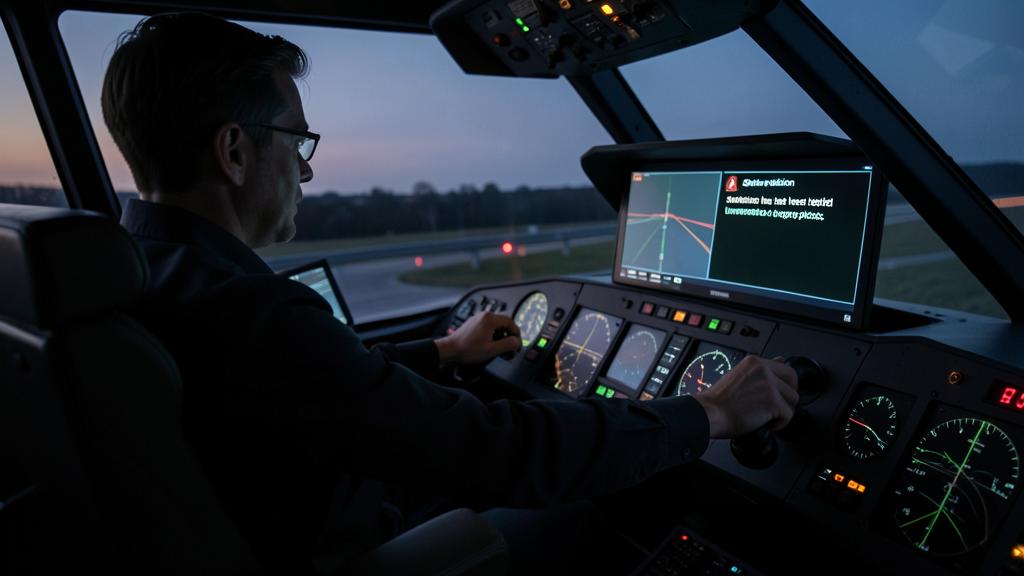
- In a light aircraft, a pilot might pull back hard to recover from a stall, but in a transport aircraft, this could overload the airframe.
- A light aircraft can handle rapid rudder inputs, but a transport aircraft’s fin might not be able to withstand the stress.
- Thrust changes in a transport aircraft create a pitching moment, which can complicate recovery from an upset.
Negative transfer from the simulator is more discreet, and just as real: there you learn that a pull-out is free and that the worst incident ends with the image frozen. The link between the two media is therefore not at the level of the individual input but of the sequence, which does transfer in full.
Recognise and announce, disconnect the automatics, then apply the order specific to the case. Nose high: reduce angle of attack by pushing, bank if necessary — the training aids retain a moderate bank angle, of the order of sixty degrees at most — to orient the lift vector and bring the nose back down, and manage thrust accordingly. Nose low: reduce thrust, roll the wings level before any pull-out, then recover by metering the load factor between buffet and the structural limit. The order is not decorative: each of its steps removes one cause from the problem before the next one applies.
| Item to be acquired | Full flight simulator | Light training aircraft |
|---|---|---|
| Sustained load factor | Not reproduced beyond a few seconds | Fully reproduced, in positive g as in unloading |
| Angle of attack cues: buffet, softening controls | Faithful up to the entry into the stall | Faithful, including noise and vibration |
| Behaviour beyond the stall angle of attack | Extrapolated from data not obtained in flight | Real, on an airframe certified for the manoeuvre |
| Spatial disorientation | Partial, and sometimes created by the motion cueing itself | Complete, including its physiological effects |
| Perceived consequence | None: the image can be frozen at any moment | Real, and that is precisely the object of the course |
| High altitude and compressibility | The only possible medium | Outside its envelope |
| Automatics and crew coordination | The reference medium | Not applicable |
What only the simulator can give: high altitude
What precedes might suggest that the aircraft wins. That is false for an entire part of the subject. At high altitude the gap narrows between the lower limit, linked to the stall, and the upper limit, linked to compressibility; the thrust available to regain energy is low there and roll and yaw damping is softer, so overcontrol comes more easily. Recovery, for its part, costs thousands of feet, which only makes sense if you have them.
No training aircraft reproduces this, and no operator will try it with an airliner. The simulator is the only place where one can experience a stall at cruise level, observe that adding thrust settles nothing and that the first useful action is to unload. It is also the only place where the collective part is trained: who flies, who calls, at what moment the aircraft is handed back to the automatics.
| Situation | What the primary medium lacks | The complement that answers it |
|---|---|---|
| Strongly nose-high attitude, decreasing energy | The physical cost of the pull-out | Aircraft session, real load factor |
| Developed nose-low attitude at high bank | The unloading and the real control forces | Aircraft session, then the sequence in the simulator |
| Incipient autorotation | Behaviour outside the validated data | Aircraft certified for the manoeuvre |
| Stall at cruise level | No training aircraft can reach it | Simulator, exclusively |
| Disorientation in instrument flight at night | The engagement of the vestibular system | Aircraft session, maintained in the simulator |
The right reflex. Have the recognition timed rather than the recovery. Ask the instructor to note the moment of the first available indication and that of the first correct action, then to debrief that interval before any discussion of technique. It is the only quantity the medium measures without distortion, and it is the one that decides the outcome in flight.
Build a pathway rather than tick a box
Three checks are made in one’s own documentation rather than in an article. The first: for which manoeuvres is the device used qualified, and how far is its model demonstrated? A device qualified for full stall and a device qualified for approach to stall do not teach the same thing, and the difference is not visible from the seat. The second: what the operations manual says about the load factor permissible in an exceptional manoeuvre and about the use of the rudder. The third: what the recurrent training programme actually provides for, and how often.
One grey area remains that no one has closed: the shelf life of what has been acquired. A UPRT course on an aircraft, taken once before the first type rating, appears to produce a short-term effect; what remains of it after several years of automated cruise is poorly established, and not all recurrent programmes include a refresher of that nature. For anyone preparing a rating or changing operator, the question to ask at the technical interview is therefore not “do you provide upset training” but “how do you maintain what has been acquired, and on what medium”. The answer says a great deal about the safety culture of the house, and it usefully guides the choice of a complementary training pathway.
The applicable regulation, the qualification specifications of the device used and the operator’s approved documentation prevail in all circumstances over the considerations above; in the event of any discrepancy, the operations manual is authoritative.
Questions fréquentes
Does a simulator qualified for full stall remove the need for a course on an aircraft?
No, because the two media do not fill the same gap. A device qualified for full stall provides a model validated beyond the stall angle of attack and makes it possible to work on recognition, the first action and crew coordination. It still does not deliver a sustained load factor or physiological engagement, which remain the specific domain of the session on an aircraft.
Why can a motion cab not reproduce a sustained load factor?
Because the travel of its actuators is bounded, out of all proportion to the real displacement the manoeuvre demands. The motion cueing filter renders the initial acceleration, the one best detected by the inner ear, then returns the platform to neutral at a rate below the perception threshold. Only a means capable of creating a real and lasting acceleration, that is to say an aircraft or a centrifuge, produces a sustained load factor.
Do basic aerobatics teach how to recover a transport aircraft?
They do not teach the individual input, they install thresholds. The pilot acquires the correspondence between stick force and load factor, the direct reading of angle of attack and the ability to act while disoriented. The aerobatic input itself, in particular the firm use of the rudder in roll, does not carry over to a swept-wing aircraft and must be explicitly defused at the briefing.
Which quantity should be debriefed as a priority after an upset attitude session?
The interval between the first available indication and the first correct action. That is the truly weak link in the chain, and it is the only quantity the simulator measures without distortion, since it depends neither on the fidelity of the aerodynamic model nor on the motion cueing. The quality of the recovery technique is discussed afterwards.
Why is a high altitude stall trained only in the simulator?
Because the margin between the lower limit linked to the stall and the upper limit linked to compressibility narrows there, because the thrust available to regain energy is low and because recovery costs thousands of feet. No training aircraft can reach those levels, and no operator will attempt it with an airliner in service.
What should be checked in one’s own documentation before preparing for a rating?
The manoeuvres for which the training device is qualified and the extent of its validated model, what the operations manual permits regarding exceptional load factor and use of the rudder, and the actual content of the recurrent training programme. These three points determine what will effectively be trained, beyond what the programme announces.


Leave a Reply
You must be logged in to post a comment.