
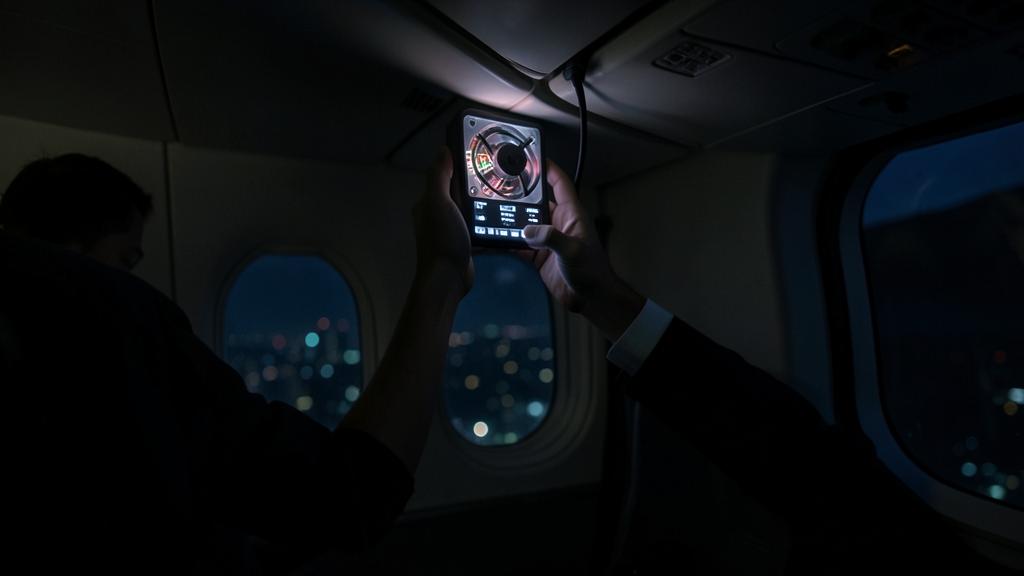
The pattern repeats from one fleet to another: a satellite receiver loses tracking in cruise, normal operation returns in descent, a ground troubleshooting finds no fault, sometimes a unit is replaced without the symptom disappearing on the next flight. What this kind of case file is missing is not avionics: it is a link budget, and it points to a transmitter located some twenty metres from the antenna rather than twenty thousand kilometres away.
A hundred and twenty decibels ahead: why the cabin beats the constellation
Geometry It all starts with a comparison of distances. The satellite transmits from roughly twenty thousand kilometres away, a cabin source sits some twenty metres from the roof antenna: the ratio of distances is on the order of a million, that of received powers on the order of a thousand billion — a hundred and twenty decibels. For equal radiated power, the onboard source therefore overwhelms the satellite by about a hundred and twenty decibels. No technical feat is involved: it is geometry.
Signal The rest of the calculation is quickly done. A navigation satellite radiates, in order of magnitude, a few hundred watts, and its signal reaches the antenna, in order of magnitude, at around minus one hundred and thirty decibels relative to a milliwatt — below the thermal noise floor of the receiving chain, from which it is extracted only through the correlation gain of the spreading code. At around twenty metres, a fraction of a nanowatt is therefore enough to match the useful signal, and a few microwatts to bury it by several tens of decibels: ordinary spurious radiation does the job as soon as it falls within the band.
Interference From this assault, the receiver shows only one quantity: the carrier-power-to-noise-density ratio, displayed satellite by satellite. Interference does not remove carrier power, it raises the noise floor, so it lowers this ratio by the same amount for every satellite in view, across all constellations combined. The abruptness of the transition matters just as much: as long as the correlation margin absorbs the added noise, nothing shows up; a few more decibels and tracking drops out all at once, on several satellites simultaneously. There is almost no intermediate range in which there would be time to wonder about it.
A device in the cabin can overwhelm the weak satellite signal because it’s much closer to the antenna. Even a tiny amount of interference can drown out the satellite signal, causing the receiver to lose tracking suddenly.
On a Boeing 787 flying at 35,000 feet, a passenger’s mobile-signal repeater in their carry-on bag emits noise at 1176 MHz. The repeater’s signal, just a few microwatts, is strong enough to raise the noise floor in the receiver, causing it to lose lock on multiple satellites simultaneously during cruise.
What radiates on board
Devices that transmit because that is their function
Repeat The textbook case is not the phone, it is the mobile-signal repeater, those boxes sold to the public to improve coverage. The principle is an amplifier between an antenna facing the network and an antenna facing the user. When the two end up a few centimetres apart, which is the rule as soon as the unit travels in a bag, the loop closes: the device self-oscillates, its gain hits the stop, it radiates wideband noise at full power. What was carried on board was not an amplifier, it was a jammer that got built. Next comes the outright jammer, sold illegally to escape a company vehicle’s tracking, the size of an ignition key and working precisely in the navigation band: it triggers nothing at the security checkpoint and its owner has no reason to declare it.
Radiation nobody wanted
Harmonics Second family, more mundane and therefore more common. A cheap switch-mode power supply, a counterfeit charger, a cable whose shielding has failed, a fast digital bus in a housing that no longer provides electrical continuity: all of these produce harmonic lines well up into high frequencies, and it only takes one to fall within the useful band. The level depends on the load, hence on what the device is doing: the emission appears when the battery is charging, when the processor is working, when the cable is bent a certain way. These sources escape airplane mode by construction, which cuts off the declared transmitters of a compliant device but changes nothing for the interference from a charger, nor from a modified box, nor from a power supply that is dying.
The non-linear junction, a source without a transmitter
Corrosion Third mechanism, with no faulty device involved. Two perfectly clean onboard transmitters feed a structure where a junction has become non-linear: a corroded bonding strap, a connector under strain, a fastener whose contact is working loose. It mixes the frequencies and produces lines where nobody is transmitting, some of which fall within the navigation band. The phenomenon depends on the mechanical condition of the contact, hence on vibration, temperature and humidity: it is the most fleeting source of all, and it follows a flight phase rather than a passenger.
The navigation repeater, which does not jam but deceives
Repeater A last case, set apart: the navigation-signal repeater, used to bring the constellation into a hangar in order to test some avionics there. It degrades nothing, it re-transmits the real signals with the delay introduced by its cable and its amplification. A receiver that picks them up computes the position of the repeater’s receiving antenna, plus a range bias corresponding to that delay. The carrier-to-noise ratio is excellent, no flag is raised, and the position is wrong. This mechanism is one of deception, not denial.
The trap of the repeater at the back of the ramp. A leak out of the hangar is enough to cover neighbouring parking stands. The receiver of a stationary aircraft then takes on a stable and consistent position, wrong by the distance separating it from the hangar, and this position can be used to initialise an inertial reference unit: one departs with an error entered in good faith, which nothing flags until the constellation is reacquired. The check that protects against this is comparing the displayed position with the actual stand, not verifying that the receiver has converged.
How the energy reaches the receiver
Coupling Two paths. The front door: the energy enters through the antenna, within the service band, the way a useful signal would. The back door: it passes through the openings in the airframe and through the wiring, reaches the receiver’s housing or its coaxial cable without going through the antenna, and pays no attention to the radiation pattern — a cable run that skirts the cabin floor for several metres is an unintentional antenna of decent quality.
Loss The quantity that engineering deals with here is coupling loss: the attenuation measured, on a real aircraft, between a source placed at a given point in the cabin and the antenna connector of the victim system. It is surveyed window by window, varies by several tens of decibels depending on location, and worsens near openings as well as wherever the antenna cable runs closest to the cabin volume. Hence a puzzling consequence: the same device is harmless in one row and decisive in another, and moving the passenger changes the received level more than a reduction in power would.
Why the symptom eludes attribution
Duty The source has a duty cycle: an oscillating repeater only radiates at full strength when driven, a charger only when it is charging, a computer only when it is computing — the emission comes in bursts, and the receiver only drops out if the burst lasts longer than its time constants. The source moves, too: it changes rows with its owner, goes into an overhead bin, moves from a bag to a seat-back pocket, and the coupling varies by several tens of decibels without anything having been switched on or off.
Non-linear The victim, for its part, is strongly non-linear: between nothing and everything there are only a few decibels, so much so that the same device in the same location gives a clear symptom one day and none the next, depending on the satellite geometry that decides what margin is available. And the symptom outlives its cause, because reacquisition takes time: the correlation between the source switching off and the return to normal is offset, which is enough to disqualify the right hypothesis in the eyes of anyone testing without waiting.
Correlation Finally, the apparent correlation misleads. The symptom appears in cruise and stops in descent because that is the rhythm of cabin activity, not because altitude is at fault; two receivers with different antennas and different cable runs degrade at different moments, which looks like a fault rather than a shared environment; and everything stops when the cabin empties out, hence before maintenance arrives. Add to this a hardware limitation: no display on any receiver is meant to measure interference. Only its effect on a victim system is ever observed, and the cause has to be traced back without ever being seen.
Separating the onboard source from the rest
Hypotheses Three hypotheses compete for the same symptom, and a few well-chosen observations separate them almost every time. The most discriminating is the effect of a heading change: an external source enters and leaves the antenna’s field of view as the aircraft turns or as the fuselage masks it, an onboard source does not.
| Observation | External ground source | Uninstalled cabin source | Equipment fault |
|---|---|---|---|
| Geographic correlation | Strong, identifiable area | None | None |
| Effect of a heading change | Marked: enters and leaves visibility | None: the source turns with the aircraft | None |
| Repetition | Same route, different aircraft | Same aircraft, different routes | Same aircraft, in flight and on the ground alike |
| Shape on the carrier-to-noise ratio | Uniform depression | Uniform depression, in bursts | Frozen or inconsistent values, one channel |
| The two receivers | Near-simultaneous degradation | Offset according to antenna and wiring | Only one affected |
| Other L-band services | Affected if the source is powerful | Affected if it is close and wideband | Unaffected |
| End of the symptom | On leaving the area | On disembarkation | Never without intervention |
The immediate neighbourhood: who drops out, and in what order
Vulnerability The L band does not belong to satellite navigation: it is shared with services whose received levels are on entirely different scales. A wideband onboard radiator assaults all of them but does not knock them all out at the same time, and this order is a diagnostic tool — the longer the list of degraded systems, the more powerful or closer the source.
| Approximate band | Service | Useful signal | Vulnerability |
|---|---|---|---|
| 960 to 1215 MHz | Distance measuring, tactical navigation | High-power pulses | Low: drops out last, but the lock-on rate falls |
| 1030 and 1090 MHz | Secondary interrogation, reply, position broadcast | High-power pulses | Low; a drop in reply rate signals a nearby source |
| Around 1176 MHz | Second civil navigation frequency | Very weak, band shared with pulsed emitters | High, worsened by pulse blanking |
| 1525 to 1560 MHz | Satellite downlink | Weak, from a geostationary satellite | High |
| 1575 and 1600 MHz | Main constellation frequencies | The weakest in the band | Maximum |
| 1610 to 1660 MHz | Low orbit and uplink | High-power onboard emission | More a source than a victim |
Pulses Two lines deserve a word. The second civil frequency shares its band with pulsed systems; receivers respond to this by blanking their input during each strong pulse, at the cost of a sensitivity loss proportional to the cumulative blanking time — an onboard source that lengthens this time degrades reception without emitting anything within the useful signal’s narrow band. As for the satellite uplink, it transmits from the roof of the aircraft, at high power, a few tens of megahertz above the main navigation frequency: separation relies on the installation’s filtering, and any modification affecting these antennas, their cables or their bonding reopens the question.
What the crew can do, in order
- Navigate Fly and navigate on what does not depend on the satellite: attitudes, heading, barometric altitude, ground-based radio aids. Diagnosis comes afterward.
- Time Note the exact time of the first message in coordinated universal time: without it, no correlation will be possible.
- Shape Read the shape of the degradation on the signal-level page, if the type gives access to it, and check whether the second receiver follows, and with what offset.
- Heading Observe the effect of a heading change already planned by the navigation: no effect points toward the inside of the aircraft.
- Shutdown Have the cabin crew note what is happening at that moment — devices charging, unusual boxes, a passenger who has just changed seat — then request a complete shutdown, not airplane mode, in a defined zone, before allowing for the reacquisition delay.
- Announce Announce the inability to maintain the required navigation performance if that threshold is reached, forgo whatever depends on it, and write up the report as a documented suspected interference rather than as a loss of position.
The right reflex: read the shape, not the number. Interference raises the noise floor, so it lowers the carrier-to-noise ratio by the same amount for every satellite, including those at the zenith, and on both constellations at once. Unfavourable geometry, fuselage masking or a degraded antenna do the opposite: they make satellites disappear one by one, starting with the lowest on the horizon. The distinction is made at a glance, without instruments, and decides what comes next — looking for a source, or looking for a fault.
The trap: airplane mode mistaken for proof, the box mistaken for the cause. An announcement is made in the cabin that everything must go into airplane mode, it is obtained, the symptom persists, and the conclusion drawn is that the source is not on board — when airplane mode touches neither the interference from a charger nor a non-compliant box. The report becomes a loss of position with no cause, troubleshooting finds nothing, a receiver gets replaced on the second occurrence. The symptom comes back, the aircraft’s record shows an unjustified component change, and the history that would have allowed the correlation has been scrambled by the modification itself.
On the ground: what troubleshooting can and cannot do
Structural The handicap is structural: the source has gotten off with the passengers, and a check at the gate, cabin empty, finds nothing and proves nothing. Start with the recordings, then: some installations keep a history of carrier-to-noise ratios and the automatic gain control state, the closest thing to an interference measurement one will have. Then multi-flight correlation, which settles the question better than any test — tied to the aircraft regardless of route, the symptom points inside; tied to a route regardless of aircraft, outside; tied to a parking stand, a repeater or a ground installation.
Measurement The measurement comes only after that: a cabin walk-through with a spectrum analyser and a directional antenna in the useful band, aircraft powered up, which means reproducing the configuration and therefore knowing what was running. Then examination of the installation: the antenna connector and cable, whose degradation emits nothing but increases susceptibility; bonding continuity and the condition of straps around transmitting antennas, the only ground for mixing products; review of the last onboard modification, a connectivity installation added afterward having possibly shifted the balance set by the original certification.
Report The report, finally, is only as good as its precision: time in coordinated universal time, flight phase, shape of the degradation, systems affected, exact wording of the messages, row and nature of the devices observed, moment of return to normal. These elements feed the European occurrence-reporting scheme and, more prosaically, the only statistic that lets anyone notice that the same registration keeps coming back a third time. Exchanges between operators on the FL330 professional forums help recognise a pattern already encountered elsewhere, without standing in for an official channel.
What is left for you to check, and the grey area
Documentation Four points can be read in the operator’s documentation, and they decide the outcome more reliably than knowledge of the mechanism. Does the portable-device policy explicitly name network-boosting boxes and jammers, or does it merely draw a line between transmitting and non-transmitting devices? Does cabin crew have a ready-made phrase for requesting a complete shutdown in a zone, and a form to log it? Is there a procedure for suspected onboard interference, specifying who decides and what gets recorded? Does the troubleshooting manual require ruling out an uninstalled source before authorising the replacement of a receiver?
Grey The grey area, for its part, will not be closed by careful reading. Nothing allows one to establish that a specific device was the source: what is observed is a correlation, never a causation, and the burden of proof falls on no one. The use of an unauthorised jammer or repeater falls under telecommunications regulation, but no security check looks for them and nothing obliges a passenger to know what their bag contains. A real threat, prohibited, undetectable by onboard means: the only countermeasure is methodical observation.
Shift For anyone preparing a type rating or a line check, the shift is clear: the subject has moved out of the equipment chapter and into threat management. The useful question is no longer to define electromagnetic compatibility, but to say which observation separates an onboard source from an external one, and why airplane mode is not proof. This is the angle taken by the FL330 professional development courses.
Mechanisms The mechanisms described here carry no instructional value. The applicable regulatory text, the specifications of the installed equipment and the operator’s approved documentation prevail over this article; in the event of any discrepancy, they are authoritative.
Questions fréquentes
How can interference from an onboard source be distinguished in flight from ground-based jamming?
The most discriminating observation is the effect of a heading change or a sustained bank: an external source enters and leaves the antenna’s field of view as the geometry changes, whereas an onboard source turns with the aircraft and stays unaffected by manoeuvres. Next come repetition and geographic correlation: a symptom tied to a route regardless of aircraft points outside, tied to an aircraft regardless of route points inside. Finally, a degradation that follows the rhythm of cabin device usage and stops on disembarkation points to the cabin.
Is airplane mode enough to rule out a cabin source?
No, and this is the most common reasoning error on this subject. Airplane mode cuts off the declared transmitters of a compliant device, but it touches neither the spurious radiation of a charger or a switch-mode power supply, nor a modified box, nor a device with a failing power supply. An entire cabin in airplane mode with a persisting symptom proves nothing: a complete shutdown must be requested in a defined zone, explicitly naming chargers and network-boosting boxes.
Why does a mobile-signal repeater turn into a jammer?
Its principle is an amplifier inserted between an antenna facing the network and an antenna facing the user. When the two antennas end up a few centimetres apart, which is unavoidable once the unit travels in a bag, the loop closes and the device self-oscillates: its automatic gain hits the stop and it radiates wideband noise at maximum power. Given the geometric advantage of a cabin source over a satellite, a few microwatts are then enough to bury the useful signal.
What is the signature of interference on the receiver's signal levels?
Interference raises the noise floor without touching the carrier: the carrier-power-to-noise-density ratio therefore drops by the same amount for every satellite in view, including those at the zenith, and across all constellations at once. Unfavourable geometry, fuselage masking or a degraded antenna produce the opposite, namely satellites disappearing one by one starting with the lowest on the horizon. Reading the shape of the degradation rather than its value points immediately toward looking for a source or looking for a fault.
Can a navigation-signal repeater falsify a position on the ground?
Yes, and without degrading the quality of the received signal, which makes it a case of deception rather than denial. The repeater re-transmits the real signals with the delay introduced by its cable and its amplification: a receiver that picks them up computes the position of the repeater’s receiving antenna, plus a range bias corresponding to that delay. A leak out of a hangar is enough to reach neighbouring parking stands, and the resulting position, stable and consistent, can be used to initialise an inertial reference unit without any flag being raised.
What should the report contain so that an onboard source can eventually be identified?
The time in coordinated universal time, the flight phase, the shape of the degradation observed on the signal levels, the list of systems affected, the exact wording of the messages, and what the cabin crew noted at that same moment: row, devices charging, unusual boxes. It should also include how and when the return to normal occurred, since reacquisition delays the symptom relative to its cause. These elements feed the European occurrence-reporting scheme and enable multi-flight correlation, the only tool truly effective at deciding between an onboard source, an external source and an equipment fault.


Leave a Reply
You must be logged in to post a comment.