
In the same logbook, two instructor ratings sit side by side: the first earned around a few hundred flight hours, the second after several thousand. A training department reading that logbook does not see two stages of the same career, but two occupations that share a word, a common course, and almost nothing else. Neither the working day, nor the risk assumed, nor the unit of pay, nor the door the rating later opens look alike. The practitioner’s real question is therefore not which of the two is better, but which one he is choosing the day he accepts the role.
The word is shared, what is taught is not
Basic competence is built from scratch. The student arrives without a formed control loop: they cannot yet link an intention to an action, nor read the gap between what they wanted and what the aircraft is actually doing. The instructor works on the physical gesture, on building a mental model, and on that precise moment when the student becomes able to decide with no one beside them — because they will indeed fly alone. The whole pedagogical structure converges toward first solo, that is, toward a competence that can only be demonstrated in the absence of the person who taught it.
At an operator, basic competence is already acquired and is no longer in question. The trainee knows how to fly, often for a long time; what they don’t know is how to operate this particular system, with these particular procedures, within a division of roles where nothing important is ever done alone. Type instruction transposes more than it builds. It installs automatisms conforming to approved documentation, then checks that two people who did not know each other the day before can jointly produce the same behaviour.
The consequence is that the two exercises are not judged on the same scale. One measures autonomy on one side, conformity coupled with cooperation on the other. A flight-school instructor who values above all the literal following of a procedure produces a pilot who becomes fragile the moment the situation departs from the script; a type instructor who values individual initiative produces an out-of-sync crew. The two errors are symmetrical, and they occur mostly in those who move from one branch to the other without changing posture.
Flight schools teach pilots to fly independently, while airlines teach crews to follow procedures and work together. The biggest mistakes happen when instructors don’t adapt their teaching style to the environment.
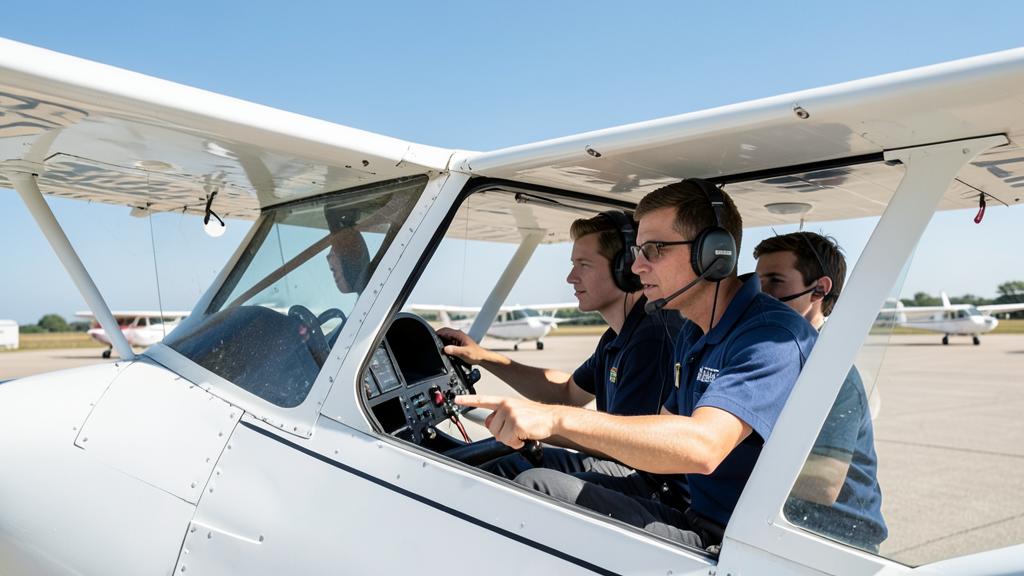
A flight school instructor teaching a student in a Cessna 172 focuses on solo flight readiness, while an airline instructor teaching an Airbus A320 type rating ensures the trainee can follow the airline’s standard operating procedures and work seamlessly with a co-pilot. The flight school instructor might let a student recover from a stall, while the airline instructor would intervene immediately to prevent any deviation from the approved procedure.
The margin for intervention: the real dividing line
What separates the two roles is the distance between an error and its consequence. In an aircraft, the instructor is the last safety net in real time. They must take over before the deviation is unrecoverable, and that point is a physical limit that moves with height, speed, runway length, and weather. Teaching stops where risk begins, and it stops early.
In simulation, that limit disappears. The error can be carried through to its consequence, frozen, replayed, resumed a few seconds earlier. It is the only device where one learns what an uncorrected error actually produces, which is why it is used for the cases nobody wants to see in flight. The price of that freedom is well known: by implication, the trainee also learns that the consequence is reversible. The debrief must restore what the reset erases, or the session ends up teaching carelessness.
This asymmetry carries over into liability. In dual-control instruction, the pilot-in-command function generally rests with the instructor, and it is not shared: they carry responsibility for the aircraft, the people on board and the overflown terrain, including while teaching. Splitting the roles at the controls does not reduce this load in any way, it merely makes it less visible from the right-hand seat. In a simulator session, the exposure is not physical but documentary. What the instructor writes in the training file commits the rest of the trainee’s path and, in the event of an audit, commits the organisation before its supervising authority.
What remains is what simulation cannot render: ground handling, the real consequences of a flare, the inertia felt in the body. Flight training on the type therefore persists in one form or another. When the device reaches the highest qualification level, this training can be pushed onto the first line flights flown under supervision: the load is not removed, it is shifted onto the line instructor, who receives it with passengers on board.
Two economies of time
Flight schools only produce hours when light and weather allow it. The day is broken into short slots — briefing, flight, debrief — and output depends on a variable nobody controls. A morning of low cloud is never made up: it gets pushed onto an already full schedule, in a season that has an end. On top of this irregularity comes everything that never flies yet still takes time: progress logbooks, preparation for first solos, coordination with other instructors, and the upkeep of internal standardisation.
Simulation devices obey the opposite logic. They are a capital asset, costly to qualify and to maintain, whose economics require a high occupancy rate. They ignore cloud base, night and season. Slots are booked far ahead, often months in advance, they typically run several hours at a stretch, and the ones still available once demand outstrips supply are precisely the ones nobody wants: the middle of the night and weekends. Instructing on type very often means instructing at the hours when nobody flies.
The second effect is less visible: the nature of fatigue changes. In a flight school it is physical and fragmented, with constant exposure to noise, turbulence and a safety vigilance that never fully relaxes. In simulation it is cognitive and circadian. Several hours of sustained analytical attention, followed by the debrief — the real pedagogical moment of the session — often fall at the trough of the body clock, that is, at the moment when the ability to phrase useful, clear feedback is at its lowest.
The trap: the total nobody consolidates. A simulator session is not free time: at an operator, it counts as duty time and falls under the flight/duty time scheme applicable to whoever conducts it. The mechanism holds as long as a single employer keeps the tally. It stops holding for the instructor who accumulates freelance sessions across several organisations, or who strings together a night in the simulator and a line rotation scheduled by two different departments: each sees its own share, nobody sees the total, and the fitness declaration then rests entirely on the individual. Before accepting a session, reconstruct the real cumulative total over the period, not just the single session on offer.
What each one costs, and what each one pays back
The entry ticket is not of the same nature. The flight instructor certificate is bought: a course, a skill test, and a candidate who meets the experience requirements can fund it themselves. That is, in fact, its economic function in many career paths — converting training spend into paid hours. The type-rating instructor certificate cannot be bought the same way, because its prerequisite — holding the type rating and operational experience on that type — was funded by an employer. Access to it is not purchased: it comes from already being there.
Pay follows this difference. Flight-school instruction is most often paid per flight hour actually flown. Income is therefore indexed to weather, season and how full the school is, and ground time is folded in very differently from one school to another. Type instruction at an operator is rarely paid as a distinct trade: it takes the form of an allowance added to pilot pay, or instruction days that replace flying days. The marginal gain is often smaller than one imagines, and what the role really pays back lies elsewhere: a more predictable schedule, influence over the airline’s standards, access to management positions.
On the freelance market, the unit changes again. Here one is paid by the session or by the day, with demand following recruitment cycles and fleet entries: an expansion period saturates the simulators, a contraction period empties them. It is an activity whose workload is not spread evenly over the year, and whose predictability depends on framework contracts negotiated well in advance by the organisation, never on the instructor’s goodwill alone.
| Criterion | Flight-school instruction, in an aircraft | Type instruction, at an operator |
|---|---|---|
| What is taught | Building basic competence and autonomy | Transposition onto a system: procedures, coordination, division of roles |
| Main platform | Light aircraft, real flight, most often single-pilot | Simulation device, supplemented by flying on the type |
| What bounds the session | The point beyond which the deviation is no longer recoverable | The approved syllabus and the length of the booked slot |
| What interrupts the activity | Weather, daylight hours, season, aircraft availability | Device unavailability, maintenance, schedule saturation |
| Placement within the day | Daytime hours, strong seasonality | Any hour, including nights and weekends |
| Usual unit of pay | Flight hour actually flown | Allowance added to salary, day or freelance session |
| Entry ticket | Course and skill test, fundable by the candidate | Type rating and operational experience, acquired on the job |
| Extension to another platform | Building blocks of privileges: night, instrument, other classes | New technical course and new assessment for each type |
| Main exposure | Pilot-in-command liability, in real time | Weight of training files and written assessments |
| Natural career path | Examiner, pedagogical management of the organisation | Examiner, airline standards, designated functions |
The right reflex: get the paid unit spelled out. Before accepting an instructing role, have three things written down: the unit of pay — flight hour, session, day, or a plain substitute for a flying day; what that unit includes on the preparation, debrief and record-keeping side; and who covers the initial training and then the upkeep of the rating itself. Two offers showing the same figure can cover very different workloads once the unflown time is put back into the calculation.
Ratings are not renewed the same way
The flight instructor certificate starts out restricted. Until the volume of instruction given and the number of supervised solo flights set by the regulation are reached, its holder works under the supervision of an instructor authorised to do so, and certain phases of training remain closed to them. The rating then extends in blocks: night flying, instrument flying, other classes, instructor training. Each block has its own conditions, and the whole thing is renewed by meeting, over the validity period, several conditions among a volume of instruction given, a refresher seminar and a competence assessment.
The type-rating instructor certificate, by contrast, is attached to a platform. The pedagogical core — that is, instructional techniques — is in principle acquired once and carries over from one certificate to the next; the technical part, however, has to be redone for each type. Adding a type to one’s instructor privileges therefore requires a new technical course and a new assessment, whereas adding a type to pilot privileges alone does not demand as much. Maintenance rests on a minimum level of instructing activity over the period and on regular standardisation run by the organisation, which is the real checkpoint: it is there that drift between instructors from the same house is caught.
One distinction is worth knowing before it is needed: instruction given exclusively on a simulation device does not require the medical fitness needed to exercise privileges in flight. That is what makes it one of the more practicable reconversions after a loss of medical fitness, provided one has held the rating concerned and meets the maintenance conditions set by the issuing authority. The switch is prepared several years in advance, by keeping a foot in training, never in the month the medical lapses.
Above both branches, the examiner function changes in nature again. The examiner does not teach during the test they conduct: they record findings, and that record has a direct effect on a licence or rating. They act under authorisation from the authority, within a standardisation framework and under oversight, which imposes a discipline of traceability that instructing alone does not demand to the same degree. Many instructors discover at that point that the hard part of the job is not assessing, but writing up what was assessed so that a third party can read it months later without having attended the session.
What the career path makes of each
In flight schools, the instructor is in transit. They come to gather hours and decision-making maturity, and they leave as soon as an airline job opens up. The organisation knows this and builds around it: heavily scripted programmes, close supervision, formalised standardisation. Pedagogical memory then concentrates in a handful of permanent staff — the head of training, instructors of instructors, examiners — and that is where the real quality of the training is decided, far more than in the constant turnover of newly rated instructors.
At an operator, instructing is not a passage but an entry point. It is very often the first management title within a flight department: the person who instructs ends up writing part of what they teach, then sitting where standards get decided, then finding themselves a candidate for designated functions with the authority. The cost of this trajectory is availability. Instruction days have to come from somewhere, rarely where one would have wished, and they compete with the flying experience useful for a seat change.
Moving from one branch to the other finally reveals what each one produces. A former flight-school instructor arriving at type instruction knows how to break down a task, diagnose a cause rather than correct a symptom, and sit with the silence while a trainee is searching. An experienced line pilot arriving at the same function brings immediate operational credibility and a fine-grained knowledge of the network, but sometimes discovers they have never had to explain a gesture they have executed without thinking for years. Both gaps can be closed, but neither in the same place nor in the same course, and the organisations that get their instructor recruitment right are the ones that know which of the two profiles they have in front of them.
What to check before signing
Three checks are worth making in one’s own documentation before accepting the role. The first concerns the organisation’s manual: which instructing tasks are tied to which authorisation, who signs the training file, and how often standardisation is conducted. An instructor who discovers these answers after their first session has already signed documents whose scope they did not appreciate.
The second concerns time: under which flight/duty time scheme the session is counted, who consolidates the cumulative total when several organisations employ you, and how a night’s unavailability is declared without it counting as a refusal to work. The third concerns the exit: what remains of the privileges if the activity is interrupted for a long time, what it costs to resume them, and whether the rating stays usable when the organisation that supported it ceases operating.
A grey area remains, and it is widening. The competency-based approach has brought graded observation into sessions that used to be pure practice: the instructor who accompanies is also the one who assesses, sometimes within the same hour. The trainee knows it, and the sincerity of what they show suffers for it, which is exactly the opposite of the intended effect. No text resolves this tension; it is managed by the way the organisation separates, or does not separate, the moment of learning from the moment of being judged. It is a question to ask before entering a training department, not after.
For anyone preparing an instructor rating, the practical consequence fits in one sentence: the pedagogical part of the course is a lasting investment, the technical part a consumable tied to a platform. Acquiring the former early, including in a flight school and for the wrong economic reasons, has a value that survives a change of branch. The experience shared on the FL330 forum and the career paths described on formations.fl330.com give a fairly accurate picture of what each branch really demands of those who commit to it.
In the event of any discrepancy between the above and an applicable text, the regulation in force, the decisions of the issuing authority, and the approved documentation of the organisation or operator prevail in all circumstances.
Questions fréquentes
Do you have to have been a flight-school instructor to become a type-rating instructor?
No, the two paths are independent. Type instruction requires holding the rating concerned and operational experience on that type, then completing the pedagogical part of the instructor course and the technical part specific to the platform. Having been a flight-school instructor generally exempts you from redoing the pedagogical core and above all brings a valuable habit, that of breaking a task down into teachable steps, but it is not an access requirement.
Can an instructor who loses their medical fitness continue to exercise their privileges?
Instruction given in flight requires the medical fitness needed to carry out that flight, so it stops. Instruction given exclusively on a simulation device does not rest on the same condition, which makes it one of the reconversion paths most commonly considered after a loss of fitness. It does, however, require having held the rating concerned and meeting the maintenance conditions set by the issuing authority, and it is prepared before the problem arises, not after.
How is type instruction at an operator really paid?
Most often as an allowance added to pilot pay, or as instruction days substituted for flying days, rarely as a separate trade. The marginal gain is therefore smaller than the rate seen on the freelance market might suggest. The real return is the predictability of the schedule, influence over the airline’s standards, and access to flight-department management functions.
What is the practical difference between instructing and examining?
The instructor teaches and assesses within a training programme; the examiner records findings, and that record has a direct effect on a licence or a rating. The examiner acts under authorisation from the authority, within a standardisation framework and under oversight, and does not teach during the test they conduct. The same person can hold both functions within the same organisation, but does not exercise them in the same session.
Why do simulator sessions so often fall at night?
Because a simulation device is a capital asset whose economics require a high occupancy rate, and it has no technical reason to stop when it is night. Daytime slots go first, so the ones left available for non-priority courses and for freelance instructors are the night and weekend slots. The consequence is lasting circadian disruption, which counts as duty time and has to be consolidated by someone.
Does flight-school instruction really save time on the path to an airline job?
It does not shorten the path, it changes how it is funded: hours accumulate while being paid rather than bought. It also produces an experience of decision-making and diagnosis that is hard to find elsewhere at that career stage. In exchange, these hours are mostly single-pilot and the pace depends on the season, so the real time needed to reach a given volume varies widely from one school and one region to another.


Leave a Reply
You must be logged in to post a comment.