
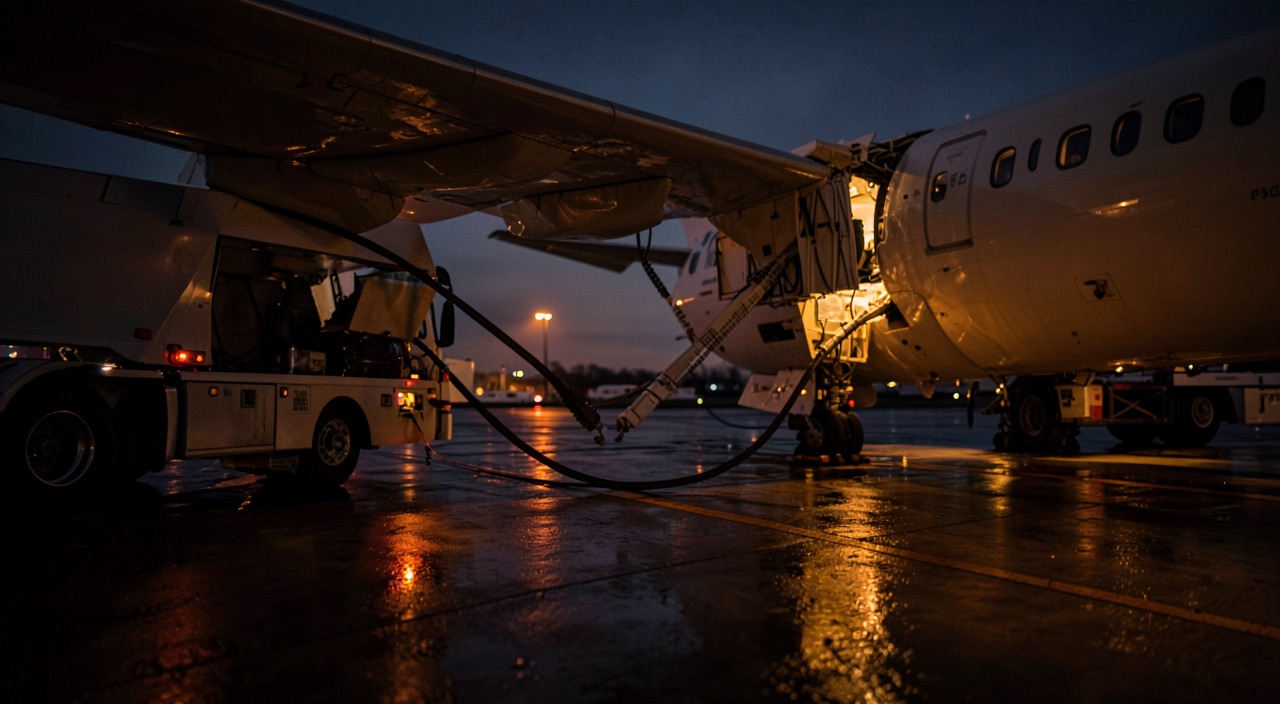
The truck is connected under the wing, the airbridge is in place, a full cabin remains seated on board, and the turnaround must fit into a short window. The question a cabin manager faces at that moment is not whether refuelling with passengers on board is allowed, because it is, under conditions, but what he himself must hold onto for as long as the transfer lasts. The answer fits into a sentence the regulation never states so bluntly: the cabin does not watch the fuel, it guarantees that at every second, everyone can get out.
What the text entrusts to the cabin, and what it entrusts to others
The European regulation on air operations does not entrust the conduct of the transfer to anyone in the cabin. It sets a state requirement: during any refuelling or defuelling carried out while passengers are boarding, on board, or disembarking, the aircraft must remain attended by qualified personnel, ready to initiate and direct an evacuation by the fastest and most practicable means available. Connecting the hose, bonding to earth, delivery pressure, and stopping the truck are the responsibility of the refuelling operator and the technical crew, according to the split written into the operations manual.
The nuance decides what can be held against whom. Asking a cabin crew member why they did not check the bonding cable is assigning them a task for which they have neither the training nor the access. Asking them whether their exit remained clear for the entire duration of the transfer is talking about their post. Preparing a turnaround with refuelling comes down to this shift of gaze: you do not watch the hose, you watch the path that runs from the furthest seat to the ground.
What makes the requirement particular is that it is continuous. It does not begin when the fuel starts flowing and does not end when it stops: it covers the entire period during which the aircraft is in refuelling configuration, including setting up and removing the equipment — moments when the truck manoeuvres and the exit map changes without anything being announced in the cabin. It is also the stretch most poorly covered by briefings, because it falls between two tasks and formally belongs to no one.
The cabin crew’s job during refuelling is not to monitor the fuel transfer but to ensure that all passengers can evacuate at any moment. This means keeping exits clear and ensuring everyone knows what to do if an emergency occurs, even as ground equipment moves around the plane.
On a busy A320 turnaround at Paris Charles de Gaulle, a fuel truck begins refuelling while passengers are still boarding. The cabin crew ensures that the seatbelt sign is off, aisles are clear, and exits remain accessible. When the airbridge is pulled back slightly, the crew immediately announces the change, as it affects the usable exit routes. The refuelling takes 15 minutes, but the cabin’s evacuation readiness must be maintained for the full 20-minute turnaround window.
The conditions, and the mechanism behind each one
The conditions, as set out by the acceptable means of compliance and each operator’s documentation, read like a list and are understood as a chain: each one removes a delay between the decision to get out and actually getting out. Taken in isolation, they look like bureaucracy; put together, they protect the assumption underlying certification, namely that a full aircraft can be emptied in ninety seconds using only half of its exits. That demonstration assumes unbelted occupants, identifiable exits, and available assisting means. In-transit refuelling threatens all three at once.
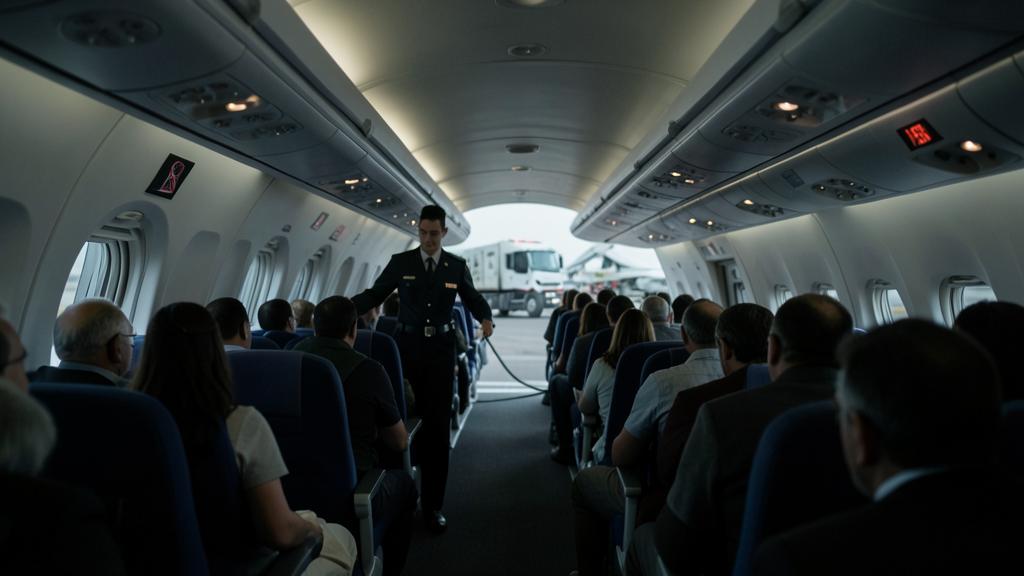
- Inform. Crew, personnel present, and passengers know that refuelling is taking place. Anyone who does not know spends the first seconds of an unexpected order trying to understand instead of moving, and those seconds come out of the ninety-second budget.
- No-smoking sign on, seatbelt sign off. The second point, counter-intuitive for anyone who links safety with a fastened seatbelt, governs mobility: an unfastened buckle is one action per occupant, multiplied by the number of seats.
- Lighting that allows the exits to be identified. Not lighting the cabin at full brightness, but guaranteeing that everyone can see their exit from their seat, at night and from the middle of a centre row.
- Qualified crew on board, and distributed. Numbers alone are not enough: three people grouped in a forward galley do not cover a fuselage. The condition concerns coverage of the exits declared usable.
- A permanent two-way link between the person supervising the operation on the ground and the qualified person on board, able to obtain a stop of the flow in either direction.
- Clear surroundings, inside as well as outside: aisles and access to exits kept free, carts stowed and braked, slide deployment areas free of vehicles and equipment.
- An immediate stop as soon as a vapour is detected in the cabin or another hazard appears. This is the only condition that explicitly gives the cabin the power to interrupt a technical operation.
| Ground configuration | Signage and instructions | Crew and stations | Required exit route |
|---|---|---|---|
| Empty cabin, no one on board except staff | Not applicable to passengers; operator’s turnaround instructions | No evacuation requirement linked to passengers | Access in place for staff and rescue services |
| Passengers seated on board | No-smoking sign on, seatbelt sign off, announcement made, exits identifiable | Qualified crew distributed across the exits declared usable | An immediately practicable exit route, clear ground area |
| Boarding or disembarkation in progress | The same, plus a controlled flow and aisles kept clear | The same, without boarding duties leaving an exit station uncovered | The door served by the airbridge, passable in both directions |
The trap. The seatbelt sign left on out of habit, or switched back on for a pushback that will not happen for another twenty minutes, cancels out the announcement just made: a passenger obeys the pictogram before obeying a sentence heard once. They stay belted, and the first second of an evacuation is spent unbuckling. The night-time variant is worse, when the cabin is dimmed to let a long transit sleep through it: allowing exits to be identified is not the same thing as leaving a row of night-lights on.
A present exit is not a usable exit
The requirement speaks of practicable exit means, not doors, and that distinction structures the entire configuration of a cabin in transit. An armed door counts as an exit means because a slide will deploy, provided the ground area is clear: a vehicle parked under a rear exit removes it just as surely as a mechanical blockage. A disarmed door, by contrast, is only as good as what serves it. Removing the airbridge without rearming leaves an opening that leads nowhere, at a height from which one does not jump.
Hence a rule few manuals state so directly: during refuelling, any movement of ground equipment is a change of safety configuration. The airbridge that pulls back a metre, the rear stairs removed because disembarkation is finished, the truck that repositions itself: each of these routine gestures removes an exit from the map, and no indicator signals it on board.
Inside, the friction comes from service more than from doors. A short transit fills up with carts, cleaning bags, and baggage being rearranged. The requirement for clear surroundings applies to aisles as much as to thresholds: a cart left stranded in the middle of an aisle turns the evacuation layout into a one-way circuit, something no certification demonstration has ever attempted.
The right reflex. Treat any movement of ground equipment as a change of configuration: airbridge pulling back, stairs departing, a catering truck positioning itself under an exit. Every movement is announced in the cabin, because it removes or restores an exit, and because whoever armed a door is not always the one who will see the airbridge leave.
Two links, and where they break
The required link connects the ground and the aircraft. In practice it takes the form of an intercom connected to the nose gear panel, a headset, or any other means deemed acceptable by the operator’s documentation. Its purpose is not to chat but to cut: it must allow, from either end, the flow to be stopped within seconds. A link that only serves to announce the quantity delivered has not fulfilled its function.
It rarely fails through breakdown; it fails through handover. The ground agent holding the handset changes post, the qualified person on board leaves to sort out a seat problem, the headset gets unplugged while equipment is being moved. No fault is visible: both ends still exist, but no one is holding them any more. That is why a named designation, stated aloud and repeated at every handover, is worth more than a box ticked on a turnaround sheet.
The second link is internal, and it is forgotten because it is routine: the one connecting the cabin to the flight deck. Through it an observation goes up, through it a decision comes down. It also carries the passenger information, whose content deserves to be written rather than improvised. A useful announcement does not thank passengers for their patience: it states that refuelling is underway, that smoking and e-cigarettes are prohibited, that seatbelts remain unfastened, that aisles must stay clear, and that crew instructions take priority. Framed that way, it lays the ground for whatever order may follow.
The right reflex. Before accepting the transit, have it stated aloud who holds each end of the link and by what action the flow is cut: the person on the ground, the person on board, the means used, the phrase that triggers the stop. A link no one can explain how to use within three seconds is not a link, but a piece of equipment merely present.
What triggers the stop, and what comes next
The point most often misunderstood is the order of operations: the stop precedes the analysis. A smell of fuel in the cabin can come from a harmless event, a backflow in a ventilation system, or a ground handling action, but the only information available at the moment it is noticed is that the interior atmosphere has changed while a hydrocarbon is flowing beneath the floor. Doubt is enough, and it costs only a few minutes of turnaround time.
What the cabin contributes next is descriptive, and that is where its value lies. Stating which side the smell is coming from, over what length of fuselage, whether a pool is visible from a window, which exits overlook it, allows the commander to choose between three courses of action that do not carry the same cost. Resuming once doubt has been cleared is the most common outcome. An orderly disembarkation, using an exit means already in place, is the reasonable compromise when the situation is stable but unexplained. A commanded evacuation is only justified when time becomes the constraint: it causes injuries, and it scatters passengers across an active ramp.
| What is observed | Immediate effect on the exit | What the cabin triggers |
|---|---|---|
| Smell of fuel in the cabin | No geometric effect, but the interior atmosphere becomes the unknown | Alert via the link, request to stop, no action liable to produce a spark, report to the flight deck |
| Visible spillage on the ground on the transfer side | The exits overlooking the pool cease to be exits | Stop, revision of the exit map, preparation of an exit on the opposite side |
| Smoke or fire, on board or on the ground | Available time becomes the sizing constraint | Immediate alert and application of the planned evacuation orders, without waiting for the transfer to end |
The trap. Faced with a spillage, the reflex to open a door and deploy a slide can send passengers straight into the pool and turn a ground-handling incident into an accident. As long as there is neither fire nor smoke, an orderly disembarkation using an exit means already in place is preferable to an evacuation whose cost in injuries is certain. That choice belongs to the commander, but it rests on what the cabin describes to them: which side, what extent, which exits remain clear.
The difficult case: passengers in motion
Refuelling while passengers are boarding or disembarking is the variant procedures allow and crews dread. It compounds three unfavourable factors. The population is not seated, and therefore not localised: some stand in an aisle, bag in hand, in exactly the position that blocks a flow. The headcount is not stabilised, which complicates any disembarkation decision. Finally, crew are tied up welcoming passengers while the requirement for exit coverage remains unchanged: welcoming passengers does not exempt anyone from holding a station, and a folded jump seat is not a station held.
Geometry adds its own constraint. Boarding often takes place through a single door, and therefore a single exit means, and that door is simultaneously an entry route and an emergency route. It must remain passable in both directions, which rules out letting passengers, ticketing equipment, or baggage refused in the hold pile up there. The practical rule is to treat the threshold and the airbridge as an exit corridor that incidentally accepts entries, not the other way round.
This is also the configuration in which coordination with the ground handler becomes decisive. The ramp agent pulling back the airbridge, the driver choosing their approach line, the cleaning crew boarding from the rear, all act on their own timing, and none of them holds the exit map. It exists only in the head of the cabin crew, and it is only valid if it is refreshed aloud the moment anything moves outside.
What to check in your own documentation
The European text sets the requirement; the operator sets the method. Four points deserve to be reread rather than assumed. First, the designation of the qualified person on board: depending on the airline, this may be the commander, the cabin manager, or a specifically assigned crew member, and this designation determines who holds the link. Next, the wording of the announcements, often scripted and sometimes multilingual, whose absence leads to phrasing that informs without instructing. The handling of fuels other than standard kerosene, wide-cut products calling for additional precautions, and certain documentation ruling out the operation altogether with passengers on board. Finally, the procedure to follow in the event of spillage, which varies enough from one operator to another that no reflex carried over from a previous airline can be relied upon.
One grey area remains that no one benefits from leaving unspoken: the gap between the moment the truck connects and the moment the announcement is made. On a tight rotation, the ground operator works to the rhythm of their own plan, and it is not uncommon for the transfer to start before the cabin has been informed. This precedence is not a fault on either side, it is a sequencing flaw an operator corrects by writing down who gives the go-ahead, and to whom. Feeding these sequences back through a report, and comparing them with what other station networks experience, is worth more than treating them as an unavoidable fact of a given hub; the case is usefully discussed on the forum.
For anyone preparing a qualification or taking up duties as a cabin manager, the expectation has shifted to the same place. What is now demonstrated in a check is no longer the recitation of the conditions, but the ability to state, at any moment of a transit, which exits are usable, by what means, who holds the link, and what would trigger the stop. Everything else is documentation; that is the job.
In all circumstances, the applicable regulation, the instructions of the authority and of the aerodrome, and the operator’s approved documentation take precedence over this article, whose purpose is to explain a mechanism, not to serve as a procedure.
Questions fréquentes
Can refuelling begin before the announcement has been made in the cabin?
No. Informing the crew, the personnel present, and the passengers is one of the conditions that make the operation acceptable, and it only makes sense if it precedes the transfer. The operator must document who gives the go-ahead on the ground, and to whom, otherwise the truck connects at the pace of the turnaround and the cabin discovers the operation already underway. If the transfer has started without an announcement, the expected response is to make the announcement immediately and report it.
Must the seatbelt sign stay on during refuelling?
It is the opposite: operational documentation typically requires the seatbelt sign to be off and the no-smoking sign to be on. A fastened seatbelt adds one action per occupant before any movement toward an exit, which directly eats into evacuation time. Passengers remain seated but unbelted, and the announcement must state this explicitly.
Who can request that the fuel transfer be stopped?
The qualified person on board designated by the operations manual and the ground supervisor both have the means to obtain a stop, since the required link works in both directions. A cabin crew member who detects a vapour or observes a spillage triggers the alert without waiting to be certain of the cause: the stop precedes the analysis. The decision to resume, however, rests with the commander once doubt has been cleared.
Must doors be armed during an in-transit refuelling?
The requirement does not concern arming but the availability of a practicable exit means. A door served by an airbridge or stairs in place is disarmed and remains an exit means; a door with no external means must be armed and have a clear ground area for its slide. The sensitive point is removing an airbridge without rearming, which leaves an unusable opening.
Can boarding continue during refuelling?
Yes, the same conditions apply to passengers boarding, on board, or disembarking, provided exit coverage remains assured. The difficulty is that welcoming passengers ties up the crew at the very moment the population is neither seated nor counted. The boarding door must remain passable in both directions, which rules out storing baggage or equipment there.
What should be done if a pool of fuel appears on the ground under a wing?
The transfer is interrupted and the information is reported to the flight deck with descriptive details: which side, approximate extent, which exits overlook the area. The exits above the pool cease to be usable and the exit map must be revised toward the opposite side. As long as there is neither fire nor smoke, an orderly disembarkation using an exit means already in place is generally preferable to an evacuation by slides.


Leave a Reply
You must be logged in to post a comment.