

A final assembly line can turn out an aircraft in a few working days; the wing fitting that reacts the pylon loads, by contrast, may well have taken something like two years, of which a few minutes under the press. When a manufacturer announces a rate increase, the useful question is not how many assembly stations there are, but how many heavy press hours exist worldwide and what share of them is contractually reserved to that manufacturer.
What comes off a heavy press, and why nothing replaces it
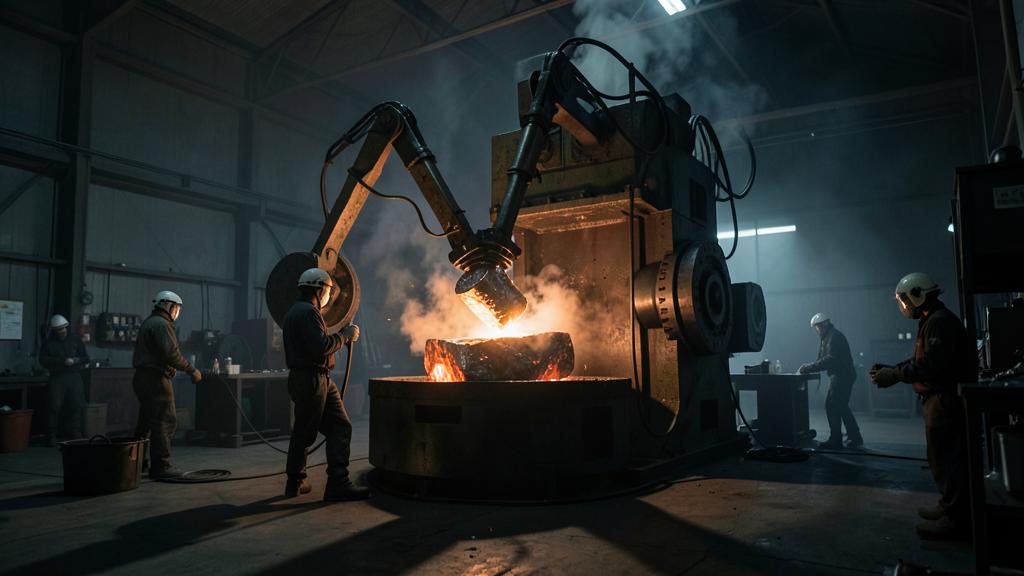
The parts concerned are few in number, yet they carry everything: wing attachment fittings, landing gear beams and axles, engine mounts and pylon fittings, reinforced door frames, compressor and turbine discs. All are classified as principal structural elements or as critical parts: their failure is not caught by an alternate load path, and the strength substantiation rests on a damage tolerance established for a given microstructure. That microstructure comes from die forging: the working of the metal orients the grain flow along the load paths, closes solidification porosity and gives the metal a fatigue behaviour that no stock machined from solid can reproduce.
Hence the impossibility of substitution. The design allowables used in the substantiation were established on coupons excised from a forging, in accordance with material and process specifications that belong to the approved design definition: changing the starting stock means reopening the substantiation, not placing an order elsewhere.
Nor is the required force any more negotiable. Closed-die forging of a titanium alloy calls for a force that grows with the projected area of the part and with the flow stress of the alloy, which stays high within a narrow temperature window. For large fittings and landing gear beams, the requirement reaches values of the order of several tens of thousands of tonnes-force. Presses of that class number in single figures worldwide; most are several decades old, each belongs as much to civil engineering as to machine tools, and their order books mix civil aerospace, defence and land-based turbines.
These parts are too important to fail, so they must be made in a very specific way. You can’t just swap in a different metal or process because it would change how the part behaves under stress. And there aren’t many machines in the world that can make these parts in the first place.
A Boeing 787 wing attachment fitting might require a press capable of exerting 50,000 tonnes-force. There are only about a dozen presses in the world that can handle this, and they’re often booked years in advance for multiple industries.
From ingot to fit to fly: where the months go
The press occupies only an instant in a chain measured in months. Upstream, the titanium sponge or the superalloy charge is vacuum remelted, once or several times depending on the specification, to obtain a homogeneous ingot free of hard inclusions — a qualified process whose worldwide capacity is of the same order of scarcity as that of the presses. The ingot is then converted into billet by a forging operation in its own right, which refines the grain and makes the metal ultrasonically inspectable.
The tooling runs in parallel. A die for a large part is itself a block of forged steel, machined, heat treated, often cut with several impressions; its manufacture takes months and each set is specific to one part number. A worn or reworked die is not neutral: its geometry governs die filling, and therefore the properties.
Then comes the forging itself: a long preheat, several blows with intermediate reheats, trimming. Then the heat treatment — solution treatment, quench, ageing — which is what actually fixes the properties. Then ultrasonic inspection of the as-forged part, for which the part must retain an inspectable geometry, a constraint that bears on the design from the outset. Finally machining, surface treatments, shot peening and documentary release. Twelve to twenty-four months typically elapse between the pouring of the ingot and a part fit to install; within that interval, the press has worked for a few hours.
The ceiling is computed in press hours
Useful capacity is expressed neither in tonnes-force nor in numbers of machines, but in press hours per aircraft. Add up, for one aircraft, the press occupancy of all its heavy die forgings: the blows, but also the preheats, the tooling changes and the reheats. Multiply by the target rate. The annual requirement so obtained has to be served by the forge master alongside his other customers, in campaigns that group part numbers together to amortise die changes. That batching sets the shop’s real rhythm: each part number returns to the schedule according to the forge’s cycle, not according to assembly’s demand.
That rhythm explains a behaviour buyers discover late: a heavy shop does not run out of capacity, it stretches. As long as utilisation stays moderate, an upset is absorbed in the gaps. Beyond that, every extra point is paid for in weeks, for want of gaps to absorb a rework, a scrapped part or a priority campaign. The curve is that of any queue, and it gives no warning.
Final assembly can ignore that ceiling for a while, and that is what makes the diagnosis late. Advance stock and work in progress built up during a low phase make it possible to hold a rate above that of the upstream supply chain. The day the buffer is emptied, the delivered rate falls back to the upstream rate, whatever the announcement may have been. Recovery is not obtained by a commercial decision: it waits for a machine, a furnace or an additional source, that is to say a step.
A source is not duplicated by purchase order
The forging process belongs to the approved design definition of the product, just as the drawing does. Material specification, process specification, heat treatment route, sometimes the machine itself: this is what the industry calls a frozen process. Changing press, die design, furnace or ingot supplier alters the microstructure, hence the mechanical properties, hence the substantiation. Requalification goes through qualification lots, mechanical and fatigue testing on excised coupons, a first article fully inspected, the agreement of the type certificate holder, and on the production side the extension of the approval to the new configuration.
None of this is accelerated by a purchase order. The comparison below does not set two investments of the same order against each other, but two time scales.
| What is to be added | A final assembly line | A heavy forging source |
|---|---|---|
| Lead time to the first deliverable part | of the order of one to two years | several years; qualification alone is measured in months |
| What has to be installed | building, assembly tooling, handling equipment | press or press slot, furnaces, inspection equipment, dies for each part number |
| Certification actions | essentially production: site, routings, quality system | design and production: testing, allowables, agreement of the certificate holder |
| Critical skills | fitters and inspectors, whose training is measured in months | forge operators, die makers, metallurgists; several years |
| Reversibility if demand falls | line slowed or closed, limited loss | machine idled at high fixed cost, hence the reluctance to invest |
| Effect on rate | gradual and quickly visible | in steps, with a lag of several years |
The trap. A dual source announced is not a dual source qualified. Until the second source has passed its qualification lots and is written into the approved data for the part number concerned, it produces nothing installable: a conforming part from an unapproved source cannot be released, and a schedule built on it is fiction.
When the bottleneck reaches the line station
Upstream scarcity does not reach the field as a press release, but as a lead time quoted in tens of weeks for a fitting, a postponed landing gear overhaul slot, a service bulletin whose compliance window keeps stretching. Three mechanisms add up: the initial provisioning of spares is sized on the in-service fleet, not on a growing fleet; a die-forged structural part is not held at a line station; and the press serves new-build first, its most visible contractual customer.
Practical consequence: repair becomes the normal answer again. On a damaged fitting, the trade-off between repair and replacement is no longer decided on technical grounds alone, but on lead time. A repair provided for in the structural repair manual is carried out in days; a repair to be designed, processed by an approved design organisation, is measured in weeks; a new part absent from stock can be measured in months. The order is counter-intuitive for anyone used to equipment: here, it is replacement that is slow.
Cannibalising another aircraft remains possible, but it is not neutral: a critical or life-limited part travels with its complete history, and without continuous traceability since manufacture it cannot be reinstalled, whatever its apparent condition. Cannibalisation moves the grounding, it does not remove it.
The right reflex. As soon as a structural forging is missing, open the parts request and the repair case in parallel instead of in sequence: waiting for the stores to answer before approaching the design organisation adds the longest lead time to the second. And the question to put to the supplier is not “do you have the part”, but “when does the next batch of this part number come out”.
What eases the bottleneck, and what will not
Three routes genuinely ease the constraint. The first is moving closer to net shape: a near-net-shape forging calls for less purchased material and far less machining. The ratio of purchased mass to installed mass is one of the most telling indicators in the industry, and it is counted in multiples, not in percentage points. Beware the shortcut: isothermal forging, which makes such shapes possible, works at low strain rate and occupies the press longer per part. What is gained is titanium and machining hours, not necessarily slots.
The second is a change of route for certain families: powder metallurgy for hot-section discs, additive manufacturing for smaller and less highly loaded parts. These routes do not remove the constraint, they move it towards atomisation, hot isostatic pressing, inspectability, and above all towards qualification time, which is the same for any new process applied to a critical part.
The third is design: splitting a monolithic part into a bolted assembly brings the requirement back below the available capacity. The price is known — mass, fasteners, additional inspection points, sensitivity to corrosion — and a design office pays it only if the alternative is not to deliver.
What does not move: the number of heavy presses, vacuum remelting capacity, the time needed to qualify a new configuration, the pool of die makers and metallurgists. These four quantities have time constants of several years, insensitive to the current year’s order book.
What to go and check on your own side
The useful exercise, for a technical department, comes down to four questions asked before the crisis rather than during it.
- Which structural part numbers depend on a single source, and what is their real contractual lead time — not the catalogue lead time?
- For those part numbers, is there an approved repair covering the plausible damage, and do you have access to the data needed to apply it?
- What exactly does your spares pooling contract cover: many cover equipment and exclude structure and landing gear.
- Are the traceability files for your critical parts complete? An incomplete file turns an available part into an unusable one, and the wait becomes the forge’s wait once more.
One acknowledged grey area remains: no capacity allocation is public. Press slots are shared out by contract, and the only signals observable from outside are quoted lead times, postponed check slots and the tension on spares; these orders of magnitude are cross-checked better between practitioners, in the exchanges between professionals, than in press releases. For anyone preparing a type rating or a technical interview, being able to say why an announced rate is not a delivered rate, and where the next step lies, distinguishes the person who knows the supply chain from the one who has read the delivery schedule.
This article describes industry mechanisms, not a prescription. The material and process specifications of the type certificate holder, the operator’s approved documentation and the applicable regulations prevail over everything above, orders of magnitude included.
Questions fréquentes
Why not machine the part from plate rather than wait for a forging?
Because the structural substantiation was established on allowables measured on coupons excised from a forging, whose grain flow follows the geometry of the part. Plate stock has neither the same grain orientation nor the same fatigue behaviour, and both the material specification and the process specification belong to the approved design definition. Substituting it amounts to a design change to be substantiated, not to a procurement trade-off. The ratio of purchased material to installed material would moreover be markedly less favourable.
How long does it take to qualify a second source of heavy forgings?
Several months at best, often a good deal more, and that lead time does not depend on the buyer’s will. Dies must be made, qualification lots produced, coupons excised and tested, a first article fully inspected, the data accepted by the type certificate holder, and the production approval extended to the new configuration. That is why a second source is prepared in a quiet period and never in reaction to a shortage.
Why is an approved repair often faster than a new part?
Because a repair provided for in the structural repair manual mobilises only the shop and its own resources, whereas a new part mobilises a whole metallurgical supply chain that is already saturated. Even a repair to be designed, processed by an approved design organisation, is generally measured in weeks. On equipment the order is the reverse, which explains the mistaken reflex of many technical departments.
Does near-net-shape forging free up press capacity?
Not necessarily. It sharply reduces purchased material and machining time, which relieves the upstream melting operations and the downstream machine shops. But the processes that make such shapes possible, isothermal forging in particular, work at low strain rate and occupy the press longer per part. The gain therefore lies in material and machining, not automatically in the number of slots available.
How can I tell whether a part number in my fleet depends on a single source?
The information does not appear in the parts catalogue, but it can be inferred: a lead time quoted in tens of weeks, the absence of any alternative or equivalent part number, and the classification of the part as a critical item are converging clues. The question is put directly to the support desk of the airframer or of the equipment manufacturer, and it is framed in terms of the date of the next manufacturing batch rather than of availability in stock. The support contract generally states what is committed and what is not.
Can a part cannibalised from another aircraft be reinstalled?
Yes, provided its file follows it. A critical or life-limited item must be accompanied by continuous traceability since its manufacture, with the history of the hours, cycles and work carried out. Without that file, the part is not reusable whatever its appearance, and the cannibalisation has merely moved the grounding from one aircraft to another.


Leave a Reply
You must be logged in to post a comment.