

Second progress check failed, in the navigation phase. The student learns it in a corridor, in three sentences, and is told that the course stops there. No debrief was ever handed over, no written objective framed the hours flown between the two checks, and the instructor who conducted the first one has since left the school. Whether the required standard was actually met no longer matters: no one will ever be able to say. The only question that remains open is which steps the approved training manual required at that stage, and which ones were skipped.
A lesson shortfall and a failed progress check are not the same thing
In an approved course, every lesson carries objectives and a completion standard. A lesson whose objective is not met gets repeated: that is how instruction normally works, not an incident. The instructor alone makes that call, records it on the progress record, and the sequence continues. A well-written manual does not count these repeats as failures, because they are the fine-tuning mechanism of the whole system: a course in which no one ever repeats a lesson is a course whose standards do not actually bite.
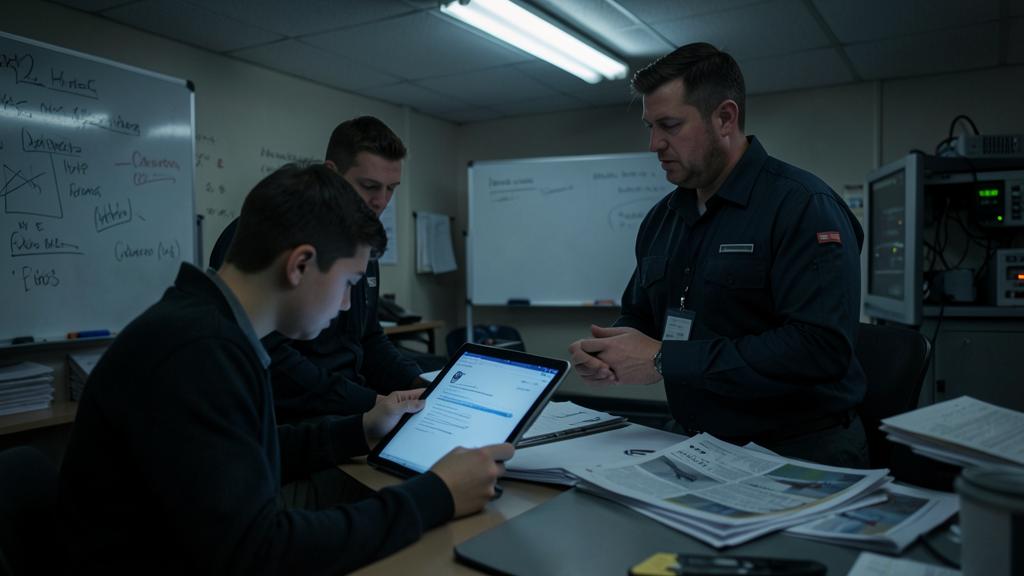
The progress check is a different animal. It is placed at a point fixed by the approved syllabus, at the hinge between two phases, and conducted by someone who did not run the sequence: an instructor designated for that purpose, the head of training, or a deputy, depending on what the manual provides. It does not measure a single lesson; it verifies that a body of skills holds up against a written standard, independent of the instructional relationship that produced it. Its outcome is not a grade: it authorises, or does not authorise, moving on to the next phase.
When it does not authorise, the decision leaves the instructor’s hands. It enters a procedure set out in the training manual, and three things become required where nothing was before: a stated reason tied to dated facts, a defined remedial measure, and a deadline. This shift is what separates a school that actively manages its students from one that merely lets things happen to them, and it is this shift that any dispute examines — far more than the student’s actual level.
A third register exists, often confused with the first two: the official test conducted by an examiner at the end of a course or a module. It does not belong to the training organisation, which can neither alter its outcome nor exempt a student from it, and a failure there is not handled through the same chain. Keep the boundary in mind: a failed internal check and a failed official test are not contested in the same place, on the same grounds, or within the same deadlines.
The progress review: what it examines, what it produces
Le nom varie — revue de progression, commission pédagogique, point d’étape — mais la fonction est partout la même : sortir la décision du face-à-face entre un élève et son instructeur. Sa composition est écrite dans le manuel. On y trouve en général le responsable pédagogique ou son délégué, l’instructeur qui a conduit la séquence, celui qui a conduit le contrôle, parfois le responsable de la conformité lorsque la décision peut mener à l’arrêt. Ce que le manuel dit de la présence de l’élève est le point le moins connu et le plus lourd de conséquences : il arrive couramment qu’il ne soit pas entendu, mais convoqué une fois la décision prise. Cela se vérifie avant de signer un contrat, pas après un échec.
La revue ne travaille pas sur des impressions, elle travaille sur le dossier : fiches signées, comptes rendus de contrôle, relevé des séances par moyen d’instruction, remarques consignées séance après séance. Un instructeur qui décrit oralement « un manque de méthode depuis trois semaines » apporte une conviction, pas un élément. Si ces trois semaines n’ont laissé aucune trace écrite, la revue statue en réalité sur un seul événement, celui du jour du contrôle — et cette faiblesse joue contre l’organisme autant que contre l’élève, puisqu’elle rend la décision aussi difficile à défendre qu’à attaquer.
Ce qu’elle doit produire tient en cinq lignes, et leur absence dit plus que leur contenu. Un écart nommé, et nommé en termes d’objectif du programme — « préparation de navigation incomplète », « hiérarchisation des tâches dégradée dès que la charge monte », « paramètres de sécurité non tenus en approche » — et non « niveau insuffisant », formule qui ne se rattrape pas parce qu’elle ne désigne rien. Une mesure, avec son contenu. Un volume borné. Un critère de reprise, qui doit être celui du contrôle manqué et pas un autre. Une échéance, enfin, avec le nom de qui conduira la mesure et de qui contrôlera ensuite.
La revue de progression examine si l’élève a atteint les objectifs fixés, mais seulement si ces objectifs étaient clairement écrits avant le contrôle. Sans preuves écrites, la décision repose sur un seul événement, ce qui la rend fragile pour les deux parties.
Un élève en formation sur Airbus A320 échoue à sa revue de progression sur le runway 25L de Paris-Charles de Gaulle. Le manuel exige un rapport signé avec trois semaines de preuves écrites avant le contrôle. L’instructeur n’a noté aucun problème pendant ces semaines, seulement verbalement. La décision d’échec est annulée car elle repose uniquement sur la performance du jour, sans preuves antérieures.
One question alone decides how solid a decision is: was the shortfall being invoked already in the file before the check? If it was, the review is recording a trajectory. If it appears only on the day itself, the review is building a justification after the fact. The difference is invisible in the wording of the decision, and perfectly visible in the timeline of the paperwork — it is the first thing anyone who later picks up the file looks at, whether an auditor, a receiving school, or legal counsel.
Remedial training is not extra hours
The costliest confusion is to translate ‘remedial training’ as ‘a few more hours’. Extra hours on the same exercise, with the same instructor and the same method, simply reproduce the same result whenever the shortfall is not purely technical — and it rarely is, on its own: past the early phases, what actually holds a student back is more often preparation, task prioritisation, or workload management than raw handling skills. A useful remedial measure therefore starts by naming the nature of the shortfall, because that is what dictates the means: ground study, a synthetic training device, an actual flight, or simply a change of instructor.
The volume of that training, next, has to be capped. Open-ended remediation is untenable both pedagogically and contractually: it exposes the student to an uncapped bill and the school to the suspicion of commercial self-interest. The manual generally sets a maximum beyond which the file must go up to a governing body; the contract, for its part, sets what is included in the quoted price. These are two separate documents, written by two different departments, and almost never read together — not by the student, and not, for that matter, by the instructor prescribing the remediation.
Finally, the exit standard has to be the same as the entry standard. Remedial training signed off on a watered-down exercise, or checked by the same instructor who just delivered it when the manual rules that out, produces a fragile pass: it will hold as long as nothing happens, and will collapse under the first serious scrutiny of the file — by a receiving school, an auditor, or an examiner. A school that agrees to replay the check exactly as before, against the same standard and with a checker who did not run the remedial measure, protects the student as much as it protects itself.
One fact remains that few schools write down and every head of training knows: the shape of the curve leading up to the failure matters more than the number of failures. An isolated dip after a break, a house move, a period of fatigue, or a change of instructor is remedied with a modest volume and a narrow objective. A ceiling — a progression that flattens out below the required standard over several consecutive lessons — almost never yields to extra hours. It calls for a change of method, sometimes of means, sometimes a reorientation that is not a sanction but a decision.
The trap. A remedial measure prescribed only verbally turns a second failure into an unchallengeable event, in both directions. The school can no longer prove it did what it was supposed to, the student can no longer prove otherwise, and the hours have been billed in the meantime. A file in this state is also the hardest to get credited elsewhere: the head of training at another school will only accept what he can tie to a written syllabus objective, and hours without an objective do not turn into acquired skills.
Five possible outcomes, and what separates them
Between repeating a lesson and terminating a course, a well-written manual makes room for three intermediate positions, and confusing them is costly. Suspension is not termination: it freezes a situation by recording the state of skills acquired on a given date, which protects the student when the cause lies outside the student’s level — a medical issue, funding that has stalled, a personal situation. Reorientation is likewise not a failure: it acknowledges that an objective specific to the intended course is not attainable within a reasonable time and transfers whatever is transferable to another course. Termination, finally, is the only outcome that must go through a governing body rather than a single person, precisely because it is irreversible.
| Outcome | What triggers it | Who decides | What must be in writing | Contractual effect | Route of challenge |
|---|---|---|---|---|---|
| Lesson repeat | Lesson objective not met, outside a check | Instructor alone | Progress record and dated remark | Hours deducted from the package or billed | None on the merits; billing remains open to challenge |
| Bounded remedial training | Failed progress check, shortfall judged remediable | Head of training, on the instructor’s proposal | Reasoned decision, objectives, volume, standard to meet, deadline | Volume included or billed under the general terms | Internal on procedure, contractual on volume |
| Suspension of the course | Cause unrelated to level: medical, financial, personal | Head of training, with the student’s written agreement | State of skills acquired as of that date, duration, conditions for resuming | Payment schedule frozen or maintained depending on the contract | On duration and on retention of acquired skills |
| Reorientation of course | Objective specific to the intended course unattainable within a reasonable time | Head of training after a review | Assessment of transferable skills and the receiving programme | Amendment, balances due and new rates | On the valuation of acquired skills |
| Termination of the course | New failure after remedial measure has been carried out, or repeated safety-related shortfall | Internal body specified in the manual, never a single person | Reasoned decision, dated facts, complete file handed over | Balance due, refund of unused hours | Internal appeal, report to the authority, contractual route |
One column deserves to be read twice: contractual effect. None of these decisions carries a financial settlement by itself. The school decides the pedagogical outcome; what is owed, refunded, or billed is read in the contract, and the two logics can perfectly well diverge. A pedagogically justified termination can still leave a balance to be refunded; a continuation accepted in good faith can still leave a disputable invoice. Handling both in the same letter is the surest way to lose on both fronts.
Challenging a decision: three subjects, three doors
A challenge most often runs aground on the same reef: it argues about the level. But no one is going to re-assess the level. Not the head of training, who signed the decision; not the supervisory authority, which has no mandate to substitute its own judgement for that of an organisation it approved precisely to exercise that judgement; not a judge, who has no way of reconstructing a flight lesson. The only examinable question about level is whether it was assessed against a written standard and on dated facts.
The second subject is procedure, and it is the one that actually produces effects. The training manual is approved: it binds the school that wrote it. A check conducted outside the point specified in the syllabus, a debrief that never took place, a decision made by someone the manual does not designate, a remedial measure prescribed without a written objective, a check run by the very instructor who delivered the sequence where the manual rules that out: these are all shortfalls that can be verified on paper. They should be raised internally first, with the head of training and then with management, and a precise written request compels a written response.
The supervisory authority comes next, and what it can actually do is widely misunderstood. It does not turn a failed check into a pass and does not reinstate anyone in a course. It verifies that a school applies the manual it approved: a documented report can trigger an oversight action, a request for correction, sometimes a new check offered by the school itself to settle a confirmed shortfall. The effect is indirect, slow, and quite real — provided the report describes a breach of procedure, not a feeling of injustice.
The third subject is the contract, and it leads a life of its own. Hours billed without a written prescription, remediation beyond the announced cap, slots that were never offered, a service that does not match what was sold: this route stays open even when the pedagogical decision is beyond reproach, and it falls to the court handling the contract, not to the supervisory authority. Finally, when the failure concerns an official test, the complaint is not addressed to the school: it goes up to the authority that appointed the examiner, following that authority’s own forms and deadlines.
The right reflex. In the days that follow, and in a dated written request: ask for the signed check report, the stated reason and the standard to be met to resume, then a complete copy of your file. If you are asked to sign a document, sign it with the note ‘received on …’, never with an agreement on the substance, and add your reservations in one factual sentence rather than refusing to sign — which suspends nothing and leaves no trace of your position. The response you get, or the absence of one, will weigh far more heavily months later than whatever you remember of the lesson itself.
Time works against the file
A challenge is not judged on what happened, but on what remains of it, and the evidence does not fade at the same pace. The detailed memory of a lesson — the order of instructions, what was said at the briefing, the state of the aircraft, the actual weather — degrades within days. Recordings from training devices, unless preservation is requested immediately, get overwritten by later sessions. An instructor leaves a school without the student ever being told. Only the records the school is required to keep survive for long: the student file, reports, reasoned decisions. The result is mechanical. The later a complaint is filed, the more it necessarily has to rest on procedure, because the substance has already vanished.
What to check before you ever need it
Five points can be read in a few minutes, in the manual or in the part of it you are entitled to see, and they change everything on the day it matters. Where the progress checks in your course are placed, and against what standard they are conducted. Who sits on the review, and whether the student is heard there. How much remedial training the manual allows before the file must go up to a governing body, and how much the contract includes in the price. What deadline you are given to request an internal re-examination, and to whom it should be addressed. How your file is handed over to you if you leave, and in what form. None of these answers depends on how good the school is; all of them depend on what it has written down.
A grey area remains, and it is worth knowing about: nothing harmonises the notion of failure from one school to another. What triggers a formal review here triggers a plain repeat elsewhere, for an identical course under the same authority, because it is each school’s own manual that sets the threshold. This latitude is deliberate — it is the counterpart of approval — but it makes any comparison between schools on this point hazardous, and it explains how the same student could be stopped at one school and carry on at another without either one being wrong.
For anyone later preparing a rating, a job application, or a change of school, one point deserves to be said plainly: a failure that is written down, given a reason, and followed by a remedial measure that was actually carried out looks far better than a gap. It shows an event, an analysis, and a recovery — exactly what an assessor is trying to find out about a candidate. A file that stays silent over three months of a course, by contrast, invites a question no one will have a written answer to — and it is the silence, far more than the failure, that closes doors.
What precedes this describes a common mechanism, not a rule: the applicable regulation, the school’s approved training manual, and the contract you signed always take precedence over this article, and it is in those three documents, read together, that the answer to any particular situation is found.
Questions fréquentes
Does a failure during training show up anywhere outside the school?
A failed progress check is an internal act: it stays in the student file kept by the school and is not carried over onto any aviation licence or rating. You can obtain a copy of it, and any receiving school will ask you for it before crediting anything. A failure at an official test conducted by an examiner follows a different logic, since it appears in the report the examiner sends to the authority.
Can the school terminate my course after a single failed check?
The approved training manual is what decides this, and it is common for a first failed check to trigger a remedial measure there, not an exit. An immediate termination normally rests on a reason distinct from level alone, for instance a repeated safety-related shortfall or behaviour incompatible with continuing. Ask in writing which provision of the manual is being invoked: the answer will tell you straight away whether the decision falls under normal procedure or an exception.
Can I refuse to sign a check report I disagree with?
Refusing to sign suspends nothing and deprives you of a useful record. The signature generally attests that the document was handed to you, not that you agree with its content, and nothing prevents you from writing next to it ‘received on …’ followed by one factual sentence of reservation. It is that dated reservation, not the refusal, that will help if the decision is reviewed later.
Can the supervisory authority overturn the school's decision?
No: it does not substitute its own pedagogical judgement for that of an organisation it approved to exercise that judgement. Its lever is oversight of compliance with the approved manual, and a documented report can lead to a corrective action, sometimes to a new check offered by the school itself. To be usable, that report must describe a breach of a written procedure, with dates and supporting documents, not a feeling of injustice.
Are remedial-training hours automatically at my expense?
The question is contractual, not regulatory: the manual says who decides on the remedial measure, the contract says who pays for it. A course advertised at a fixed price most often includes a clause capping the volume of remediation covered, beyond which hours are billed. Hours conducted without a written prescription or an objective tied to the syllabus, on the other hand, remain open to challenge on the invoice, regardless of any discussion about level.
What should I get back if I leave the school after a failure?
A complete, signed copy of your file: progress records, check reports, reasoned decisions, and a log of lessons broken down by training device. The head of training at the receiving school will only credit what he can tie, document in hand, to an objective in his own approved syllabus. Ask for it while the relationship is still normal, because a request made after a dispute takes far longer to be honoured.


Leave a Reply
You must be logged in to post a comment.