
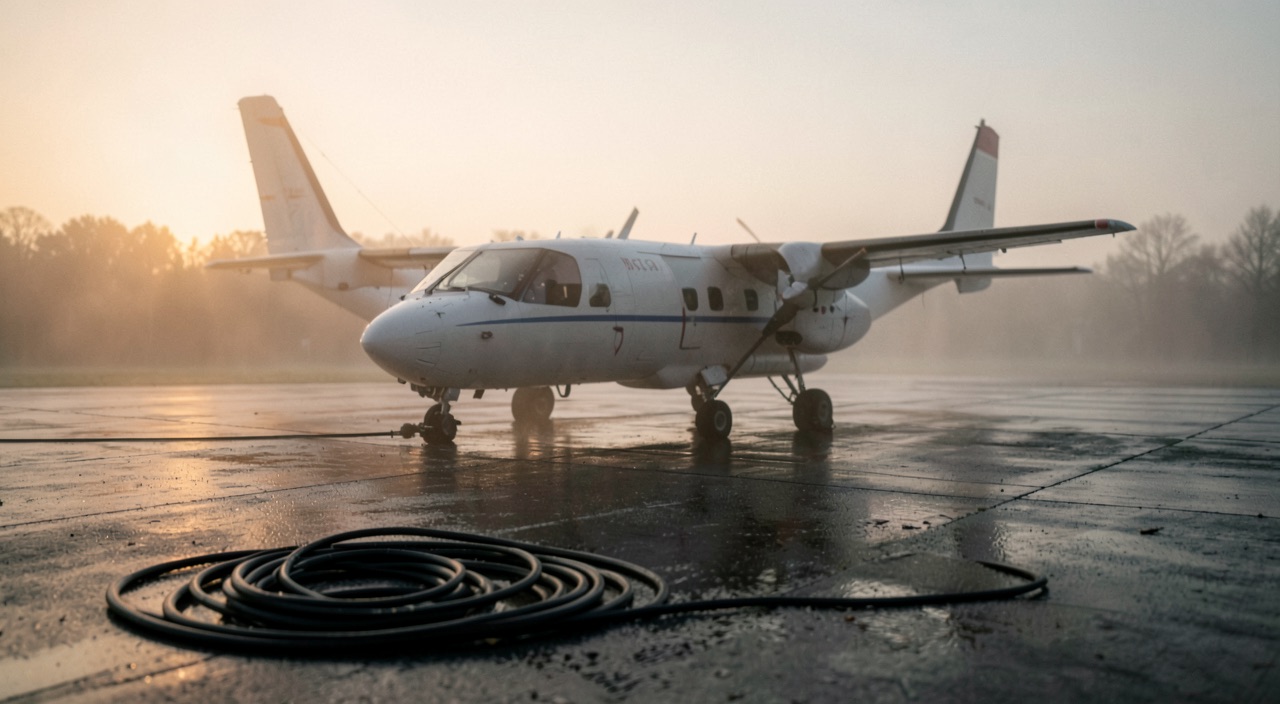
A typical file lands on a training manager’s desk: a few hundred hours accumulated across the Atlantic, a private pilot licence issued by a third country, an instrument rating started and then abandoned, and a logbook kept in pen. The applicant asks the only question that interests them: how many months and how many euros does all this save on a European course? The answer is not found in the logbook’s total. It lies in a distinction the logbook never shows — between what counts as prior experience and what can be deducted from an approved programme.
Two counters, and a third that never moves
An approved school works with three quantities that everyday conversation lumps together under the single word “hours”. Confusing them is the source of almost every commercial misunderstanding in the sector.
The first is prior experience. It is a quantity, expressed in total hours, in pilot-in-command hours, in cross-country navigation, in night flying, in instrument time. It governs entry into certain courses and the issue of certain licences — the airline transport pilot licence remains anchored to a total experience threshold of roughly one thousand five hundred hours, whatever route was taken to reach it. This quantity is established from documentary evidence. It says nothing about the quality of the instruction received.
The second is instruction: what an approved programme is designed to deliver, in a given sequence, with criteria for moving on to the next phase. It is not established after the fact, it is attested — by an organisation whose training manual, instructors, fleet, and training devices have been approved by the authority. This is the only item a credit can bite into, and it is also the only one the school sells.
The third brings together examinations and certifications: theoretical examinations, the practical test, language proficiency, medical fitness. No school credits these, because none of them issues them. They belong to the authority and do not cross the border.
This leads to a counter-intuitive consequence: an applicant may satisfy an experience prerequisite without obtaining the slightest reduction in the course, while another, with very little experience but trained at an organisation approved under the European regulation, keeps the full length of the course even if they flew on the other side of the world. Approval travels with the organisation, not with geography.
There are three types of hours: experience (what you’ve flown), instruction (what an approved school teaches), and exams (what authorities check). Only instruction hours can be credited, not experience or exams. A school can’t just give you credit—it has to follow strict rules.
A pilot with 500 hours in a Cessna 172 from a US flight school applies to a European school. The US school isn’t approved under European rules, so the 500 hours count as experience (they help meet the 1,500-hour requirement for an airline licence) but don’t reduce the European course. If the pilot had trained at a European-approved school, those 500 hours could cut the course time.
The prerequisite: a counted hour is not an admissible hour
Admissibility is decided line by line, never on a total. Four filters apply, and a file missing even one of them is sent back for further review, sometimes for several months.
The documentation. A logbook must carry the expected entries — date, registration, type, function on board, nature of the flight, time — and remain consistent with supporting evidence: organisation attestations, operator records, flying-club invoices, flight reports. The most frequent reason for rejection is not fraud, it is late reconstruction: a logbook rewritten the eve of submission, without an instructor’s countersignature or matching evidence, proves nothing.
The status of the aircraft. The hour must have been flown on an aircraft registered in a State, holding a valid airworthiness document and falling within the intended category. State aircraft, experimental-category aircraft and uncertified light aircraft are subject to their own regimes: their hours exist, but they do not automatically feed the counter in question.
The nature of the time. A threshold is only filled by the hours the rule assigns to it. Dual-command time does not fill a pilot-in-command requirement; simulated instrument time in flight does not fill a real instrument-flight requirement; single-engine time does not fill multi-engine time. The total can therefore inflate without a single box being ticked.
The training device. Ground sessions only count if the simulator or trainer has been qualified by a recognised authority, and within the limits the regulation sets for each type of device. A session on unqualified equipment is excellent training and a line with no administrative value.
| Origin of the hour | Counts as experience | Can reduce instruction | Evidence establishing it |
|---|---|---|---|
| Instruction at an organisation approved under the European regulation | Yes | Yes, within the limits of the approved programme | Organisation attestation and student file |
| Instruction at a foreign school outside European approval | Yes | No, unless a credit provision is expressly foreseen | Countersigned logbook and school attestation |
| Flight as pilot-in-command on a certified aeroplane | Yes | No | Logbook, flying-club or operator records |
| Session on a device qualified by a recognised authority | Yes, within the foreseen limit | Yes, within the foreseen limit | Session attestation and device qualification certificate |
| Session on an unqualified device or private trainer | No | No | Not applicable |
| Flight on a State, experimental, or out-of-scope-category aircraft | Depending on the specific regime of the aircraft | No | File reviewed case by case by the authority |
The instruction credit is capped by the programme, not by good will
A school does not grant a credit, it applies one. What it can do fits within three margins, and none of them is negotiable over the phone. First, it can apply the credits the regulation expressly foresees for holders of certain licences or ratings — these credits are stated, bounded, and often conditional on recent practice. Next, it can adjust the length of instruction under its own responsibility, above the minima, which amounts to not charging for hours it considers unnecessary. Finally, for an atypical profile, it can build a bespoke course — but this must be approved by the authority before it is carried out, and that approval takes time.
What it cannot do is equally clear: go below the minima of the approved programme, credit instruction that no evidence attests, or turn experience into instruction. An operator that is recruiting looks at the licence; the authority that oversees the school looks at student files, practical-test pass rates, and the consistency between what was planned and what was actually done. A generous, poorly documented credit costs the school a finding of non-compliance, and costs the candidate extra hours at the end of the course, billed at the full rate because they arrive at the worst possible moment.
This structural caution explains a discrepancy that applicants often mistake for commercial bad faith: the school that announces the smallest credit is often the one that has actually read the file, and the one that promises the largest is often the one that has not yet opened it.
The right reflex. Demand the credit in writing, item by item, with the basis invoked for each, and have the school explicitly distinguish the credit already earned — based on evidence already produced — from the conditional credit, subject to the outcome of the entry assessment. A quote that does not make this distinction is not a quote, it is a guess.
The entry assessment, as it actually unfolds
The entry assessment has three parts, and the first is nothing spectacular. The documentary review consists of cross-checking the logbook, licences and ratings with their dates, organisation attestations, the medical certificate, and the state of language proficiency. On its own, it determines the ceiling of the possible credit: what is not proven at this stage will not be credited later.
Next comes a diagnostic theoretical assessment, whose purpose is not to penalise but to gauge the foundation: flight mechanics, performance, navigation, regulation. A candidate trained under a different regulatory system generally arrives solid in operations and navigation, and quite uneven on legal subjects and on the procedures specific to European airspace.
The third part is a flight or a session on a training device. The evaluator is not looking for performance but for the speed of learning: working method, flight-path management, rigour in English radiotelephony, use of a chart and a panel, reaction to an unexpected instruction. It is this part that turns a conditional credit into a firm one, or reduces it.
The output of the assessment is an individual programme: a list of sessions, a projected volume of hours, and a review clause. This last item is the point candidates neglect the most. Without a written review clause, the review will happen anyway — but at the hourly rate, and with no room for discussion about what triggers it.
The economic calculation: where starting over costs less than catching up
Two strategies are open to a file coming from elsewhere. Topping up means asserting what one already holds and buying only the remainder, at retail price. Starting over means entering a pre-built course and buying a block, with the pedagogical coherence and wholesale price that come with it. Their respective costs do not vary the same way depending on how established the file is.
The determining factor is not the number of hours, it is the nature of the titles held and the recency of practice. A professional licence combined with a valid, recently exercised instrument rating tips the calculation towards topping up: most of the flight instruction is already acquired, and what remains is to prove it and bring it up to standard. A private licence and a few hundred leisure hours leave almost everything still to be done, and buying retail then costs more than buying the block.
The trap. Accumulating low-cost hours abroad in the hope of crossing a threshold is the least profitable expense in the whole process. These hours inflate a total but do not fill the precise boxes the rule requires — pilot-in-command, cross-country navigation, night, real instrument time, multi-engine — and they shorten no course, since they come from no approval. One ends up funding an accounting line that will never convert into months saved.
The line items the quote does not show
The visible part of a training budget is the flying hour. The part that decides feasibility lies elsewhere, and it does not move with the credit obtained.

These include the theoretical preparation and session fees, whatever the entry level; the authority fees for reviewing the file and issuing the licence; the examiner’s fee and aircraft rental for the practical test; the medical examination, which must have been conducted under European rules and not simply presented in another form; the language proficiency assessment, which must come from an organisation recognised for this purpose to be entered on a European licence. Two costs that nobody quotes a figure for are added on top: mobility, because one does not always choose the nearest examination centre, and time, because every month spent waiting for a decision is a month without income.
The timeline is, in fact, the most poorly anticipated item. Reviewing a file containing foreign documents requires checks with the authority of origin; approval of a bespoke course requires an additional round trip. These delays cannot be made up by paying more, and they interact with validity periods: that of medical fitness, that of examinations already passed, that of the instrument rating one had hoped to have recognised.
The second trap. The series of theoretical examinations is bound by a clock that starts at the first attempt, not at enrolment, and a second clock then runs until the licence is issued. Opening the series before securing funding for the flying, or before having the authority’s answer on the credit, amounts to putting subjects already passed at risk. Files are regularly seen retaking subjects already acquired, not through insufficiency but through timing.
| Candidate profile | What is acquired from the outset | What remains to be done | Dominant cost item |
|---|---|---|---|
| Foreign private licence and leisure hours | Only the volume of experience, with no instruction credit | Almost the entire professional course and all of the theory | Flight instruction |
| Professional licence and instrument rating from a third country, recent practice | Experience, and the instruction credits expressly foreseen | Theory, the practical test, procedural refresher training | Theory and fixed costs |
| Old professional licence, interrupted practice | The experience, but credits tied to recency lapse | Theory, substantial flight refresher training, the practical test | Flight refresher training, hard to cost in advance |
What must be gathered before signing anything
The file that obtains the best credit is not the thickest, it is the most verifiable. Before any commercial meeting, gather the complete logbook with a breakdown by function on board and by flight condition; copies of licences and ratings with their issue and expiry dates; attestations from the organisations attended, specifying their status with their own authority; the qualification certificate of the training devices used; the state of medical examinations and the language assessment; and, if a theoretical series has already been opened elsewhere, the date of the first attempt. This last item, often forgotten, governs the entire schedule. A theoretical preparation started too early costs more than the same preparation started a few months later, once the credit has been settled.
There remain grey areas that neither the school nor the candidate can settle alone. Arrangements between authorities exist, evolve, and are never to be assumed: what was true for a colleague a few years ago is not necessarily true today, and the only legitimate contact is the intended issuing authority. Military experience follows its own logic, in which the unit’s records and the nature of the aircraft weigh more than the total. Finally, a title obtained through a pathway closely tied to a single operator does not transfer well, even within Europe.
For anyone preparing a rating after a foreign course, the reasoning changes in nature. The question is no longer “how many hours have I been credited with” but “what document is missing so that every line of my file is enforceable”. It is an archivist’s job before it is a pilot’s job, and it is done far better before departure than years after returning — organisations close down, instructors change employers, and an attestation obtained in a few days on the spot becomes almost impossible to reconstruct from a distance.
On each of these points, the applicable regulation, the organisation’s approved training manual, and the instructions of the relevant issuing authority prevail over this article, whose sole purpose is to set out the mechanism.
Questions fréquentes
Do my hours flown abroad count towards European thresholds?
Yes, as long as they are traceable and were flown on an aircraft falling within the intended category. The place of flight is not the criterion: the rule expresses its thresholds in hours and functions on board, not in geography. However, each hour only feeds the counter its nature assigns it, so a large total can coexist with several empty boxes.
Is the credit announced in a quote guaranteed to me?
Rarely in full, and the nuance is costly. A credit can only rest on three grounds — those the regulation expressly foresees for holders of certain titles, the margin the school has above the minima of its own approved programme, and a bespoke course validated beforehand by the authority — and each must be proven on documents. As long as the documentary review is not closed and the assessment session has not taken place, the part of the credit that depends on the observed level remains conditional. So have it written down, item by item, what is acquired at signature and what will be re-examined after the entry assessment.
Do I have to retake all the theory?
The examinations belong to the issuing authority and do not transfer from one system to another. Reductions exist where the regulation foresees them for holders of third-country licences, but they are assessed by the authority, not by the school. In the great majority of files, theory is the heaviest item still to be done, both in money and in schedule.
Is time spent on a simulator abroad taken into account?
It is, if the device was qualified by a recognised authority and within the limits the rule sets for each type of device. You must therefore be able to produce the equipment’s qualification certificate, in addition to the session attestation. A session on an unqualified trainer keeps its pedagogical value but has no administrative value.
From what point is it better to start a full course over?
The tipping point turns on the titles held and the recency of practice, not on the total number of hours. With a professional licence and a valid, exercised instrument rating, topping up remains almost always more economical. With a private licence, leisure hours, and a long interruption, buying the missing elements at retail quickly exceeds the price of a course sold as a block.
Are my foreign medical certificate and language proficiency recognised?
No, these are two attestations that do not transfer. Fitness must be established under European medical rules, and the language assessment must come from an organisation recognised for this purpose to be entered on a European licence. Both items should be budgeted for from the outset, since the time it takes to obtain them often governs the training start date.


Leave a Reply
You must be logged in to post a comment.