

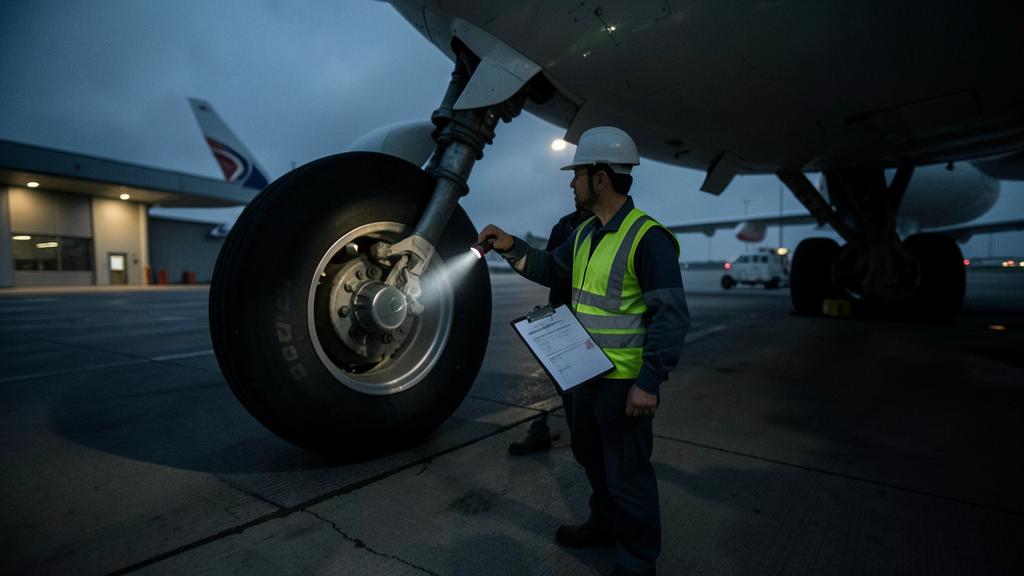
A main-gear tyre below the wear limit, recorded during an overnight stop three time zones from base: the aircraft departs, the crew heads home, and a few weeks later the authority that issued the operating certificate demands an action plan. In between, the finding has followed a precise route that never passes through the operator first. Here is that route, what the finding actually weighs in the oversight profile, and why the quality of the response matters more than the severity of the deviation.
A Ramp Inspection Is Not an Audit, and That Is What Makes It Costly
Sampling defines ramp inspections. An inspector who boards during a turnaround has a standardized checklist and only as much time as the stop lasts. They will not see the operations manual, the safety management system, or the maintenance records: they will see the flight deck, the cabin, the exterior of the aircraft, sometimes the cargo, and whatever documents are actually on board. The programme forbids them from unduly delaying the flight, which confines the exercise to a sample.
System failures, not individual errors, are the focus. Everything that follows stems from this sampling nature. Unable to observe the system itself, the inspector records what the sample reveals about it. An expired fire extinguisher is not an extinguisher problem, it is a problem with how safety equipment is tracked, and it will be read that way by the authority that receives the report. The question the reader of the report asks is never “was the aircraft safe that evening,” but “what, within the organisation, let this reach the ramp.”
Compliance gaps, not technical failures, dominate findings. The reference framework is the second point that gets underestimated. The inspector does not know your approved procedures; they compare what they see against international standards and the documents the aircraft is carrying. A deviation that your authority has fully approved, but for which the proof is not on board, is indistinguishable from a genuine non-compliance. This is the most common source of avoidable findings: not actual failures, but compliance that cannot be demonstrated on the spot.
Ramp inspections check what’s visible at the time, not your entire system. A missing document or expired item reveals how your company tracks compliance, not just that one item. The inspector’s report focuses on what went wrong in your processes, not the aircraft’s immediate safety.
An A320 arrives in Istanbul with a cabin safety card missing. The inspector notes this as a “significant” finding. The operator’s response must explain how safety documents are tracked fleet-wide, not just why this one card was missing. The real issue might be a procedure gap, not the crew’s oversight.
The Finding’s Rating and the Action Taken Are Two Separate Scales
Severity and action are independent. Findings are rated by their influence on safety: minor, significant, major. That rating qualifies the deviation, not the response. What the inspector decides on the spot belongs to a second scale, ranging from a simple note to the commander through to an operating restriction on the aircraft, with a requirement to correct before flight in between. Conflating the two produces costly misunderstandings at the ramp.
Capacity to act on-site matters most. The decoupling works both ways. A major finding can still result in an on-time departure if the correction is made and documented in front of the inspector: a document produced, a part replaced, a minimum equipment list item correctly applied and deferred. Conversely, a significant finding that no one can close on the spot, for lack of technical support or a spare part, grounds the aircraft. It is not severity that decides the outcome of the stop, it is the capacity to deal with it on the spot.
| Level | What It Qualifies | What Can Be Decided on the Ramp | Who Is Informed | What the Operator Produces Next |
|---|---|---|---|---|
| Minor | Limited influence on flight safety | Note to the commander, normal departure | Programme’s shared database, accessible to the operator’s authority | Nothing formal, but the finding weighs on the ratio and the history |
| Significant | Notable influence, a deviation touching a substantive requirement | Correction requested, most often before the flight | Operator and its authority, by notification | Root-cause analysis and corrective action, within the deadline set |
| Major | Major influence on flight safety | Mandatory correction before flight, operating restriction, grounding if no fix is possible | Operator, its authority, the inspecting State and, where applicable, the programme’s bodies | Root-cause analysis, corrective action and proof of effectiveness |
Preparation prevents groundings. That capacity is prepared beforehand, never during. It rests on three things: being able to reach, at the local time of the stop, someone at the operator who can decide; having a technical point of contact on the ground or a handling contract that covers it; producing a document within minutes rather than days. An operator with none of these three levers, far from its base, mechanically turns minor deviations into groundings.
The Report’s Journey: Several Readers See It Before You Do
Database is the first stop. The report does not go to the operator first. It goes to the programme’s shared database, fed by every participating State and maintained at European level. That is where the finding becomes data: linked to an operator, an aircraft type, an aerodrome, a specific item on the inspection checklist, with its rating attached. The authority that issued the air operator certificate accesses it and is notified of whatever concerns them.
Deadline starts with official transmission. The crew, for their part, leaves with a copy of the form. It is the only copy that travels at the operator’s own speed, and it is the one that goes astray. The response deadline does not start running from the moment the compliance department discovers the matter: it starts from the official transmission. A report that sits for several days in a flight bag eats into that deadline all the same, and the response arrives late without anyone on board having done anything wrong.
The trap: treating the form handed over at the stop as an information document. It sets off a countdown the operator does not control, and a late response counts, in the file, for almost as much as no response at all: it documents an operator that does not know where its own findings are.
Oversight profiles are collective. It is also worth understanding what the inspecting State does with its own collection of data. Findings recorded across operators of the same State are read as a series: they say less about each individual operator than about the oversight exercised by their authority. This is the point where two scales meet, that of a single operator and that of a national safety oversight system, the very one examined by the international organisation’s universal audits. An operator therefore carries, without having sought it, a share of its flag State’s record.
What the Findings Ratio Really Measures
Normalisation is key to fair comparison. The oversight profile is not written in a count of findings, but in findings weighted by rating and set against the number of inspections, over a rolling window. Normalisation is essential: without it, an operator inspected heavily simply because it flies a great deal would mechanically show the worst record in the programme. With it, what gets compared is a density of deviations per inspection, not a volume of activity.
Volatility affects small operators most. The practical consequence is counter-intuitive for small fleets. An operator subject to few inspections has a highly unstable ratio: one unlucky stop weighs enormously, and it then takes many clean inspections to bring the average back down. A large carrier absorbs the same incident without its curve moving at all. At identical real-world performance, the two therefore do not carry the same risk of attracting attention, and the small operator has to compensate through the quality of its response what it cannot compensate through volume.
Inspections increase with a worsening ratio. A worsened ratio does not trigger a sanction. It triggers inspections. The mechanism is a loop: priority rises, the operator is checked more often and in more States, so the probability of new findings increases, so the ratio worsens further if nothing changes at the root. It is this loop, not the crossing of a single threshold, that pulls a file out of the ordinary. Symmetrically, an absence of inspections does not amount to a good record: it amounts to missing data, and missing data invites scrutiny.
What Closes a Finding, and What Does Not
Audiences have different expectations. The response is read by two audiences who are not expecting the same thing. The inspecting State wants to know whether the deviation found has been eliminated. The operator’s authority wants to know how that deviation could have occurred, and what will prevent it recurring elsewhere in the fleet. A response that satisfies the first and ignores the second is exactly the kind that sets up the repeated finding, on another stop and often on another aircraft.
Content must be complete and verifiable. The expected content is stable regardless of the subject: a description of the deviation as it was actually observed, the immediate action and its date, the root cause identified — the real one, not “human error” —, the corrective action with an owner and a deadline, the scope of extension across the fleet, and proof that the action produced its effect. That last point is the one people forget: a decided action is not a verified action.
| Element of the Response | Perfunctory Response | Acceptable Response |
|---|---|---|
| Root cause | Crew error, oversight, inattention | Failure identified in the pre-departure check, with the conditions that made it possible |
| Action | Reminder circulated, internal memo | Amendment to the working document, effective date and named recipients |
| Scope | The aircraft concerned | The fleet and stops exposed to the same mechanism |
| Proof of closure | Operator’s statement | Verifiable evidence: dated revision, inspection record, result of a subsequent spot check |
| Meeting the deadline | Sent at the end of the deadline, sometimes after a reminder | Prompt acknowledgement and interim response, complete file before the deadline |
| Effect on the profile | The finding closes, the risk of repetition remains intact | The finding closes and repetition becomes unlikely |
The right reflex: one channel, one clock. The form is photographed or scanned and sent to a single service address before the crew leaves the stop, never to a named individual who might be on leave. That same hour, the operator knows whether it has a file to open, and the clock starts running for it at the same time as for its authority.
System proof matters more than clean history. The quality of the response produces an effect of its own, independent of the finding that triggered it. It is the only sample of the operator’s management system a foreign authority will ever see. A prompt, well-sourced, verifiable response is worth more than a clean history paired with an evasive answer: the first proves a system that finds and fixes, the second offers no proof of any kind.
Why the Second Time Does Not Cost Double
Repetition questions the system. A repeated finding is not a finding twice over. It is a finding, plus proof that the previous corrective action failed or was never implemented at all. It therefore strikes directly at what the certificate itself attests: the organisation’s capacity to deal with its own deviations. That is why a recurring minor item weighs more heavily, in an oversight decision, than an isolated significant one.
Patterns reveal different causes. Repetition can be read along several axes, and it is worth knowing which one before drafting a response: the same item at the same operator, the same item on the same registration, the same item always at the same handling aerodrome, the same item across several operators of the same State. Each points to a different cause — procedure, aircraft, ground handling, national oversight — and a response that picks the wrong axis gets rejected without the reader needing to argue the point.
When the Escalation Changes in Nature
Path depends on operator origin. As long as the matter stays between the operator and its authority, it is settled within the oversight programme: a shortened cycle, an audit targeted on the process at fault, verification of how findings are handled. That is the normal path, and by far the most frequent one. Leaving that path takes two forms depending on the operator’s origin.
Third-country operators face different levers. For an operator based outside the Union and operating into it, the authorisation it holds to serve the territory is subject to continuous oversight, fed precisely by ramp inspections. That authorisation can be made conditional, limited, suspended or withdrawn: it is a standalone lever, one that does not go through the authority that issued the air operator certificate. Beyond that, a persistent case can be examined against the common criteria underlying the list of air carriers banned from operating within the Union, after consultation with the operator and its authority.
European operators face certificate changes. For a European operator, the escalation is internal: it is the terms of its own certificate that shift. A privilege gets restricted, a specific approval gets suspended, a requested extension is put on hold. The certificate is almost never withdrawn all at once; it shrinks through its operations specifications, quietly, at the pace of findings that fail to close.
What the Crew Does During the Inspection, and What It Avoids
Three actions are required. The commander does not have to build the case. There are three things to do: grant access and accompany the inspector, produce what is asked for without commenting on what is not, and document. Documenting means noting the inspector’s identity and State, the report reference, the time, and adding one’s own remarks on the form when a fact seems to have been recorded inaccurately.
Signature is just acknowledgement. The commander’s signature amounts to acknowledgement of receipt, not acceptance of the finding. This point worries crews needlessly, and leads some to refuse to sign: the file then becomes far harder to defend, since the operator ends up contesting a document it does not even have a copy of. Any justified challenge is made afterwards, in writing, by the operator, to the inspecting State.
The trap: correcting things in front of the inspector. Re-inflating a tyre, removing an object, replacing a safety card while the inspection is under way does not erase a finding already recorded. It adds a second one, about conduct, and sometimes a third if the intervention fell outside authorised maintenance scope. A correction only counts if it was requested, carried out by someone entitled to carry it out, and documented.
The right reflex: a documentary review before opening a new destination. The documents to present vary from one State to another, and the requirement is often about form: a certified copy rather than a plain copy, the document’s language, physical presence on board rather than electronic access. Treat this list as part of route preparation, on the same footing as operational minima.
What to Go and Check in Your Own Documentation
Three questions need answers. Three questions belong in the operations manual, and the answer is rarely written down in black and white there. Who, by name, receives a ramp inspection report, and within what internal deadline? What is the channel when the stop is at an aerodrome where the operator has neither office nor representative? And who owns the response: compliance, airworthiness, ground operations? A finding concerning the external condition of the aircraft involves at least three departments; without a designated owner, the response goes out late and fragmented.
Interpretation issues need evidence. The grey area that persists no matter how careful the preparation lies at the boundary between a genuine deviation and one of interpretation. An inspector who cannot read the language of the minimum equipment list, a deferral practice tolerated by one authority and unknown to another, cabin equipment approved to an older standard: these cases are handled in the written response, with supporting evidence, not at the ramp, with arguments. They are prevented by carrying proof on board rather than conviction.
Training value is high. For anyone preparing to take on a compliance or flight safety role, the subject is a rich training ground: handling ramp inspection findings is one of the rare processes where the entire chain plays out on a short cycle — external detection, root-cause analysis, action, proof of effectiveness, measurable effect on an indicator the authority tracks. The training courses that cover continuous oversight readily draw on this case, and the ramp-stop stories practitioners exchange on the forum often teach more than a theoretical presentation.
This article describes a mechanism, not an applicable procedure. The regulatory text in force, the instructions of the competent authority, and the operator’s approved documentation prevail over everything above, and it is the latter that governs in the event of a discrepancy.
Questions fréquentes
Does a minor finding recorded abroad oblige the operator to respond?
A minor-level finding does not always call for a formal written response, but it is recorded and counts toward the weighted ratio that drives inspection priority. Treating it the same as any other finding is the only way to avoid it resurfacing later as a repeated finding, with all the weight that carries. Most mature operators route every level through the same internal chain.
From when does the response deadline start running?
It runs from the official transmission of the finding to the operator’s authority, not from the date the compliance department becomes aware of it. A report left sitting in a flight bag therefore eats into the deadline without anyone noticing. This is why the reporting channel from the stop must be a single one, known to every crew, and immediate.
Can the commander refuse to sign the inspection report?
The signature amounts to acknowledgement of receipt of the document, not acceptance of the finding. Refusing to sign erases nothing and complicates the subsequent defence, since the operator ends up contesting a document it does not have a copy of. Good practice is to sign and add remarks on the form when a fact is inaccurately recorded; a formal challenge then follows, in writing, from the operator.
Can a ramp inspection ground the aircraft?
Yes. When the deviation affects flight safety and no fix is possible on the spot, the inspecting authority can impose an operating restriction that can go as far as forbidding take-off until the fix is made. The outcome depends less on the severity of the deviation than on the operator’s ability to correct it and document that correction during the stop.
Is an operator that is rarely inspected at an advantage?
No, it is mainly more exposed to variance. Since the ratio sets weighted findings against a small number of inspections, a single unlucky stop moves its curve sharply and takes a long time to fade. Moreover, an absence of inspections does not produce a good profile but missing data, which has never discouraged an authority from carrying out a check.
Can findings recorded at an operator reach its State?
Yes, indirectly. Results aggregated by State of origin feed into the assessment of national oversight, the very thing examined by international safety audits. The most severe decisions, such as an operating ban within the Union, rest on common criteria that weigh the authority’s capacity as much as the operator’s.


Leave a Reply
You must be logged in to post a comment.