
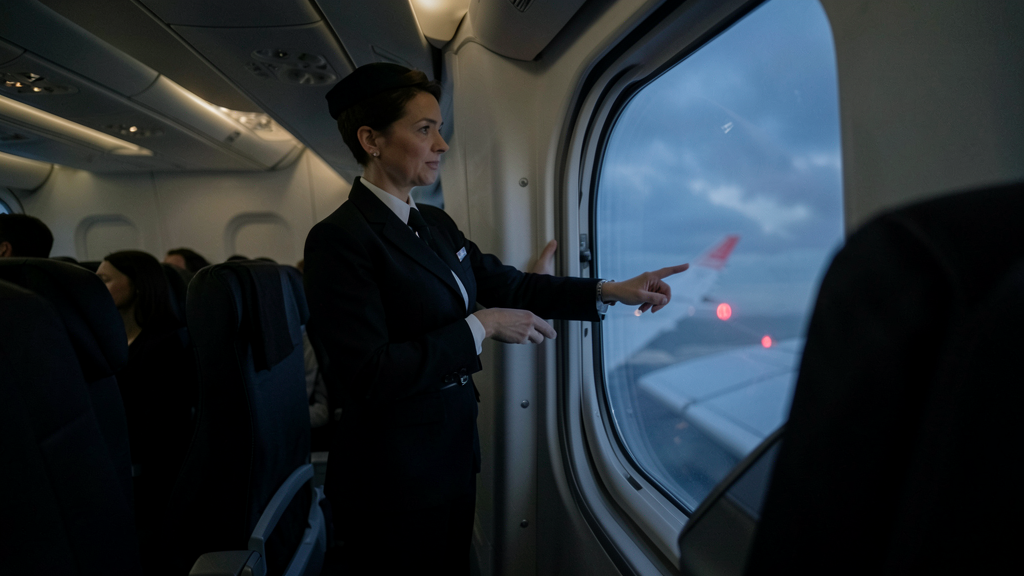
The exit row is sold as legroom and allocated as a function. Almost everything that goes wrong there — the argument in the aisle, the crew member who backs down when the passenger produces a receipt, the seat left occupied by someone who cannot use it — grows out of that gap between what was bought and what is required. What follows: what the row is rated to do, where the criteria come from, why they differ between operators, and how to build a refusal that survives the passenger’s reply.
What the row is rated to do
Cabin evacuation capability is demonstrated for the type, on the ground, using no more than half the exits, within ninety seconds. That demonstration does not prove a real evacuation will go well; it sets the geometry of the cabin — how many occupants a given exit arrangement may carry, how wide the access must be, how far anyone should have to travel to a usable way out. Every seat is sold on the strength of that arrangement, and the exit row is the part of it that depends on a passenger.
The dependence is not the same at every exit. At a floor-level door the drill belongs to a crew member and the passenger’s obligation is negative: do not obstruct the assist space, do not stow anything that will end up in the doorway, do not need help getting out of the way. At an overwing hatch it becomes positive. The hatch is a plug — pressure seats it, and it must come inward before it goes anywhere else. It is heavy, it is awkward, and once released it arrives in the arms of whoever is holding it, in a cabin that may be dark, sloping and filling with smoke. Some designs are hinged and swing up; many are not, and must be lifted clear without blocking the opening just created.
That is the job the seat carries. It is not a favour asked of a volunteer, and not a reward for status: it is a load-bearing assumption in the cabin’s safety case.
Where the criteria come from, and why yours are not universal
Two regulatory traditions arrive at the same place by different routes, and the difference matters when crews move between operators.
ICAO Annex 6 obliges the operator to establish seating procedures with evacuation in mind, without saying who may sit where. EASA’s Part-CAT works the same way: passengers must be seated so that they can best assist an evacuation and will not hinder it. The list of who qualifies lives in the operations manual, which the competent authority accepts, and it is therefore not a suggestion. The FAA took the opposite route and wrote the functions into the rule itself: it enumerates what an exit-seat occupant must be able to do, requires a determination for each passenger made in a non-discriminatory way, and puts an information card at the seat.
Two consequences follow. Under an operator’s own list, « I’ll make an exception this once » is a deviation from an approved manual, not an act of kindness. And thresholds genuinely differ: the minimum age for an exit seat is not a single global number, and neither is the treatment of extension belts, casts or service animals. Reciting another airline’s rule at your own gate is how a crew loses an argument it should have won.
The trap. « The website sold it to me » is true and irrelevant: a booking engine allocates seats against a commercial inventory, and cannot assess the person who will occupy one. The assessment happens where a human can see the passenger, and it happens every sector — same passenger, same seat, nothing changed. The check only looks arbitrary when it is applied selectively.
Exit rows are not just extra legroom—they’re part of the plane’s safety plan. The person sitting there must be able to open an emergency exit quickly, even in a crisis. Airlines have rules about who can sit there, and those rules are based on safety, not comfort.
On an Airbus A320, the overwing exit hatch weighs about 40 pounds (18 kg) and must be lifted inward before being moved aside. A passenger with a broken arm or a child in their lap wouldn’t be able to do this safely, so they’d be moved to another seat. The crew checks for this during boarding.
The functions, and what a crew can actually observe
The commonest error in exit-row screening is to look for a category of person instead of a set of functions. Categories invite argument, and they invite discrimination. Functions can be described out loud — and a passenger who cannot perform one usually knows it before the crew does.
| Required of the occupant | Why it is demanding | What the crew can observe in seconds |
|---|---|---|
| Reach, release and bring an overwing hatch inward, then dispose of it clear of the opening | A plug hatch comes in before it goes out; it is heavy and must be handled while braced, perhaps on a slope | Reach and grip from the seat; whether both arms work; whether they can take weight |
| Judge the outside conditions before committing to open | Fire, water or wreckage make that exit the wrong one, and the call is made in a second | Whether they engage with a question rather than nodding through it |
| Follow a shouted instruction, once, without a repeat | Commands are given at volume, in one language, over noise, in the dark | Whether a spoken question produces a spoken answer — not a smile, not a nod |
| Move unaided and quickly into a congested space or onto a wing | Anyone slow in that row becomes the plug in the flow behind them | How they boarded, how they sat down, whether they needed help with a bag |
| Assist other occupants and keep the flow moving | The task needs free hands and undivided attention | Whether they are travelling with someone who depends on them |
The disqualifications that have nothing to do with strength
A large share of exit-row re-seating has nothing to do with physical capability, which is why the refusal is easier to phrase than crews expect: the passenger is not being judged, a competing obligation is being recognised.

| Situation | Why the row does not work | What it is not |
|---|---|---|
| Infant in arms, or a seat belt extension in use | The first duty in an evacuation would be to another person, and an extension belt is a restraint the row is not equipped for | Not a comment on parenting, and not a reason to move the family |
| Travelling with anyone who will need their help — a child, an elderly relative, a companion with reduced mobility | The row demands undivided attention; the natural instinct will win, and it should | Not a suggestion that they be separated |
| Cannot follow a spoken instruction in the crew’s working language | Evacuation commands are verbal, loud and unrepeated; the safety card is no help then | Not a test of accent, literacy or fluency — one spoken exchange settles it |
| Cast, splint, dressing, recent surgery, an arm in a sling | The hatch needs two hands and a braced body | Not a medical assessment, and never a request for a diagnosis |
| Assistance dog or service animal at the seat | The animal occupies space that must stay clear and would itself need managing | Not a refusal of the animal or of carriage |
| Below the applicable minimum age, or an unaccompanied minor | The threshold comes from your operations manual, or from the rule itself where the regulator has written one in | Not negotiable at the aircraft door, whatever the young passenger’s build |
| Deportee, inadmissible passenger or person under escort | Access to an exit is itself the issue, and escort and escorted must not be split | Not a matter for discussion in front of the cabin |
| Visibly impaired by alcohol, or unable to take in an instruction | The judgement the seat requires is the first thing to be lost | Not the same decision as offloading — those are two separate calls |
European legislation on the rights of passengers with disabilities and reduced mobility frames the subject usefully: seating requests are to be met so far as safety requirements allow, and a refusal grounded in safety comes with a duty to give the reason. The ground has to exist, and it has to be stated. A refusal that cannot be explained is not a safety decision, it is a preference.
A paid seat is a commercial fact, not a safety criterion
Cabin crew do not adjudicate money, and the fastest way to lose control of an exit-row conversation is to start. The ancillary charge bought a product sold subject to the airline’s own safety rules, and putting that right is a ground process with a record, not a crew member improvising in an aisle.
The phrasing that settles most of these exchanges separates the two matters: the seat is decided now and is not open; the money is a question for the airline, and here is how to raise it. Anything resembling a promise of a refund is a commitment the crew cannot keep, and it reopens a closed safety issue as a commercial grievance.
The right reflex. Decide the seat, then acknowledge the money — never the reverse. Once compensation is on the table, the safety decision reads as an opening position, and every sentence after it as a bargaining move.
The checks that should have happened before the cabin
By the time the exchange happens with a queue behind it, three earlier opportunities have usually been missed. Crews cannot fix the upstream process from the aisle, but knowing where it broke changes both the tone and the report. The cabin catches what is left, at the highest price.
| Stage | What is catchable there | Why it is missed |
|---|---|---|
| Booking and seat selection | Declared assistance, infant in the booking, unaccompanied minor, animal in cabin | Declarations are made after the seat is chosen, and few systems retract it |
| Check-in | Age, visible mobility need, groups travelling together, escort arrangements | Automated check-in sees none of it; a rushed agent sees a booking, not a person |
| Gate and boarding | Impairment, injury, dependency between passengers, pre-boarding assistance | The gate is optimising for on-time departure; the exit row is not on its checklist |
The words
A refusal fails for predictable reasons. It fails when it diagnoses the passenger — « you look like you’d struggle » — because that invites an argument about their fitness the crew cannot win. It fails when it opens with an apology and a justification, because the passenger correctly hears an opening bid. And it fails when it starts with « you can’t », a statement about the person rather than about the seat.
What works is a fixed order: function, decision, alternative. State what the seat requires, without reference to the individual. State that the seat is being changed — a decision already made, in the past tense if possible. Then offer the replacement seat by number at once, so the passenger has somewhere to go before they can build a position.
- Function: « This row is an emergency exit row. The seat comes with a job — opening that hatch and helping people out, without assistance and without being responsible for anyone else. »
- Decision: « Because you are travelling with your daughter, I’ve moved you out of this row. »
- Alternative: « You’re both in 22C and 22D, together, and I’ll take the bags across now. »
When the passenger asks why they were singled out, answer with the criterion, not the observation: « anyone travelling with a child who may need their help is moved out of this row » is a rule; « I could see you’d have your hands full » is a judgement. And never compare with the neighbour: explain why the person across the aisle may stay and the conversation becomes an audit of the crew’s fairness rather than a seat change.
When the answer is no
Once a re-seating has been stated and the passenger refuses, the subject has changed: it is no longer an exit-row question but compliance with a crew instruction, and it escalates like any other. Say the instruction once more, plainly and without new arguments — repeating the reasoning invites debate, repeating the instruction does not. Make clear the aircraft will not depart with the seating as it stands, because it will not.
Then bring it to the commander early rather than late. That authority over everyone on board is not a threat held in reserve; it is the mechanism that exists for exactly this, and it works far better before the door is closed than after. Ground staff and, if it comes to it, offload are options that exist at the stand and evaporate on pushback — which is why screening belongs at the start of boarding, not during the safety demonstration.
Whatever the outcome, it is a report — not because anyone did anything wrong, but because a seat sold to a passenger who could not occupy it is an upstream failure, and it will keep happening until the data says how often. Crews trade the wording of these conversations on the FL330 forums; the manual on your aircraft is what decides.
The briefing that justifies the criteria
All of this is wasted if the row is then briefed by loudspeaker. An occupant selected for capability and never told what to do is no better than one never assessed: the individual briefing is where the seat earns its criteria.
Three things make it work. It is delivered face to face and requires a spoken answer, which doubles as the last comprehension check. It asks for willingness, not only capability — a passenger who is able but unwilling is a worse choice than one who declines, and the invitation to opt out must carry no stigma. And it points at the hardware: the placard, the sequence, the fact that the hatch comes inward, and where it goes afterwards. A passenger who has looked at the handle is in a different state from one who has heard a paragraph.
What to carry into the next boarding
- The criteria that bind you are your operator’s, in the operations manual — not the ones you learned at a previous airline, and not the ones the passenger read online.
- Screen for functions, never for categories: faster, more accurate, and the only version that is defensible.
- Say the criterion, not the observation: rules survive being challenged, personal judgements do not.
- Decide the seat before you acknowledge the fare, and never promise money.
- Do it at the start of boarding, before the passenger has settled — and escalate to the commander early, while ground options still exist.


Leave a Reply
You must be logged in to post a comment.